Is your child feeling lost in a crowded classroom, like just another face in a sea of thirty desks? I’ve talked to so many parents lately who are worried about this exact thing. Big class sizes can make it incredibly hard for kids to get the specific help they need. You aren’t the only one looking for a change.
Did you know that micro-schools and learning pods are quickly becoming a permanent fix for this problem? These aren’t just a temporary reaction to the pandemic anymore; they are a fast-growing movement where kids learn in small groups and actually get known by their teachers.
Walk you through exactly how these schools work, the costs you can expect in 2026, and why millions of families are making the switch. Grab a coffee, and let’s figure out if this is the right path for your family.
What Are Micro-Schools and Pod Learning?
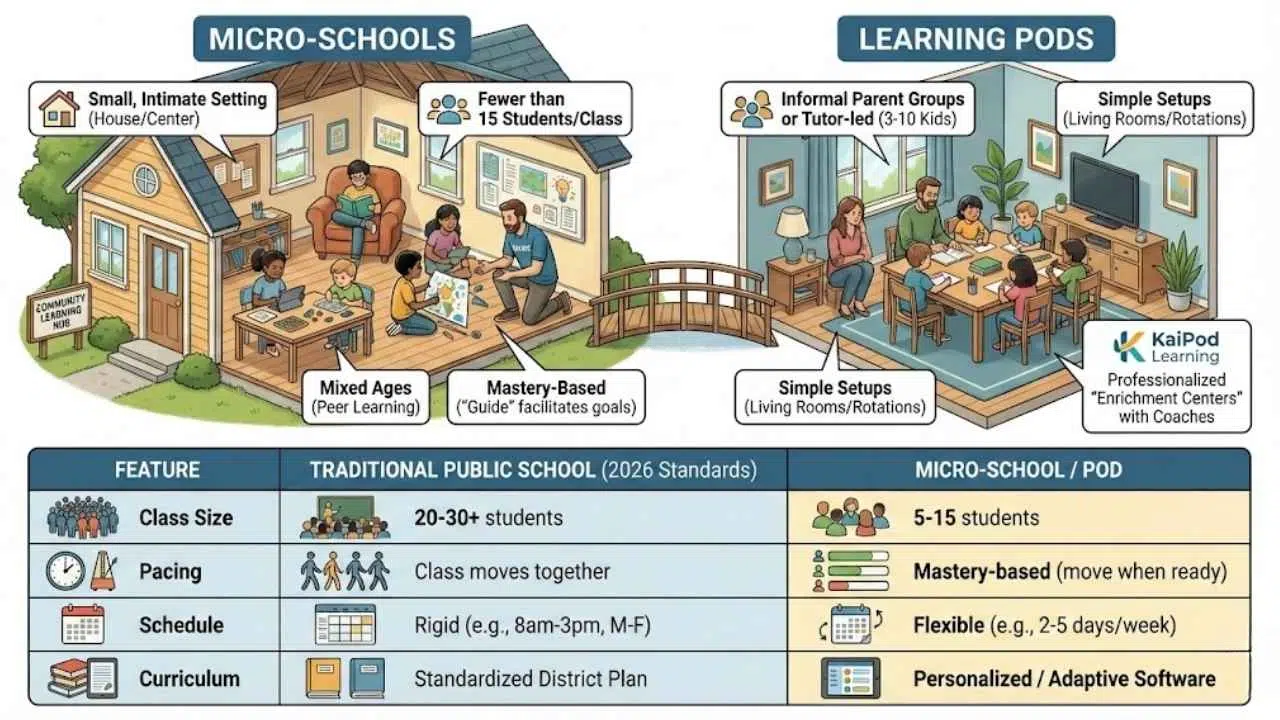
Think of a micro-school as a bridge between homeschooling and a private school. It’s small, intimate, and often operates out of a house, a community center, or even a local library. Instead of a rigid system, it focuses on the child.
Definition of micro-schools
Micro-schools are exactly what they sound like: tiny schools, usually with fewer than 15 students per class. But here is the insider detail that matters: many of them don’t even use the word “teacher.”
Networks like Prenda and Acton Academy often call their adult leaders “Guides.” This isn’t just a fancy title. It means their job is to help students set their own daily goals and master a subject before moving on, rather than just lecturing at a whiteboard for an hour.
While traditional schools group kids strictly by age, micro-schools often mix ages. You might see a 7-year-old and a 10-year-old working side-by-side. This mimics a real-world community where people learn from peers of all experience levels.
Understanding learning pods
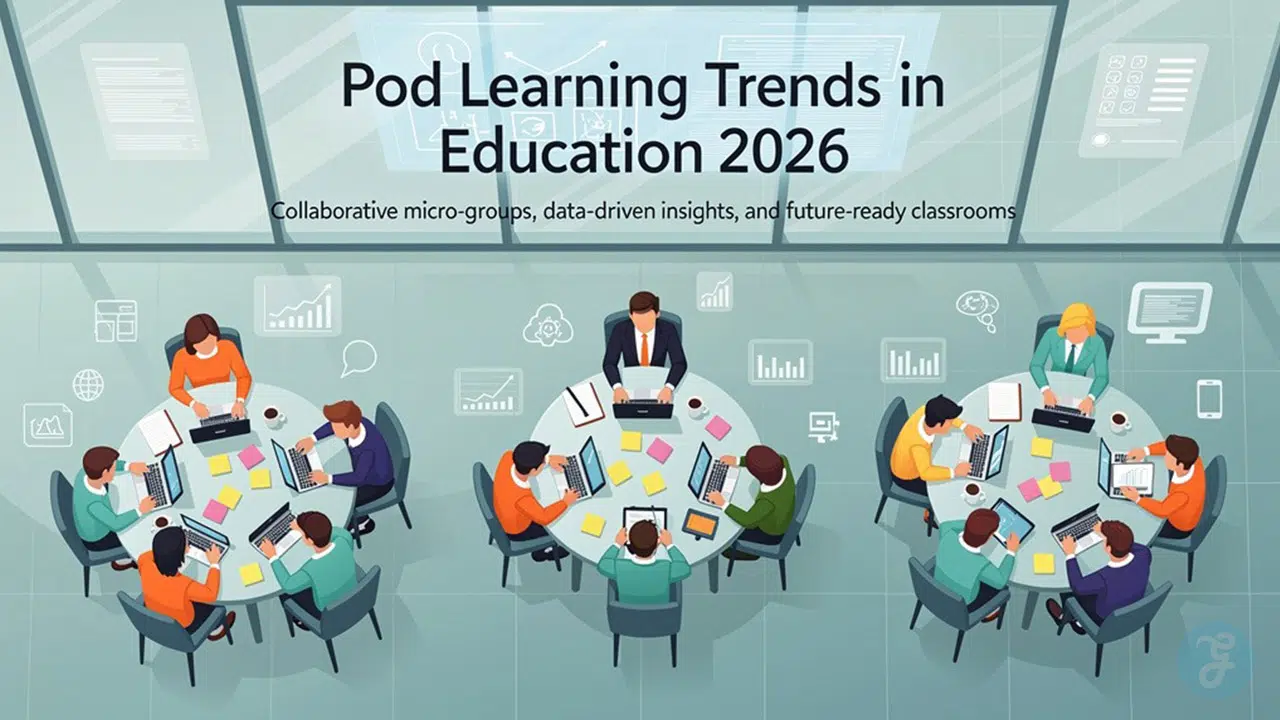
Learning pods are slightly different. These often started as informal groups of parents hiring a tutor for 3 to 10 kids. While micro-schools are often businesses or franchises, a “pod” can be as simple as three families rotating supervision duties in a living room.
A great example of how this has professionalized is KaiPod Learning. They offer spaces called “enrichment centers” where homeschooling students come together in small groups. They get the social vibe of a school and the support of a coach, but they work on their own chosen curriculum.
Key differences from traditional education models
If you are trying to decide between the two, it helps to see the differences side-by-side. Here is a quick comparison based on current 2026 standards:
| Feature | Traditional Public School | Micro-School / Pod |
|---|---|---|
| Class Size | 20-30+ students | 5-15 students |
| Pacing | Class moves together | Mastery-based (move when ready) |
| Schedule | Rigid (e.g., 8am-3pm, M-F) | Flexible (e.g., 2-5 days/week) |
| Curriculum | Standardized District Plan | Personalized/Adaptive Software |
The Rise of Micro-Schools and Learning Pods
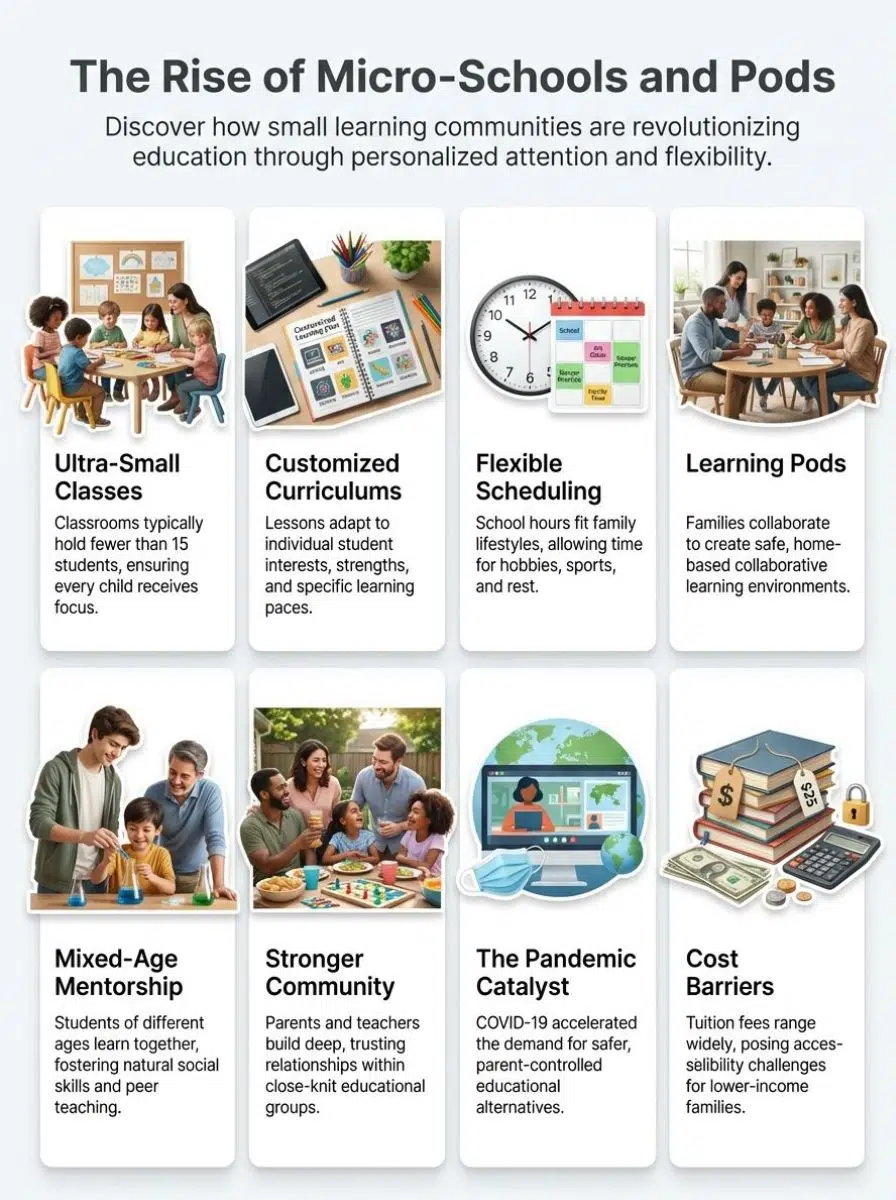
Suddenly, it seems like these little schools are popping up everywhere. What started as a survival tactic during the pandemic has turned into a massive shift in the US education system.
From pandemic response to permanent choice
In 2020, parents scrambled to form pods because schools were closed. But when schools reopened, a surprising number of families didn’t want to go back. By 2025, estimates suggested that between 1 and 2 million students in the US were attending a micro-school full or part-time.
Why did they stay? Because they saw their kids thriving. Families realized that the “standard” way wasn’t the only way. Parents found that without the bureaucracy of a massive district, they could control the environment, the values, and the safety of their child’s day.
Increased demand for personalized learning
Parents are tired of the “one size fits all” approach. A 2024 survey by EdChoice found that 64% of parents felt K-12 education was on the “wrong track.” They wanted something that actually saw their child as an individual.
In a micro-school, technology plays a huge role in this personalization. Students often use adaptive tools like Khan Academy, Lexia, or Zearn for core subjects like math and reading. These programs adjust instantly—if a student misses a concept, it stays there until they get it. If they ace it, they move on. No one is bored, and no one is left behind.
Parents seeking alternatives to public education
The biggest driver right now is the expansion of state funding. This is the “secret weapon” for many families.
States like Arizona, Florida, Utah, and West Virginia have passed Universal Education Savings Accounts (ESAs). This legislation allows parents to take the state money that would have gone to a public school (often $7,000 to $8,000 per year) and use it for micro-school tuition instead.
“In Arizona, the Empowerment Scholarship Account (ESA) has been a game-changer. It effectively makes micro-schooling free or very low-cost for thousands of families who couldn’t afford private school before.”
Benefits of Micro-Schools and Pod Learning
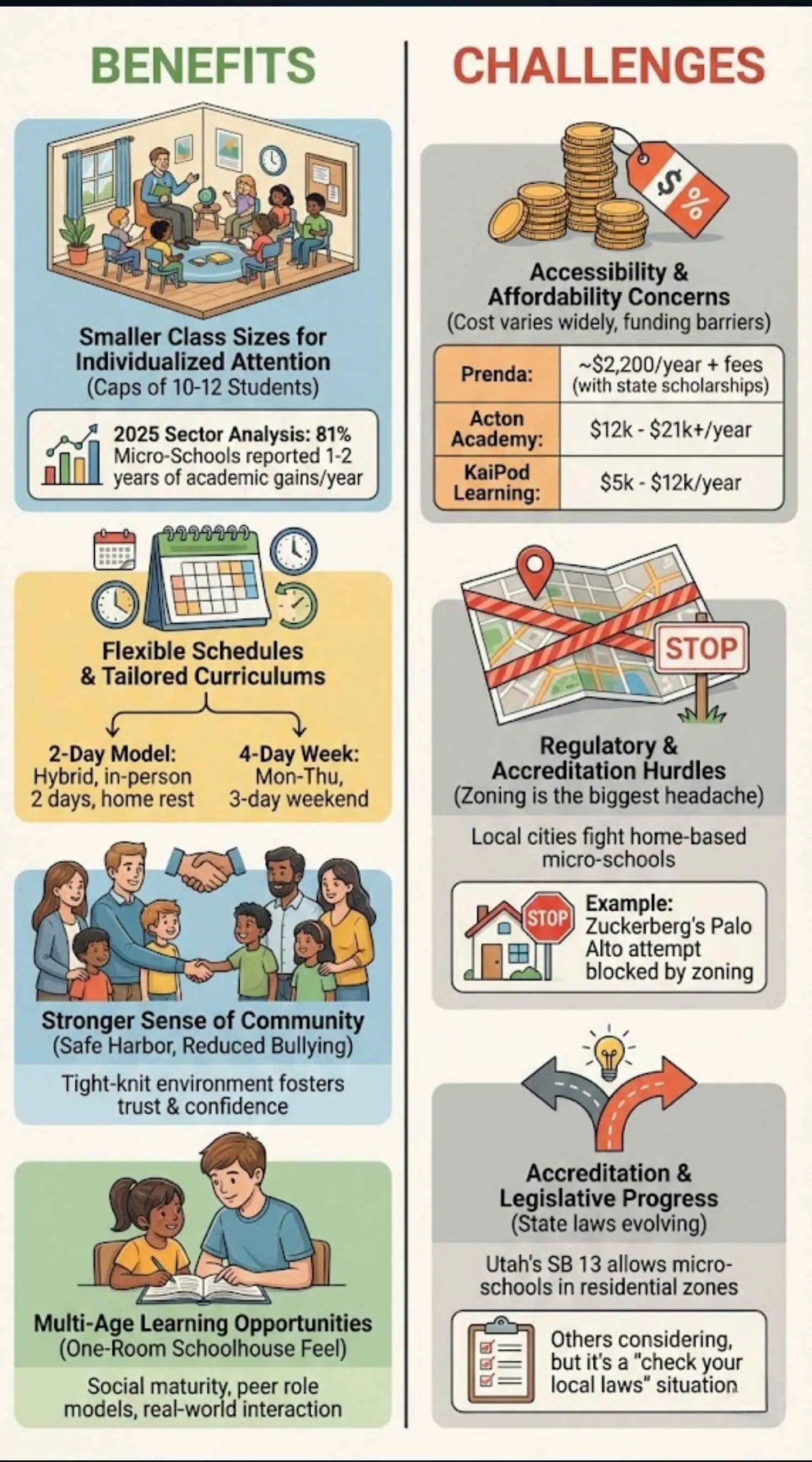
Kids get more attention, learn with friends of different ages, and enjoy a school day that actually fits their life. Here is why families are loving this approach.
Smaller class sizes for individualized attention
With groups often capped at 10 or 12 students, there is no back row for a child to hide in. Teachers (or guides) can spot a struggle immediately.
According to a 2025 sector analysis, 81% of micro-schools reported that their students achieved between 1 and 2 years of academic gains in a single school year. When you remove the distractions of a 30-person classroom, efficiency goes through the roof.
Flexible schedules and tailored curriculums
Micro-schools don’t always follow the 8:00 AM to 3:00 PM grind. Many offer hybrid schedules.
- The 2-Day Model: Some networks, like KaiPod, offer plans where kids attend in-person just two days a week and work from home the rest.
- The 4-Day Week: Many independent micro-schools operate Monday through Thursday, giving families a three-day weekend for travel, sports, or family time.
This flexibility is huge for student athletes or families who want to travel without triggering truancy letters from a strict district.
Stronger sense of community for students and families
In a micro-school, you aren’t just dropping your kid off at a gate. You likely know every other parent by their first name. Trust forms quickly because the group is small.
This tight-knit environment is especially powerful for students who have faced bullying. In a small pod, social dynamics are managed closely by the adult guide. It creates a safe harbor where anxiety drops, and confidence can finally grow.
Multi-age learning opportunities
One of the best features is the “one-room schoolhouse” feel. A 10-year-old might help a 6-year-old with reading, which reinforces the older child’s skills and gives the younger one a role model.
It’s not just about academics; it’s about social maturity. Kids learn to interact with people older and younger than them, which is exactly how the real world works. They aren’t segregated into a bubble of only 11-year-olds.
Challenges Facing Micro-Schools and Pod Learning
It sounds great, but it isn’t always simple. There are real hurdles you need to watch out for before you sign up or start your own.
Accessibility and affordability concerns
While state funding is helping, cost is still a barrier in many states. If you live in a state without an ESA program, you are footing the bill yourself.
Costs vary wildly depending on the model:
- Prenda: Often around $2,200/year for families using state scholarships, plus guide fees.
- Acton Academy: Can range from $12,000/year in places like Ohio to over $21,000/year in Silicon Valley.
- KaiPod Learning: roughly $5,000 to $12,000/year depending on how many days per week you attend.
If you don’t have access to state funds, these numbers can be steep compared to “free” public school.
Regulatory and accreditation hurdles
The biggest headache for micro-school founders right now is zoning. Most people want to run these small schools out of a home to keep costs low, but local cities often fight back.
Here is a famous example: Mark Zuckerberg and his wife tried to open a small school in a home in Palo Alto, and even they were shut down due to local zoning laws. If a billionaire can’t easily navigate the red tape, it shows how tricky the system is.
However, there is hope. Utah recently passed “SB 13,” a law that specifically allows micro-schools to operate in all zones, including residential ones. Other states are looking to follow this lead, but for now, it remains a “check your local laws” situation.
The Future of Micro-Schools and Pod Learning
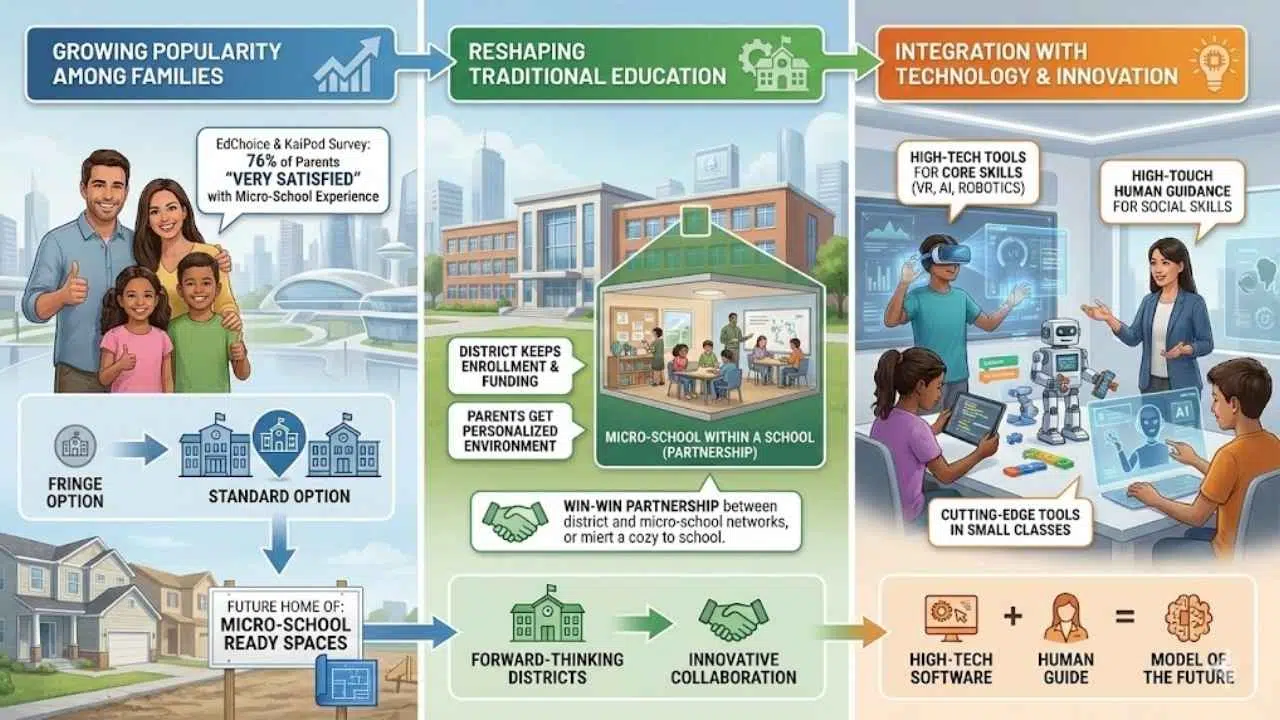
Families are embracing these fresh ways to teach because they keep school exciting and new. The genie is out of the bottle, and it’s not going back in.
Growing popularity among families
As mentioned earlier, satisfaction rates are incredibly high. A survey by EdChoice and KaiPod found that 76% of parents were “very satisfied” with their micro-school experience. Word of mouth is spreading fast.
We are seeing a shift where micro-schools are no longer considered “fringe.” They are becoming a standard option alongside public, private, and charter schools. Real estate developers are even starting to build “micro-school ready” spaces in new neighborhoods.
Potential to reshape traditional education systems
Public schools are watching this trend closely. Some forward-thinking districts are actually partnering with micro-school networks to create “schools within a school.”
This allows the district to keep the enrollment numbers (and funding) while offering the small, personalized environment that parents are demanding. It’s a win-win that we might see more of in the next few years.
Integration with technology and innovative teaching approaches
The future of these pods is high-tech. Because the class sizes are small, teachers have the freedom to use cutting-edge tools that big districts are too slow to adopt.
We are seeing pods that focus entirely on coding, robotics, or the arts, using VR headsets and AI tutors to supplement the human guide. This blend of high-tech software for core skills and high-touch human guidance for social skills is the model of the future.
Final Thoughts
Micro-schools and pod learning have shaken up education, offering smaller classes, more choices, and a bigger sense of community. Families are picking these options for flexibility and personal support that large schools simply cannot match. These fresh models make it simple for children to speak up, ask questions, and be seen as individuals. Challenges like cost or zoning rules might pop up, but the growth keeps going strong—and families keep finding creative ways forward.
Could your child thrive in a group where they get real attention from caring adults? If you want to know more, I’d suggest looking into your state’s ESA programs first to see if funding is available. My neighbor’s son—once shy in crowded rooms—now reads poetry aloud at his micro-school. Sometimes small groups spark big changes. Maybe it is time to see if this path fits your family too!