

Have you ever looked at the news and wished you had a solid “Plan B”? You aren’t the only one. Dual citizenship—being a legal citizen of two countries at once—is no longer just for spies in movies or the ultra-wealthy. In 2026, it is becoming a mainstream strategy for everyday families looking for safety, freedom, and options. Think of it as the ultimate insurance policy. If things get rocky in one place, you have a guaranteed right to live, work, and thrive in another.
Whether you are worried about political shakeups, rising costs, or just want your kids to have the option to study in Europe for a fraction of the price, a second passport is the key. But it’s not all smooth sailing; there are tax forms to file and rules to follow.
So, grab a cup of coffee, and let’s go through it together. I’ll show you exactly why this is the smartest move you can make this year and how to navigate the tricky parts without getting a headache.
What is Dual Citizenship?
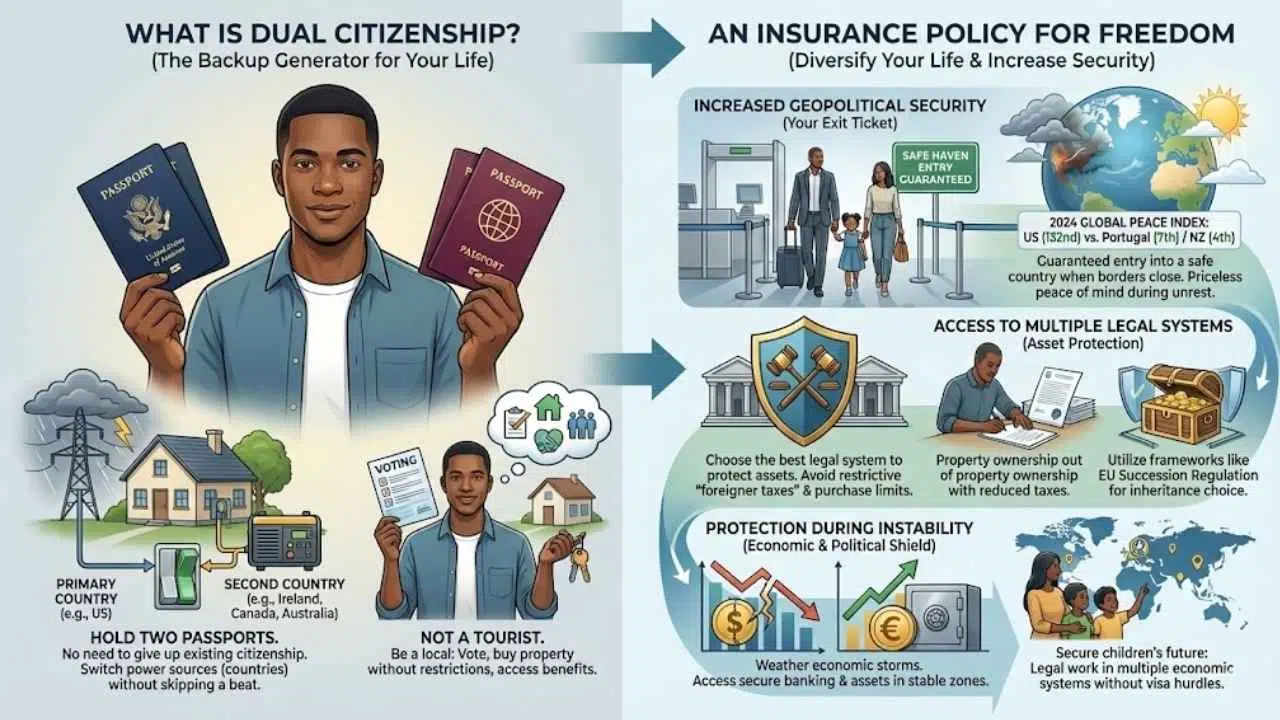
In simple terms, dual citizenship means you hold a passport for two different countries at the same time. The United States allows this, which means you don’t have to give up your American passport to become a citizen of another nation like Ireland, Canada, or Australia.
It works like a backup generator for your life. If the power goes out in one location, you simply switch to the other without skipping a beat. The “So What?”: Holding two passports means you are not a tourist in your second country—you are a local. You can vote, buy property without restrictions, and access social benefits that foreigners can’t touch.
Today, more investors and families are rushing to secure this status. With global instability rising, having that second legal home is about more than just easy travel; it is about survival and opportunity.
Why Dual Citizenship is Considered an Insurance Policy
We buy insurance for our cars and homes, so why not for our freedom? A second citizenship diversifies your life so you aren’t 100% dependent on the economy or politics of a single nation.
Increased Geopolitical Security
If political unrest or a sudden crisis hits, a second passport is your “exit ticket.” It guarantees you entry into a safe country when borders might otherwise be closed to foreigners. In 2026, this peace of mind is priceless.
Consider the 2024 Global Peace Index, which ranked the United States 132nd in the world for peacefulness. Compare that to countries like Portugal (7th) or New Zealand (4th). Holding citizenship in a high-ranking peaceful nation gives your family an immediate safe haven if the political climate at home becomes volatile.
Access to Multiple Legal Systems
Living under two flags means you can choose the legal system that best protects your assets. For example, if you own property in Europe, being a citizen often protects you from the restrictive “foreigner taxes” or purchase limits that non-citizens face.
You also gain protection under frameworks like the EU Succession Regulation. This allows dual citizens in Europe to choose which country’s laws apply to their inheritance, potentially saving their heirs from a legal nightmare. It feels good knowing you have two sets of courts and laws to back you up if you ever face a personal or financial dispute.
Protection During Political or Economic Instability
Currencies crash and markets dip, but a second passport helps you weather the storm. If the dollar takes a hit, having access to assets and banking in a stable zone like Switzerland or Singapore can save your portfolio.
Families are using this to secure their children’s future. By holding dual nationality, your kids are not stuck in one economic system. If the job market freezes in the U.S., they can legally work in the EU or Asia without begging for a visa.
Benefits of Dual Citizenship
Beyond safety, the perks of a second passport can upgrade your lifestyle immediately. From cheaper college to VIP travel, here is what you gain.
Expanded Travel Freedom
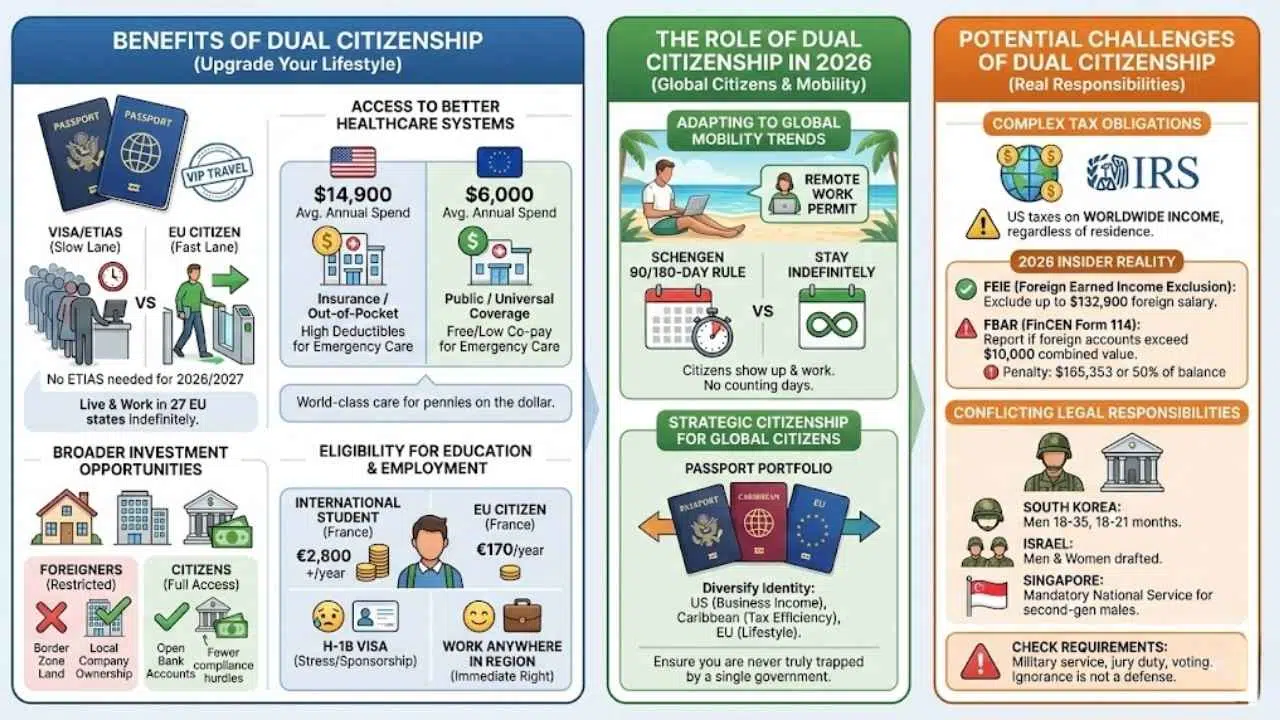
Tired of visa applications? A second passport is the ultimate travel hack. While U.S. citizens have great travel access, adding a European Union passport allows you to live and work anywhere in the 27 EU member states indefinitely.
The ETIAS Advantage: Starting in late 2026 or 2027, U.S. citizens will need to register and pay for ETIAS authorization to enter Europe. However, if you hold an EU passport, you skip this entirely. You breeze through the “EU Citizens” line at the airport, saving time and avoiding the new red tape.
Access to Better Healthcare Systems
Healthcare costs in the U.S. are a major concern for many, but dual citizenship can unlock world-class care for pennies on the dollar.
| Feature | United States (Avg.) | European Union (Avg.) |
|---|---|---|
| Annual Spend Per Person | ~$14,900 | ~$6,000 |
| System Type | Insurance / Out-of-Pocket | Public / Universal Coverage |
| Emergency Care Cost | High Deductibles | Free or Low Co-pay |
For example, citizens of Portugal have access to the Serviço Nacional de Saúde (SNS), where most essential treatments are free or cost a nominal fee. During a global health crisis, having the legal right to choose where you receive treatment can be a literal lifesaver.
Broader Investment Opportunities
Many countries restrict what foreigners can buy, but citizens get the full menu. This includes buying land in restricted “border zones” or investing in local companies that prohibit foreign ownership.
In 2026, real estate markets in places like Greece and Spain are still attractive, but rules for foreigners are tightening. As a citizen, you bypass these hurdles. Plus, you can open bank accounts in jurisdictions that might turn away strict U.S.-only account holders due to compliance costs.
Eligibility for Education and Employment
This is a massive win for parents. Top universities in Europe often charge citizens a fraction of what international students pay.
- The Cost Gap: A U.S. student in France might pay €2,800+ per year, while an EU citizen pays only €170 per year for the same Bachelor’s degree.
- The Work Perk: After graduation, your child doesn’t need to stress about an H-1B visa or sponsorship. They have the legal right to work anywhere in the region immediately.
The Role of Dual Citizenship in 2026
As we move further into the decade, the “digital nomad” lifestyle is reshaping how we view citizenship. It is no longer just about where you were born; it is about where you choose to be.
Adapting to Global Mobility Trends
Remote work is here to stay, and dual citizenship is the ultimate remote work permit. Countries like Spain and Italy have launched specific visas for digital nomads, but citizens don’t even need those. You just show up, open your laptop, and start working.
With visa rules getting stricter—like the Schengen Zone’s 90/180-day rule enforcing tighter borders in 2026—a second passport allows you to stay as long as you want without counting days on a calendar.
Strategic Citizenship for Global Citizens
Smart families are building a “portfolio” of passports. They might combine a U.S. passport for business income with a Caribbean passport for tax efficiency and an EU passport for lifestyle.
Think of it as diversifying your identity. In an era where a single government decision can lock down borders or freeze assets, having multiple citizenships is the only way to ensure you are never truly trapped.
Potential Challenges of Dual Citizenship
It’s not all wine tasting and skip-the-line passes. There are real responsibilities you need to know about before you commit.
Complex Tax Obligations
The U.S. is one of the few countries that taxes its citizens on worldwide income, regardless of where they live. This doesn’t change when you get a second passport.
The “Insider” Reality:
You still have to file with the IRS every year. However, for 2026, the Foreign Earned Income Exclusion (FEIE) allows you to exclude up to $132,900 of your foreign salary from U.S. taxes. You also need to watch out for the FBAR (FinCEN Form 114). If the combined value of your foreign accounts exceeds $10,000 at any time, you must report it. The penalty for willfully missing this can be the greater of $165,353 or 50% of your account balance.
Conflicting Legal Responsibilities
Different countries have different demands. A common surprise for new dual citizens is mandatory military service.
- South Korea: Men aged 18-35 must serve 18-21 months.
- Israel: Both men and women are often drafted, though exemptions exist for those living abroad permanently.
- Singapore: Mandatory National Service for second-generation male permanent residents and citizens is strictly enforced.
Before applying, always check if your new country requires you to serve in the army, sit on a jury, or vote in elections. Ignorance of the law is never a valid defense.
How to Obtain Dual Citizenship
Ready to take the plunge? There are three main paths, and one of them might be open to you right now.
Ancestry and Descent Pathways
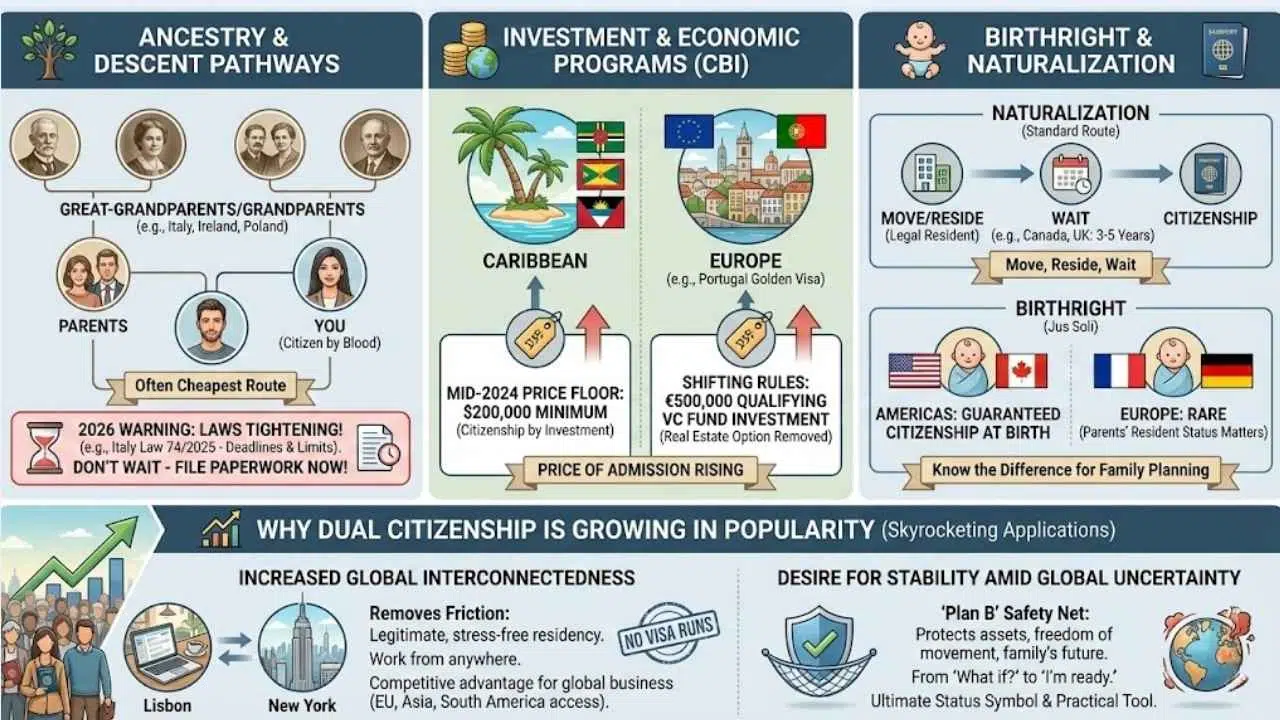
This is often the cheapest route. If your parents, grandparents, or sometimes great-grandparents were born in a country like Italy, Ireland, or Poland, you might already be a citizen by blood.Warning for 2026: Don’t wait. In 2025, Italy introduced stricter interpretations of their citizenship laws (like Law 74/2025), creating new deadlines and generational limits. These “open door” policies can slam shut without much warning, so if you have the lineage, file your paperwork now.
Investment and Economic Programs
If you don’t have the ancestry, you can “buy” your way in—legally. This is known as Citizenship by Investment (CBI).
However, the price of admission has gone up. As of mid-2024, Caribbean nations like Dominica, Grenada, and Antigua & Barbuda agreed to a minimum price floor of $200,000. In Europe, the famous “Golden Visas” are shifting. Portugal removed its real estate option, so now you generally need to invest €500,000 in qualifying venture capital funds to get your foot in the door.
Birthright and Naturalization
The standard route is naturalization: move there, become a legal resident, and wait. In countries like Canada or the UK, this usually takes 3-5 years of living in the country.
Birthright citizenship (Jus Soli) is rare outside the Americas. While being born in the U.S. or Canada guarantees citizenship, being born in France or Germany usually doesn’t—unless your parents are residents. Knowing the difference is critical if you are planning to start a family abroad.
Why Dual Citizenship is Growing in Popularity
The numbers don’t lie. Applications for second passports are skyrocketing as people realize that relying on a single government is a risky bet.
Increased Global Interconnectedness
We live in a world where you can work for a New York company while sitting in a cafe in Lisbon. Dual citizenship removes the friction from this lifestyle. It turns “visa runs” and “border hopping” into legitimate, stress-free residency.
As business becomes more global, having the legal right to work in the EU, Asia, or South America gives you a massive competitive advantage over someone who needs a sponsor for every move.
Desire for Stability Amid Global Uncertainty
Let’s face it: the world feels unstable. From pandemics to political polarization, people are craving a “Plan B.”
In 2026, a second passport is the ultimate status symbol, but it is also a practical tool. It is a safety net that protects your assets, your freedom of movement, and your family’s future. It turns the question “What if?” into “I’m ready.”
Final Thoughts
Dual citizenship is a powerful strategy for 2026, offering travel freedom, financial options, and a secure backup plan for your family. Whether you are looking to retire in the Mediterranean or just want to make sure your kids have affordable college options, the benefits are clear.
Yes, the tax forms and military rules can be tricky, but for millions of people, the peace of mind is worth every bit of effort. If you think you might qualify, start digging into your family tree or looking at investment options today. The rules are tightening, and prices are going up. Don’t wait until you need a second passport to start trying to get one.





















