

You’ve had a long day. Your brain feels fried, and the idea of following a complex new plot feels like lifting a heavy weight. So, what do you do? You don’t browse the “New Releases” tab. Instead, you hit play on that one movie you’ve seen a dozen times. It fits like your favorite old sweater.
You aren’t alone in this. In fact, a 2024 survey by UserTesting found that the average American spends nearly 110 hours a year just deciding what to watch. That is almost five full days lost to scrolling! It’s no wonder we often skip the decision entirely and choose something we know by heart.
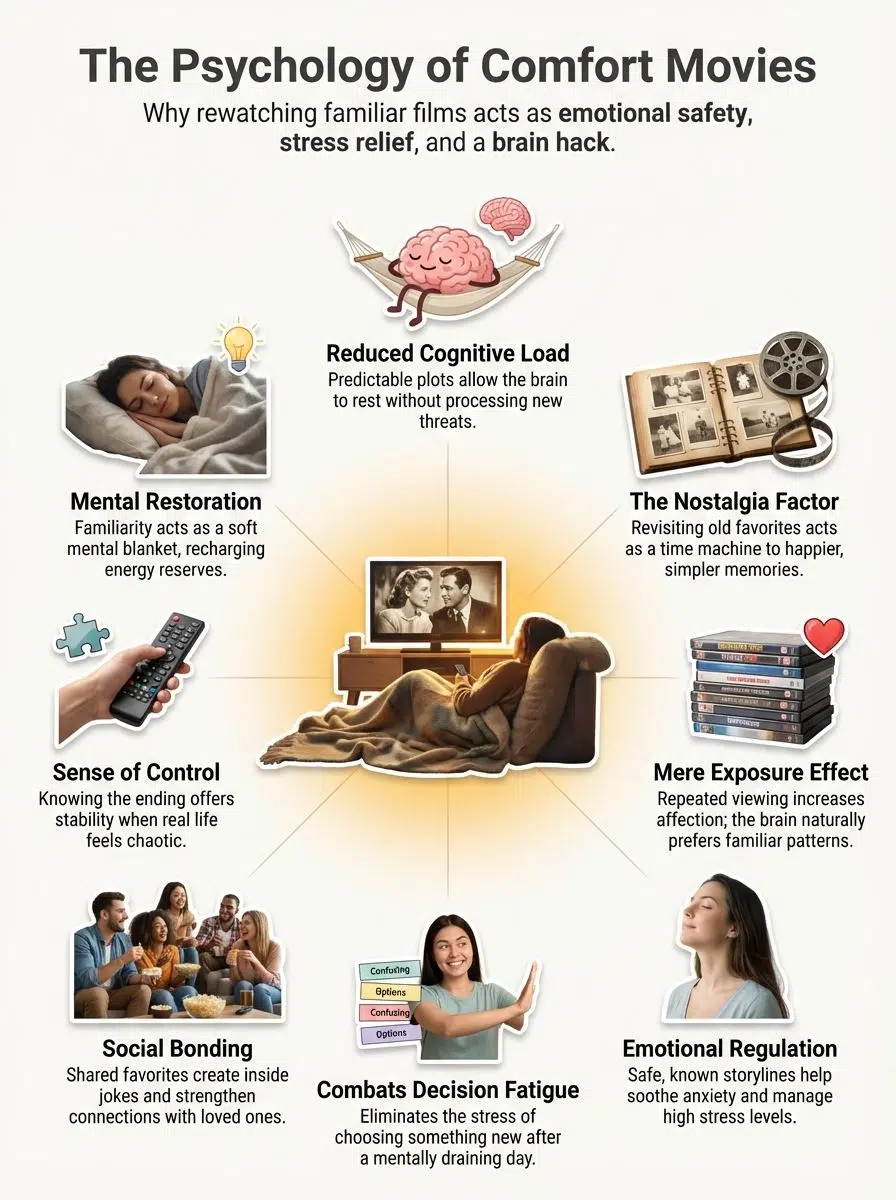
Science has a name for this cozy habit: volitional reconsumption. It turns out that rewatching The Office or Star Wars isn’t just about being lazy; it is a powerful way to soothe anxiety and restore your mental energy. I’m going to walk you through exactly why your brain craves these familiar stories, the Psychology of Comfort Movie, and how they actually help you heal.
What is a Comfort Movie?
A comfort movie is more than just entertainment. It acts like a psychological anchor. While a thriller spikes your adrenaline, a comfort film lowers your heart rate and signals to your body that you are safe.
Definition and characteristics
Psychologists use the term “volitional reconsumption” to describe the active choice to watch, read, or do something again because of the emotional reward it brings. Unlike “hate-watching” or mindless scrolling, this is a purposeful act of self-care.
These films usually share a few key traits that make them perfect for a tired brain:
- Low Stakes: The conflict is often mild, or you already know it gets resolved happily.
- Aesthetic Warmth: Many comfort films use warm color palettes (golds, oranges) or cozy settings (holidays, small towns).
- Rhythmic Dialogue: Think of the rapid-fire banter in Gilmore Girls or the quotable lines in The Princess Bride. The rhythm itself is soothing.
Examples of popular comfort movies
Everyone has their own “safety” film, but certain titles appear constantly in psychological surveys because they master the art of reassurance. Here is why these specific films work so well:
- The Wizard of Oz (1939): This film is a masterclass in “Technicolor therapy.” The shift from sepia to bright colors physically stimulates the brain, while Dorothy’s journey offers a clear, linear path to a happy ending.
- Home Alone (1990): Beyond the laughs, this movie taps into “competence motivation.” Seeing a child successfully protect his home makes us feel capable and in control, even when adult life feels messy.
- Harry Potter Series: These films grow with you. Dr. Clay Routledge, a leading expert on nostalgia, notes that returning to a childhood franchise helps anchor our sense of self when the present feels unstable.
- Finding Nemo (2003): The mantra “just keep swimming” isn’t just a line; it’s a cognitive reframing tool. Watching anxious Marlin overcome his fears gives viewers a safe space to process their own parental or separation anxiety.
- Ferris Bueller’s Day Off (1986): This is pure “vicarious agency.” When you feel trapped by rules or work, watching Ferris break them all without consequence releases that tension for you.
- Paddington 2 (2017): Often cited as the “perfect” movie, its focus on unwavering kindness triggers the release of oxytocin, the bonding hormone, making you feel physically warmer.
- The Princess Bride (1987): The framing device of a grandfather reading a book reminds us of being cared for. It blends wit with a fairy tale structure that promises “true love wins,” satisfying our need for justice.
- Mean Girls (2004): It transforms social anxiety into humor. By quoting the movie (“You can’t sit with us!”), We reclaim power over the painful high school dynamics we all experienced.
- Back to the Future Trilogy: These films offer a “controlled time travel” fantasy. They let us imagine fixing the past, which is a common desire when we feel regret or uncertainty in real life.
- Toy Story Series: This taps into “animism”, the childhood belief that objects have feelings. It validates our earliest attachments and reminds us of a time when play was our only “job.”
The Psychology Behind Comfort Movies
Why does your brain sigh with relief when the opening credits roll? It comes down to three specific psychological mechanisms that work together to lower your cortisol levels.
Nostalgia and emotional connection
Nostalgia is not just dwelling on the past; it is a psychological resource. Dr. Clay Routledge from North Dakota State University has found that nostalgia actually increases our sense of meaning. When you feel lonely or anxious, your brain reaches for a nostalgic movie to remind you that you are loved and have a history of being happy.
Think of it as “auto-tuning” your mood. If you associate The Lion King with family pizza nights from 1998, your brain releases the dopamine associated with that memory the moment you hear “Circle of Life.”
“Nostalgia serves an existential function. It brings to mind cherished experiences that assure us our lives are meaningful.” – Dr. Clay Routledge
The mere exposure effect
This is a principle from social psychology which states that we tend to like things simply because we have seen them before. The first time you watch a movie, your brain is working hard to process faces, plot twists, and new sounds. It is cognitive work.
By the tenth viewing, that work is gone. This is what author Elizabeth Margulis calls “The Conjuring Effect.” Because you know exactly what is about to happen, you feel a sense of power and participation, almost as if you are directing the scene yourself. This shift from “processing” to “predicting” is deeply relaxing for a stressed mind.
Predictability and reduced cognitive load
Your brain has a limited amount of energy for making decisions each day. This is called your “cognitive load.” By 8:00 PM, you might suffer from decision fatigue, where even choosing a pasta sauce feels impossible.
Rewatching a movie is a “zero-choice” activity. You already know:
- The good guy wins.
- The couple gets together.
- The dog doesn’t die.
This predictability gives your amygdala (the fear center of the brain) permission to go offline. You are creating a controlled environment where nothing can hurt or surprise you.
Why We Rewatch the Same Films
Beyond the brain chemistry, there are practical, emotional reasons we hit the “replay” button. It’s often less about the movie itself and more about what we need from it.

Emotional regulation and stress relief
We use movies as a tool to manage our feelings. If you need a good cry but can’t cry about your own life, you watch a tear-jerker you know well. If you need to feel brave, you watch an action movie you’ve memorized.
This allows you to “schedule” your emotions. You are safely opening a valve to let off steam, knowing exactly when the relief will come. It is a controlled emotional release that is safer than dealing with the unpredictability of the real world.
Grounding and stability through familiarity
When the world feels chaotic, like during a global pandemic or a personal crisis, we crave structure. A 2012 study by Russell and Levy described rewatching as a way to “navigate time.”
By watching a movie you loved ten years ago, you build a bridge between who you were then and who you are now. It reminds you that you have survived difficult times before. The movie is a constant; it never changes, even if your job, relationships, or health do. That stability is incredibly grounding.
Escaping reality and revisiting simpler times
Escapism often gets a bad rap, but “temporary escapism” is healthy. It gives your nervous system a break. When you watch a childhood favorite, you are briefly transporting yourself back to a time when your biggest worry was homework.
This mental vacation allows you to recharge. You aren’t running away from your problems forever; you are just taking a 90-minute recess so you can come back to them with fresh energy.
Psychological Benefits of Comfort Movies
So, is this habit actually good for you? The data says yes. Rewatching favorites offers tangible mental health benefits that act almost like a supplement for your mood.
Reduced decision fatigue
We mentioned the “paradox of choice” earlier, the idea that having too many options makes us miserable. Streaming services are the ultimate example of this. With 50,000 titles available, the pressure to pick the “perfect” movie can actually cause anxiety.
Choosing a comfort movie eliminates this risk. There is no “buyer’s remorse.” You are guaranteed a return on your investment of time. This preserves your willpower for the decisions that actually matter, like work projects or family needs.
Enhancing mood and mental well-being
A study from the University of Buffalo found that watching familiar shows can actually restore your self-control. After a mentally draining task, people who watched a favorite rerun were quicker to recover their energy than those who watched something new.
The study suggests that these familiar characters act as “social surrogates.” They give us the feeling of belonging and connection without the energy drain of real social interaction. It is a way to fill your social tank when you are too tired to go out.
Coping with anxiety, burnout, and depression
For those dealing with anxiety, the unknown is the enemy. New movies introduce uncertainty: Will this get too sad? Will there be a jump scare?
Familiar films remove that threat. A 2021 study during the pandemic showed that people with higher anxiety levels were significantly more likely to turn to nostalgic media. It acts as a soothing mechanism, similar to a child carrying a security blanket. It provides a portable safe space you can access anytime you feel overwhelmed.
The Role of Comfort Movies in Social Connection
While rewatching is often a solo activity, it also plays a huge role in how we connect with others. Shared nostalgia is a powerful social glue.
Introducing a partner or child to your comfort movie is a vulnerable act. You are saying, “This is a piece of who I am.” When they enjoy it, it validates your identity.
Families often build “rituals” around these films, like watching Hocus Pocus every October or Elf every Christmas. These rituals create a shared family language. The quotes you repeat to each other become shorthand for affection (“You’re killing me, Smalls!”).
Relatable characters as emotional surrogates
Dr. Jaye Derrick’s research on “parasocial relationships” explains why we feel close to fictional characters. When you watch Friends for the 20th time, Ross and Rachel feel like your friends.
This isn’t delusional; it is functional. If you are feeling lonely or isolated, spending time with these “friends” creates a genuine sense of belonging in the brain. It reduces feelings of rejection and can buoy your spirits until you are ready to engage with the real world again.
Balancing Comfort Movies in Daily Life: Is It Good for Us?
Like any coping mechanism, rewatching is healthiest when used with intention. It should be a tool, not a crutch.
Moderation and mindful watching
If you find yourself only watching old movies and refusing to try anything new, you might be getting stuck in a “nostalgia loop.” This can prevent you from growing or finding new favorites.
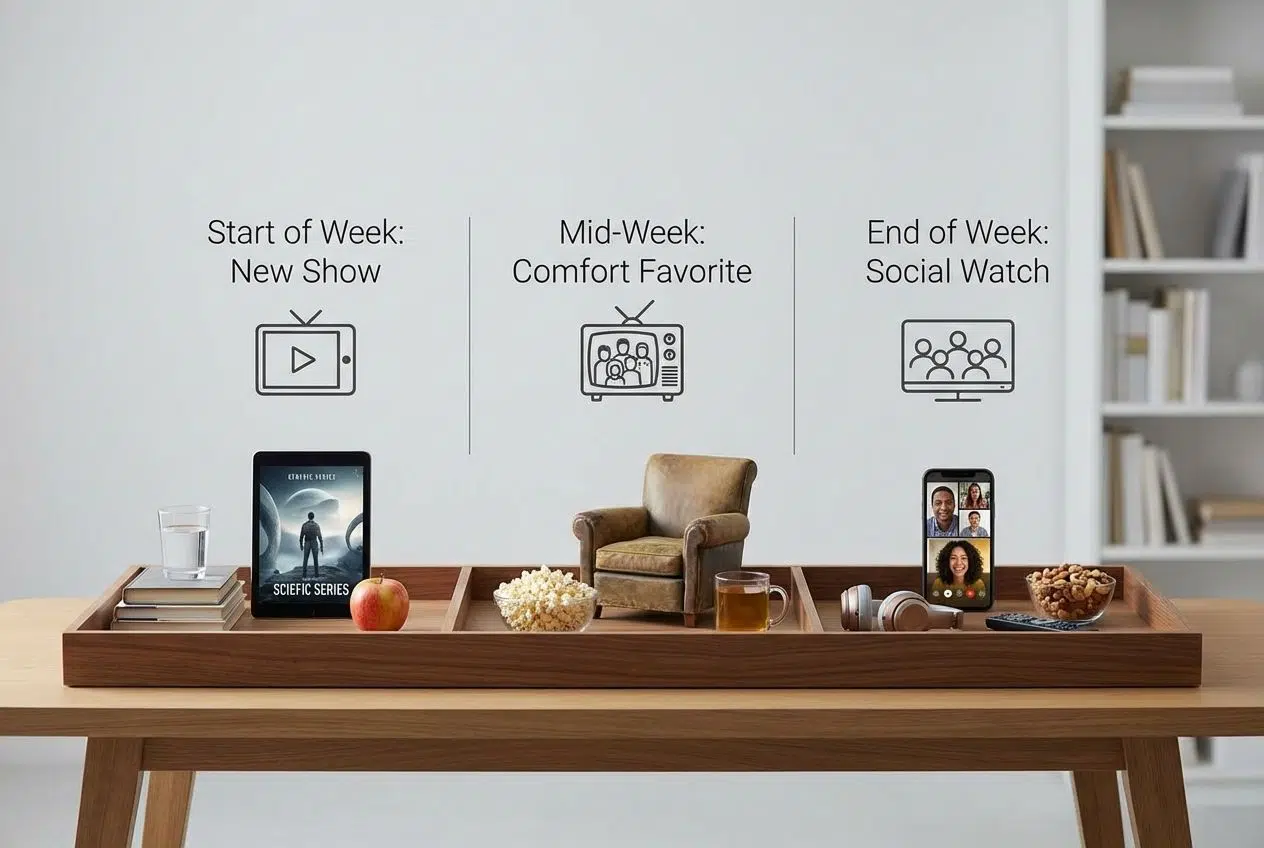
Try the “Sandwich Method”:
- Start your week with a new show or documentary to stimulate your brain.
- Rewatch a comfort favorite mid-week when stress is high.
- End the week with something social or current.
This keeps your brain flexible while still giving you the comfort you crave.
Avoiding over-reliance as a coping mechanism
Pay attention to why you are hitting play. Are you watching The Office to relax after work? That is healthy. Are you watching it to avoid a difficult conversation with your spouse or to procrastinate on a deadline? That is avoidance.
If you use movies to numb out constantly, you might be masking deeper anxiety. Use the movie to recharge, then take that energy and apply it to the things you need to do. Let the movie be the break, not the whole day.
Final Words
Rewatching psychology of comfort movie isn’t a bad habit to break; it is a natural, healthy response to a busy world. It offers you a rare moment of control, safety, and guaranteed joy.
Whether you need the courage of a hobbit, the humor of a high school clique, or just the reassurance that “there’s no place like home,” your favorite movies are there to help. They are a tool for your mental health, accessible anytime you press play.
So, tonight, don’t feel guilty about skipping the trendy new drama. Go ahead and visit your old friends. They’ve been waiting for you.






















