For years, the digital nomad conversation was dominated by the same three players: Portugal, Bali (Indonesia), and Costa Rica. But if you’ve tried to book a villa in Canggu or an appointment at AIMA in Lisbon recently, you know the truth: the “OG” hubs are overcrowded, overpriced, and increasingly bureaucratic.
Fortunately, the remote work landscape has just shifted dramatically.
Late 2025 and early 2026 have seen a massive wave of new legislation from countries hungry for remote talent. We aren’t just talking about re-branded tourist visas; these are dedicated, purpose-built residency permits with clear tax rules and reasonable income thresholds.
From the tropical shores of Sri Lanka (which literally just opened its portal this month) to the safari plains of Kenya, here is the definitive guide to the 7 newest digital nomad visas launched in late 2025. What you need to know about right now.
Digital Nomad Visas: The New Class of 2025-2026
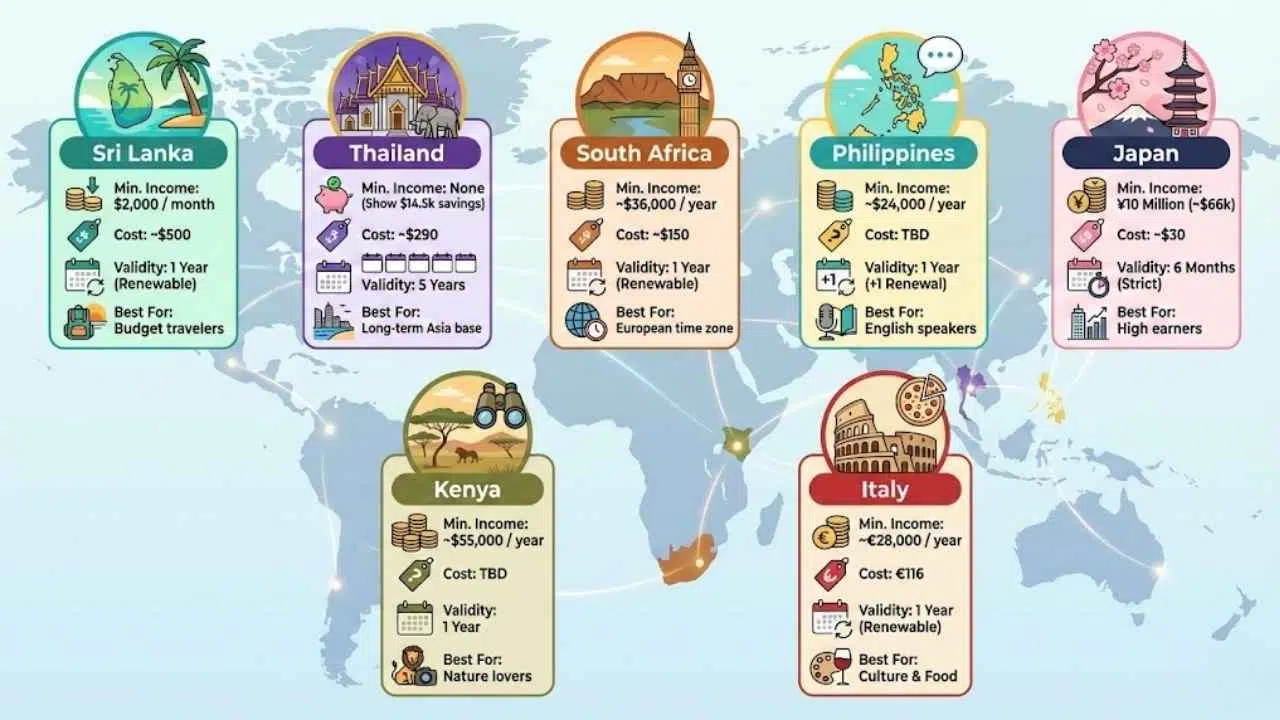
If you are in a rush to pack your bags, here is the high-level breakdown of what’s new on the market.
| Country | Visa Name | Min. Income Requirement | Visa Cost (Approx.) | Validity | Best For |
| Sri Lanka | Digital Nomad Visa | $2,000 / month | $500 | 1 Year (Renewable) | Budget travelers |
| Thailand | DTV (Destination Thailand Visa) | None (Show $14.5k savings) | $290 | 5 Years | Long-term Asia base |
| South Africa | Remote Work Visa | ~$36,000 / year | ~$150 | 1 Year (Renewable) | European time zone |
| Philippines | Digital Nomad Visa | ~$24,000 / year | TBD | 1 Year (+1 Renewal) | English speakers |
| Kenya | Class N Permit | ~$55,000 / year | TBD | 1 Year | Nature lovers |
| Italy | Digital Nomad Visa | ~€28,000 / year | €116 | 1 Year (Renewable) | Culture & Food |
| Japan | Designated Activities (Nomad) | ¥10 Million (~$66k) | ~$30 | 6 Months (Strict) | High earners |
1. Sri Lanka: The Newest Contender
Status: Launched February 2026
If you’ve been waiting for a true “budget” alternative to Bali, this is it. After years of speculation and delays, Sri Lanka officially activated its Digital Nomad Visa portal in February 2026, making it the freshest option on this list.
Why It’s a Game Changer
Sri Lanka offers an incredibly low cost of living—often 30-40% cheaper than Thailand—combined with surf culture, mountains, and high-speed fiber internet in major hubs like Colombo and Weligama. The government has aggressively positioned this visa to attract freelancers who might not meet the high income bars of Europe.
The Requirements
- Income: You must prove a monthly income of $2,000 USD. This can be from freelance contracts, remote employment, or business ownership.
- Application: Fully digital. The new portal allows you to upload documents and pay the fee without visiting an embassy.
- Cost: The government fee is set at $500.
- Family: You can bring your spouse and dependents, though the income requirement increases slightly (typically by $500 per dependent).
The “Catch”
The internet infrastructure in rural areas can still be spotty. If you plan to work from a beach hut in Arugam Bay, bring a backup Starlink or 5G router.
2. Thailand: The “Destination Thailand Visa” (DTV)
Status: Stabilized & Fully Operational as of Late 2025
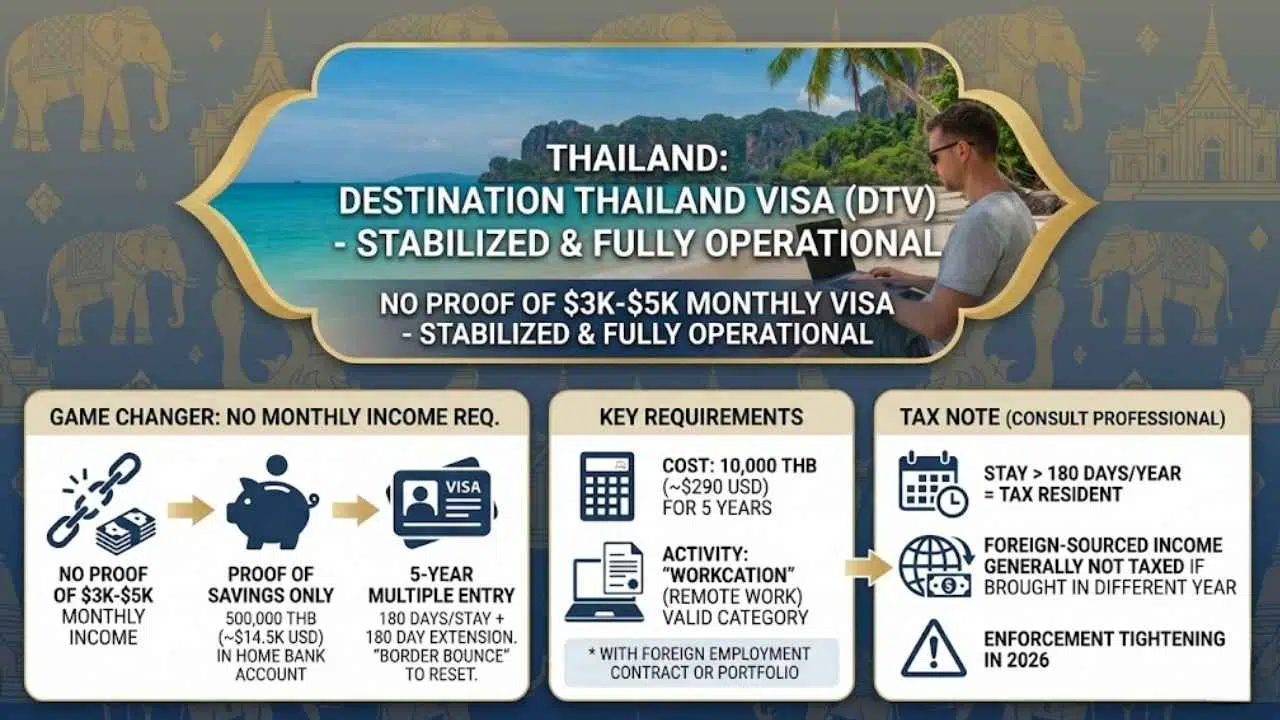
While the DTV technically launched in mid-2024, it effectively killed the “visa run” culture in late 2025. It has become the gold standard for digital nomad visas globally because of one unique feature: It has no monthly income requirement.
Why It’s a Game Changer
Most visas require you to prove you earn $3k or $5k every single month. Thailand’s DTV only asks for proof of savings. If you have the cash in the bank, you’re in. It acts as a 5-year multiple-entry visa, allowing you to stay for 180 days at a time, extend for another 180 days, and then do a quick “border bounce” to reset the clock.
The Requirements
- Financials: You must show a bank statement with at least 500,000 THB (approx. $14,500 USD). This money does not need to be in a Thai bank; your home bank account is fine.
- Cost: 10,000 THB (approx. $290 USD). This is remarkably cheap for a 5-year visa.
- Soft Power Activity: Originally, there was confusion about needing to book a “Muay Thai” or “Cooking” course. However, current clarifications allow “Workcation” (remote work) as a valid category on its own, provided you have a foreign employment contract or portfolio.
Tax Note
If you stay in Thailand for more than 180 days in a calendar year, you become a tax resident. However, under current interpretation, foreign-sourced income is generally not taxed if it is brought into Thailand in a different year than it was earned. (Always consult a Thai tax professional, as enforcement on this is tightening in 2026).
3. South Africa: The Remote Work Visa
Status: Fully Implemented Late 2025
For years, Cape Town was the world’s favorite nomad hub without a visa. Travelers had to abuse tourist visas to stay. That changed when the Remote Work Visa regulations were finally gazetted and operationalized in late 2025.
Why It’s a Game Changer
South Africa shares a time zone with Europe (UTC+2), making it the ultimate winter escape for UK and EU remote workers who can’t handle the jet lag of Asia or Latin America.
The Requirements
- Income: You must earn a gross annual income of R650,976 (approx. $36,000 USD). This is significantly lower than the originally proposed $50k+ requirement.
- Employer: You must work for a foreign employer or be self-employed with clients abroad. You cannot work for a South African company.
- Tax Benefit: A massive win for this visa is the tax exemption. If you stay in South Africa for less than 6 months (183 days) in a 12-month period, you are exempt from registering for local tax.
Essential Tip
South Africa’s Department of Home Affairs is notorious for slow processing. While the law is new, the bureaucracy is old. Apply at least 3 months before your intended travel date.
4. Philippines: The Digital Nomad Act
Status: Rolling out Mid-2025
The Philippines has long been a favorite for English-speaking travelers, but strict visa renewals were a hassle. The new Digital Nomad Visa, launched mid-2025, opens up the archipelago of 7,000+ islands to long-term stays.
Why It’s a Game Changer
Language. unlike Thailand or Vietnam, English is an official language in the Philippines. Negotiating rent, reading contracts, and making local friends is frictionless. Plus, the “island hopping” lifestyle here is unmatched.
The Requirements
- Income: Approximately $24,000 USD per year.
- Validity: 12 months, with the option to renew for another 12 months.
- Location: While Manila has the best internet, most nomads are using this visa to set up base in Cebu (IT Park area) or Siargao (now equipped with better fiber infrastructure).
The “Catch”
Internet reliability outside major cities is still a challenge. Verify upload speeds personally before signing any long-term lease.
5. Kenya: Class N Permit
Status: Operational (Online Portal Stabilized April 2025)
Kenya is positioning itself as the “Silicon Savannah.” The introduction of the Class N Permit was a direct move to compete with South Africa for the African remote work market.
Why It’s a Game Changer
It combines a high-tech ecosystem (Nairobi hosts offices for Google, Microsoft, and Visa) with bucket-list adventure. You can code in a Nairobi cafe on Friday and be watching lions in the Masai Mara by Saturday morning.
The Requirements
- Income: There is some conflicting info between agencies, but the safest threshold to target is $55,000 USD per year. (Some sources cite $24k, but approvals are faster at the higher tier).
- Clean Record: A police clearance certificate from your home country is strictly required.
- Validity: Issued for 1 year, renewable.
Pros & Cons
- Pro: Nairobi has some of the fastest mobile data speeds in Africa (5G is widespread).
- Con: The cost of living in expat areas (like Westlands or Karen) is higher than you might expect—comparable to parts of Eastern Europe.
6. Italy: The Digital Nomad Visa
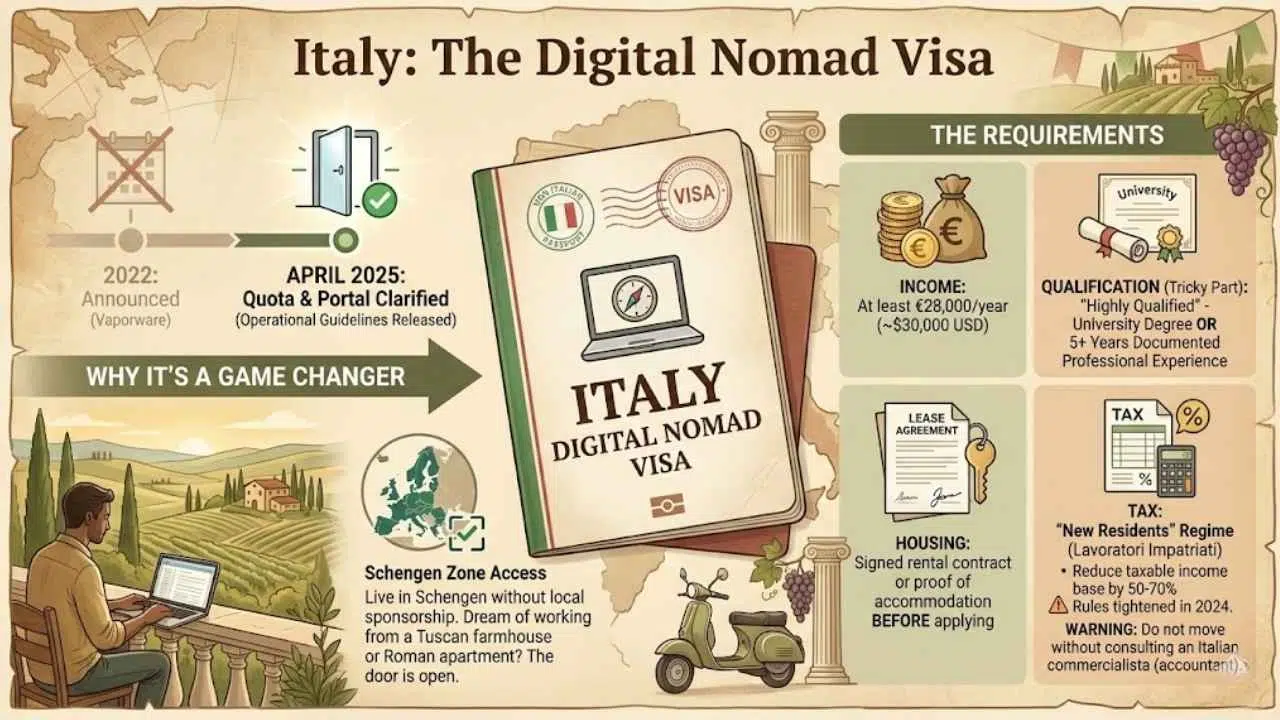
Status: Quota & Portal Clarified April 2025
Italy technically announced this visa in 2022, but it was “vaporware” (non-existent) for years. Late 2025 finally saw the release of clear operational guidelines that allowed non-corporate freelancers to actually apply and get approved.
Why It’s a Game Changer
It allows non-EU citizens to live in the Schengen zone without being sponsored by a local company. If you’ve dreamed of working from a Tuscan farmhouse or a Roman apartment, the door is finally open.
The Requirements
- Income: You must earn at least €28,000 per year (approx. $30,000 USD).
- Qualification: This is the tricky part. You must be “highly qualified,” which usually means holding a University degree or having documented professional experience in your field for at least 5 years.
- Housing: You must have a signed rental contract or proof of accommodation before applying.
- Tax: Italy offers a “New Residents” tax regime (Lavoratori Impatriati) that can reduce your taxable income base by 50-70%, though the rules for this were tightened in 2024. Do not move here without speaking to an Italian commercialista (accountant).
7. Japan: The Digital Nomad Visa (Designated Activities)
Status: Fully Active (Launched 2024, Tax Clarifications 2025)
Japan’s entry into the market was highly anticipated but comes with strict limitations. It is designed for the “high-end” nomad who wants a cultural sabbatical rather than a permanent relocation.
Why It’s a Game Changer
It opens up a country that was previously notoriously difficult for long-term stays. It’s perfect for those who want to experience the cherry blossom season and the autumn leaves in one trip.
The Requirements
- Income: ¥10 Million (approx. $66,000 USD). This is one of the highest bars on this list.
- Validity: 6 Months Only. This is non-renewable. You must leave the country for 6 months before applying again.
- Dependents: Spouses and children can come, and they are not required to have their own income, but they cannot work.
The “Catch”
This visa does not give you a residence card (Zairyu Card). This makes it very difficult to sign a long-term apartment lease, buy a SIM card, or open a bank account. You will likely be living in Airbnbs or “Monthly Mansions” (short-term furnished rentals).
Notable Mentions & Rumors
- Indonesia (Bali): The “E33G” Remote Worker KITAS is now the official route. The days of living on a B211A tourist visa are numbered, with immigration conducting more raids in Ubud and Canggu. The E33G requires proof of funds and a formalized application.
- Turkey (Tech Visa): While not a pure nomad visa, Turkey launched a “Tech Visa” in 2024/25 aimed at entrepreneurs and start-up founders, offering a 3-year residency.
Final Thoughts
If there is one takeaway from the visa launches of late 2025 and 2026, it is this: Legitimacy is the new normal. Governments are done with the “grey area” nomad who works on a tourist visa. They want you to register, prove your income, and contribute to the local economy legally. In exchange, they are offering you security—no more border runs, no more fear of deportation, and the ability to truly settle in.