


Trying to study in Canada can feel like running through a maze. You might worry about getting a study permit or keeping your spot with so many changes in the air. Many students wonder why it is suddenly harder to get into Canadian schools and if their dreams are on hold. Here is one thing you should know: The new Canada Immigration Cap will cut down on international student permits, starting soon.
This move could change how and where you study, raising big questions for students everywhere. I’m going to walk you through the exact steps I use to understand these shifts, and I think you’ll be surprised at how manageable it can be with the right plan.
Overview of Canada Immigration Cap
Canada now limits the number of newcomers each year, including students. These new rules could shape who gets to study, work, or live in Canada soon.
Key objectives of the immigration cap
Limiting the number of new study permits helps balance population growth with local resources. The aim is to avoid strain on housing, schools, and hospitals. Setting a clear cap supports fair allocation across provinces and regions. Policy makers focus on quality education for international students while protecting jobs and services for residents.
“The immigration cap aims to keep opportunities open but manageable for everyone.”
Approval rules put education first and help control tuition spikes at public colleges. Graduate exemptions encourage high-level talent like Master’s or Ph.D. students who can boost innovation in Canada’s workforce.
This measured approach keeps both community needs and federal regulations in mind. It is not a wild goose chase, just some good old-fashioned planning.
Temporary resident and study permit limits for 2026-2028
Canada’s new policy sets some very clear limits for temporary residents and international students. Here is a quick breakdown of what to expect over the next few years.
| Year | Temporary Resident Cap | Study Permit Cap | Key Points |
|---|---|---|---|
| 2026 | Reduced from 6.2% to 5% of Canada’s population | 155,000 new study permits (arrivals) |
– Provincial Attestation Letter (PAL) required for most undergrads – Total permits issued capped at 408,000 (including extensions) – Ontario and British Columbia face the largest cuts
|
| 2027 | Capped at 5% of the population | Stays near 155,000 new arrivals |
– No major increase planned – Master’s and Ph.D. students at public schools remain exempt from the cap – Provinces adjust admission targets based on housing data
|
| 2028 | Still capped at 5% of the population | Similar permit cap stays |
– Policy under review for adjustments – More data collection on temporary residents – Ottawa monitors impacts on labor markets
|
Expect more competition for fewer spots. Master’s and Ph.D. students at public institutions will find some relief, thanks to their exemption.
Undergrads and private college hopefuls face a tighter squeeze. Ontario and British Columbia take the hardest hit, with bigger reductions forecasted. Canada’s focus is on keeping population growth in check, all while juggling infrastructure limits.
The Study Permit Cap: Key Details
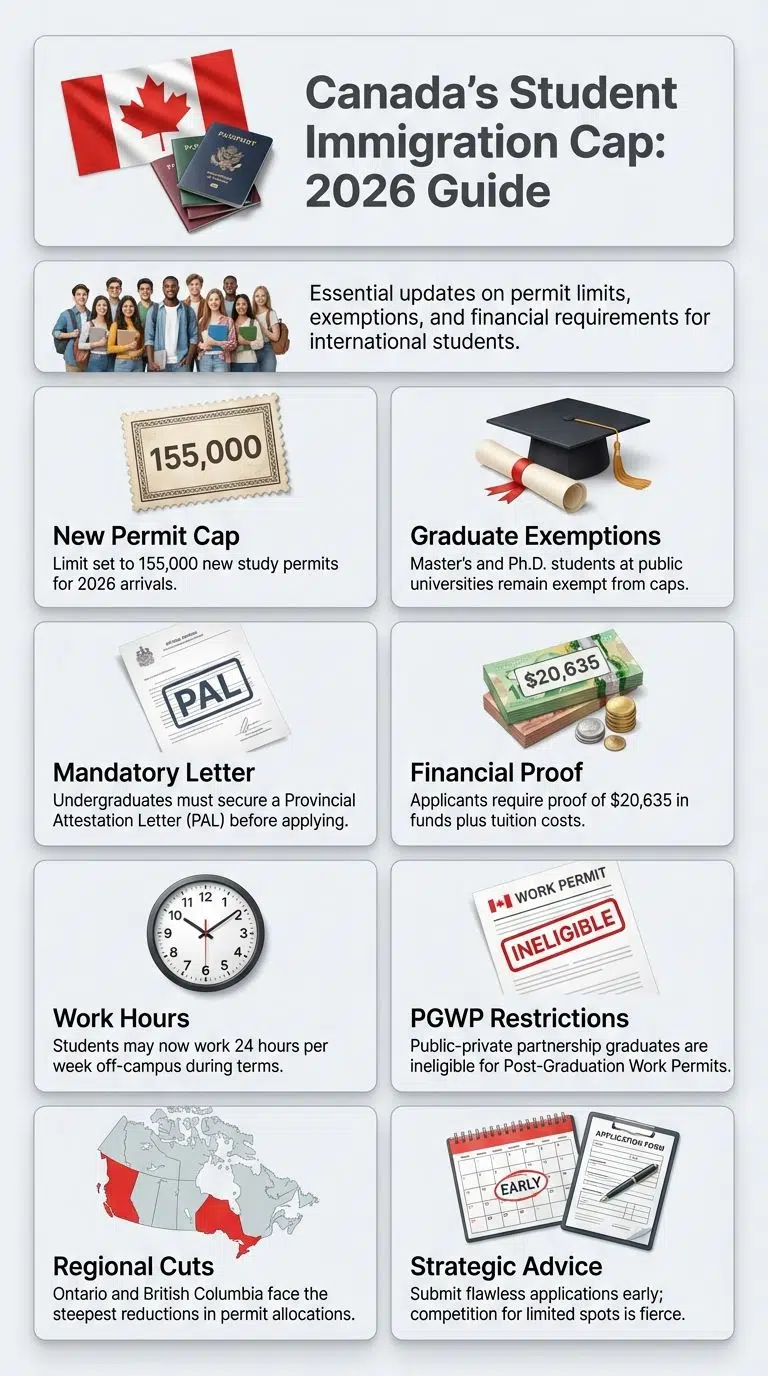
Canada will set a limit of 155,000 new study permits for arriving students in 2026. Some graduate students at public schools may still get permits beyond this cap.
Reduction to 155,000 new permits in 2026
The federal policy will lower the number of new study permits for international students in 2026. Only 155,000 new permits for arriving students will be approved that year. This cap applies to most post-secondary programs at public colleges and universities across Canada. Fewer spots make competition tighter and may affect your plans if you want to study here.
The Financial Hurdle: It is not just about the cap. You now need to prove you have at least $20,635 (for a single applicant) in available funds, plus tuition. In Quebec, that number jumps to over $24,000 starting in 2026. This ensures you can comfortably afford life in Canada without immediate stress.
Graduate programs like Master’s and Ph.D. at public institutions are not part of this limit. Still, many undergraduate or college-level students must work harder on their applications since there are fewer than before.
The change is big compared to past years, where the numbers were higher, making it more difficult for many to want a Canadian education experience.
Exceptions for Master’s and Ph.D. students at public institutions
After setting the limit at 155,000 new study permits in 2026, Canada still offers some flexibility. There are exceptions for certain graduate students in public universities.
- No PAL Required: As of January 1, 2026, Master’s and Ph.D. students at public schools are exempt from the Provincial Attestation Letter requirement.
- Cap-Exempt Status: These advanced degree students can get study permits even after permit limits are filled up for other levels.
- Targeting Talent: Graduate exemptions aim to keep top international talent coming into Canada’s higher education system.
- Regional Benefits: Public colleges and universities in provinces like Ontario, British Columbia, and Alberta benefit since they can still admit bright graduate researchers.
- Higher Approval Odds: Study permit approval rates for Master’s and Ph.D. applicants are higher compared to other student categories under federal regulations.
- Economic Value: The government feels these students add more value to Canadian research programs and economic growth than shorter-term or lower-level learners.
Reasons Behind the Immigration Cap
Canada wants to cool down the rush of new arrivals. There is a real need to fix crowding and strained cities before opening the doors wider again.
Addressing housing and infrastructure challenges
Housing costs shot up in many cities, leaving students struggling to find a place they could afford. Apartments were scarce, and rent prices soared. Too many people arrived too fast for schools and roads to keep up. Rental vacancy rates dropped below 1.5 percent in large cities like Toronto and Vancouver by the end of 2023. This made it feel like everyone was chasing after the same set of keys.
Government leaders said new immigration caps might help slow down this squeeze. By reducing study permit approvals, fewer newcomers would compete for homes or crowd buses and trains on their way to class.
This change aims to give communities time to fix shortages and plan better infrastructure. They want bigger classrooms and more student housing so future students can get settled without wading through wave after wave of stress.
Managing population growth
Limits on new study permits help address more than just housing. They also slow rapid population growth in Canada. The government plans to lower the number of new temporary residents each year, and this directly affects international students.
Canada saw its fastest population jump in 66 years during 2023, adding over one million people. Federal policies now set cap limits for study permits from 2026 through 2028, targeting about 155,000 new approvals a year by 2026.
By keeping numbers in check, officials hope cities can keep up with needs like schools, public transit, and healthcare for everyone. This creates a tighter squeeze for those dreaming of studying here but aims to balance the benefits across Canadian society.
Impacts on International Students
International students face a tighter race for spots, making every application count more than ever. Fewer study permits also mean stiffer competition and fresh challenges after graduation.

Limited access to Canadian education
Fewer study permits mean fewer students can get into Canadian schools. Only 155,000 new study permits will be available in 2026; this is a big drop from past years.
Some spots are now out of reach for many who want to study in Canada. Students working to enter bachelor’s or diploma programs may face more hurdles than before. Master’s and Ph.D. students at public institutions might have an easier time since they get some exceptions.
This cap makes competition fierce, like musical chairs with too few seats left when the music stops. Schools must pick carefully who gets a spot and who does not, based on federal regulations and allocation limits set by Ottawa.
Fewer student visa approvals could mean higher tuition fees as colleges try to balance their books. More details lie ahead about the increased competition for these limited study permits.
Increased competition for study permits
Tougher rules mean fewer spots for study permits. As the cap drops to 155,000 new permits in 2026, spots fill up fast. Many students around the world compete for these limited openings. Now, every application faces a much sharper review. Students need higher grades and stronger documents than before.
This shift makes it harder to start studying in Canada. Even students with good records may not get approval on their first try. Provinces like Ontario and British Columbia feel this squeeze even more as they host most international students.
With stricter federal policy, only top applications make the cut each year. This makes competition fierce across all levels of education except graduate exemptions at public institutions.
Stricter post-graduation work permit pathways
Canada now has tougher rules for post-graduation work permits. Fewer students will qualify, especially those from private colleges or less recognized schools.
Many international students used to rely on the Post-Graduation Work Permit Program (PGWPP) to stay and work in Canada after finishing their studies. Now, new limits and stricter criteria make it harder.
Critical Warning: As of May 15, 2024, students enrolled in public-private partnership programs (where a public college curriculum is taught at a private college) are no longer eligible for a Post-Graduation Work Permit.
Some programs are no longer eligible for these permits starting in 2024. Only graduates from certain public institutions or approved graduate programs may still apply with success. These changes aim to control growth by limiting temporary residents, but this pushes students to plan more carefully before picking a college or university in Canada.
Provincial and Institutional Effects
Some provinces now see fewer students walking their campus halls, especially in Ontario and British Columbia. This shift forces schools to rethink budgets, classrooms, and even which programs they can offer next fall.
Declining temporary residents in Ontario and British Columbia
Ontario and British Columbia face a drop in temporary residents as the new immigration cap tightens. Fewer study permits mean fewer international students filling classrooms.
Data from 2024 shows Ontario receives about half of Canada’s total study permit approvals, while British Columbia usually gets over 20 percent. With Ottawa cutting student allocations, both provinces will see crowded application pools and tougher approval chances.

In fact, Ontario’s allocation for 2026 is set to roughly 104,000 applications, a number designed to yield only about 70,000 approved permits. This is a massive shift from previous years.
Many schools in these regions count on tuition from international students to run programs and pay staff. Now, limits could shrink their budgets or even force cuts to services and classes.
Students once flocked here for more education options, but now must race for fewer spots. This change hits smaller colleges hard since they rely most on overseas enrollment to keep doors open.
Challenges for universities and colleges
Fewer study permits and tighter immigration rules hit universities and colleges hard. Many schools in British Columbia and Canada’s largest province, Ontario, now face lower enrollment numbers. Less international student tuition means budgets shrink fast, making it tough to keep up staff and programs.
Schools must follow strict federal policy on student visa regulation and permit allocation. Some small private colleges may close since they rely almost fully on these students for funding.
Public universities worry about losing their top graduate candidates, too, as exceptions do not cover every program or student group. With fewer temporary residents arriving each year under the cap limit, competition heats up both in classrooms and over much-needed resources like housing.
Getting Through the New System: Tips for Students
Getting a permit now means jumping through more hoops, so plan ahead and stay sharp. Catch the next section for smart moves that can help you stand out in the crowd.
Understanding eligibility and exceptions
Study permit applicants must meet strict eligibility rules to qualify under the new immigration cap. Only 155,000 undergraduate study permits will be approved in 2026. Most students applying for college or bachelor’s programs will face stiffer competition for a slot. Those wanting entrance into Master’s or Ph.D. programs at public schools get special treatment.
The federal government exempts these graduate students from the tight cap, so they do not have to compete with undergraduates for allocation limits. Public institutions remain key; private and language schools see more restrictions than before. Exceptions exist mainly for higher-level degree seekers and some exchange agreements between countries, but even those are rare cases now.
Always check if your program qualifies as an exception before you apply; this helps avoid heartache later on down the line. Getting past these hurdles matters since only strong applications move forward under stricter federal policy.
Preparing strong applications
A good application can make you stand out among thousands. Highlight your grades, language test scores, and any work or volunteer experience. Include awards and letters of recommendation. Show why you want to study in Canada and how your goals match the program.
Make sure every document is clear and up-to-date. Federal regulations now favor complete applications without missing information.
- Secure Your PAL: If you are an undergrad, you must get a Provincial Attestation Letter from your school before applying for the visa. No letter means an instant rejection.
- Double-Check Details: Verify personal details like your name and passport number for correct spellings before sending anything off.
- Apply Early: A small mistake could cost a chance at approval under the new cap limit. Spots fill fast as competition grows due to strict allocation limits in place for study permits across provinces such as Ontario and British Columbia.
Exploring alternative pathways
Some students choose diploma or certificate programs at public colleges. These often have different permit rules than four-year degrees.
Master’s and Ph.D. levels can offer other open doors, since many graduate programs are exempt from the study permit cap in 2026. Short-term courses, language schools, or online education with a Canadian institution may still help you gain skills while the limits last.
Pathways like transfer agreements between schools give more routes into higher education, too. Staying sharp about changes to Canada’s immigration policies helps keep dreams within reach, even if the road twists and turns along the way!
Broader Implications for Canadian Education
Big changes to student numbers could shake up university budgets, campus life, and even local shops. Stick around to see what is next for schools across Canada!
Impact on universities and colleges
Universities and colleges now face tough choices. Fewer study permits mean fewer international students on campus. Campuses feel quieter, especially in provinces like Ontario and British Columbia, where most international students go to school.
Tuition revenue drops, so schools may cut programs or raise fees for local students. Research projects slow down if there are fewer graduate exemptions.
Some small schools worry about staying open at all. They once relied on tuition from students coming from abroad. Staff jobs could be at risk too, since less funding means smaller budgets for hiring teachers and support workers. This shift pushes many institutions to rethink their future plans under the new federal policy limits.
Potential economic consequences
Many schools depend on international students to keep tuition income steady. After the immigration cap, fewer study permits mean a drop in new students and less money flowing into Canadian colleges and universities.
In 2023 alone, international students paid nearly $9 billion in tuition fees across Canada. This huge sum keeps school programs running, supports staff salaries, and funds campus upgrades.
Local businesses near campuses may also feel the squeeze as fewer students rent apartments or spend money on food and travel. The effects ripple out; cities like Toronto and Vancouver could see smaller grocery bills at shops or emptier buses on busy routes.
Fewer temporary residents can even slow growth for tech firms that count on skilled grads from graduate programs. With federal policy changes limiting student arrivals until at least 2028, everyone from landlords to lunch counters faces tighter budgets.
Final Words
Canada’s new immigration cap puts students on a tightrope, balancing dreams and tough choices. This article covered key facts about the study permit limits, exemptions for graduate programs, and why Canada is changing these rules.
The tips here make it clear that staying organized and applying early can give you an edge in this competitive game. Fewer permits mean higher stakes, so every detail matters when filling out your paperwork or picking schools. For extra help, check official Canadian government websites or reach out to student advisers; they have the latest updates that could change your plans fast.
Big changes may seem scary at first blush, but with patience and smart moves, determined students still find their way across new borders with nothing but hope and a packed suitcase!





















