


Finding your next step after graduation can feel like staring at a “Game Over” screen. You’ve beaten the final boss (your exams), but now you’re asking, “How do I keep playing in this server?” Many students worry about their visa expiring before they can land a job or getting stuck in a paperwork loop. Here is the good news: The UK, Canada, and Australia have released what I like to call “Expansion Packs” for international students. These are officially known as “Post-Study Work Visas.”
They give you the legal right to stay, earn money, and level up your career without needing a company to sponsor you immediately. In this guide, I’m going to walk you through the latest patch notes, I mean, immigration rules for 2026. We will cover the new age limits in Australia, the language tests in Canada, and the fees for the UK. Ready to map out your next move? Let’s get into it.
What is a Post-Study Work Visa?
Think of a Post-Study Work Visa as a “Season Pass” for your career. It allows international students to remain in the country after graduation to work, look for a job, or even launch a startup. Unlike a standard work visa, you usually don’t need a job offer to apply. You get the permit first, then you find the work.
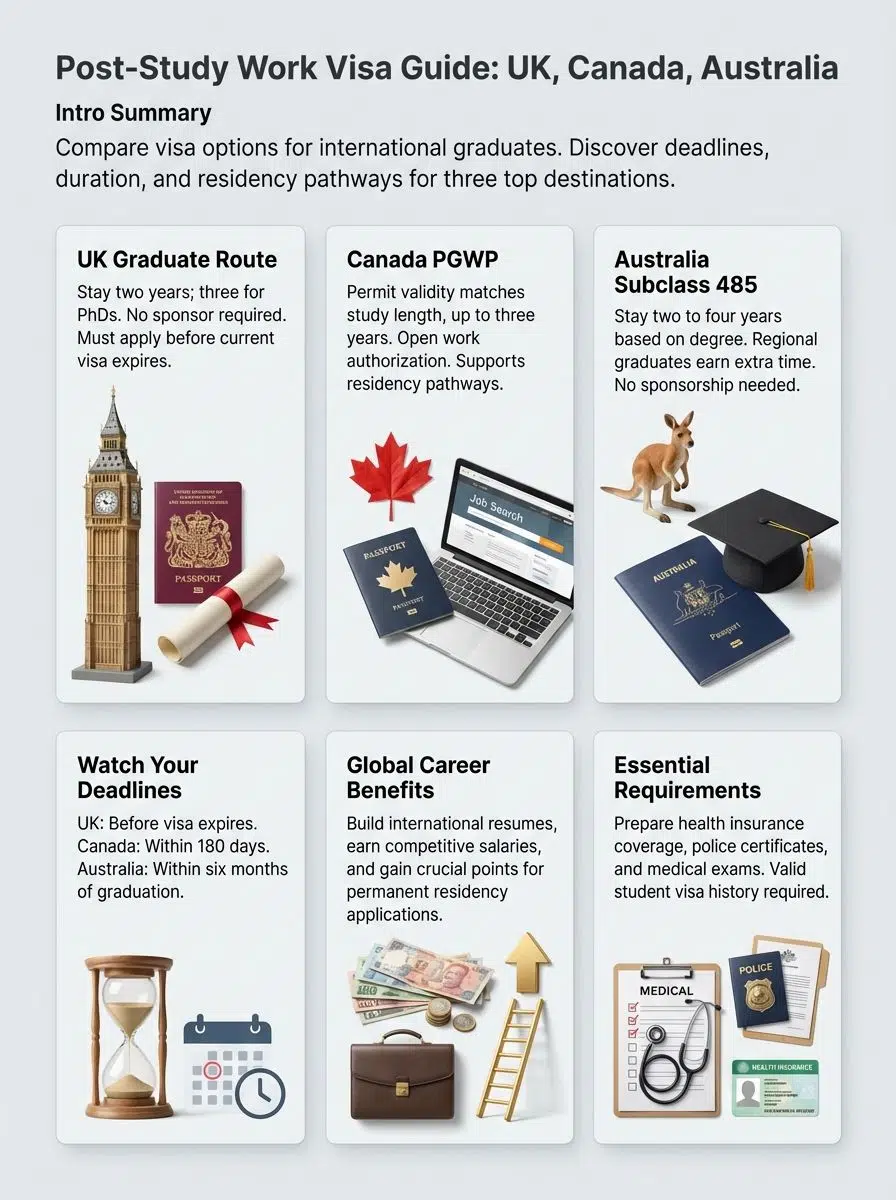
Countries like the UK, Canada, and Australia use these visas to recruit high-level players, that’s you, to their workforce. They want your skills, and they are willing to give you time to prove yourself.
For many, this is the first major quest in the “Permanent Residency” storyline. For others, it’s about grinding for two or three years to build a resume that looks impressive anywhere in the world. Either way, it transforms you from a student into a skilled professional.
Post-Study Work Visa Options in the UK
If you want to stay in the UK, the system is surprisingly straightforward, but it comes with a high “subscription fee.” The Graduate Route Visa is your main option here. It grants you permission to stay for at least two years after completing an eligible course.
The “No Sponsorship” Feature
The best part of the Graduate Route is that it is unsponsored. You don’t need to convince a boss to pay for your visa. You can work as a barista, a freelance graphic designer, or a junior engineer. You can switch jobs whenever you want. This flexibility lets you figure out your career path without the pressure of being tied to one employer.
Eligibility Requirements (UK)
To unlock this visa, you need to meet a specific set of criteria. The Home Office is strict, so ensure you have these boxes checked before you apply.
- Valid Student Visa: You must be in the UK and hold a valid Student visa (or Tier 4) when you apply. If your visa expires today, and you apply tomorrow, it’s game over.
- Course Completion: You don’t need your physical graduation certificate yet, but your university must have updated the Home Office system to say you’ve successfully finished your course.
- No “Double Dipping”: You can only hold this visa once. You cannot get a Graduate visa after a Bachelor’s and then another one after a Master’s.
- Clean Record: You cannot have any serious criminal issues or previous immigration breaches.
Pro-Tip: Do not travel outside the UK while your application is processing. Doing so will automatically withdraw your application, and you will lose your application fee. Stay put until you get the digital green light.
Duration and Costs (UK)
This is where you need to budget carefully. The UK visa fees increased in April 2024 and April 2025, making this one of the pricier options.
The Cost Breakdown:
- Application Fee: As of April 2025, the application fee is £880.
- Immigration Health Surcharge (IHS): You must pay this upfront for the full visa duration. It is currently £1,035 per year. For a standard two-year visa, that is £2,070 due the moment you apply.
- Total Upfront Cost: For a typical Master’s graduate, you need roughly £2,950 ready in your bank account just for the fees.
Time Limits:
- Bachelor’s & Master’s Graduates: 2 years.
- PhD & Doctoral Graduates: 3 years.
- Processing Time: It typically takes around 8 weeks to get a decision.
Post-Study Work Visa Options in Canada
Canada has always been a favorite destination for international students, but the developers (the government) released a massive update in late 2024 that changed the meta. The Post-Graduation Work Permit (PGWP) is still powerful, but it is harder to get for certain players now.

The New Rules: Language and Fields of Study
If you applied for your study permit after November 1, 2024, you face stricter requirements. This is the biggest change in years, so pay attention.
1. The Language Test Requirement
Previously, you didn’t need a language test for the PGWP. Now, you do. You must prove your English or French skills using a test like the IELTS or CELPIP.
- University Graduates: You need a CLB 7 (roughly IELTS 6.0 in all bands).
- College Graduates: You need a CLB 5 (roughly IELTS 5.0 in all bands).
2. The “Field of Study” Restriction
If you graduate from a university degree program (Bachelor’s, Master’s, or PhD), you are safe, and you can study anything. However, if you graduate from a college program (diploma or certificate), your field of study must be linked to a labor shortage area. These areas include agriculture, healthcare, STEM, trade, and transport. If you study a general business diploma at a college, you might not be eligible for a work permit anymore.
Duration and Benefits [Canada]
The duration of your PGWP depends on how long you studied. It’s a simple calculation:
- Program under 8 months: Not eligible.
- Program between 8 months and 2 years: The permit length matches your study length (e.g., study for 1 year, get a 1-year permit).
- Program of 2 years or more: You can get a permit valid for up to 3 years.
- Master’s Degrees: Even if your Master’s program was less than 2 years (e.g., 16 months), you are now eligible for the full 3-year permit.
Fees and Processing:
- Application Fee: CAD $255.
- Processing Time: This varies wildly, often sitting around 130 days for online applications.
Post-Study Work Visa Options in Australia
Australia recently “nerfed” its visa system. The government reduced the age limit and shortened the stay for many graduates to focus on younger, skilled workers. The visa is officially called the Temporary Graduate visa (subclass 485).
The Age Limit Shock
The most critical change is the age cap. For the “Post-Higher Education Work” stream (formerly Post-Study Work), the maximum age is now 35 years old. It used to be 50. If you turn 36 before you apply, you are locked out of this stream unless you are a Hong Kong/BNO passport holder or completing a specific research degree (Master’s by Research or PhD).
Duration and Pathways [Australia]
Australia has split the visa into clearer streams. Make sure you pick the right loadout for your character.
Post-Higher Education Work Stream:
- Bachelor’s Degree: 2 years.
- Master’s (Coursework): 2 years.
- Master’s (Research) & PhD: 3 years.
- Stay Bonus: If you studied and live in a regional area (like Perth, Adelaide, or the Gold Coast), you can apply for a second visa to stay an extra 1 to 2 years.
Key Stats for 2026:
- Cost: The base application charge is AUD 2,300.
- English Score: The requirement has increased. You now need an IELTS 6.5 overall (with no band lower than 5.5).
- Processing Time: Varies, but usually takes several months. Check the “Visa processing time guide tool” on the Home Affairs website for the current server status.
Comparison: Which Country Offers the Best Loot?
Choosing a destination often comes down to the ROI (Return on Investment). Here is how the three major players stack up side-by-side.
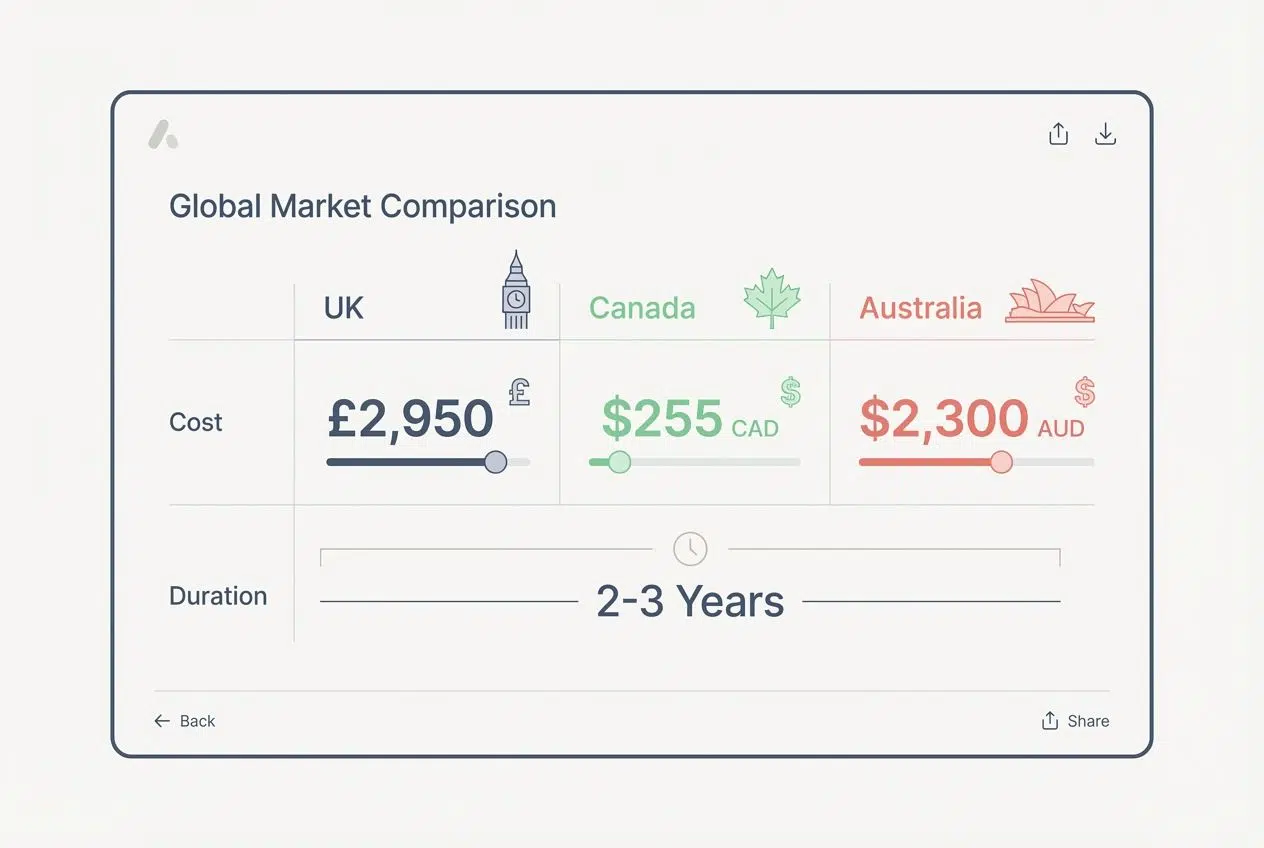
| Feature | UK (Graduate Route) | Canada (PGWP) | Australia (Subclass 485) |
|---|---|---|---|
| Max Duration | 2 Years (3 for PhD) | 3 Years | 2 Years (3 for PhD) |
| Approx. Cost | ~£2,950 (Fee + IHS) | ~$255 CAD | ~$2,300 AUD |
| Age Limit | None (if on a student visa) | 18+ | 35 (for most streams) |
| Sponsorship? | No | No | No |
| Path to PR? | Difficult (Must switch visas) | Strong (Express Entry points) | Moderate (Points system) |
Key Benefits of Post-Study Work Visas
Why go through the hassle? Because the “XP” (experience points) you gain here are worth double what you might get back home.
Level Up Your Career
Employers love candidates who have played on “Hard Mode.” Working in a foreign country proves you are adaptable, culturally aware, and resilient. Even if you eventually return home, having “London,” “Toronto,” or “Sydney” on your resume acts like a permanent buff to your employability.
Unlock the Permanent Residency Quest
For many, this visa is the bridge to staying forever.
- Canada: Working for one year on a PGWP qualifies you for the “Canadian Experience Class” in Express Entry, significantly boosting your score.
- Australia: Your time spent working counts toward the “Points Tested” skilled migration streams.
- UK: While the Graduate route itself doesn’t count toward settlement, it gives you two years to find an employer willing to sponsor you for a “Skilled Worker Visa,” which does lead to residency.
Tips for Applying for a Post-Study Work Visa
Applying for a visa is not the time to freestyle. You need a strategy. Here are three tips from the pros to ensure your application doesn’t get rejected.
1. The “Decision Ready” Strategy
Immigration officers are busy. Make their job easy. Upload your documents in clear, color scans. Label them perfectly (e.g., “Passport_Bio_Page.pdf” instead of “Scan001.jpg”). In Australia, organize your health exams early by generating a HAP ID before you even lodge the visa, if possible. A messy application is a slow application.
2. Watch the Clock [The Speedrun]
Timing is everything.
- UK: You must apply before your current student visa expires. Even one day late makes you an overstayer.
- Canada: You have 180 days from the moment you receive your final grades (not the ceremony!).
- Australia: You generally have 6 months after your course end date.
3. The “Funds” Glitch
Always check if you need to show proof of funds (bank statements). While the UK Graduate Route generally doesn’t require financial evidence if you’ve been living there for a year, Australia often requires you to prove you can support yourself. Don’t let an empty bank account be the reason you fail the final check.
The Bottom Line
Now you have the map for the UK, Canada, and Australia. These post-study work visas are rare opportunities to test your skills in the global market. The costs and rules might seem like high barriers to entry, but the payout, global experience, potential residency, and a powerful network are massive.
Don’t wait until the last minute to start your paperwork. Check your dates, save up for those fees, and get your application in. Your career is waiting for you to press start. Good luck!






















