In 2026, the heart is no longer a symbol; it is a ledger. As global markets fluctuate and the “permanent” job becomes a relic of the past, Valentine’s Day has shed its silk skin. The era of performative romance: expensive tasting menus and imported roses, has been replaced by Practical Intimacy. This is Love in the Time of Layoffs.
For millions of couples, the ultimate act of devotion isn’t a diamond; it’s a shared login, a split utility bill, or the quiet sacrifice of a “treat” to fix a tool of the trade. This is love redefined by the friction of the gig economy and the sudden, cold reality of a redundancy notice. In this new era, romance isn’t measured by the height of the champagne bubbles, but by the depth of the shared foxhole.
Love in the Time of Layoffs: Global Narratives of Practical Devotion
Case Study: London, The Sacrifice of the “Treat”
6:30 AM: The light in Hackney was the colour of wet pavement. Sonia watched the ceiling, her mind a spreadsheet of dwindling savings since her project management role vanished. Beside her, Marcus, once a designer, now a delivery rider, felt the knots in his back tighten.
They had a treaty: no “Happy Valentine’s.” No performance.
On the counter sat a gag gift, Sweethearts candy. The top one read: SPLIT BILL. It wasn’t a joke; it was their constitution.
Sonia’s phone flickered: “Final interview. Monday. 9:00 AM.” Hope surged, but Marcus’s voice broke the moment. “The bike’s broken. The derailleur. It’s £85.”
That was their “Treat Fund.” The steak and wine they had saved for. Sonia didn’t hesitate. “Fix the bike.”
In the age of uncertainty, love isn’t chocolate. It’s ensuring your partner has the tools to keep going.
Case Study: Indore, The Midnight Shift
12:00 PM: Six thousand miles away, Dharmendra stared at a whirring ceiling fan. A mid-level manager made redundant three months ago, he was now a man waiting for a miracle in Madhya Pradesh.
Manisha, a teacher whose salary was now the only bridge across their debts, stirred Poha in the kitchen. Outside, Indore was a riot of red hearts, but their flat remained a fortress of pragmatism.
“I found a gig,” Dharmendra said. “Remote. Night shifts for a firm in Bristol. Half the pay.”
Manisha looked at the grey at his temples. She didn’t want him working nights. She wanted the man who came home at 6 PM with a smile and Indori Sev. She glanced at the stack of bills on the fridge.
“Take it,” she whispered, squeezing his hand.
No gold jewellery. No grand gestures. Just the quiet agreement to keep the lights on.
So, from London to Indore, the trend is clear. Love in the Time of Layoffs isn’t about how much you spend, but how much you endure together when the safety net vanishes.
Clarity over Chaos: Romance Without the Riddles
Ravi Mittal, Founder and CEO of QuackQuack, observes:
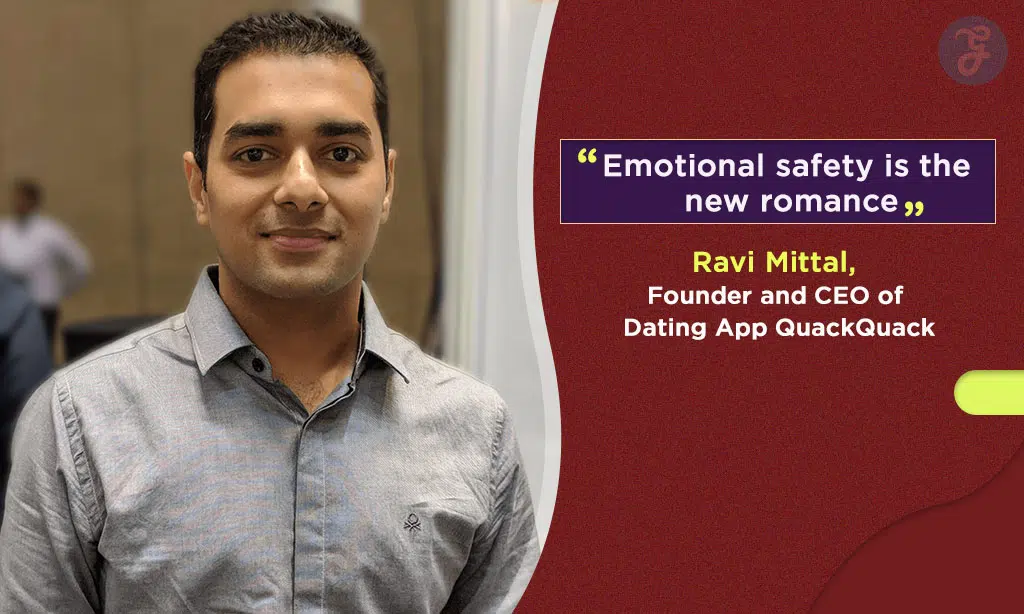
“With layoffs and economic instability, we are seeing two distinct trends in the dating world. First, people are moving away from performative romance, especially when the future is uncertain. They are seeking genuine emotional safety instead. Second, Valentine’s Day is shifting from grand displays and expensive gifts toward consistent effort and simple reassurance.
Moreover, users are increasingly leading with transparency. If they are facing career troubles or relocation plans, they are upfront about it. Many are even addressing financial stress early on to ensure they do not lead on a match without disclosing the entire truth. Vulnerability and the courage to show it have become highly desirable traits. Difficult times filter out incompatible connections more effectively than any other factor.”
Love in the Time of Layoffs: The Friction of Uncertainty
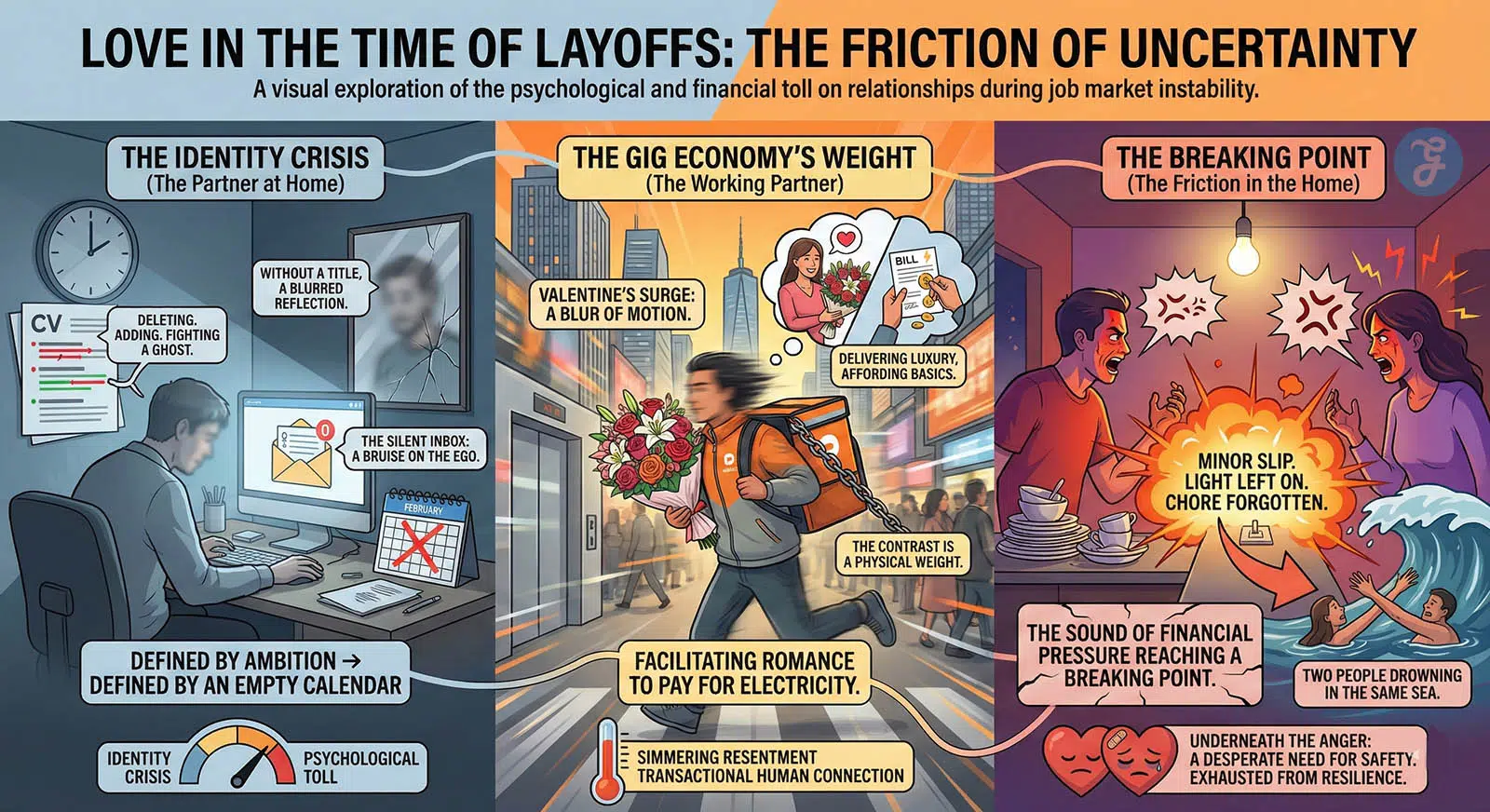
The afternoon sun offers no warmth to those trapped in the job hunt. In flats from London to Indore, the psychological toll begins its slow crawl. One partner sits before a glowing screen, a victim of ‘Agentic Displacement’ where an AI orchestrator now does the work of her entire former PM team. She deletes a line on a CV; she is fighting a ghost.
Outside, the K-shaped reality bites hard: while white-collar roles evaporate into automation, the other partner is a blur of physical motion in the Valentine’s surge, navigating a gig economy that demands more sweat for less ‘surge’ pay. They navigate high-rise elevators with thermal bags. They carry fifty-pound flower arrangements to people who do not see them. The contrast is a physical weight. They are delivering the very luxury they can no longer afford. It is a strange, modern irony. They facilitate the romance of others to pay for their own electricity. A simmering resentment begins to grow. It is not directed at the partner at home. It is directed at a system that turns human connection into a transaction.
By sunset, the friction enters the home. A minor slip occurs. A light is left on. A chore is forgotten. The air catches fire. The argument is loud and sharp. Yet, the words have nothing to do with lightbulbs or dishes. It is the sound of financial pressure reaching a breaking point. It is the terror of a future that feels like a dead end. They are two people drowning in the same sea, accidentally pulling each other down. Underneath the anger is a desperate need for safety. They are exhausted from being resilient. They are tired of being brave. As the psychological toll of unemployment deepens, the resulting emotional distance can sometimes lead to a search for validation outside the partnership, reflecting broader Valentine’s Day and infidelity 2026 trends where financial stress becomes a catalyst for betrayal.
The Redefinition (The “Valentine’s” Moment)
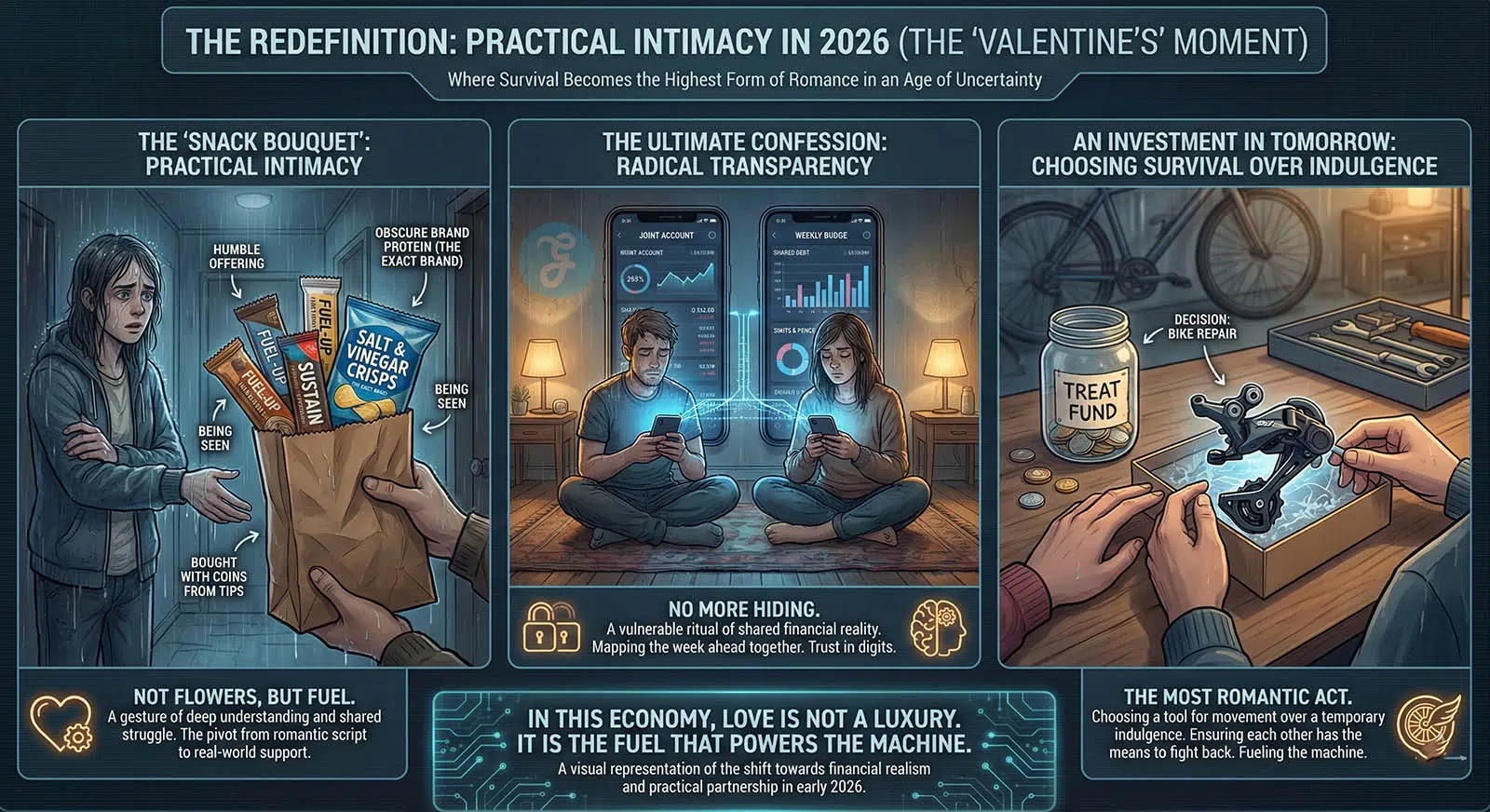
The rain turns the city into a smudge of charcoal, mirroring a global mood where “financial realism” has replaced the traditional romantic script. One partner returns home, soaked to the bone and shivering from the February chill. There are no long-stemmed roses in hand. There is no velvet box. Instead, they pull a crumpled paper bag from a thermal delivery kit. Inside is a “Snack Bouquet.” It is a collection of specific, obscure protein bars and the exact brand of salt-and-vinegar crisps the other partner craves. These were bought with coins earned from tips. It is a humble offering. It is a sign of being seen. This is the pivot toward Practical Intimacy. It is the moment where survival becomes the highest form of romance.
They do not go to a candlelit bistro. They sit on the floor instead. They perform the most intimate act of 2026. They open their banking apps together. The blue light of the screens illuminates their tired faces. They look at the joint account. They look at the numbers without flinching. This is the real Valentine’s Day message. There is no more hiding. There is only transparency. They count their shared life in digits and pence. They map out the week ahead. It is a vulnerable ritual. It is the ultimate confession of trust in an age of uncertainty.
The climax of the evening is a quiet decision. They look at the small “treat fund” sitting in the jar. It was meant for a steak dinner or a bottle of wine. They decide to spend it on a bike repair. They choose a new derailleur over a temporary indulgence. It is the most romantic thing they have ever done. It is not a gift for today. It is an investment in tomorrow. They are choosing to keep each other moving. They are ensuring the other has the tools to fight back. In this economy, love is not a luxury. It is the fuel that powers the machine.
This quiet sacrifice in a rain-slicked flat isn’t just a private struggle; it is a live data point in a global shift toward what 2026 analysts are calling the ‘Practicality Pivot’, a survival-based restructuring of modern romance.
Love by the Numbers
Research from early 2026 confirms that the shift from “splurge” to “substance” is a widespread reality, backed by emerging consumer trends and psychological studies:
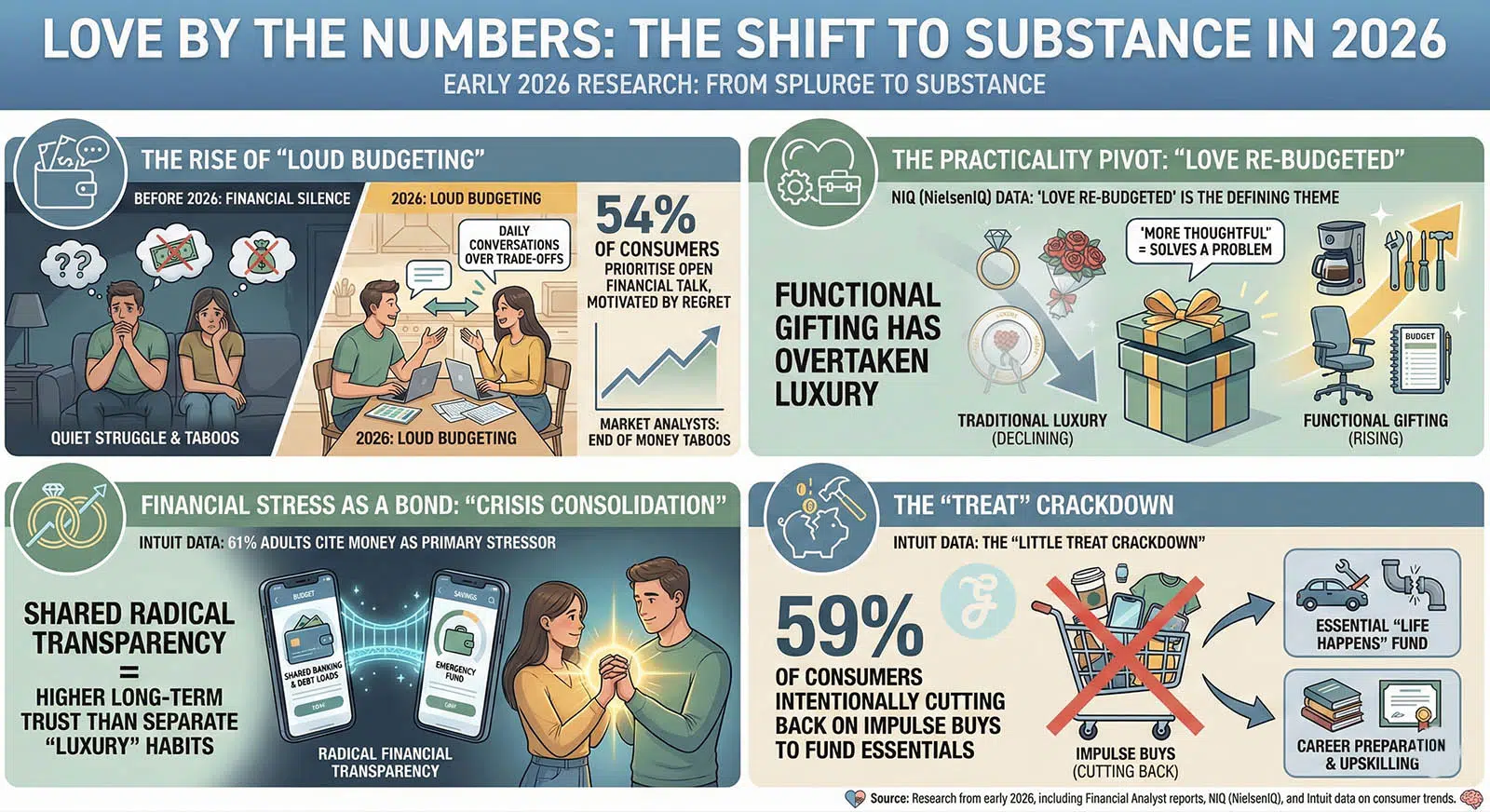
- The Rise of “Loud Budgeting”: Financial analysts note that 2026 has seen the end of money taboos. The “Loud Budgeting” trend has moved into the home, driven by the 54% of consumers who, motivated by financial regrets, are now prioritising open, daily conversations about trade-offs over quiet financial struggle.
- The Practicality Pivot: Market research from NIQ (NielsenIQ) identifies “Love Re-Budgeted” as the defining theme of the season. Functional gifting has overtaken luxury, with couples reporting that practical items, those that solve a problem or reduce daily stress, now feel “more thoughtful” than traditional romantic gestures.
- Financial Stress as a Bond: While Intuit data confirms that 61% of adults identify money as their primary life stressor this year, studies suggest a “Crisis Consolidation” effect. Couples who practice radical financial transparency, sharing banking apps and debt loads, are reporting higher levels of long-term trust than those maintaining separate “luxury” spending habits.
- The “Treat” Crackdown: Further data from Intuit reveals a “Little Treat Crackdown,” showing that 59% of consumers are intentionally cutting back on impulse buys to fund essential “life happens” moments, such as emergency repairs or career preparation.
The Structural Remix: Global Labour Displacement in the Efficiency Era
As of February 2026, the global labour market is navigating a period of intense restructuring, marked by more than 600,000 redundancies recorded worldwide in the first two months of the year. This cycle differs from previous downturns as it is driven by a mandate for “efficiency” and the integration of generative intelligence. Major employers, including Amazon (cutting ~16,000 roles) and Citigroup, have initiated significant reductions specifically designed to eliminate “pandemic era bloat” and flatten management layers.
The technology sector remains a central driver, contributing significantly to a U.S. total of 108,000 job losses in January 2026 alone, the highest January volume since 2009. However, these efficiency measures have now permeated logistics and retail, as firms “right-size” to protect margins. Within this landscape, a trend of “Agentic Displacement” is emerging: 54% of executives now report they expect automation to displace existing roles, with middle management identified as a primary target. Consequently, the market has bifurcated: there is aggressive demand for technical specialists and “AI orchestrators,” while entry level generalist positions have largely stagnated.
The Anthem of the Invisible
The world in 2026 feels heavy. Redundancy notices and shifting gig targets have turned the romantic calendar into a field of landmines. Yet, amidst the digital noise of job boards and the quiet hum of empty bank accounts, a classic sentiment has found a second life. A lo-fi, AI-remixed version of American singer John Denver’s lyrics has become a viral ‘core-memory’ trend on social media, serving as a digital lifeline for those navigating this storm: ‘In times of trouble when you are alone, the memory of love will bring you home.’
This quote is doing the rounds for a reason. It strips away the commercial veneer of the season. When the office keycard stops working and the salary deposit fails, the walls of the ego start to crumble. In that isolation, love is not a luxury. It is a compass. It is the memory of shared strength that guides a person back to their sense of worth.
For the modern couple, “home” is no longer just a physical address with a high rent. Home is the person who looks at you without a job title and still sees a hero. It is the partner who understands that a career gap is just a chapter, not the whole book. This Valentine’s Day, the most viral sentiment isn’t about finding someone to spend money on. It is about remembering who stayed when the money was gone.
Love in the age of layoffs is a gritty, unpolished thing. It is found in the shared silence of a small flat and the resilience of a joint effort. John Denver’s words remind us that even when the system fails, the human connection remains. It is the only thing that cannot be downsized. It is the only thing that truly brings us home.
The New Standard of Love: Inflation-adjusted affection
The evening arrives without fanfare. There is no curated gallery of photos. No staged smiles for an Instagram feed. The choice is made to simply hide out. The world outside may demand a performance of perfection, but inside, the air is thick with the truth. Dinner is an elevated bowl of ramen. It is warm, salty, and sufficient. The ritual of the night is not a romantic toast. It is the steady, quiet work of preparing for a Monday morning interview. They go over talking points. They polish sentences. They build a bridge toward a paycheck with words and patience.
The realisation settles in the quiet spaces between them. In an age of sudden shifts, love is not found in bouquets that wilt by Friday. It is found in the inventory of a shared life. It is the shared logins for streaming services. It is the split bills on the kitchen table. It is the transparency of a joint account. In this climate, they practice an inflation-adjusted affection, where the value of a gesture is measured by its cost to their security rather than its price tag. Above all, it is the resilience to stay in the room when the lights might go out. This is the new standard of devotion. It is a partnership of utility and deep, unshakeable roots.
The final image of the night is a portrait of survival. They are asleep at last, exhausted by the day’s friction. An interview suit hangs on the door, crisp and ready for a new beginning. On the floor, a set of bike tools lies scattered near a fresh repair. These objects are the real valentines of 2026. One represents the hope of a return to the system. The other represents the grit required to navigate the gig economy. Together, they tell the story of a love that does not just exist in spite of uncertainty, but grows because of it.
Note: All names and identifying details in these layoff case studies have been changed to protect the privacy and identity of the individuals involved.