Have you ever wondered why your phone, laptop, or even your car battery seems so hard to recycle? Many of us have a drawer full of old gadgets simply because we don’t know what to do with them. We want the latest tech, but we also worry about the waste it creates. You aren’t alone in this dilemma. These issues point to a much bigger challenge: finding sustainable rare earth solutions that don’t wreck our planet.
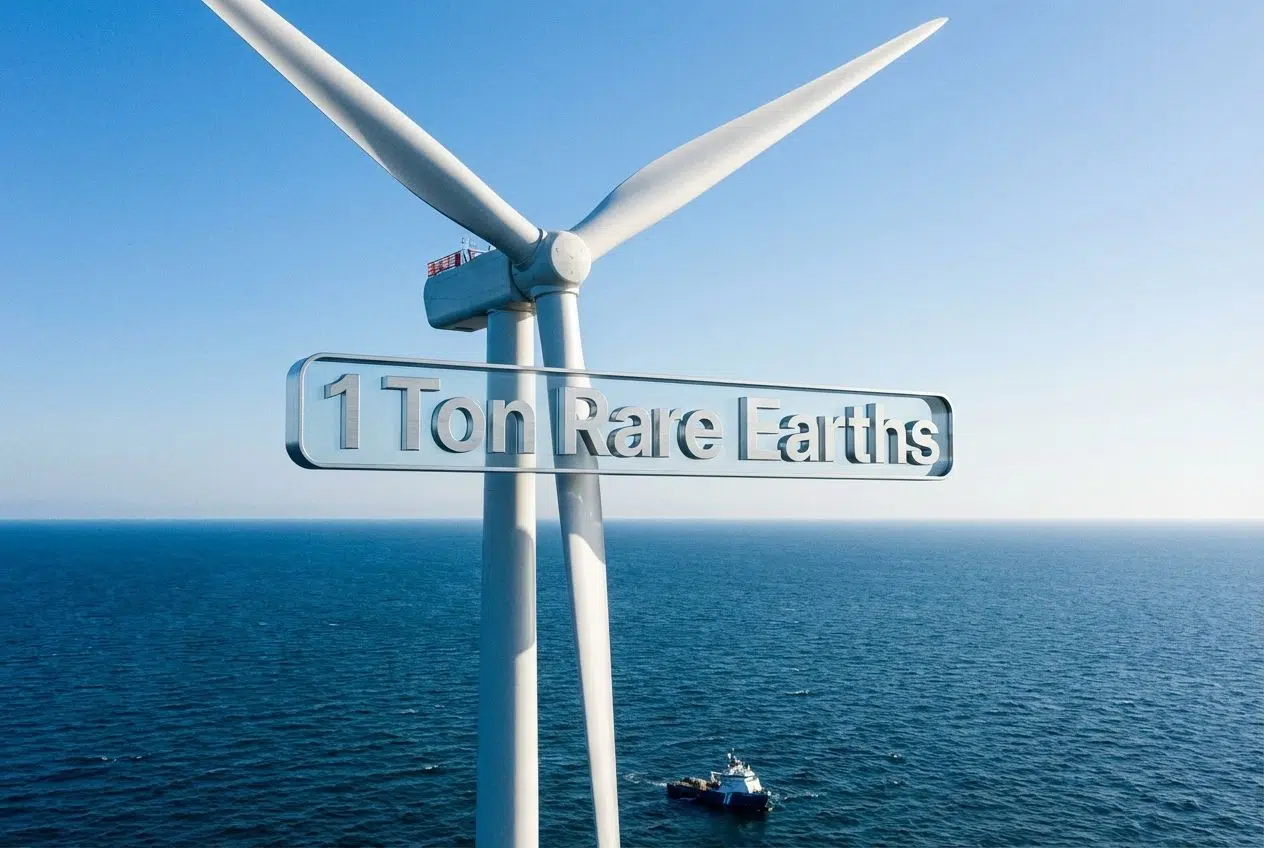
Here is a fact that might stick with you. A single offshore wind turbine can contain up to one ton of rare earth minerals. That puts massive pressure on mining operations and the environment. In this guide, I’ll walk you through exactly what these elements are, why clean energy depends on them, and the new technologies that could finally make our gadgets green.
Curious if a virus or a robot can fix this mineral mess? Stick around, because the answers are more surprising than you might think.
Understanding Rare Earth Minerals
Rare earth minerals are hidden in plain sight, tucked into the devices you use every single hour. These special elements are the secret sauce that keeps our modern world buzzing, from the phone in your pocket to the wind turbines generating your power.
What are rare earth elements?
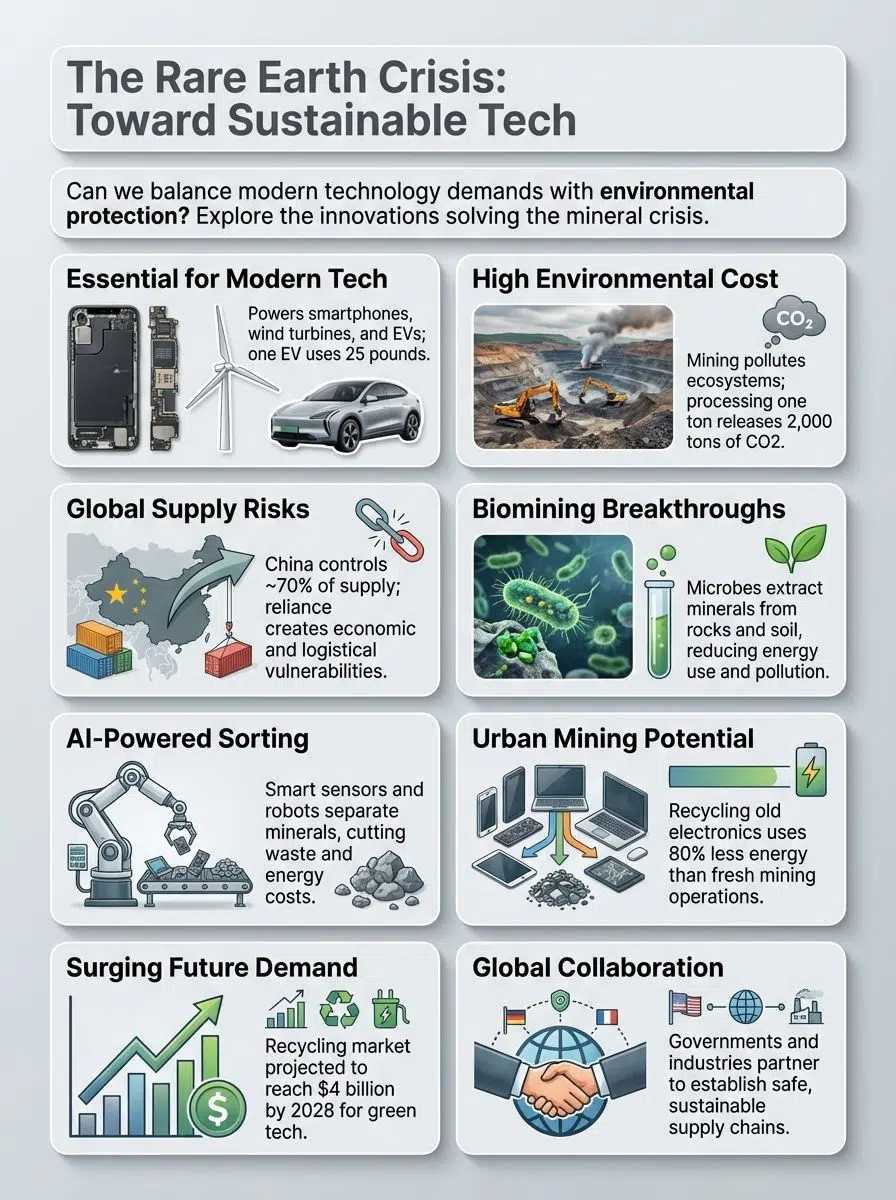
There are 17 rare earth elements (REEs). They have names that sound like they belong in a sci-fi movie, such as neodymium, europium, and dysprosium. While they often look like soft gray metals, their powers are unique.
- Neodymium: Creates the incredibly strong permanent magnets used in electric vehicle (EV) motors and iPhone speakers.
- Europium: Provides the red and blue phosphors that make your flat-screen TV and smartphone display so vibrant.
- Dysprosium: Adds heat resistance to magnets, ensuring your EV motor doesn’t lose power when it gets hot.
Despite the name, they aren’t actually “rare” like gold. They are just hard to find in concentrated clumps. They hide deep in rock layers, mixed with other elements, which makes mining them a bit like trying to extract sugar from a baked cake.
“These tiny metals power big dreams: clean air, smart tech, green cars. But getting them out of the ground is where the trouble begins.”
Their role in modern technology
You can’t have a high-tech life without these minerals. Smartphones rely on them for everything from vibration alerts to the color on the screen. Electric vehicles need them to drive farther on a single charge because rare earth magnets create lighter, more efficient motors.
Even medical tech relies on them. MRI machines use these materials to create the powerful magnetic fields needed to scan your body. From headphones to satellites, almost every piece of modern hardware depends on them. Without a steady supply, or better yet, smarter recycling, our push for cleaner energy could hit a wall.
The Environmental Impact of Rare Earth Mining
We need to talk about the cost of doing business. Rare earth mining can turn green hills into scarred land, and if not managed perfectly, it can poison the water for miles.
Pollution and ecosystem damage
Mining for these minerals is messy. It often involves dousing the earth with chemicals like sulphate and ammonium to separate the metal from the rock. If these chemicals leak, they destroy rivers and streams.
The most famous example is the Bayan Obo mine in China. It is the world’s largest rare earth mine, but it is also known for its massive tailings pond, a toxic lake created by decades of waste discharge. In contrast, the Mountain Pass mine in California (operated by MP Materials) uses a “dry tailings” process to avoid this specific risk, but the industry as a whole still struggles with a heavy environmental footprint.
One specific danger is thorium. This radioactive element is often found alongside rare earths. If miners don’t handle the waste rock carefully, they risk releasing low-level radiation into the soil and air, harming local wildlife and communities.
Energy-intensive extraction processes
Digging these minerals out of the ground is also a power-hungry job. It takes massive amounts of electricity, oil, and water to process the ore. In fact, for every ton of rare earth oxide produced, the process can generate up to 2,000 tons of toxic waste if traditional methods are used.
Factories burn fossil fuels to run the crushers and separators day and night. Dr. Rebecca Williams at the Clean Energy Research Center puts it simply: “Rare earths may be in your phone or electric car battery, but their journey starts with a huge energy bill.” This creates a paradox where building “green” technology starts with a very brown, carbon-heavy process.
Innovations in Sustainable Rare Earth Mining
Fortunately, smart people are fixing these dirty processes. Scientists and engineers are testing fresh ways to get these minerals without wrecking the planet.
Biomining techniques
Imagine using tiny bugs instead of heavy machinery. That is the promise of biomining. Scientists use bacteria or fungi to naturally pull minerals out of rocks. These living helpers eat away at the ore and release the metals into a liquid.
This field is moving fast. In November 2025, researchers at UC Berkeley announced a breakthrough using a genetically engineered virus called a bacteriophage. This virus acts like a “smart sponge,” grabbing specific rare earth metals from water while leaving other materials behind. It works at room temperature, which saves a fortune in energy costs.
Similarly, Purdue University technology is being used by companies like ReElement Technologies in Indiana to refine battery materials using cleaner chromatography methods, proving we can process these metals safely in the US.
Ionic clay extraction methods
In places like southern China and increasingly in Brazil, miners look for “ionic clays.” These soft soils hold rare earth elements loosely, meaning you can wash them out with water and simple chemicals instead of blasting rock.
While easier, this method has historically been dirty because miners would inject chemicals directly into the ground. New techniques developed in 2024 are changing this by using contained leaching tanks that prevent chemicals from seeping into the groundwater. It protects the local water table while still recovering valuable heavy rare earths like terbium.
AI-enabled separation technologies
Sorting rocks used to be slow and inaccurate. Now, Artificial Intelligence is stepping in. AI-powered sensors can scan rocks on a conveyor belt and tell robot arms exactly which ones contain valuable minerals.
Companies like Tomra are leading this charge with sensor-based sorting. By picking out the good rocks early, they save huge amounts of energy that would otherwise be wasted crushing useless stone. These systems learn as they go, making split-second decisions that humans simply can’t match.
| Feature | Traditional Mining | AI-Enhanced Mining |
|---|---|---|
| Sorting Method | Manual or chemical floatation | High-speed optical sensors |
| Waste | High (processes all rock) | Low (discards waste early) |
| Energy Use | High intensity | Reduced by up to 50% |
The Role of Recycling in Addressing the Crisis
We toss away old phones and laptops every day. But hidden inside that junk drawer are tiny bits of rare earth minerals just waiting for a second chance. Recycling is the fastest way to reduce our reliance on new mines.
Recovering rare earths from end-of-life products
Old electronics are essentially “urban mines.” Recovering materials from them is cleaner and often cheaper than digging in the ground.
- Apple’s Daisy Robot: This robot is a dismantling beast. It can strip apart 200 iPhones per hour, separating the tiny magnets and cameras so the minerals inside can be reused. In their 2025 environmental report, Apple claimed that 99% of the rare earths in their batteries now come from recycled sources.
- Redwood Materials: Founded by former Tesla CTO JB Straubel, this company is building a massive recycling hub in Nevada. As of 2025, they recover 95% to 98% of critical minerals (like nickel, cobalt, and lithium) from old EV batteries, feeding them right back into the US supply chain.
- New Tech: Scientists are developing “self-assembling electrolytes” that allow batteries to be broken down easily at the end of their life, solving the safety risks of recycling lithium-ion packs.
- Magnet Recycling: Companies like Noveon Magnetics in Texas are turning old magnets directly into new ones, skipping the energy-intensive refining stage entirely.
Circular mineral harvesting processes
This concept is called the “circular economy.” Instead of a straight line, mine, use, throw away, we create a loop. Companies pull rare earths from used wind turbines and old EVs, clean them up, and put them straight into new products.
This isn’t just a dream; it’s happening now. The European Union has mandated that by 2030, a significant percentage of strategic raw materials must come from recycling. This pushes companies to design products that are easy to take apart from day one.
Reducing reliance on new mining operations
Every ounce of neodymium we recycle is an ounce we don’t have to mine. Recovering rare earths from used products takes about 80 percent less energy than digging them up fresh. It means fewer open pits, less toxic waste, and a smaller carbon footprint for your green tech.
Challenges in Creating a Sustainable Supply Chain
Global demand is skyrocketing, but moving these minerals from a mine to your phone is a logistical nightmare. The roadblocks ahead are real, and they affect everything from price to national security.
Economic and logistical hurdles
Prices for rare earths are a rollercoaster. Because the market is small and controlled by a few players, a single policy change can cause prices to spike. For example, when China restricted the export of gallium and germanium in 2023, the tech world held its breath.
Moving these materials is also tricky. There are very few processing plants outside of Asia. Even if rock is mined in the US, it often has to be shipped across the ocean to be refined, and then shipped back. That adds cost and carbon emissions to every step.
Dependency on specific regions for resources
We need to address the elephant in the room: China controls the board. As of 2025, they refine nearly 90% of the world’s rare earth elements. Even more critically, they control almost 100% of the heavy rare earths (like dysprosium) needed for advanced military and EV tech.
“In December 2023, China banned the export of rare earth processing technology. Then, in late 2025, they added stricter rules for military-linked exports. This is a wake-up call for the rest of the world to build its own factories.”
The US is catching up, with MP Materials producing thousands of tons of concentrate, but we still rely on imports for the separated, final metals. If trade stops, the production of EVs and wind turbines in the West could grind to a halt.
The Future of Rare Earth Minerals in the Energy Transition
Rare earth minerals are the spark for cleaner energy. As we switch from gas to electric, these elements will define how fast we can move.
Role in renewable energy technologies
You can’t build a high-performance wind turbine without them. The permanent magnets in the generator allow the blades to spin efficiently even in low wind. A typical 3-megawatt wind turbine uses roughly one ton of rare earth minerals.
Solar panels rely on them too, though in smaller amounts. As we install more renewable capacity, the demand for these elements will likely double by 2030.
Opportunities for green transportation advancements
The electric car revolution is hungry for magnets. In 2023, over 10 million electric vehicles were sold globally. Most of these use motors packed with neodymium and dysprosium.

However, policy is pushing for change. Under the US Inflation Reduction Act (IRA), to qualify for the full $7,500 tax credit in 2025, an EV’s battery must contain 60% critical minerals sourced from the US or free-trade partners. This requirement jumps to 70% in 2026, forcing carmakers to secure sustainable, local supplies faster than ever.
Innovations and Future Outlook for Rare Metal Recycling
New recycling methods are popping up fast, reshaping how we reuse these precious resources.
Cutting-Edge Recycling Technologies
Smart machines are changing the game. We are seeing “hydrometallurgy” processes that use water-based solutions to dissolve metals without the extreme heat of smelting. This captures more material with less pollution.
In 2025, researchers at Rice University introduced “flash Joule heating,” a technique that zaps e-waste with electricity to instantly separate rare earths. It is incredibly fast and uses no solvents, making it one of the cleanest methods on the horizon.
Environmental and Economic Benefits
Cleaner recycling protects our water and air, but the economic win is just as big. Keeping these materials in the country creates local jobs and keeps cash from flowing overseas.
- Job Creation: New recycling plants in places like Nevada and Texas are hiring thousands of workers.
- Cost Stability: Recycled materials aren’t subject to international trade wars or shipping delays.
- Security: A domestic supply of rare earths means the US military and energy grid aren’t dependent on foreign rivals.
Industry Growth Projections
The business of recycling is booming. Experts predict the global market for rare earth recycling could grow from $1 billion in 2022 to nearly $4 billion by 2028.
With governments offering tax breaks and grants, companies are racing to build the infrastructure. We are moving toward a future where “mining” happens in a factory, not a pit.
Challenges and Future Directions
Despite the progress, the road ahead is bumpy. Recycling is still expensive compared to cheap, dirty mining. Collecting old devices is also a headache; most people just leave them in a drawer because there is no easy curbside pickup for electronics.
Technically, many products aren’t designed to be opened. Glue and proprietary screws make it hard for robots like Daisy to do their job. Governments are starting to demand “Right to Repair” laws and eco-design standards, but it will take time for these changes to trickle down.
We are in a transition period. We know where we need to go, a closed loop where waste is a resource—but we are still building the map to get there.
Collaborative Efforts for a Sustainable Future
Many hands make light work. Solving this crisis requires teamwork between rival countries and competing companies.
Partnerships between governments and industries
The US isn’t acting alone. The Minerals Security Partnership (MSP) brings together the US, Canada, Australia, the EU, and others to fund mining projects that meet high environmental standards. It is like a “NATO for minerals,” ensuring that friendly nations help each other secure supplies.
In February 2026, the US and the UAE signed a new framework to invest jointly in mining and processing projects in Africa and South America. This deal aims to counter other monopolies and spread the production across more countries.
Research and development in sustainable solutions
Innovation is getting a massive cash injection. The US Department of Energy is funding projects through the Critical Materials Institute, looking for substitutes for rare earths. For example, Tesla has announced plans to move toward permanent magnet motors that use zero rare earths in their next-generation platform to avoid these supply chain risks entirely.
From university labs in Berkeley to massive recycling plants in Nevada, the best minds are working to ensure that our high-tech future doesn’t cost the Earth.
Wrapping Up: The Path Toward Sustainable Rare Metal Use
Cleaner mining, better recycling, and smarter supply chains are keeping hope alive. We are finding ways to get the minerals we need without leaving a trail of destruction behind. Old tech is beginning to feed new tech, creating a circle of life for our devices.
This means your old phone might one day help power a wind turbine. If countries continue to invest in safe mining and we all get better at recycling, we can protect the planet while keeping our favorite gadgets running. It is a big challenge, but for the first time in a long time, we have the tools to solve it.