You know that feeling. It’s 6:30 AM. The alarm hasn’t even gone off yet, but your chest is already tight. Your heart is thumping against your ribs like a trapped bird, and a wave of “impending doom” washes over you before you have even opened your eyes. This isn’t just “stress.” It’s a biological ambush. To stop this cycle, you don’t need a pep talk; you need a Vagus Nerve Reset for Morning Anxiety. By mastering the “brake pedal” of your nervous system, you can effectively flip the switch from panic to peace before your feet even hit the floor.
For years, we have been told that anxiety is all in our heads. We are told to “think positive” or “just breathe.” But when you are in the middle of a morning spike, your brain isn’t listening to logic. It’s listening to your body. Specifically, it’s listening to a thick, wandering cable of nerves that runs from your brainstem to your gut.
If you want to stop the spiral, you need a physiological solution. At Editorialge, we believe in mastering the intersection of biology and lifestyle. Today, we are diving deep into the “brake pedal” of your nervous system to show you exactly how to flip the switch from panic to peace.
The Biological Glitch: Vagus Nerve Reset for Morning Anxiety
Before we get to the “how,” we have to understand the “why.” Why do our bodies choose the most peaceful time of day to freak out?
It is crucial to understand that this isn’t a psychological failure, it is a physiological timing error. It comes down to something called the Cortisol Awakening Response (CAR). About 30 minutes after you wake up, your body naturally floods your system with cortisol, the “get up and go” hormone. It’s designed to give you the energy to start your day.
But for many of us, our nervous systems are already “primed” for threat. Maybe it’s work stress, health recovery, or just the weight of a busy life. When that natural cortisol hit meets an overactive nervous system, it’s like throwing gasoline on a smoldering fire. Your body enters “fight or flight” mode before you can even reach for your phone.
This is where the vagus nerve reset for morning anxiety comes in. Think of it as a manual override. You are telling your brain, through your body, that the fire isn’t real.
The Case of the “Hidden” Physical Trigger
For years, Vivek Soni (name changed on request) lived in a loop of morning panic. Every morning at 6:00 AM, his heart would race, and a heavy sense of dread would settle in his stomach.
“Everyone around me, my family, my colleagues, even my close friends, kept telling me it was psychological,” Vivek recalls. “They told me I was just ‘stressed about work’ or that I needed to ‘stop overthinking.’ I started to believe I was mentally weak because no amount of positive thinking could stop the racing heart.”
However, it wasn’t until Vivek consulted with a psychologist that the narrative shifted. Instead of focusing solely on his thoughts, the specialist clarified that his symptoms were a physiological misfire. His body was stuck in a high-alert state, and his morning cortisol spike was triggering a “threat” response that had nothing to do with his actual life.
By shifting his focus to a vagus nerve reset for morning anxiety, Vivek stopped fighting his mind and started managing his biology. “The moment I realized it was a ‘glitch’ in my nervous system and not a flaw in my character, the healing finally began,” he says.
What is the Vagus Nerve, Anyway?
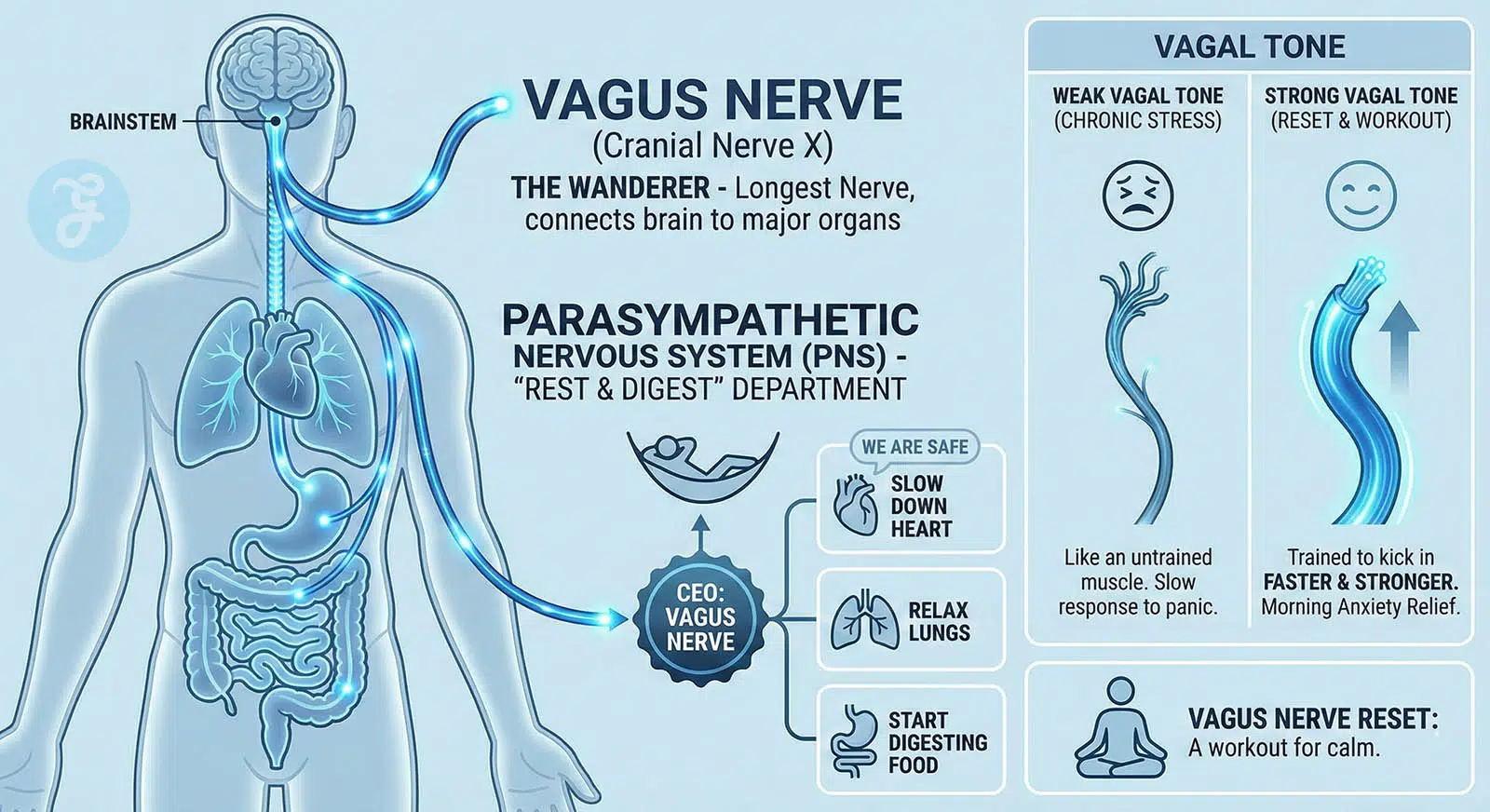
Imagine a high-speed fibre-optic cable. This is the Vagus Nerve (Cranial Nerve X). It is the longest nerve in your body, and its name literally means “The Wanderer” in Latin. It starts in your brainstem and wanders down through your neck, touching your heart, lungs, and every major organ in your abdomen.
The vagus nerve is the CEO of your Parasympathetic Nervous System (PNS), the “Rest and Digest” department. When the vagus nerve is active, it sends a signal that says: “We are safe. Slow down the heart. Relax the lungs. Start digesting food.”
However, when we are chronically stressed, our “Vagal Tone” gets weak. It’s like a muscle that hasn’t been to the gym. A vagus nerve reset for morning anxiety is essentially a workout for that nerve, teaching it to kick in faster and stronger when the morning panic starts to rise.
The Expert Perspective
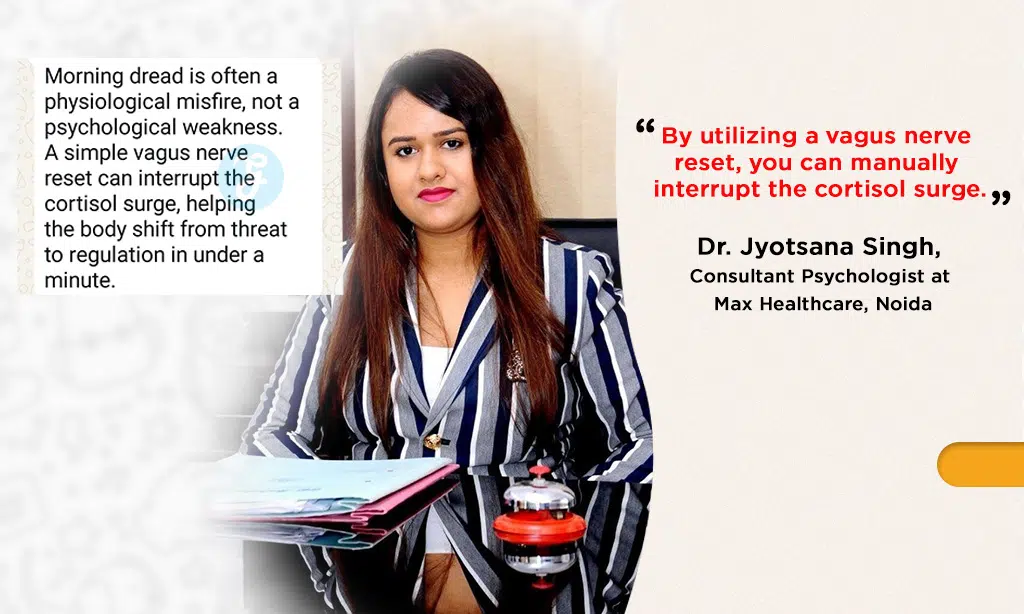
“Morning dread is frequently a physiological misfire rather than a psychological weakness,” explains Dr. Jyotsana Singh, Consultant Psychologist at Max Healthcare, Noida. “By utilizing a vagus nerve reset, you can manually interrupt the cortisol surge. This allows the body to shift from a state of ‘threat’ to one of ‘regulation’ in under sixty seconds.”
The 5 Most Effective Ways to Reset Your Morning
Not all “calming” techniques are created equal. Some take twenty minutes; some take twenty seconds. When you are staring at the ceiling at 7 AM, you need tools that work fast.
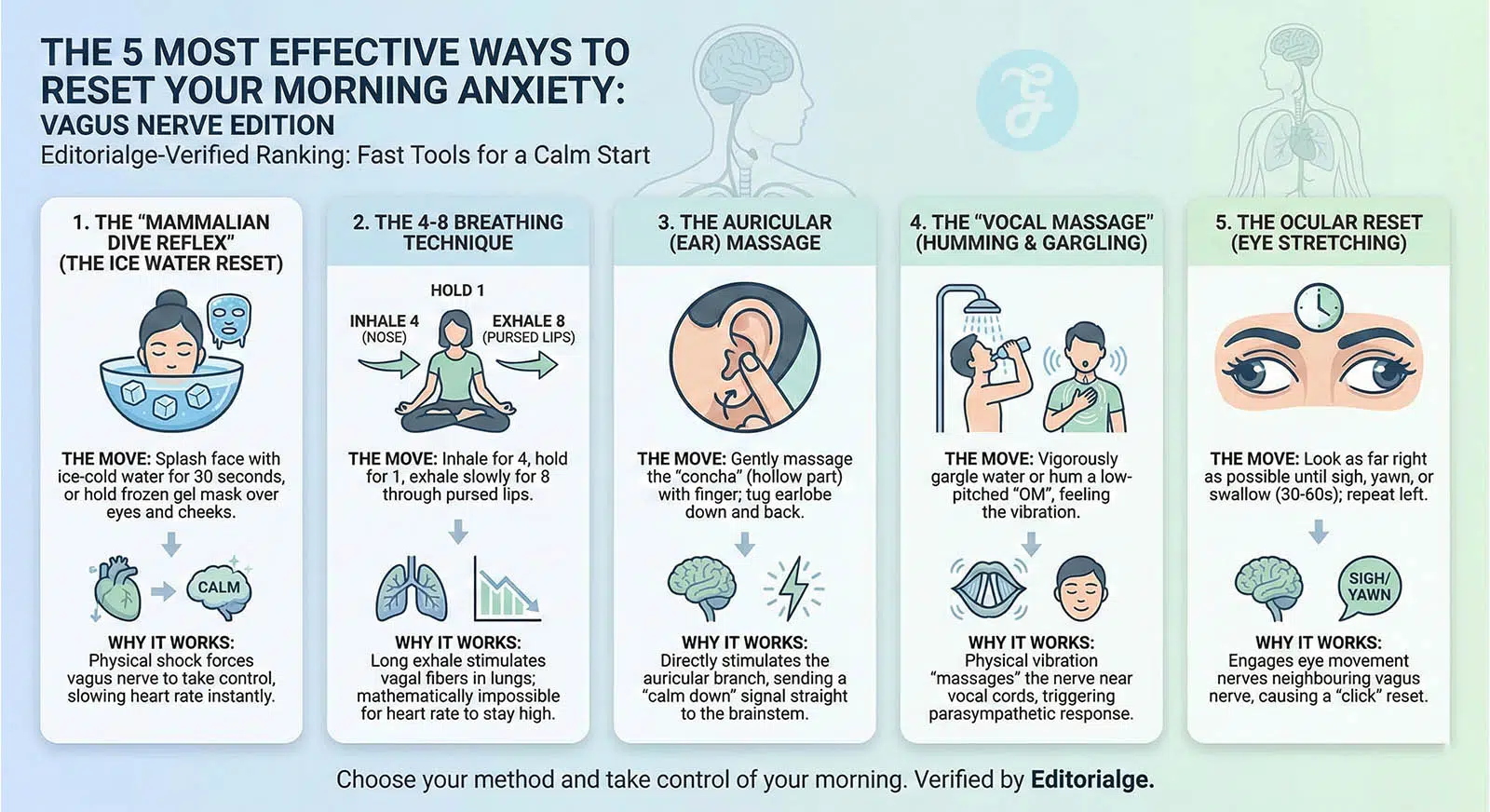
Here is our Editorialge-verified ranking of the best methods for a vagus nerve reset for morning anxiety:
1. The “Mammalian Dive Reflex” (The Ice Water Reset)
This is the gold standard. When your face hits icy water, your body thinks you are diving into a cold lake. To save you, it instantly slows your heart rate and shifts blood flow to the brain and heart.
- The Move: Splash your face with ice-cold water for 30 seconds, or hold a frozen gel mask over your eyes and upper cheeks.
- Why it works: It’s a physical shock that forces the vagus nerve to take control immediately.
2. The 4-8 Breathing Technique
Most people breathe shallowly into their chest when anxious. This actually tells the brain to stay panicked.
- The Move: Inhale through your nose for a count of 4. Hold for 1. Then, exhale through pursed lips (like you are blowing through a straw) for a count of 8.
- Why it works: The long exhale stimulates the vagal fibres in the lungs. It is mathematically impossible for your heart rate to stay high when you exhale twice as long as you inhale.
3. The Auricular (Ear) Massage
Did you know a branch of the vagus nerve is accessible right in your outer ear?
- The Move: Use your index finger to gently massage the “concha”, the hollow part of your ear just above the ear canal. Gently tug your earlobe down and back.
- Why it works: You are directly stimulating the auricular branch of the nerve. It’s subtle, but it sends a “calm down” signal straight to the brainstem.
4. The “Vocal Massage” (Humming and Gargling)
The vagus nerve passes right by your vocal cords and the muscles in the back of your throat.
- The Move: While you are in the shower, gargle water vigorously. If you are still in bed, hum a low-pitched “OM” or your favourite song, feeling the vibration in your chest.
- Why it works: The physical vibration “massages” the nerve. It’s a literal internal vibration that triggers the parasympathetic response.
5. The Ocular Reset (Eye Stretching)
Our eyes are deeply connected to our state of alertness. When we are stressed, we get “tunnel vision.”
- The Move: Keep your head facing forward. Without moving your head, look as far to the right as you can with just your eyes. Hold until you feel a reflexive sigh, yawn, or swallow (usually 30–60 seconds). Repeat on the left.
- Why it works: This engages the nerves that control eye movement, which are neighbours to the vagus nerve in the brainstem. That sigh or yawn is the “click” of the nerve resetting.
How to Build a “Vagus-First” Morning Routine
We believe in giving you more than just facts; we want to provide a repeatable strategy. If you struggle with chronic morning dread, don’t wait for the panic to hit. Build a “Vagus-First” routine to protect your peace before the day begins.
- Wake Up: Before checking your emails (which is a cortisol bomb!), do 2 minutes of 4-8 Breathing.
- The Shift: Perform the Ocular Reset while still lying on your pillow. Wait for that first yawn.
- The Bathroom: Instead of just washing your face, do the Cold Water Splash. Gargle your mouthwash for a full 60 seconds.
- The Soundtrack: Hum or sing while you make your tea or coffee.
By the time you sit down to start your work day, you have performed a multi-layered vagus nerve reset for morning anxiety. You aren’t just “trying to be calm”, you have physically re-tuned your body’s instrument.
The Recovery Connection: A Personal Note
For those of us navigating recovery, whether it’s from surgery, chronic illness, or burnout, morning anxiety can feel even more intense. When the body is healing, the nervous system is often on “high alert.”
Whether you are recovering from a spinal issue (like a CSF leak) or just a high-pressure career, your vagus nerve is your greatest ally. It is the bridge between the physical healing of the body and the emotional peace of the mind. By practicing a vagus nerve reset for morning anxiety, you aren’t just stopping a panic attack; you are creating the internal environment necessary for deep, systemic healing. This healing is powered by a specific biological mechanism that goes beyond just “feeling calm.”
The “Inflammatory Reflex”: Protecting Your Long-Term Health
Beyond immediate relief from morning dread, a vagus nerve reset serves as a powerful defense against systemic inflammation. Modern research into the “Inflammatory Reflex” has revealed that the vagus nerve acts as a real-time monitor for the body’s immune response. When you stimulate the nerve, you aren’t just calming your mind; you are triggering the release of acetylcholine, a neurotransmitter that tells your immune cells to stop pumping out pro-inflammatory cytokines. In the high-stress landscape of 2026, chronic inflammation is the “silent engine” behind burnout, brain fog, and metabolic fatigue. By manually engaging your “biological brake” every morning, you are effectively lowering the baseline of inflammation in your body. This practice transitions your internal environment from a state of “threat” to a state of “repair,” protecting your cardiovascular system and enhancing your long-term physical resilience against the toll of a high-pressure lifestyle.
Decoding HRV: The Metric of Your Nervous System’s Agility
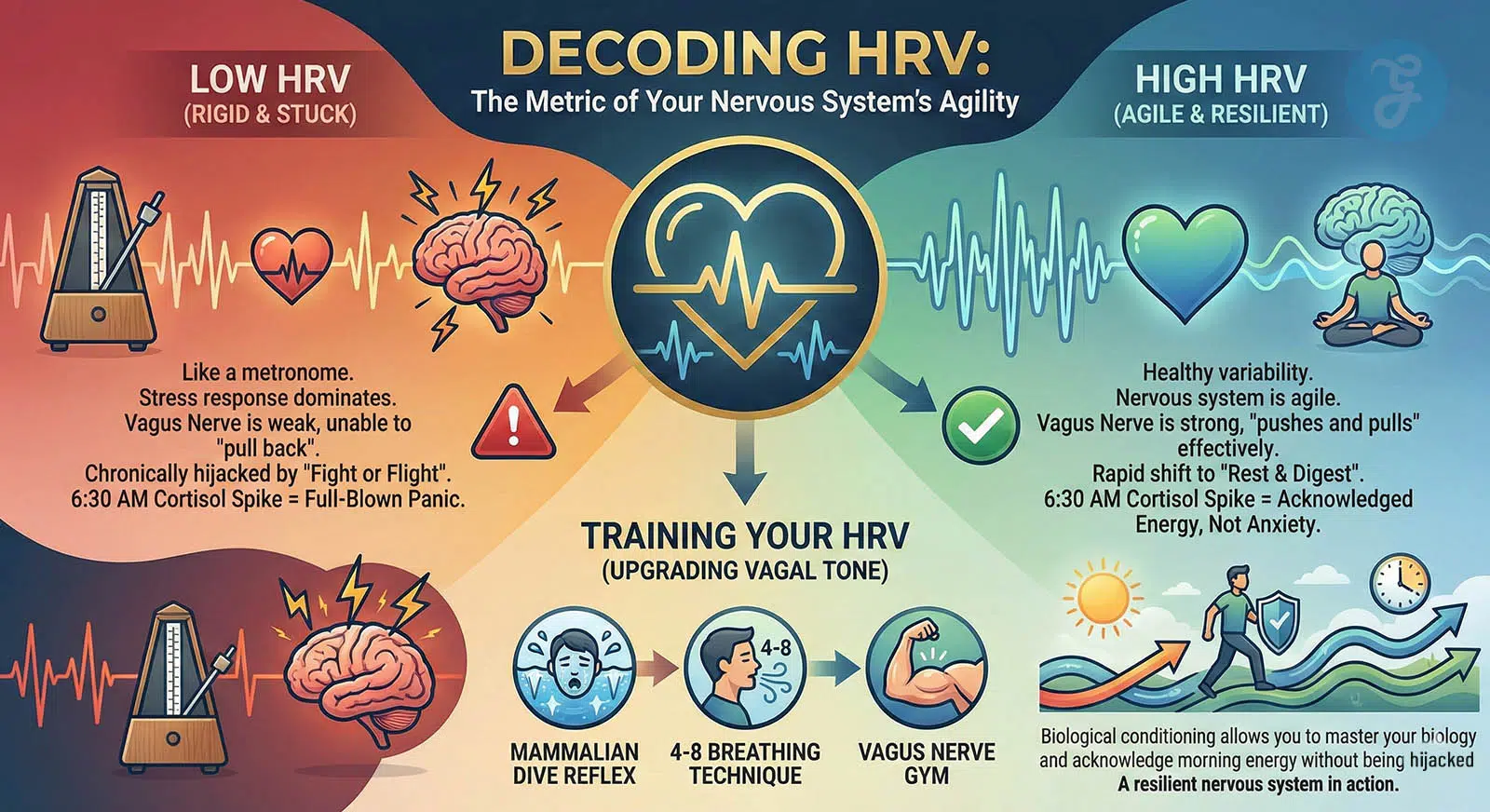
To truly master your biology, you must understand Heart Rate Variability (HRV), the primary gold-standard metric for “Vagal Tone.” Contrary to popular belief, a healthy heart doesn’t beat like a steady metronome; it should have microscopic, healthy fluctuations in the timing between beats. This variability is a direct reflection of your vagus nerve’s ability to “push and pull” against the stress of your environment. A high HRV indicates a nervous system that is agile, resilient, and capable of shifting from high-alert back to “Rest and Digest” in seconds. When you practice tools like the 4-8 Breathing Technique or the Mammalian Dive Reflex, you are essentially “training” your HRV. Over time, this biological conditioning means that the 6:30 AM cortisol spike no longer triggers a full-blown panic response. Instead, your upgraded vagal tone allows you to acknowledge the energy of the morning without being hijacked by the anxiety of the “fight or flight” system.
The 2026 Fact Sheet: Market Data & Statistics
- 74% of Global Professionals: Report experiencing high-intensity cortisol spikes within 15 minutes of waking.
- $66.2 Billion: The projected value of the global workplace wellness market by 2027, with “Vagal Tone” training becoming a top-tier corporate benefit.
- 19–75 ms: The healthy range for Heart Rate Variability (HRV). Consistently low HRV is now recognized as a leading indicator of burnout and systemic inflammation.
- The “Inflammatory Reflex”: Research now proves that stimulating the vagus nerve releases acetylcholine, which actively tells immune cells to stop producing pro-inflammatory cytokines.
The Bottom Line
As we navigate the high-velocity demands of 2026, the “Morning Spike” doesn’t have to be your baseline. We are moving toward a future where Biological Literacy is just as important as professional skill. In fact, we predict that by 2027, “Vagal Health” will move from a wellness hack to a standard medical recommendation for high-performance professionals.
The “Morning Spike” doesn’t have to define your day. You have a “manual override” button built into your anatomy: the wandering, wonderful vagus nerve. By utilizing a reset, you aren’t just managing stress, you are reclaiming your life from a primitive survival mechanism that no longer serves you.
The Final Question
If you have the physiological “source code” to switch off your anxiety in under 60 seconds, why are you still letting an outdated hormonal response dictate your reality? Don’t fight your thoughts. Hack your biology, signal safety to your brain, and watch the world look a little brighter by 9:00 AM.