The era of the “prompt whisperer” ended faster than it began. In early 2024, prompt engineering was hailed as the “job of the future.” By 2026, the reality has shifted: models have become so context-aware and autonomous that “clever phrasing” is now a basic literacy, not a specialized career.
To secure the most high-paying tech skills in today’s market, you must look beyond the chat box. Based on 2026 data from Levels.fyi, Robert Half, and Korn Ferry, the market has pivoted toward builders, gatekeepers, and architects.
The Quick Reality Check: “Prompt Engineering” Didn’t Disappear—The Job Did

Why prompts got commoditized (models improved + prompts automated)
In 2026, the idea of hiring a person solely to write prompts feels as dated as hiring someone solely to type. Two major shifts killed the standalone role:
- Model Evolution: Models like GPT-5.2 and Claude 4 now feature “Deep Context Awareness.” They no longer need perfect instructions; they can ingest entire codebases or 500-page manuscripts and “reason” through intent.
- Prompt Autotuning: Most enterprise AI platforms now include built-in optimizers. When you provide a goal, the system uses an internal loop to draft, test, and refine its own instructions. The “secret sauce” of a perfect prompt is now just an API call away.
The new value is systems, not clever phrasing
The value has moved from the input (the prompt) to the infrastructure (the workflow). Companies aren’t looking for someone to ask an LLM to “act as a marketing expert.” They are looking for engineers who can build a multi-agent system where a marketing agent, a data analyst agent, and a compliance agent work together to launch a campaign with zero human intervention.
What Replaced It: Context Engineering + Workflow Architecture
Context engineering explained
While prompts are dead, Context Engineering is thriving. This isn’t about how you ask, but what the AI knows when it answers. Context engineering involves:
- Grounding: Connecting the LLM to real-time company data.
- Retrieval (RAG): Designing the pipelines that pull the right document at the right time.
- Memory: Giving AI systems “long-term” memory of user preferences.
The enterprise shift: reliability, governance, evaluation
The “Wild West” of 2024 is over. Enterprises in 2026 demand Reliability. They don’t care if a prompt works once; they need it to work 100,000 times without hallucinating or leaking private data. This has birthed the “Evaluation Era,” where the highest-paid pros are those who can mathematically prove an AI system is safe and accurate.
4 High-Paying Tech Skills in 2026 (And the Roles Hiring for Them)
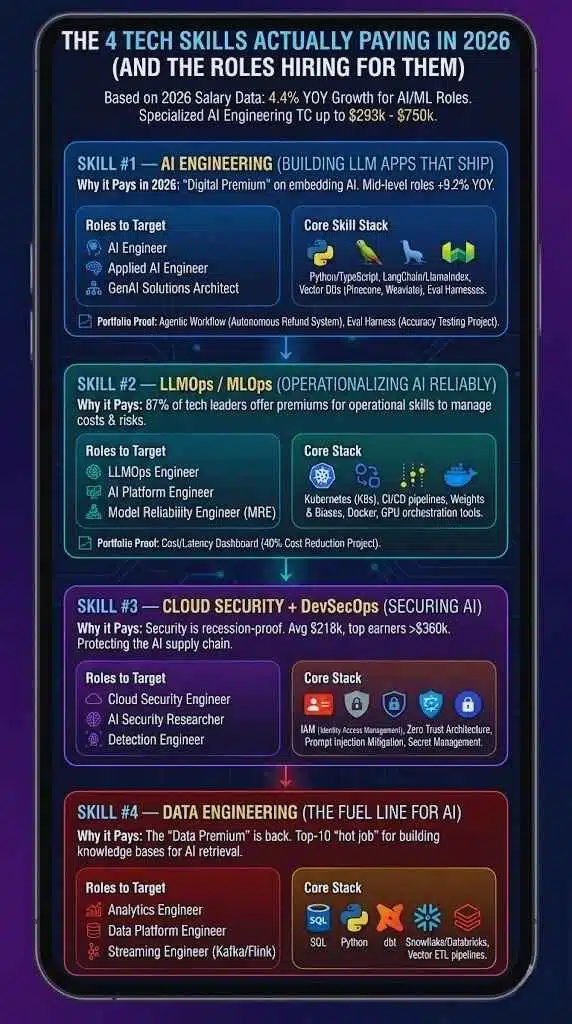
The following skills represent the highest salary growth in the 2026 tech market. We selected these based on Robert Half’s 2026 Salary Guide, which shows a 4.4% YOY growth for AI/ML roles, and Levels.fyi, where specialized AI Engineering roles are seeing total compensation (TC) packages reaching up to $293,000.
Skill #1 — AI Engineering (Building LLM Apps That Ship)
What it is
AI Engineering is the art of taking a raw model and turning it into a functioning product. It involves building RAG (Retrieval-Augmented Generation) pipelines, managing agentic workflows (where the AI can use tools like email or SQL), and setting up guardrails to prevent the model from going off the rails.
Why it pays in 2026
According to 2026 salary data, mid-level AI Engineers are seeing the strongest gains (9.2% YOY), with senior roles at FAANG companies commanding TC packages between $350,000 and $750,000. The “digital premium” is no longer on those who use AI, but on those who embed it into the company’s core software.
Roles to target
- AI Engineer
- Applied AI Engineer
- GenAI Solutions Architect
Core skill stack
- Must-have: Python/TypeScript, API Orchestration (LangChain/LlamaIndex), Vector Databases (Pinecone, Weaviate), Eval Harnesses.
- Nice-to-have: Multimodal integration, latency/cost optimization, basic PyTorch.
Portfolio proof
- Agentic Workflow: A system where an AI identifies a customer complaint, checks the database for their order, and drafts a refund—all autonomously.
- Eval Harness: A public project showing how you tested an LLM’s accuracy across 1,000 edge cases.
Common mistakes that keep people stuck in ‘prompt tinkering’
Focusing on the “perfect response” in a chat window instead of building a repeatable data pipeline or monitoring system to catch failures in production.
Skill #2 — LLMOps / MLOps (Operationalizing AI Reliably)
What it is
If an AI Engineer builds the car, the LLMOps Engineer builds the factory and the highway. It’s a specialized subset of DevOps focused on the “lifecycle” of a model: versioning prompts like code, monitoring for “model drift,” and managing the massive GPU costs associated with AI.
Why it pays
Enterprises are terrified of “Shadow AI” and runaway costs. Robert Half reports that 87% of tech leaders offer premiums for specialized operational skills. In 2026, companies aren’t asking “can we build it?” but “can we maintain it without breaking the bank?”
Roles to target
- LLMOps Engineer
- AI Platform Engineer
- Model Reliability Engineer (MRE)
Core stack
- Kubernetes (K8s), CI/CD pipelines, Weights & Biases (for tracking), Docker, and GPU orchestration tools.
Portfolio proof
- Cost/Latency Dashboard: A project demonstrating how you reduced an LLM’s API costs by 40% through intelligent caching and model routing.
Skill #3 — Cloud Security + DevSecOps (Securing AI)
What it is
With AI comes new vulnerabilities: prompt injection, data poisoning, and model theft. DevSecOps in 2026 is about securing the entire AI supply chain.
Why it pays
Security remains the most recession-proof tech skill. 6figr data shows DevSecOps Engineers in 2026 earn an average of $218,000, with top earners exceeding $360,000. As AI handles more sensitive data, the “Gatekeepers” become the most valuable people in the room.
Roles to target
- Cloud Security Engineer
- AI Security Researcher
- Detection Engineer
Core stack
- IAM (Identity Access Management), Zero Trust Architecture, Prompt Injection Mitigation, and Secret Management.
Skill #4 — Data Engineering (The Fuel Line for AI)
What it is
AI is only as good as the data it’s fed. Data Engineering in 2026 is no longer just about “cleaning spreadsheets”; it’s about building knowledge bases for AI retrieval.
Why it pays
The “Data Premium” is back. Randstad’s 2026 Report highlights Data Engineering as a top-10 “hot job” because, without clean, high-lineage data, Generative AI is useless.
Roles to target
- Analytics Engineer
- Data Platform Engineer
- Streaming Engineer (Kafka/Flink)
Core stack
- SQL, Python, dbt, Snowflake/Databricks, and Vector ETL pipelines.
If You’re ‘A Prompt Engineer’ Today: The Fastest Pivot Path

- 30 Days: Stop using ChatGPT’s web UI. Start using the API. Build a basic Python script that queries a model and evaluates the output using a second “judge” model.
- 60 Days: Learn RAG. Connect your script to a PDF or a database. Deploy it using a basic cloud function (AWS Lambda or Vercel).
- 90 Days: Specialize. Choose one of the four tracks above (Building, Operating, Securing, or Feeding) and build one deep “Case Study” project.
The Cheat Sheet: Skill-to-Role Mapping
| If You Like… | Your 2026 Role is… | Targeted Salary (Mid-Senior) |
| Building products & features | AI Engineer | $180k – $320k |
| Systems, servers, & scaling | LLMOps Engineer | $170k – $290k |
| Breaking things & protecting data | DevSecOps Engineer | $190k – $350k |
| Organizing info & pipelines | Data Engineer | $160k – $280k |
Final Words
In 2026, prompts are table stakes. They are the “Word Processing” of the 2020s—everyone is expected to know how to do it. The real pay multipliers are Engineering, Operations, Security, and Data. Don’t be the person who knows how to talk to the machine; be the person who knows how the machine is built, secured, and fueled.