AI Marketing Strategy is the foundation of modern digital growth in 2026, because AI now shapes how people discover brands, evaluate options, and decide what to buy. A few years ago, marketers could treat AI as an extra tool. Today, it is woven into search results, social feeds, ad platforms, analytics dashboards, and customer messaging. That does not mean “everything is automated.”
It means your strategy must be designed for a world where algorithms and assistants influence what people see first, what they trust, and which brands feel credible before a click ever happens.
Quick Start: The AI Era Digital Strategy In 10 Minutes
If you only remember one thing from this article, remember this: AI is changing how people find you, not why they buy. People still buy from brands they trust, that feel relevant, and that make the next step easy.
To build a modern AI marketing strategy, you need five pieces working together.
- Tighten your positioning so your message is instantly clear.
- Design your content like a knowledge system using pillar pages and clusters.
- Structure content for answer engines so it can be summarized accurately and quickly.
- Build distribution beyond search using short-form video, creators, and community, so you are not dependent on one channel.
- Measure performance with business metrics and testing discipline because perfect attribution is no longer realistic.
If you do those five things consistently, you will outperform teams that only “use AI tools” to publish more content. The AI era rewards strategy, clarity, and proof, not volume.
The 2026 Reality: Marketing Is Now AI-Mediated
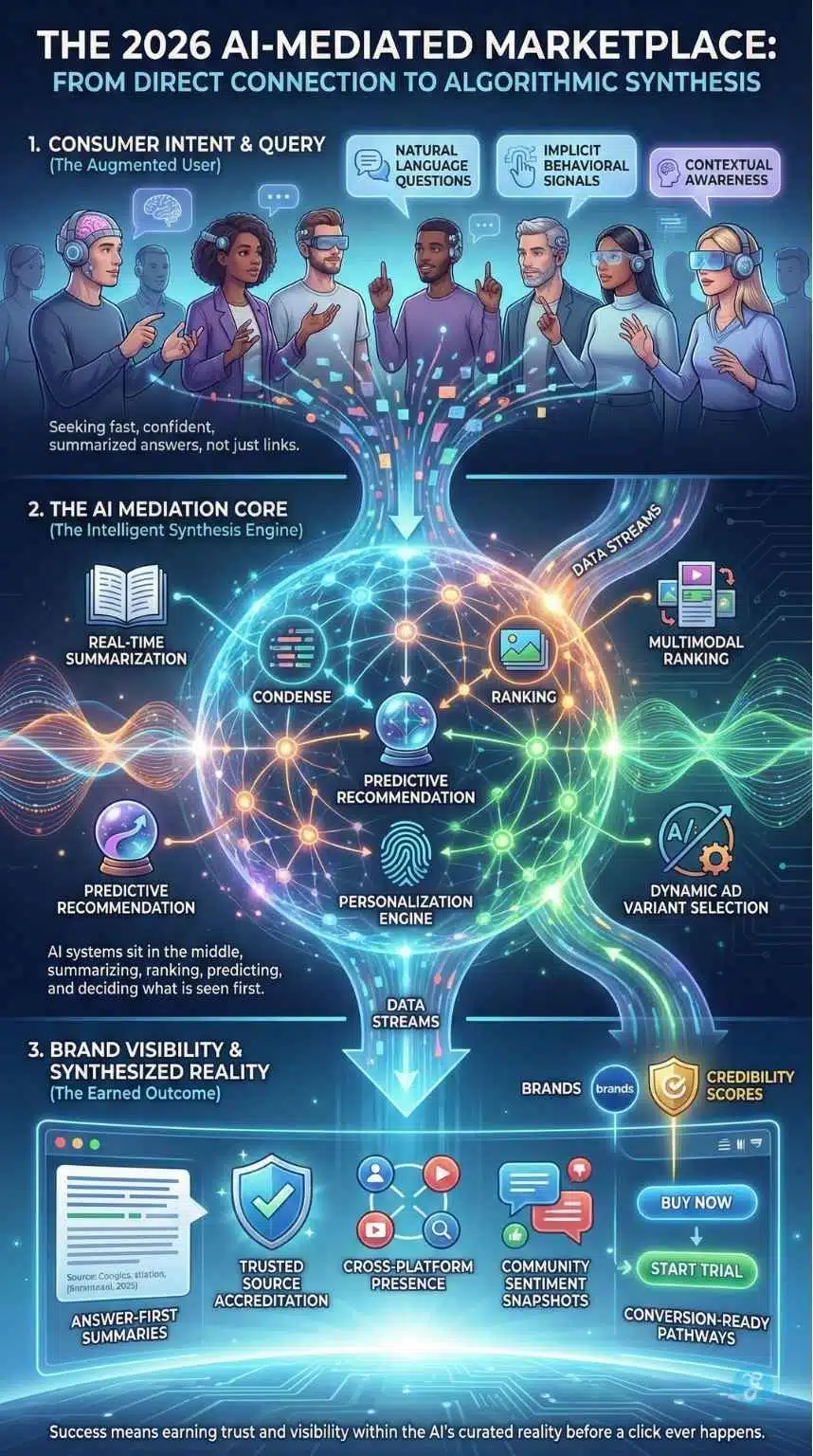
The simplest way to understand digital strategy in 2026 is this: you are no longer speaking directly to your audience in many of the moments that matter. AI systems sit in the middle. They summarize. They rank. They recommend. They predict what a person will watch next. They decide which ad variant gets more spend. They personalize which email is sent. Even if your brand is excellent, you can lose attention if your strategy is not built for this new layer.
The shift is not only technical. It is behavioral. People increasingly want fast answers and confident guidance. When they search, they often see summaries and recommendations immediately. When they scroll, platforms serve content based on predicted interest, not chronological order. When they shop, marketplaces and comparison engines influence what “best” means. This changes the marketer’s job from “drive traffic” to something broader and more durable: earn visibility, earn trust, and earn conversion across multiple paths.
What Changed In Search [Answer-First Experiences And Zero-Click Behavior]
Search has become more conversational, more summary-driven, and more competitive. Users ask full questions. They expect direct explanations. And they often get those explanations without needing to click through.
This does not kill SEO. It changes what SEO is for. Your content must still be discoverable, crawlable, and relevant. But it also needs to be structured and written in a way that AI systems can interpret correctly and confidently. If your page is unclear, generic, or poorly organized, it becomes harder for both people and machines to trust it.
This is why the modern zero-click SEO strategy has two parallel goals: traditional visibility and answer visibility. Ranking matters, but being “the source” that gets summarized and referenced can matter just as much.
What Changed In Content [Abundance And The Trust Problem]
The internet is now flooded with content that looks polished but says very little. AI can generate the shape of an article quickly, but the shape is not the value. The value is in specificity, accuracy, experience, clarity, and proof.
In 2026, readers are more skeptical, not less. They want to know, “Is this real?” and “Will this work for my situation?” That means your content must do more than explain. It must help readers make decisions. It must show how to act. And it must feel like it was created by people who understand the problem deeply.
A pillar page has a special role here. It becomes your “home base” of authority. When it is done correctly, it feels less like a blog post and more like a guidebook that readers can return to.
What Changed In Ads [More Automation, Less Perfect Tracking]
Paid platforms have become more automated, and that is generally good for speed. But automation without strategy can quietly burn budget. At the same time, privacy changes and signal loss make it harder to measure performance with old-school certainty.
So you need a modern approach: lean into automation for efficiency, but use strong guardrails, testing discipline, and business-based measurement so the system optimizes for profit, not just cheap conversions.
The New Funnel: From Traffic To Trusted Presence
In 2026, the funnel is no longer a straight line from search to click to purchase. It behaves more like a web. People discover you in one place, validate you somewhere else, and convert later through a different channel. Many conversions now come after several “invisible” touches, including AI summaries, creator mentions, community conversations, and branded searches.
A modern funnel has five stages, but the stages overlap more than they used to. Discovery is where you first appear in search summaries, social feeds, short videos, and recommendations. Evaluation is where people look for proof, comparisons, experiences, and community sentiment. Conversion is the moment you make the next step easy through landing pages, checkout, calls, demos, or messaging. Retention happens when you personalize value and build a habit through lifecycle messaging and community. Advocacy happens when customers create content, refer friends, or become repeat buyers who defend your brand in public conversations.
The strategic shift is simple: you still want clicks, but you cannot depend on them. Your brand must become easy to recognize, easy to trust, and easy to choose—across multiple platforms and “answer-first” environments.
The AI Era Strategy Stack [A Playbook You Can Reuse]
A strong digital strategy in 2026 is not a checklist of tactics. It is a stack, layers that work together. When one layer is weak, the rest become expensive and unstable. When the stack is strong, marketing becomes calmer, more predictable, and easier to scale.
Here is the stack you can use as the backbone of your pillar and as the logic behind your cluster system.
Positioning And Offer Clarity
Positioning has always mattered, but AI makes it unavoidable. When everyone can publish content, run ads, and create visuals quickly, being “similar to everyone else” becomes the fastest path to invisibility.
A practical positioning approach starts with clarity about your best-fit customer. Not “anyone who needs this.” Not “small businesses.” Not “busy parents.” You want a clear segment with a clear pain, a clear desire, and a clear reason to choose you.
Then you tighten your offer until it is easy to explain. The more complicated your value, the harder it is for AI-driven systems and fast-moving audiences to understand. In 2026, clarity is a growth advantage.
Think of positioning as your filter. It determines which topics you prioritize, what tone you use, what kind of proof you show, and which channels deserve your attention. A good offer also shapes conversion. If your landing page is not obvious, your ads and content have to work too hard.
Data And Privacy Foundation [GDPR/CCPA Mindset Without Legal Jargon]
In the AI era, data helps you personalize, measure, and improve. But “collect everything” is no longer smart, and in many cases, it is risky.
A modern privacy-first foundation is built around three principles: transparency, control, and restraint. Transparency means you tell people why you collect data and what they get in return. Control means they can change preferences or opt out without friction. Restraint means you do ethical data collection for marketing and stop there.
This matters strategically because your best marketing channels in 2026 are often owned or semi-owned: email, SMS, community, customer portals, subscriptions, loyalty programs. Those channels work better when your data is clean and permission-based.
Content System [Pillar + Clusters + Ongoing Updates]
Content is not a one-time project anymore. It is a living system. Pillar strategy works because it organizes your expertise into a structure that both readers and search engines can understand. Your pillar page is the master guide. Your clusters are focused on deep dives. Each cluster answers a specific intent better than a general pillar can.
In 2026, the main benefit of this model is topical authority and coherence. When your content is organized into a tight network, your site looks like a knowledge source rather than a random collection of posts.
The second benefit is maintenance. Instead of publishing endless new articles, you refresh and strengthen the core. That is how you remain relevant when AI and platforms change quickly.
Distribution System [Search, Social, Creators, Community, Email]
Distribution is the part most marketers underbuild. They publish content and hope traffic arrives. In 2026, hope is not a strategy.
Distribution is how you consistently put content in front of the right people. That includes AI-era SEO and AEO, but it also includes platforms where attention is actively flowing: short-form video, creator ecosystems, podcast advertising, and communities.
The smartest teams do not try to win everywhere. They choose a few channels where their message fits, then repurpose intelligently so every piece of content does more work.
Paid Growth System [Programmatic + Testing Discipline]
Paid growth is still one of the fastest ways to scale. But it works best when it amplifies something that already converts: a clear offer, credible proof, strong creative, and neuromarketing for a landing page that matches intent.
In the AI era, paid platforms are more “black box,” which makes testing discipline more important. Your job is to feed the system good inputs and evaluate results using business metrics, not only what the platform reports.
Measurement System [Reality-Based Metrics In A Privacy-First World]
Measurement is now a blend of direct tracking and smart inference. You will rarely get perfect attribution across all channels. So you build a measurement stack that includes conversion tracking where possible, CRM-based cohort analysis, and incrementality thinking.
The goal is to answer one question clearly: Are we growing profitably?
To make this easier for readers, you can use a simple table that shows how measurement has evolved.
| Area | Old Approach | 2026 Approach | Why It Matters |
| Attribution | Last-click heavy | Blended + incrementality | Platforms over-credit themselves |
| Optimization | Channel-by-channel | System-wide outcomes | Channels influence each other |
| Reporting | Weekly dashboards | Decision dashboards + experiments | More clarity, less noise |
| Tracking | Cookie-first | Privacy-first + server-side where possible | Signal loss is real |
| Success Metric | CTR/ROAS | CAC, LTV, retention, profit | Business wins, not vanity wins |
AEO And AI Search Visibility: How To Become The Answer
AEO is one of the most practical upgrades to modern SEO. If SEO helps you get discovered, AEO helps you get understood and selected in answer-first environments.
You do not need to chase every new buzzword. You need to write and structure content so it performs well in the way people actually consume information now.
What AEO Means In 2026
AEO means your content is designed to answer questions in a clean, confident way. It prioritizes comprehension. It reduces ambiguity. It uses structure so both humans and machines can extract meaning quickly.
In real content terms, it looks like:
- A direct answer near the top of a section
- Headings that match real questions
- Short, readable paragraphs
- Clear steps and checklists
- Definitions that do not drift
AEO works especially well when your article is a pillar because pillar pages cover many subtopics. Without an AEO structure, a long pillar can feel messy. With the AEO structure, it feels like a guided tour.
The “Answer-First” Content Pattern
To keep this readable and high-performing, use a simple rule inside each major section: summarize first, then expand.
For example, if a section is about privacy-first personalization, open with two to four sentences that explain the concept and why it matters. Then expand into practical steps and examples. This is friendly for readers, good for skimmers, and much easier for AI systems to summarize accurately.
Structuring Content For AI Features Without Making It Robotic
You can keep a natural tone while still being structured. You do it by writing like a teacher, not like a textbook.
Use short paragraphs. Explain one idea at a time. Connect ideas with clear transitions. When you introduce a term, define it in plain language. When you give advice, include a “why.” When there are tradeoffs, say them out loud. It’s like SEO in a post-ChatGPT world, which involves generative engine optimization (GEO) strategy.
Pillar Content Strategy 2026: Building Topical Authority That AI Trusts
Your pillar page should be the “central hub” that makes your cluster topics feel inevitable. A reader should land on this page and think, “This is the guide.” Then each cluster should feel like the next chapter.
Hub-And-Spoke Internal Linking Blueprint
A clean pillar-and-cluster system has three jobs.
- It helps readers navigate. A pillar page is long, and people want shortcuts. Internal links act like signposts: “If you care about this part, go deeper here.”
- It helps search engines and AI systems understand your site. When your internal links are consistent, the relationship between topics becomes clear.
- It helps your site avoid fragmentation. Without a pillar strategy, you can publish dozens of posts that compete with each other. With a pillar strategy, every page has a role.
A strong internal linking pattern for your topic can work like this: the pillar links to all twelve clusters, and each cluster links back to the pillar plus a few related clusters. Over time, you can add supporting sub-clusters, but only after the primary cluster network is stable.
Content Refresh Rules [The Hidden Advantage In 2026]
In 2026, “publishing more” is often less effective than “improving what already ranks and converts.”
A refresh strategy typically includes:
- Updating sections where platforms changed
- Improving clarity and structure for answer-first experiences
- Adding new examples and proof layers
- Strengthening internal links
- Improving readability and scannability
A pillar page should not be a one-and-done post. It should evolve as the market evolves.
Proof Layers That Make Your Content Hard To Replace
Your best defense against generic content is proof. It can be practical and simple. It can be a framework that readers can apply. Or, a workflow you use internally. It can be a “common mistakes” section that feels real. It can be a table that makes decisions easier. These are the parts that AI-written articles often miss.
This is why pillar content works: you are not only ranking. You are building a reputation.
Build A Content Moat: What AI-Written Pages Usually Can’t Copy
Most AI-generated marketing articles fail in one predictable way. They explain ideas, but they rarely provide decision-grade usefulness. They do not show tradeoffs, they do not show real constraints, and they do not provide assets a reader can apply immediately.
A pillar page becomes significantly more powerful when it includes a “content moat.” A content moat is a set of elements that make your page hard to replace because the value is not just wording—it is structure, clarity, and utility. Examples include a clear framework that the reader can use to plan their strategy, mini templates they can copy into their workflow, and realistic examples that reflect the messy reality of marketing.
One of the best moats you can add is a simple operating model that readers can repeat. For example, when you introduce AEO, you can show a repeatable section pattern: define the question, answer it in two to four sentences, then expand with steps, examples, and a quick checklist. This teaches the reader how to create better content, not just what to think about.
Another strong moat is proof-based specificity. Instead of saying “use video,” explain what the first 30 days of video output should look like and what a reasonable measurement approach is. Instead of saying “personalize,” explain exactly which lifecycle moments to personalize first and why. Readers trust content that sounds like it has been practiced.
When your pillar includes a content moat, it is more likely to earn shares, return visits, and internal links—signals that matter even more in an AI-saturated content environment.
The Modern Content Engine: Video, UGC, Creators, And Community
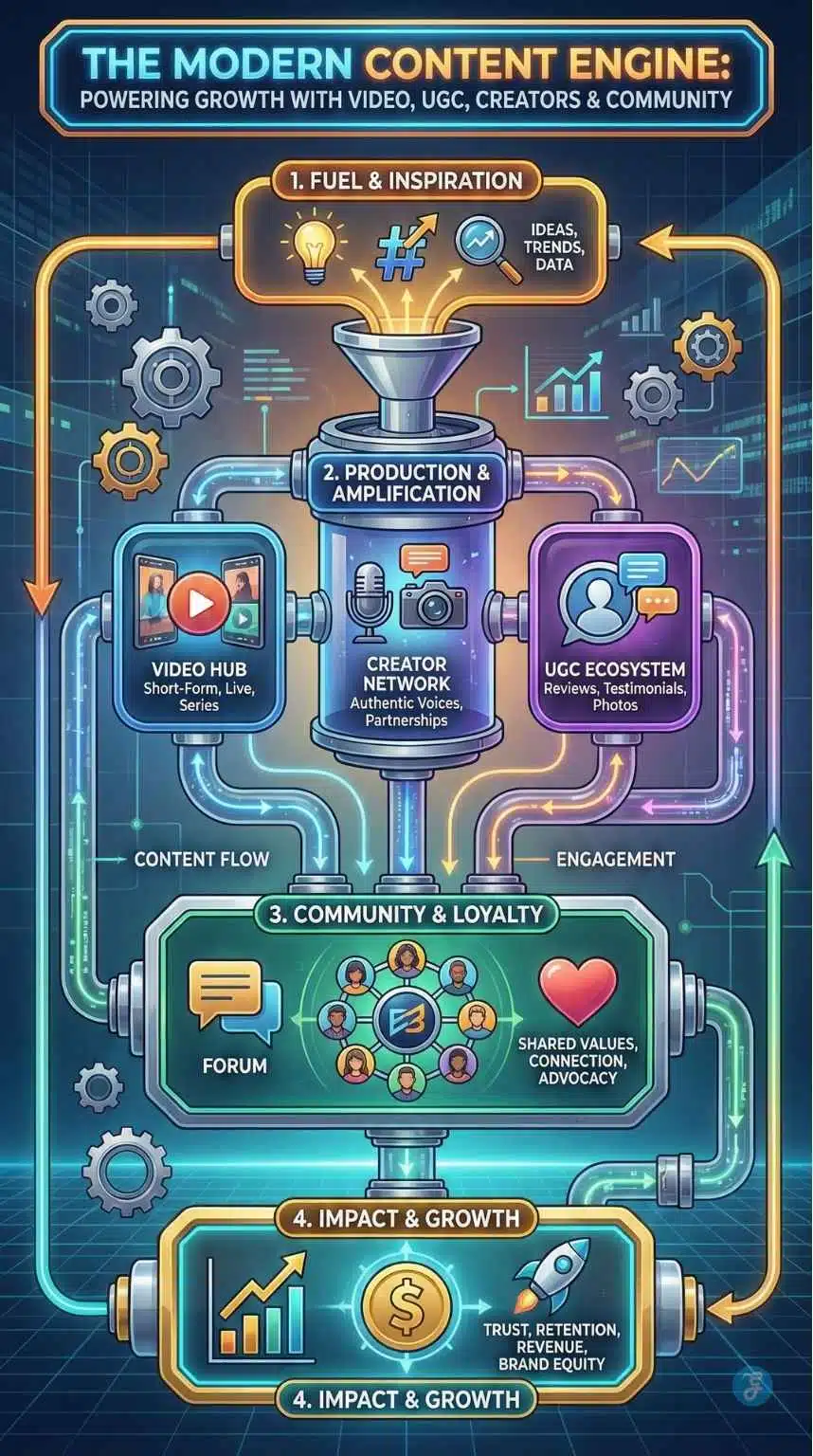
If you build a pillar page without a content engine, you will always be dependent on search. In 2026, you want both: search visibility and ongoing demand creation.
Short-Form Video As A Discovery Layer
Short-form content has become one of the strongest ways to reach new audiences quickly. It is fast to consume, easy to share, and perfectly aligned with how people learn on mobile.
But the goal is not to “go viral.” The goal is to create consistent visibility with content that matches your positioning.
A simple way to turn this pillar into a short-form engine is to treat each major section as a mini-series. One series can be “AI search is answer-first.” Another can be “privacy-first personalization.” Another can be “programmatic guardrails.” Each cluster topic can become its own video arc later.
Short-form video marketing works best when it has a strong hook and a clear payoff. In 2026, audiences are trained to decide in seconds whether content is worth attention. If your first line is vague, you lose.
UGC Creators And Micro-Niche Influencers As Trust Infrastructure
Creator marketing has matured. Brands are shifting away from “big names for awareness” toward smaller, niche creators who feel credible and close to the audience.
UGC creators are not always influencers with huge followings. Micro-influencer marketing strategy is different. Many are skilled content makers who can create product-in-context videos that look native and believable. They help brands produce a steady flow of creative assets for ads, social, and landing pages.
The biggest advantage here is trust. People trust faces, stories, and real usage. They are tired of perfect studio content that feels disconnected from real life. In 2026, “real” wins.
This fits your pillar theme because AI increases content supply, which makes authentic proof even more valuable. Creators and UGC are proof at scale. It’s like the brand marketing shift and the future of battle between UGC creators vs models.
Community-Led Growth Beyond Traditional Social Groups
Communities are becoming a bigger part of the growth stack, especially for brands that want retention, loyalty, and feedback loops.
Why? Because communities create “owned attention.” You are not fighting algorithms as much. You are building relationships and repeat engagement.
Discord and Slack communities work well when they are built around a real job-to-be-done. Some communities are for education. Some are for support. Some are for networking. The strongest ones are not built around the brand. They are built around the member.
Community can also support your pillar strategy. Your pillar becomes a shared resource. Cluster posts become weekly discussion topics. Member questions become future content ideas. The community-led growth strategy starts feeding itself.
Privacy-First Personalization: Growth Without Creepy Tracking
Personalization is one of the most overhyped ideas in marketing, mostly because people interpret it as “use more data.” In 2026, the smarter definition is simpler: personalization means being relevant and timely while respecting boundaries.
Ethical Data Collection That Still Converts
Ethical data collection starts with respect and value exchange. People will share information when they believe it benefits them.
This is why tools like quizzes, onboarding surveys, preference centers, and downloadable resources work well. They make the exchange obvious. They also produce cleaner data because users are self-identifying their needs and interests.
The practical win here is segmentation. When you segment based on real preferences, your messaging becomes more relevant. That improves conversion and reduces unsubscribes.
Hyper-Personalization Workflows That Feel Human
Using a hyper-personalization strategy does not require complicated AI systems to start. It requires a clear journey. A simple journey might look like this: a user enters through a topic, you send them the next most helpful resource, you guide them toward a clear outcome, and you follow up based on what they engage with.
In practice, the most effective personalization focuses on:
- Onboarding
- Activation
- Re-engagement
- Retention
- Cross-sell based on real usage
It is less about “Hi, we know you live in this neighborhood” and more about “Based on what you asked for, here is the next step.”
Consent And Preference As Part Of Customer Experience
In 2026, permission is brand value. A preference center is not a compliance checkbox. It is a trust-building tool. When people can choose what they receive, they stay longer. When they feel trapped, they leave.
Paid Growth In The AI Era: Programmatic Without Waste
Paid marketing can still scale fast. But the rules have changed. You cannot rely only on platform reporting. You need guardrails, testing, and a measurement approach that reflects reality. Overall, understand the concept of programmatic advertising strategy and stop wasting your budget.
Where AI Helps
AI helps most when you already have:
- A clear conversion event
- Strong creative variety
- A landing page that matches intent
- Enough signal for optimization
In that situation, automated bidding and placement can improve efficiency.
Where AI Hurts
AI hurts when you give it weak inputs. If your creative is generic, your tracking is noisy, or your offer is unclear, the system may optimize for cheap conversions rather than valuable customers. You can feel like results are improving while profitability falls.
Testing Discipline And Incrementality Thinking
A modern approach uses testing as the engine. You test hooks, formats, and angles. You log the results. You keep winners. You replace losers. You avoid constant random changes that make learning impossible.
Incrementality thinking is also essential. You ask: what is truly incremental, and what would have happened anyway? This prevents you from overvaluing channels that are good at taking credit.
Conversational Discovery: Voice, Assistants, And Multi-Platform Search
Search is no longer one place. Many buyers discover through:
- Voice assistants
- YouTube search
- Social search
- Community discussions
- Podcasts
- AI chat interfaces
Voice Search Optimization In Plain Language
Voice search queries sound like people talking. They are longer and more specific. They often include context and intent. For voice search optimization and conversational discovery, your content should include:
- Question-based headings
- Short, direct answers
- Natural phrasing
- FAQ blocks that mirror real conversations
This is another reason a pillar page works well. It covers many angles, which increases the chance that a spoken query matches a section on the page.
The Operating System: Team, Tools, Governance, And QA
A strategy is only as good as your ability to execute it consistently.
AI speeds up production, but speed without quality creates noise. The brands that win in 2026 are not the ones who publish the most. They are the ones who publish with clarity, proof, and consistency.
Human-In-The-Loop Standards That Protect Trust
Human-in-the-loop is not about distrust of AI. It is about responsibility. AI can help with drafts, variations, and structure, but humans should own:
- Factual accuracy
- Brand voice and tone
- Compliance and privacy language
- Final judgment about what is helpful
A simple editorial QA routine can prevent most issues. Review for clarity, remove repetition, verify claims, add examples, and ensure each section has a clear takeaway.
Brand Voice As A Competitive Advantage
In a world of similar content, voice matters. Your voice is how readers recognize you across platforms. It is also how your content becomes memorable. Keep it consistent. Keep it human. Keep it specific.
Workflow Templates That Make This Sustainable
Templates reduce chaos. They keep quality stable across writers and editors. They also make it easier to scale cluster content without losing the pillar’s structure.
AI Prompting That Stays On Brand: A Simple Library And Guardrails
AI can speed up execution, but it also introduces two common risks: voice drift and confident mistakes. The best teams solve this by building a small prompt library that is tied to brand rules and a review checklist.
A good prompt library is not a collection of clever tricks. It is a set of repeatable instructions that produce consistent drafts. The easiest way to keep it usable is to organize prompts around tasks: research synthesis, outlines, section drafting, rewrites for clarity, short-form scripts, email sequences, and landing page messaging.
For example, your content prompts should always include audience context, intent, tone guidance, and structure requirements. Your rewrite prompts should always specify what must not change, what must be simplified, and what proof must be added. And your fact-check prompt should always ask the model to list claims that need verification instead of inventing certainty.
Guardrails make prompts safer. Keep a short list of rules your team follows every time: do not invent statistics; do not claim legal compliance without review; do not make medical or financial promises; avoid copying competitor phrasing; keep language simple; and always add real examples and next steps.
This is not about making AI perfect. It is about making your workflow reliable. When your team uses prompts plus guardrails, you can publish faster without losing trust.
Who Owns What: Roles And Responsibilities In An AI-Assisted Marketing Team
AI changes the marketing team’s workflow, but it does not remove ownership. Strategy still needs a clear owner, content still needs editorial leadership, paid growth still needs guardrails, and data still needs governance.
A simple model is to treat AI as production support while keeping human accountability at the decision points. Someone owns positioning and messaging. Someone owns content quality and publishing standards. Someone owns growth experiments and budget decisions. Someone owns data practices and compliance coordination. When these owners are clear, teams move faster and make fewer trust-damaging mistakes.
10 Common Mistakes In AI Era Marketing [And How To Avoid Them]
In the AI era, many marketing teams move faster but still get weak results because they repeat the same strategic mistakes in new tools. The points below highlight the most common pitfalls and the practical fixes that keep your growth system clear, trustworthy, and profitable.
1. Using AI to produce more content without improving strategy
What happens: You publish faster, but rankings, leads, and sales don’t move much because the messaging is generic and the offer is unclear.
How to fix it: Lock your positioning first (audience, promise, proof). Then use AI to support a system, pillar + clusters, consistent internal linking, and content that includes real examples and decision-ready guidance.
2. Chasing every platform update instead of building a stable growth stack
What happens: Your plan changes weekly. Teams burn out, and results become inconsistent.
How to fix it: Keep the core stack steady: positioning, content system, distribution, privacy-first data, paid testing, and measurement. Adjust tactics inside each layer, not the whole strategy.
3. Writing for algorithms instead of writing for comprehension
What happens: Pages feel stuffed with keywords, hard to read, and easy to skim past. AI summaries may also misinterpret or skip your content.
How to fix it: Use an answer-first structure: short direct answers at the top of sections, clear headings, simple language, and scannable formatting that still reads naturally.
4. Publishing “clean-looking” content that lacks proof
What happens: The article sounds correct but doesn’t feel trustworthy or useful. Readers don’t take action or share it.
How to fix it: Add proof layers: real workflows, checklists, templates, tradeoffs, and examples. Make the page hard to replace because it’s practical, not just well-written.
5. Letting brand voice drift across AI-assisted outputs
What happens: Your content feels inconsistent, which reduces credibility and recognition.
How to fix it: Maintain a short style guide, a brand glossary (preferred terms), and a review checklist. Build a prompt library that includes tone, audience, and structure requirements every time.
6. Trusting platform-reported results without reality checks
What happens: You scale spend based on ROAS or conversions that may be over-attributed, then profit quietly drops.
How to fix it: Track real business outcomes: CAC, LTV, retention, and cohort quality. Run incrementality tests where possible and compare performance across time periods, not just dashboards.
7. Over-automating paid growth without guardrails
What happens: Automated systems optimize toward cheap conversions or low-quality leads.
How to fix it: Set clear constraints: max CPA, minimum lead quality, budget caps, creative testing cadence, and landing page alignment. Treat automation as an accelerator, not a strategist.
8. Ignoring “distribution beyond search” and becoming traffic-dependent
What happens: When search clicks decline, growth stalls because there’s no alternative demand engine.
How to fix it: Build a channel mix: short-form video, creators/UGC, community, email/SMS, and partnerships. Treat search as one pillar of discovery, not the whole building.
9. Personalizing in ways that feel invasive or “creepy”
What happens: Trust drops, unsubscribes rise, and your brand feels unsafe.
How to fix it: Use consent-based personalization: preferences, lifecycle stage, and behavior inside your ecosystem. Keep personalization focused on relevance and timing, not intimate details.
10. Measuring vanity metrics instead of outcomes
What happens: You celebrate traffic, impressions, and engagement without improving revenue.
How to fix it: Connect metrics to decisions: conversion rate, pipeline, revenue, retention, and profit. Use vanity metrics only as supporting indicators, not success definitions.
Wrap-Up: The Modern Marketer’s Next Step
A modern AI marketing strategy is not one channel and not one trick. It is a connected system that balances visibility, trust, and performance.
If you want this pillar to become the center of your content ecosystem, treat it as your hub and build clusters that expand each major section into deeper tactical guides. That is how pillar strategy works in 2026: a strong master guide that earns authority, plus focused clusters that win specific intents and feed authority back to the hub.