The Earth’s surface is 70% water, a vast, restless expanse holding enough kinetic energy to power the globe several times over. Yet, for decades, we have looked only to the sky, relying on wind and solar, while ignoring the immense force surging beneath the waves. Energy experts and physicists refer to tidal and wave energy as the “Sleeping Giant” of the renewable sector.
As we step deeper into 2026, technological breakthroughs are finally allowing this giant to wake up. This comprehensive guide explores the physics, the breakthrough technologies of 2026, the shifting market dynamics, and the real-world projects that are turning the blue economy into the world’s next great energy frontier.
Key Takeaways
- The Sleeping Giant: Tidal and wave energy offer high density and predictability, solving the intermittency issues of wind and solar.
- Tech Maturity: In 2026, floating tidal platforms and “tunable” wave buoys have moved the sector from R&D to commercial deployment.
- Market Boom: The sector is experiencing a 20%+ annual growth rate, with major investments from oil giants and private equity.
- Blue Economy: Beyond electricity, marine energy is powering desalination and green hydrogen production.
- Locations: The UK, Portugal, the USA, and China are currently the primary hubs for marine energy innovation.
Why the Grid Needs the Ocean: Solving the Reliability Crisis
As we race toward 2050, the renewable energy conversation has shifted from “capacity” (how much can we build?) to “dispatchability” (can we trust it?). While solar and wind are the workhorses of the transition, they suffer from a critical flaw known as intermittency. The sun sets every evening, and the wind can vanish for days at a time (a phenomenon known in Europe as Dunkelflaute).
In 2026, grid operators are turning to the ocean not just for more power, but for smarter power. Here is why marine energy is the missing puzzle piece for grid stability.
1. The Predictability Paradox
The “Holy Grail” of grid management is knowing exactly how much power will be available at any given second.
- Astronomical vs. Meteorological: Unlike wind and solar, which rely on chaotic weather patterns, tidal energy is astronomically driven. Because the tides are governed by the gravitational lock between the Earth, Moon, and Sun, we can predict the exact energy output of a tidal turbine for the next 100 years with near-perfect accuracy.
- The “Lag” Benefit: Wave energy also offers a unique advantage over wind. Waves are generated by winds blowing across vast stretches of ocean, often continuing to roll for days after the wind has stopped. This creates a natural “time lag,” meaning wave farms continue to generate power long after local wind turbines have stalled, effectively smoothing out the supply curve.
2. Filling the “Duck Curve”
Solar energy production peaks at midday but drops to zero just as electricity demand spikes in the evening (the famous “Duck Curve”).
- Cyclical Consistency: Tides cycle four times a day (two highs, two lows). This means a tidal farm guarantees generation blocks throughout the day and night, regardless of cloud cover or season.
- Capacity Factor Superiority: This consistency gives marine energy a massive advantage in Capacity Factor (the percentage of time a plant produces maximum power).
- Solar PV: ~15–25%
- Onshore Wind: ~30–40%
- Tidal Stream (2026 Avg): ~40–60%
3. Inertia and Frequency Control
A less discussed but critical grid service is system inertia. Traditional coal or gas plants have massive spinning turbines that act as flywheels; if demand spikes, their physical momentum keeps the grid frequency stable (at 50Hz or 60Hz). Solar panels have no moving parts and offer zero inertia.
- The Marine Solution: Tidal turbines, spinning in water 832 times denser than air, possess significant kinetic energy. In 2026, developers are utilizing “Virtual Inertia” systems where the physical momentum of underwater turbines is used to inject millisecond-level frequency response into the grid, preventing blackouts during sudden demand surges. This capability makes marine energy not just a battery saver, but a grid stabilizer.
The Physics of Ocean Power: Why Density is Destiny
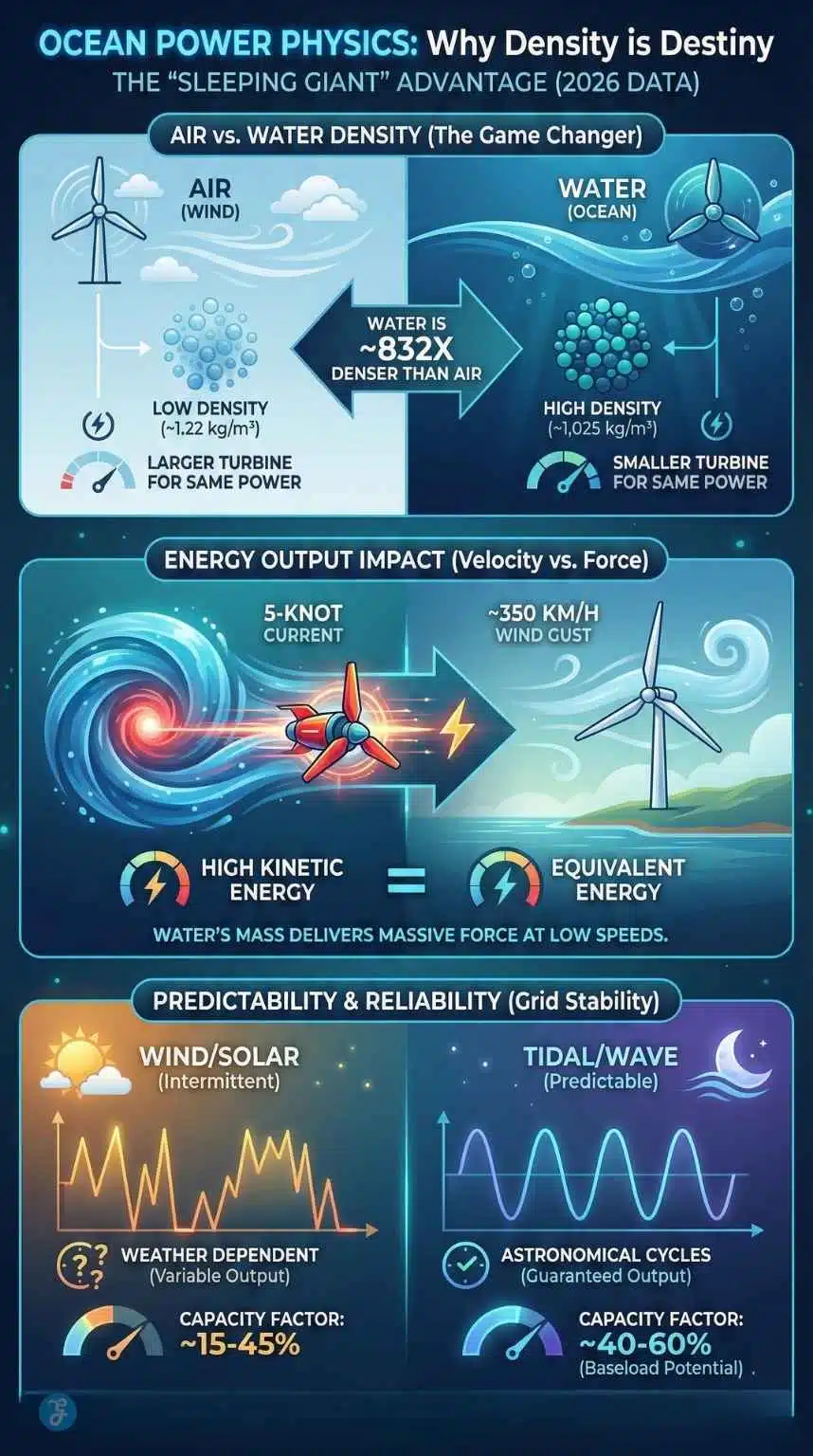
To understand why investors and engineers are suddenly pivoting to the ocean, one must understand the fundamental physics of fluid dynamics. The primary argument for marine energy comes down to a single, unchangeable fact: Water is approximately 832 times denser than air.
The Density Advantage
This difference in density changes the engineering equation entirely. In wind energy, you need massive blades spanning hundreds of feet to capture enough kinetic energy from thin air to turn a turbine. In the ocean, the medium itself is thick and heavy. A 5-knot ocean current carries more kinetic energy than a 350 km/h wind gust.
Consequently, marine turbines can be significantly smaller than their wind counterparts while generating equivalent power. This “energy density” allows for compact arrays that sit below the waterline, invisible from the shore, yet churning out utility-scale electricity.
The Predictability Factor: The Holy Grail of the Grid
The Achilles’ heel of renewable energy has always been storage. We need batteries because we cannot predict exactly when the wind will blow or how much cloud cover will obscure the sun.
- Tidal Energy: Tides are governed by the celestial mechanics of the Earth-Moon-Sun system. We can predict the exact volume and timing of tidal movements for the next 100 years with near-perfect accuracy.
- Wave Energy: While less predictable than tides, waves are far more consistent than wind. Waves are created by winds blowing across vast stretches of ocean (fetch), and they continue to roll for days after the wind has ceased. This creates a natural “lag” that smoothes out the energy supply.
Renewable Energy Source Comparison [2026 Data]
| Feature | Wind Energy | Solar PV | Tidal/Wave Energy |
| Density (kg/m³) | ~1.22 | N/A (Photon-based) | ~1,025 (Seawater) |
| Predictability | Low (Weather dependent) | Medium (Day/Night cycle) | High (Astronomical cycles) |
| Capacity Factor | 30% – 45% | 15% – 25% | 40% – 60% |
| Visual Impact | High (Skyline dominance) | High (Land usage) | Zero (Mostly submerged) |
Tidal Energy: Harnessing the Moon’s Gravity
Tidal energy is the most mature technology in the marine sector. It relies on the vertical rise and fall of water (tidal range) or the horizontal flow of currents (tidal stream). In 2026, the industry has largely moved away from massive concrete dams toward smarter, floating technologies.
1. Tidal Stream Generators: The Underwater Wind Farm
This is currently the commercially dominant technology. Tidal stream generators function almost exactly like wind turbines, but they are submerged in fast-flowing currents caused by tides moving around headlands or through channels.
- The Technology: Horizontal-axis turbines are anchored to the seabed or suspended from floating platforms. As the tide rushes in, the blades turn; as the tide goes out, the blades reverse (or pitch) to capture energy in the opposite direction.
- 2026 Innovation – Orbital Marine Power: The Scottish firm Orbital Marine Power has revolutionized this sector with its “O2” and the newer “O2-X” platforms. These are floating superstructures that look like yellow submarines on the surface. They have two massive turbine legs that drop down into the water.
The Game Changer: The highest cost in offshore energy is maintenance. If a seabed turbine breaks, you need expensive divers and cranes. Orbital’s platform allows the legs to be raised to the surface with the push of a button, allowing simple boat crews to fix them. This has slashed the Levelized Cost of Energy (LCOE) drastically.
2. Tidal Barrages
The “old school” method involves building a dam across a river estuary. Sluice gates open to let the high tide in, then close. When the tide recedes outside the dam, the trapped water is released through turbines.
- The Legacy: The La Rance Tidal Power Station in France has been operating since the 1960s, proving the longevity of the tech.
- The Problem: Environmentalists argue that blocking estuaries destroys wetlands and disrupts bird migration, which is why new barrage projects are rare in Western countries, though China and Korea continue to explore them.
3. Tidal Lagoons: The Eco-Friendly Compromise
Instead of blocking a whole river mouth, a tidal lagoon builds a circular wall attached to the coastline, creating an artificial pool.
- Benefits: This design allows marine life to swim around the structure and preserves the natural flow of the estuary while still capturing the tidal range.
- Status: In 2026, several pilot projects in the UK (Swansea Bay revival concepts) and Asia are testing whether lagoons can double as flood defenses for coastal cities with rising sea levels.
Wave Energy: Catching the Surface Motion
If tidal energy is the steady heartbeat, wave energy is the erratic muscle. It is vastly more powerful but much harder to capture because waves move in multiple directions—up, down, forward, backward, and side-to-side. Furthermore, the ocean surface is a violent place; devices must survive “100-year storms” where waves can reach 20 meters in height.
1. Point Absorbers: The “Pumping Heart”
Point absorbers are buoys that float on the surface and are tethered to the seabed. As the buoy rises and falls with the waves, it pumps a hydraulic cylinder or drives a linear generator to produce electricity.
- CorPower Ocean (The Tesla of Waves): The Swedish company CorPower Ocean is the standout leader in 2026. Their C4 and C5 machines utilize a biological mimicry concept—they function like a human heart.
- The Breakthrough: Their “WaveSpring” phase control technology allows the buoy to oscillate in resonance with the waves, amplifying the motion and capturing 300% more energy than a standard buoy. Crucially, in 2026, they perfected “detuning” mode—where the device stops fighting the waves during a storm and goes transparent to the force, ensuring survival.
2. Oscillating Water Columns (OWC)
These are often built into the shoreline or breakwaters. An OWC is a concrete chamber with an opening below the waterline.
- How it Works: As waves enter the chamber, the water level rises, pushing the air inside the chamber up through a vent. This moving air spins a turbine. When the wave retreats, air is sucked back in, spinning the turbine again.
- Advantage: The moving parts (the turbine) are out of the water, meaning no saltwater corrosion on the most sensitive equipment.
3. Attenuators
These are long, snake-like devices that float parallel to the direction of the waves. As the wave passes along the length of the device, the sections flex and bend. This hinging movement drives hydraulic pumps inside the joints to generate power.
The “Sleeping Giant” Market Analysis [2026 Update]
For years, marine energy was stuck in the “Valley of Death”—the gap between successful lab tests and commercial viability. In 2026, the industry will have successfully bridged that gap.
Market Valuation and Growth
According to the latest Global Marine Energy Market Report 2026:
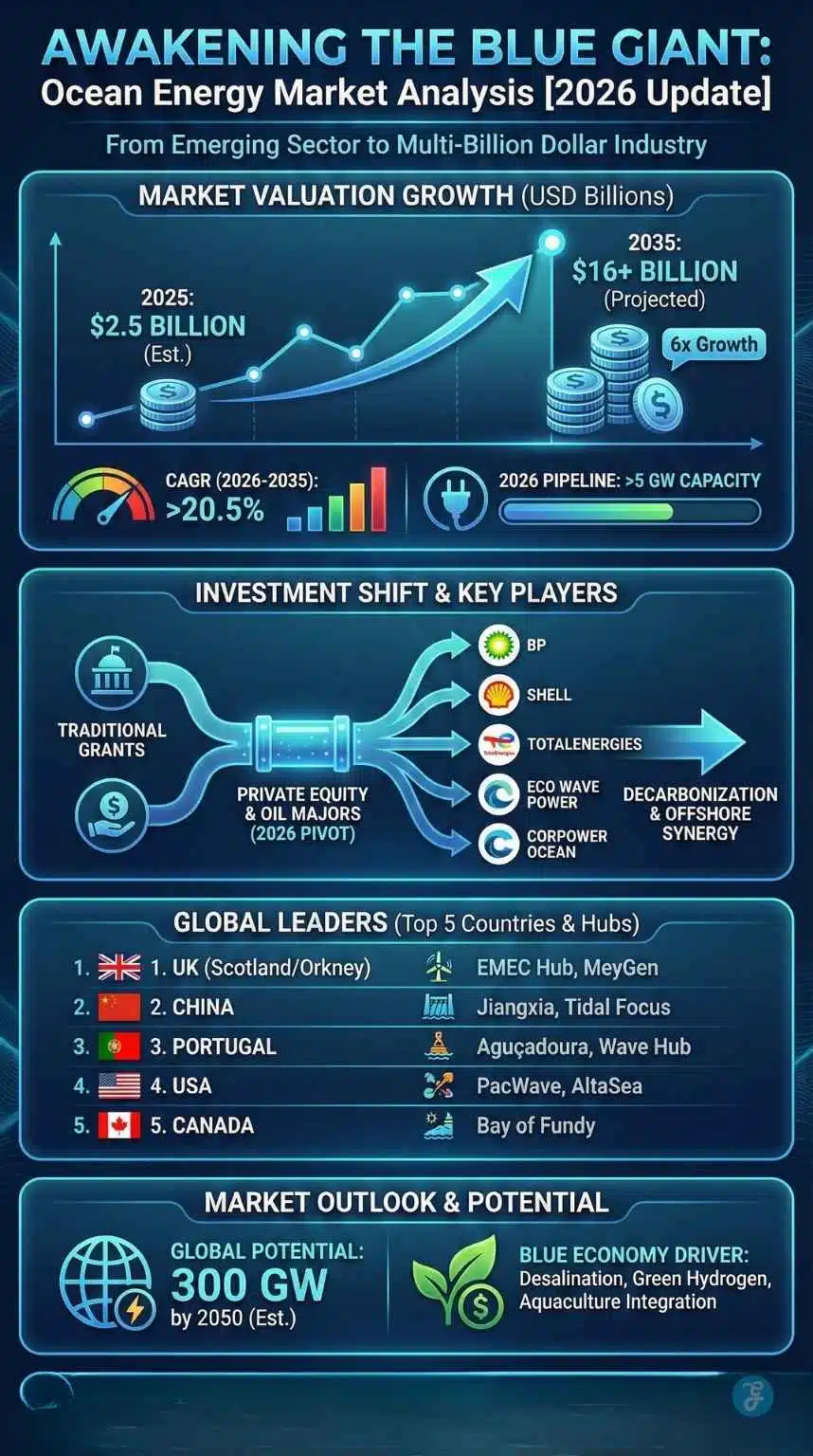
- The global market size for wave and tidal energy is projected to grow from $2.5 billion in 2025 to over $16 billion by 2035.
- CAGR: The sector is witnessing a Compound Annual Growth Rate (CAGR) of over 20.5%, significantly outpacing mature renewables like onshore wind in terms of relative growth velocity.
- Pipeline: Over 5 GW of capacity is currently in the permitting or construction phase globally, a 400% increase from 2020 figures.
The Shift in Investment
The money fueling this growth has changed. Ten years ago, it was all government grants. Today, it is private equity and venture capital.
- Oil Majors Pivoting: Companies like BP, Shell, and TotalEnergies are heavily investing in marine energy. They view their offshore expertise (rigs, subsea cables) as directly transferable to ocean energy. They need to decarbonize, and the ocean is their home turf.
Top 5 Countries Leading Marine Energy [2026]
| Rank | Country | Focus Area | Key Project/Hub |
| 1 | United Kingdom | Tidal Stream & Wave | EMEC (Orkney), MeyGen |
| 2 | China | Tidal Barrage & Stream | Jiangxia Tidal Power Station |
| 3 | Portugal | Wave Energy | Aguçadoura / HiWave-5 |
| 4 | USA | Wave & River Current | PacWave (Oregon), AltaSea (LA) |
| 5 | Canada | Tidal Stream | Bay of Fundy (FORCE) |
Global Hubs & Case Studies
To understand the scale of operation, we must look at the specific locations where the ocean is currently plugging into the grid.
The United Kingdom: The Undisputed Leader
Scotland, specifically the Orkney Islands, remains the Silicon Valley of marine energy. The European Marine Energy Centre (EMEC) in Orkney has tested more wave and tidal devices than any other site in the world.
- MeyGen Project: Located in the Pentland Firth (a stretch of water with some of the fastest currents on earth), MeyGen is the world’s largest tidal stream array. In late 2024, it surpassed 60GWh of total generation—enough to verify that tidal stream is a reliable utility-scale contributor.
Portugal: The Atlantic Gateway
Portugal has capitalized on its massive Atlantic coastline. The government has aggressively simplified maritime licensing, attracting companies like CorPower Ocean to set up their manufacturing hubs there. The Aguçadoura Wave Farm was a pioneer, and the new HiWave-5 park is setting the standard for grid-connected wave arrays.
The United States: Awakening the Pacific
The US was slow to start but has accelerated rapidly under recent infrastructure bills. The PacWave South test site off the coast of Oregon is now fully operational in 2026, offering grid-connected testing berths for wave developers. Meanwhile, Eco Wave Power has successfully deployed onshore wave technology at the Port of Los Angeles, proving that wave energy doesn’t always need to be miles offshore; it can be integrated into existing breakwaters and piers.
Beyond Electricity: The Multi-Purpose Blue Economy
One of the most exciting developments in 2026 is the realization that marine energy serves purposes beyond just feeding the electric grid. It is becoming the backbone of the “Blue Economy.”
1. Desalination without Carbon
Water scarcity is a global crisis. Traditional desalination (removing salt from seawater) is incredibly energy-intensive and usually powered by fossil fuels.
- The Synergy: Wave energy converters are now being mechanically coupled to desalination pumps. The motion of the waves drives the high-pressure reverse osmosis process directly. This creates zero-emission fresh water, a lifeline for arid coastal regions and islands.
2. Offshore Green Hydrogen
Instead of sending electricity through expensive subsea cables to the shore, some 2026 projects are producing hydrogen right at the source.
- The Process: Floating platforms use tidal or wave power to run electrolyzers, splitting seawater into oxygen and hydrogen. The hydrogen is stored in tanks and shipped to shore or used to refuel hydrogen-powered cargo ships mid-ocean. This solves the “grid connection” cost problem for remote offshore sites.
3. Powering Aquaculture
As wild fish stocks deplete, the world is turning to offshore fish farming. These farms need power for feeding systems, monitoring, and water filtration. Diesel generators are expensive and dirty to ship out to sea. Small-scale wave and tidal devices are now providing autonomous, clean power for these remote food production hubs.
Environmental & Socio-Economic Impact
The transition to renewables is often framed as a trade-off, but marine energy is proving to be remarkably benign, and in some cases, beneficial to the local environment.
Marine Life and Biodiversity
The primary concern has always been: “Will fish get chopped up in the turbines?”
- The Verdict: After years of monitoring with underwater cameras and sonar, the State of the Science Report 2024 confirmed that collisions are extremely rare. Marine mammals and fish are agile and avoid the slow-moving rotors of tidal turbines.
- Artificial Reef Effect: Much like shipwrecks, the underwater foundations of these devices attract algae, barnacles, and mussels. This creates a food source that attracts smaller fish, which in turn attract larger predatory fish. Many wave farm sites have effectively become de facto marine reserves where fishing is prohibited, allowing stocks to replenish.
Socio-Economic Revitalization
Marine energy is reviving coastal communities that were left behind by the decline of fishing and shipbuilding.
- Job Creation: These technologies require steel, fabrication, boat crews, divers, and engineers. Shipyards in Scotland and Portugal are bustling again, building wave buoys instead of oil tankers. It is a “Just Transition” in action, utilizing the existing skills of the maritime workforce for a green future.
Challenges & The Road to Scale
Despite the optimism of 2026, the industry still faces significant hurdles that must be cleared to reach the 300 GW potential by 2050.
1. The Cost Battle (LCOE)
While costs have dropped 40% in the last five years, tidal energy is still more expensive than offshore wind.
- Current Reality: Offshore wind costs roughly $50-$70 per MWh. Tidal stream is currently hovering around $130-$150 per MWh.
- The Path Forward: The industry needs “Economies of Scale.” Just as solar panels became cheap when we started making millions of them, marine turbines will only become cost-competitive when factories start mass-producing them rather than hand-building prototypes.
2. Survivability vs. Efficiency
The paradox of wave energy is that the best place to generate power is where the ocean is most violent. Designing a device that is sensitive enough to capture energy from a gentle swell but robust enough to survive a hurricane is an immense engineering challenge. While “detuning” technology has helped, long-term fatigue on materials in saltwater is a constant battle.
3. Biofouling
The ocean wants to grow on everything. Within weeks, devices are covered in slime and barnacles, which weigh them down and ruin their hydrodynamics. Developing non-toxic, anti-fouling coatings that last for years is a critical area of materials science research in 2026.
Final Thought: The Inevitable Tide
For centuries, humanity has stood on the shore, watching the tides roll in and the waves crash with awe-inspiring power. We wrote poems about it, we feared it, and we navigated it. But we rarely thought to plug into it.
The technology of 2026 proves that the ocean is no longer just a wilderness; it is a power plant. While the sleeping giant is groggy and the costs are still stabilizing, the trajectory is clear. To achieve a carbon-neutral world, we cannot rely on the sky alone. We must look to the depths. The ocean has been waiting for us, pulsing with energy, twice a day, every day, since the moon first orbited the earth. It is finally time we accepted the offer.