The environmental impact of battery energy storage is the critical, often overlooked variable in the global race toward Net Zero. As nations dismantle the internal combustion engine in favor of electric motors and grid-scale batteries, we are not simply switching from “dirty” to “clean” energy; we are entering a complex new era of resource management.
While batteries are essential for decarbonization, they are not magic wands that erase pollution. Instead, they represent a fundamental trade-off. This analysis strips away the marketing gloss to examine the gritty reality of the battery revolution, exploring whether we are truly solving the climate crisis or merely changing the nature of our environmental footprint.
Key Takeaways
- The Carbon Backpack: Batteries are not zero-emission products. They carry a heavy “front-loaded” carbon debt (9–16 tonnes for an EV) generated during mining and manufacturing.
- Geography Matters: A battery made in a coal-powered region (like much of China) is 40–60% dirtier than one made in a renewable-powered region.
- Water & Human Rights: Lithium extraction stresses water tables in South America, and cobalt mining is linked to human rights abuses in the DRC, though the industry is shifting toward cobalt-free LFP chemistries.
- The Payback: Despite the upfront cost, batteries “break even” environmentally after 2–3 years of use and are essential for replacing dirty “peaker plants” on the grid.
- Circular Economy: The future of the industry depends on recycling. With the EU “Black Mass” regulations and Battery Passports arriving in 2026/2027, the “make, use, dispose” model is finally becoming illegal.
The Green Paradox: Shifting the Burden
Environmental scientists often describe this trade-off as the “Green Paradox.” In our effort to eliminate tailpipe emissions, we are inadvertently creating a new set of ecological challenges at the mine and the factory floor. The battery does not remove the environmental cost of energy; it shifts the burden from the moment of use to the moment of creation.
Unlike a gasoline vehicle, which pollutes cumulatively over time, a battery energy storage system (BESS) is born with a heavy “front-loaded” carbon debt. Before a battery ever stores solar power or drives a single mile, it has already incurred a significant ecological price tag through mining and refining. To understand if energy storage is truly green, we must look beyond the zero-emission operation and confront the intensive “cradle-to-grave” lifecycle of its production.
The “Front-Loaded” Carbon Debt: Starting in the Red
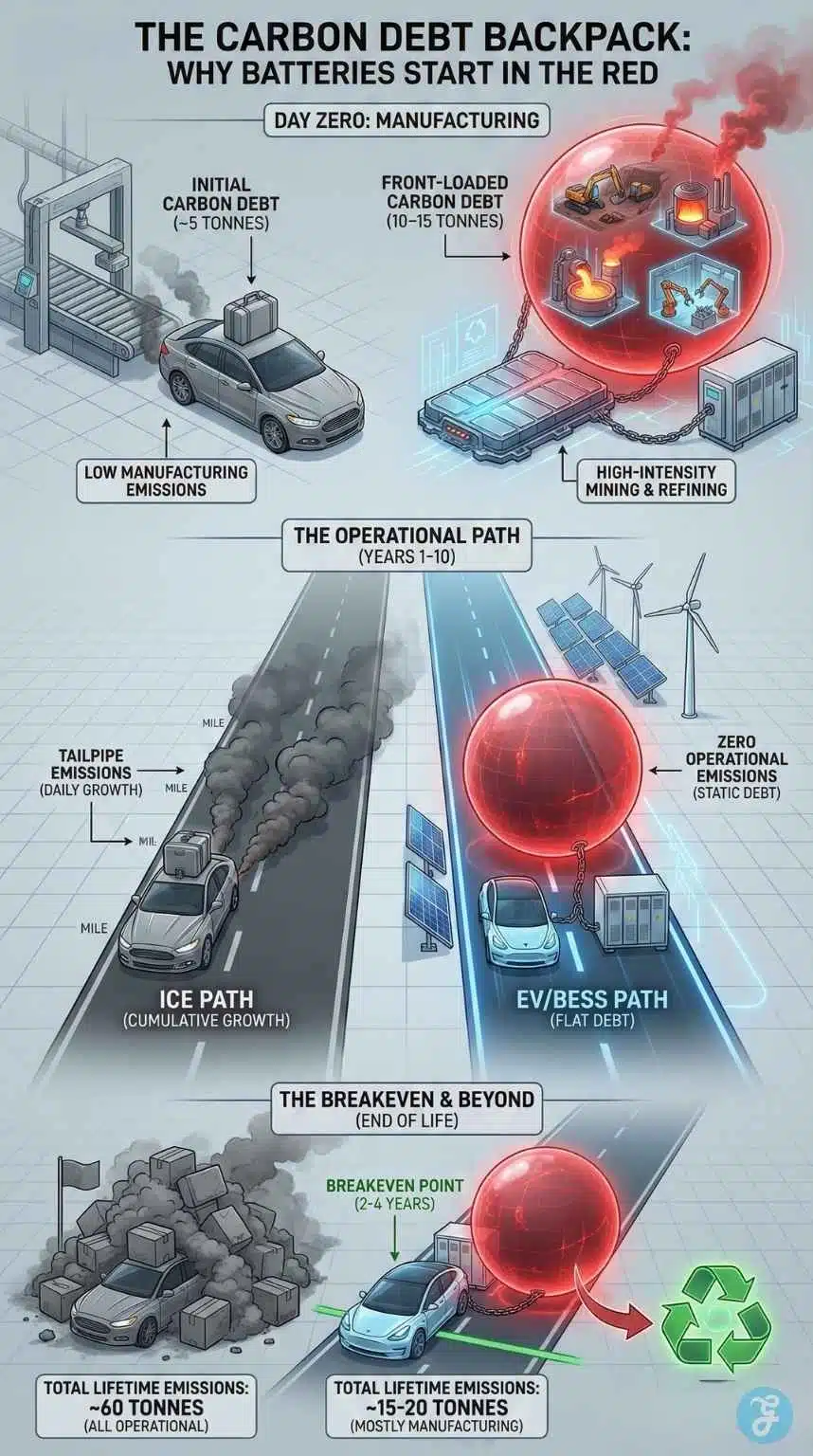
To understand the true ecological footprint of a battery, one must first understand the concept of “Embodied Carbon.”
When a traditional gas-powered car rolls off the assembly line, its carbon footprint is relatively small. Its environmental damage is cumulative; it pollutes a little bit every day it is driven. An electric vehicle (EV) or a grid-scale Battery Energy Storage System (BESS), however, is born with a massive carbon debt.
The Energy-Hungry Factory Floor
As of late 2025, manufacturing a lithium-ion battery generates between 150 and 200 kilograms of CO2 per kilowatt-hour (kWh) of capacity. To put that in perspective, a standard Tesla Model Y Long Range with an ~80 kWh battery comes with a “carbon backpack” of roughly 12 to 16 metric tonnes of CO2 before it even drives its first mile. This is equivalent to the emissions generated by driving a gasoline car for nearly two years.
Why is battery production so carbon-intensive?
- Cathode Calcination: The production of the cathode (the positive electrode) requires synthesizing materials like nickel, manganese, and cobalt in massive kilns. These ovens must run at temperatures between 800°C and 1,000°C for days at a time to ensure the correct crystalline structure forms.
- Dry Rooms: Lithium is highly reactive to moisture. Battery assembly must take place in “dry rooms” where the humidity is kept lower than that of the Sahara Desert (often below 1% relative humidity). Maintaining this environment requires industrial-scale dehumidifiers that consume vast amounts of electricity, running 24/7.
- Solvent Recovery: The electrode coating process uses toxic solvents like NMP (N-Methyl-2-pyrrolidone). Evaporating and recovering these solvents requires significant heat energy.
The “Grid Mix” Geography
The “greenness” of a battery is heavily dictated by where it is made.
- The China Factor: As of 2026, China still controls approximately 77% of global battery manufacturing capacity. Despite rapid renewable expansion, China’s industrial grid remains heavily reliant on coal. A battery manufactured in a coal-powered Chinese province can have a carbon footprint 40% to 60% higher than the exact same battery manufactured in Sweden (which uses hydro and nuclear power) or the US Pacific Northwest (hydro).
- The 2026 Shift: We are seeing a slow diversification. The “Battery Belt” in the US South and the “Gigafactories” in Northern Europe are beginning to come online, attempting to lower this embodied carbon. However, for the immediate future, the majority of the world’s storage is still being baked in coal-fired ovens.
The Extraction Toll: Digging for the “New Oil”
If data is the new oil, then lithium, cobalt, and nickel are the new steel. The shift to renewables is driving the largest mining boom in history. To replace the volume of fossil fuels we burn, we must dig up gigatonnes of earth. This extraction comes with a profound local ecological price.
Lithium: The Water Thief
Lithium is the lightest metal on Earth and the heart of the modern battery. It is primarily sourced from two very different methods, each with its own scar on the planet.
Brine Mining [The Lithium Triangle]
Over 60% of the world’s lithium resources are found in the “Lithium Triangle”—the high-altitude salt flats bordering Chile, Argentina, and Bolivia.
- The Process: Miners pump mineral-rich brine from deep underground aquifers into massive evaporation ponds. The sun evaporates the water over 12–18 months, leaving behind lithium salts.
- The Cost: This is arguably the most controversial aspect of the industry. Producing one tonne of lithium via this method evaporates approximately 2 million liters of water. In the arid Atacama Desert, one of the driest places on Earth, this industrial thirst depletes the water table, drying up lagoons used by migrating flamingos and destroying the agriculture of indigenous communities like the Toconao people, who rely on these aquifers for quinoa farming and llama herding.
- 2026 Update: New “Direct Lithium Extraction” (DLE) technologies are beginning to scale in 2026. DLE reinjects the brine back underground after extracting the lithium, theoretically saving 80-90% of the water. However, commercial adoption is still in the early stages, and the vast majority of production remains dependent on evaporation ponds.
Hard Rock Mining [Australia]
Australia is the world’s largest lithium producer, but it mines spodumene ore (hard rock) rather than brine.
- The Cost: While this doesn’t have the same water impact, it is incredibly energy-intensive. Giant diesel-powered excavators dig open pits, and the rock must be crushed and roasted. Furthermore, as of 2026, most of this Australian rock is still shipped to China for refining, adding thousands of miles of maritime shipping emissions to the lifecycle.
Cobalt: The “Blood Diamond” of Tech
Cobalt stabilizes the battery and prevents it from catching fire. It is also the industry’s ethical nightmare.
- The DRC Monopoly: Roughly 70% of the world’s cobalt comes from the Democratic Republic of the Congo (DRC).
- Artisanal Mining: While large industrial mines exist, a significant portion (estimated at 15-30%) comes from “artisanal” miners—freelance workers who dig tunnels by hand. In 2025/2026, reports of child labor, dangerous collapses, and “Hard Metal Lung Disease” (caused by inhaling cobalt dust) persist.
- Legislative Tensions: In February 2025, the DRC government amended decrees to try and provide a legal path for artisanal miners to sell to industrial buyers safely, but implementation has been spotty. The stigma is so high that many EV makers (like Tesla and Ford) are actively moving toward “cobalt-free” chemistries like LFP (Lithium Iron Phosphate) to excise this risk from their supply chain.
Nickel: The Ocean Dumper
As demand for “long-range” EVs grows, so does the demand for nickel. Indonesia has become the global hub for nickel, but the environmental regulations there are lax compared to Western standards.
- Deep Sea Tailings Placement (DSTP): To deal with the toxic sludge (tailings) left over from acid-leaching nickel ore, some facilities in Southeast Asia employ DSTP, piping the waste directly into the ocean. This smothers coral reefs and contaminates marine food chains, a practice that would be illegal in many other jurisdictions.
The Geopolitics of Gigafactories: From “Just in Time” to “Just in Case”
In 2026, the battery is no longer just a product; it is a matter of national security. For the last decade, the world relied on a globalized supply chain that flowed almost exclusively through China.
- The Decoupling: Following the US Inflation Reduction Act (IRA) and the EU Critical Raw Materials Act, we are seeing a massive “onshoring” effort. The emergence of the “Battery Belt” in the American South and “Battery Valley” in Northern Europe is an attempt to break reliance on Chinese refining.
- The Cost of Security: This shift makes the supply chain more robust but also more expensive. “Ethical” and “Local” batteries cost more to produce than those made with coal power and cheap labor. As a consumer, the “Green Premium” you pay is partly a fee for supply chain independence.
The Usage Phase: The “Green” Turnaround
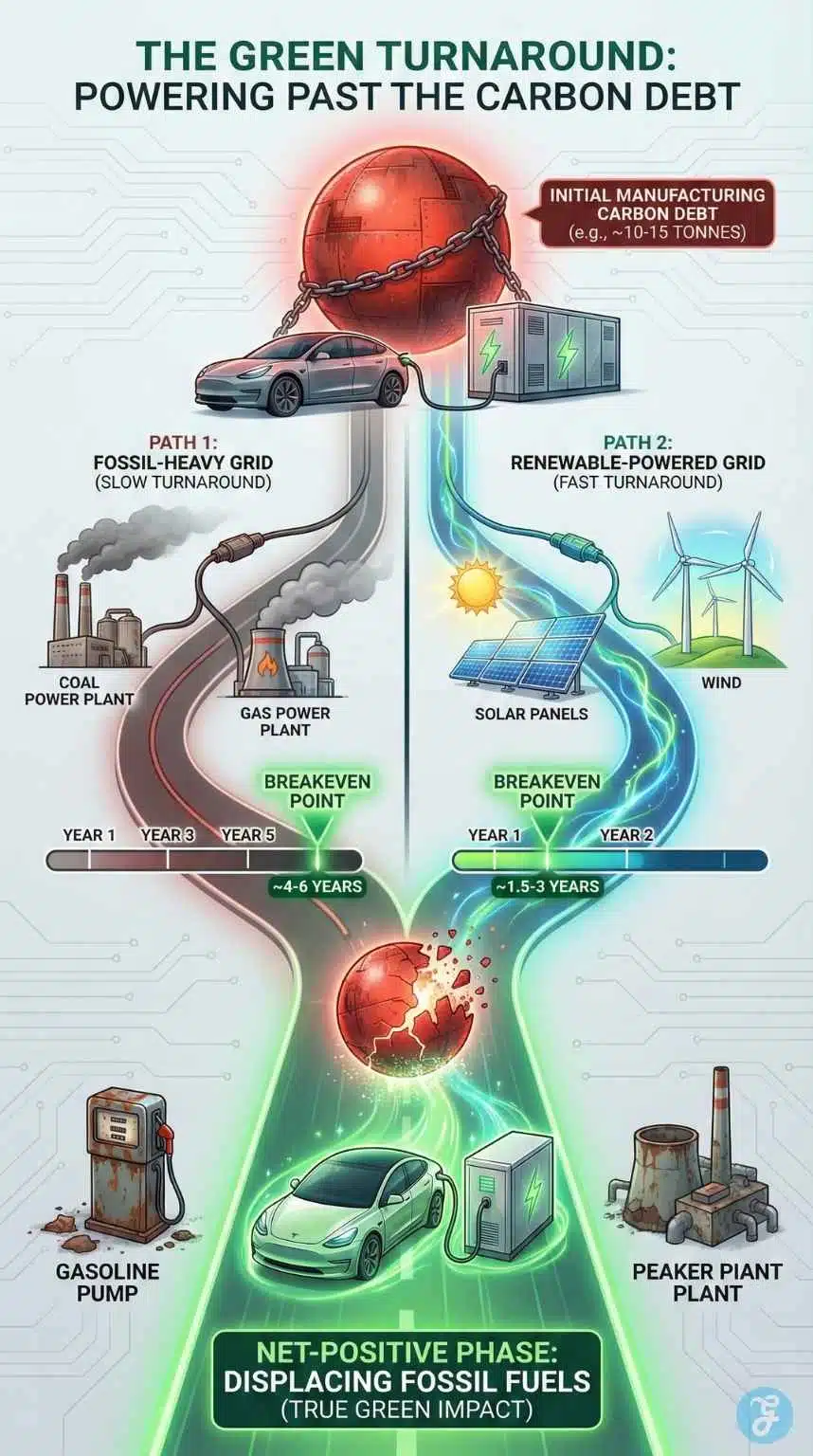
If the story ended at the factory gate, batteries would be an environmental disaster. But the magic happens during the “Usage Phase.” This is where the battery begins to pay back its carbon debt.
Calculating the Payback Period
The “Carbon Payback Period” is the time it takes for an EV or BESS to offset the emissions generated during its manufacturing.
- The Math: An internal combustion engine (ICE) car emits roughly 4.6 metric tons of CO2 per year. An EV emits zero tailpipe emissions.
- The Breakeven: Recent Lifecycle Assessments (LCA) in 2026 show that the average EV breaks even with a gas car after 20,000 to 30,000 miles (roughly 2–3 years of driving). After this point, every mile driven is a net benefit to the climate.
- Grid Storage: For stationary batteries replacing gas “peaker plants,” the payback is even faster, often under 18 months, because peaker plants are notoriously inefficient and pollution-heavy.
Killing the “Peaker”
The single greatest environmental contribution of battery storage is the elimination of Peaker Plants. These are gas or coal turbines that sit idle 90% of the time, firing up only during moments of extreme demand (like a hot summer afternoon). They are expensive, dirty, and often located near marginalized communities.
By charging up with solar power at noon and discharging it at 6 PM, batteries render these dirty plants obsolete. In this context, the battery is not just a storage device; it is a grid-cleaning tool.
The Fire Risk: Separating Fact from Viral Fear
One of the most persistent myths surrounding the battery revolution is the danger of fire. Viral videos of EVs burning have created a perception of high risk, but the 2025/2026 data tells a different story.
According to the latest global insurance and safety data:
- Frequency: Electric vehicles catch fire significantly less often than internal combustion engine (ICE) vehicles.
- Gas/Diesel Fire Rate: ~1,530 fires per 100k vehicles.
- EV Fire Rate: ~25 fires per 100k vehicles.
- Conclusion: You are roughly 60 times less likely to experience a fire in an EV than in a gas car.
- Intensity: The nuance lies in the type of fire. If a lithium-ion battery does ignite (usually due to physical damage or manufacturing defects), it undergoes Thermal Runaway. This creates a fire that generates its own oxygen, making it incredibly difficult to extinguish. Fire departments in 2026 are still adapting, often using “dunk tanks” or specialized blankets rather than standard water hoses.
| Vehicle Type | Fire Probability | Primary Fire Cause | Extinguishing Difficulty |
| Gasoline (ICE) | High (1.5%) | Fuel leaks, electrical shorts | Low (Standard Foam/Water) |
| Hybrid | Highest (3.4%) | Dual complexity (Gas + Battery) | Medium |
| Electric (EV) | Very Low (0.025%) | Impact damage, cell defects | High (Thermal Runaway) |
The End-of-Life Crisis: A Tsunami of Waste
We are currently standing on the precipice of a waste crisis. The first generation of EVs (sold in the early 2010s) is now hitting retirement age. By 2030, analysts predict that over 11 million metric tons of spent Li-ion batteries will reach the end of their service life globally.
The “Black Mass” Challenge
Recycling a battery is infinitely harder than recycling a plastic bottle or an aluminum can.
- Design Flaws: Current batteries are designed for performance, not disassembly. Cells are welded together and glued into packs with strong adhesives. Taking them apart is labor-intensive and dangerous due to the risk of Thermal Runaway (chemical fires).
- The Shredder: Most recycling today involves shredding the battery into a powder known as “Black Mass.” This powder contains lithium, cobalt, nickel, and manganese.
- The Processing Gap: As of 2026, while we have plenty of “shredding” capacity, the world lacks enough “hydrometallurgical” capacity actually to separate the Black Mass back into battery-grade metals. Much of this powder is currently shipped halfway across the world (often back to China) for final refining, adding yet another layer of transport emissions.
The “Second Life” Opportunity
Before a battery is recycled, it can be reused. An EV battery is considered “dead” for a car when it degrades to 80% capacity (limiting range). However, 80% capacity is arguably perfect for stationary storage.
- Real World Application: In 2026, we are seeing major automakers partnering with utility companies to bolt old EV batteries together to create grid storage farms. This extends the useful life of the unit by another 10–15 years, significantly diluting its original manufacturing carbon footprint.
Regulatory Hammers: The EU Battery Passport
Government policy is finally catching up. Starting in February 2027, the European Union will mandate a “Battery Passport” for all EV and industrial batteries.
- This digital twin will track the battery’s origin, recycled content, and carbon footprint.
- Crucially, new regulations coming into force in late 2026 classify Black Mass as “hazardous waste,” banning its export from OECD countries to non-OECD countries. This forces Europe and North America to build their own recycling infrastructure rather than dumping the problem on developing nations.
Future-Proofing: Emerging Technologies
The battery of 2030 will not look like the battery of 2025. The industry is rapidly pivoting toward chemistries that solve the specific ethical and environmental flaws of Lithium-Ion.
| Feature | Lithium-Ion (NMC) | Sodium-Ion (Na-ion) | LFP (Lithium Iron Phosphate) |
| Primary Use | Long-range EVs, Laptops | Grid Storage, Budget EVs | Standard Range EVs, Grid |
| Critical Metals | Lithium, Cobalt, Nickel | Sodium (Salt), Iron | Lithium, Iron |
| Scarcity | High (Geopolitical Risk) | Zero (Abundant everywhere) | Medium |
| Cost | High ($100+/kWh) | Low (<$60/kWh target) | Medium |
| Eco-Footprint | High (Mining intensity) | Lowest (Minimal extraction impact) | Medium-Low |
The Sodium-Ion Revolution
Sodium-ion batteries are the most promising “green” alternative entering the market in 2026.
- The Chemistry: Instead of lithium, they use sodium, which can be extracted from soda ash or even seawater. They use aluminum current collectors instead of copper (which is cheaper and lighter) and contain zero cobalt or nickel.
- The Trade-off: They are heavier and less energy-dense than lithium batteries. You likely won’t see a sodium-ion sports car, but for a stationary box sitting next to a solar farm, weight doesn’t matter.
- Status: In 2026, major players like CATL and BYD are ramping up mass production, and companies like Hithium have announced sodium cells capable of 20,000 cycles, potentially lasting decades longer than current tech.
LFP (Lithium Iron Phosphate)
LFP has already won the war for standard-range storage. It uses no cobalt and no nickel. While it still requires lithium mining, it eliminates the worst human rights abuses associated with the Congo. If you buy a standard-range Tesla or a home storage battery in 2026, it is likely LFP.
Solid-State Batteries
Often called the “Holy Grail,” solid-state batteries replace the liquid electrolyte (which is flammable) with a solid material. This allows for higher energy density, meaning you need less material to get the same amount of power. While still in pilot phases in 2026, they promise to significantly reduce the raw material tonnage required for the global fleet.
Beyond Chemistry: The Rise of Mechanical Storage
Not all energy storage needs to be a chemical battery. To truly reduce environmental impact, we are seeing a resurgence of “Low-Tech” solutions for the grid in 2026.
- Gravity Storage: Companies are using surplus wind power to lift massive concrete blocks or heavy rail cars up a hill. When power is needed, they let gravity pull them down, spinning a turbine.
- Green Score: A+. No lithium, no degradation, and the “battery” is just concrete and steel.
- Pumped Hydro: The oldest form of storage (pumping water up a dam) is getting a reboot with “Closed-Loop” systems that don’t damn existing rivers but circulate water between two man-made reservoirs.
Consumer Guide: How to Lower Your Personal Battery Footprint
If you own an EV or home battery, your behavior dictates its environmental score.
- The 80% Rule: Unless you are on a road trip, stop charging at 80%. Charging to 100% daily stresses the chemical structure, degrading the battery faster. A battery that lasts 15 years is twice as green as one that lasts 7 years.
- Thermal Management: Don’t fast-charge in freezing cold or blistering heat if you can avoid it. Extreme temperatures during charging cause lithium plating, which permanently reduces capacity.
- Support “Second Life”: When buying home storage, look for units made from “repurposed” EV modules. These units give a second life to batteries that are no longer fit for the road but perfect for your basement.
The Environmental Calculus: Static vs. Compounding Debt
Is energy storage truly green? If “green” means “harmless to nature,” then the answer is no. No industrial product is harmless. Every battery represents a hole dug in the ground, a gallon of water evaporated, and a plume of CO2 released from a factory.
However, if “green” means “better than the alternative,” then the answer is a resounding yes. The environmental cost of a battery is a finite, one-time toll paid to build an asset that can store clean energy for decades. The cost of the fossil fuel system is a continuous, compounding debt that grows with every second of combustion.
What ultimately determines whether energy storage earns the label “green” is not its existence, but how responsibly it is governed across its full life cycle. Transparency in supply chains, accountability for environmental damage, and long-term investment in reuse and recovery will decide whether batteries reduce harm or merely shift it elsewhere. The transition succeeds only if the systems built to enable clean energy are held to standards as rigorous as the goals they are meant to serve.
Final Thought: The Imperfect Bridge
The hidden costs of batteries are real, serious, and must be mitigated through better mining practices, stricter recycling laws, and new chemistries like sodium-ion. But let us be clear: The battery is the imperfect bridge we must build to cross the river. We just need to make sure we don’t burn the bridge down while we’re standing on it.