


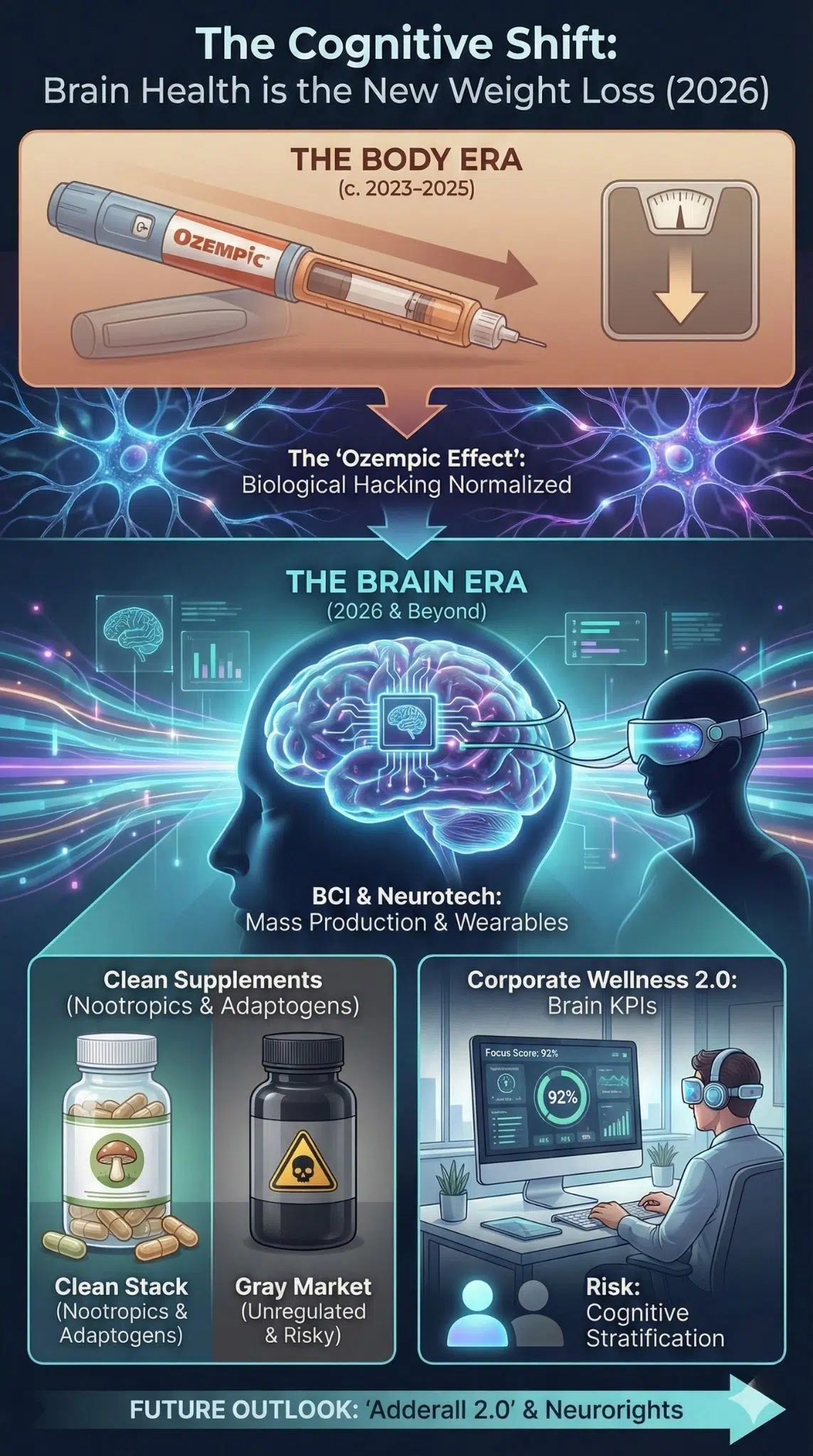
In January 2026, the wellness conversation has fundamentally shifted. The “Ozempic Era” normalized the medicalization of physical optimization; now, that same relentless pursuit of perfection has migrated upwards—to the brain. With Neuralink announcing mass production plans and a surge in “digital nootropics,” we are witnessing the dawn of the Cognitive Optimization economy.
The Pivot: From Body Mass to Brain Power
For the last three years, the global health narrative was dominated by GLP-1 agonists (like Ozempic and Wegovy). These drugs didn’t just shrink waistlines; they rewrote the cultural script on biology, proving that willpower could be chemically engineered. Now, as physical weight loss becomes a solved variable for the affluent, the frontier of human optimization has moved to the last unconquered territory: the mind.
We are currently witnessing a massive capital and cultural pivot. In the first two weeks of January 2026 alone, three distinct events signaled this change: Elon Musk’s Neuralink confirmed plans for “high-volume” brain chip production by year’s end; the FDA issued fresh warnings against unregulated “gas station smart drugs”; and a controversial “digital drug” audio therapy, The Brain Song, went viral with claims of stimulating neuroplasticity.
This isn’t just about avoiding dementia anymore. It is about competitive cognition—the belief that in an AI-driven world, your brain’s processing speed, focus, and emotional regulation are your only remaining assets.
The Pillars of the Cognitive Boom
The rise of cognitive optimization is being driven by a convergence of technological maturity, pharmaceutical desperation, and workforce anxiety. We can break this phenomenon down into five distinct sub-themes.
1. The “Ozempic Effect” on the Brain
The success of weight loss drugs created a psychological precedent: consumers are now comfortable treating biological traits as “hackable.” Interestingly, the bridge to brain health was built by Ozempic itself. Emerging research in late 2025 confirmed that GLP-1 agonists have profound neuroprotective effects, reducing “food noise” and addictive behaviors.
This paved the way for a new class of consumers who ask: “If I can quiet the hunger noise, can I quiet the anxiety noise? Can I turn up the focus volume?” The market is responding not just with supplements, but with peptides and “smart drugs” that promise to do for IQ what semaglutide did for BMI.
2. The Hard Tech: BCI Goes Mainstream
While invasive options like Neuralink grab headlines with promises of “LASIK-like” implantation surgeries for mass markets, the non-invasive sector is seeing broader adoption. By early 2026, the “wearable” market has graduated from counting steps to tracking focus.
New devices in 2026 don’t just monitor; they modulate. Headbands using transcranial photobiomodulation (tPBM) and focused ultrasound are moving from clinical trials to executive boardrooms. The goal is no longer just “wellness”; it is “performance sustainment” during 12-hour workdays.
3. The “Nootropic” Wild West
As demand outpaces regulation, the supplement market has become a minefield. The FDA’s recent advisories against products like “Smart IQ+” highlight a dangerous trend: the proliferation of unregulated cognitive enhancers.3
We are seeing a bifurcation in this market:
- The Clean Stack: High-end, transparent brands offering adaptogens (Lion’s Mane, Rhodiola) and synthetic nootropics (Racetams) to Silicon Valley elites.
- The Gray Market: “Gas station heroin” (Tianeptine) and other dirty stimulants sold to gig workers and students desperate for an edge.
4. Corporate Wellness 2.0: Brain KPIs
In 2024, companies offered gym memberships. In 2026, they are offering “Cognitive resilience” packages. Data from major HR consultancies suggests that “Executive Ownership of Wellbeing” is a top trend for 2026.
This is a double-edged sword. While employees get access to expensive neuro-feedback tools, there is a rising fear of “cognitive surveillance.” If your employer pays for your focus-tracking headband, do they get to see when your attention drifts?
5. The Inequality of Intelligence
Perhaps the most disturbing aspect of this trend is the potential for Cognitive Stratification. If cognitive optimization costs $500/month for high-quality peptides and neuro-coaching, intelligence becomes a pay-to-play feature.
We risk creating a society with two distinct classes: the Neuro-Enhanced, who can interface seamlessly with AI and handle high-stress cognitive loads, and the Baseline, who are left to struggle with the increasing demands of the digital economy on “legacy hardware.”
Data & Visualization
To understand the scale of this shift, we must look at the numbers. The market for brain health is not just growing; it is exploding in specific, performance-oriented sectors.
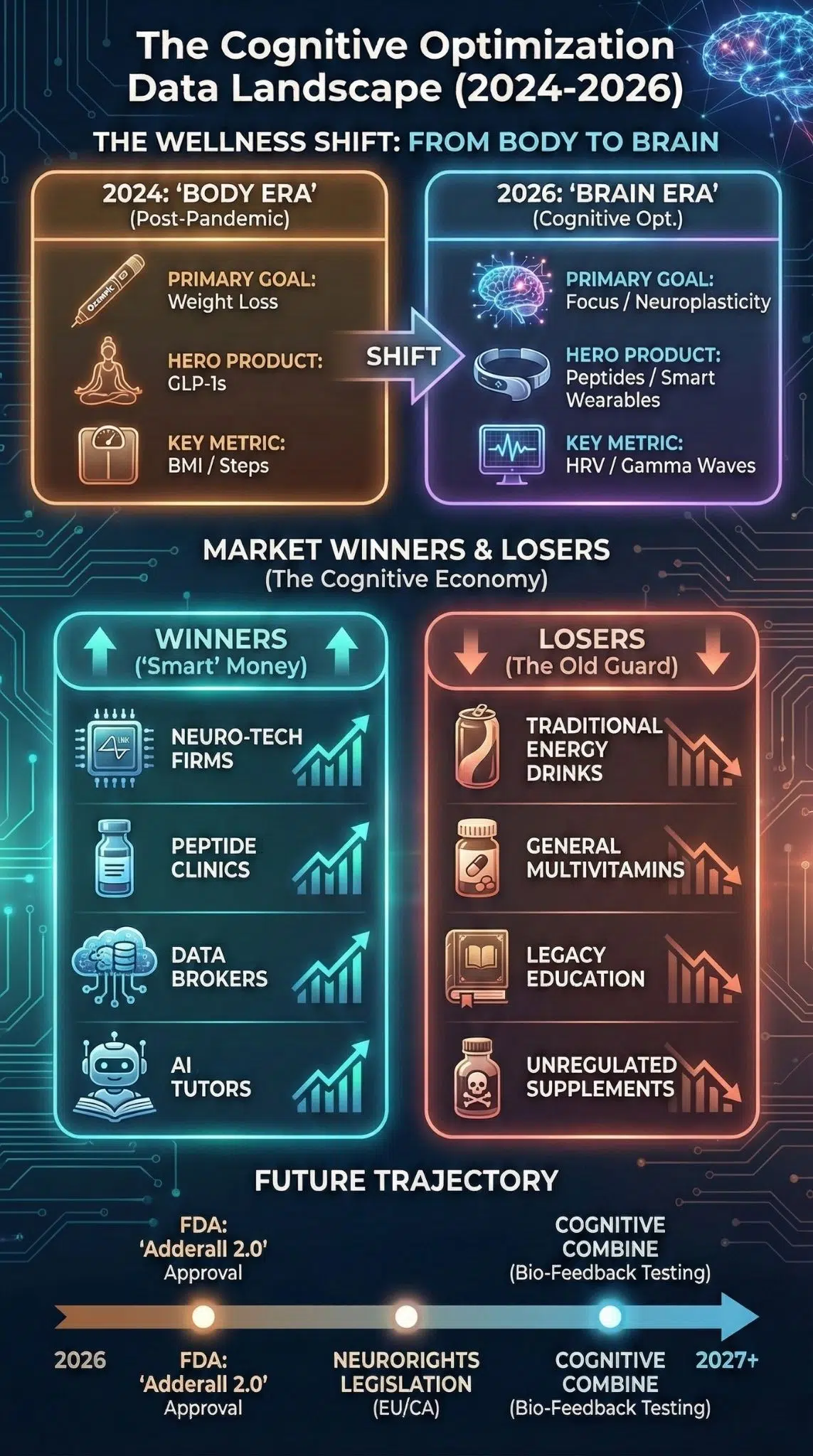
The Wellness Shift (2024 vs. 2026)
| Feature | 2024 “Body Era” (Post-Pandemic) | 2026 “Brain Era” (Cognitive Opt.) |
| Primary Goal | Weight Loss / Immunity | Focus / Neuroplasticity |
| Hero Product | Ozempic (GLP-1s) | Peptides / Smart Wearables |
| Status Symbol | Thinness / Pilates Body | Deep Focus / Emotional Control |
| Workplace Perk | Standing Desks | Neuro-Feedback Headsets |
| Key Metric | BMI / Steps per Day | HRV / Gamma Wave Activity |
Market Winners & Losers in the Cognitive Economy
| Winners (The “Smart” Money) | Losers (The Old Guard) |
| Neuro-Tech Firms: Companies like Neuralink & Synchron moving to mass production. | Traditional Energy Drinks: High sugar/caffeine is being replaced by “calm focus” blends. |
| Peptide Clinics: Med-spas offering “Brain Stacks” alongside Botox. | General Multivitamins: Consumers now demand outcome-specific (memory/mood) formulas. |
| Data Brokers: Firms that collect and analyze neural data. | Legacy Education: Rote memorization is devalued vs. adaptable “fluid intelligence.” |
| AI Tutors: Tools that act as “cognitive prosthetics” for the unenhanced. | Unregulated Supplements: FDA crackdowns are intensifying on “dirty” nootropics. |
Expert Perspectives
The transition to a brain-first economy is not without its detractors. The medical and ethical communities are deeply divided.
- The Optimists: Silicon Valley venture capitalists and transhumanists argue that cognitive optimization is a moral imperative. “If we can cure depression and increase global IQ by 10 points through technology, we solve poverty and conflict,” is a common refrain in 2026 tech manifestos. They point to the “Brain Song” and similar non-invasive therapies as democratizing access to mental health.
- The Skeptics: Bioethicists warn of the “coercion of enhancement.” Dr. Aris Thorne, a theoretical neurobiologist, noted in a recent symposium: “Once 10% of the workforce is enhanced, the other 90% is obsolete. We aren’t just creating a skills gap; we are creating a biological gap.”
- The Regulators: The FDA is currently playing whack-a-mole. Their January 2026 warnings highlight the difficulty of policing a market where “research chemicals” can be bought with Bitcoin and delivered by drone. The agency is struggling to define where “supplement” ends and “unapproved drug” begins, especially with compounds that cross the blood-brain barrier.
Future Outlook: What Happens Next?
As we look toward the remainder of 2026 and into 2027, three key milestones will define the trajectory of cognitive optimization:
- The “Adderall 2.0” Approval: Watch for the first FDA approval of a drug specifically labeled for “Cognitive Enhancement in Healthy Adults.” Currently, drugs are only approved for disorders (ADHD, Narcolepsy). The pharmaceutical lobby is pushing hard to create a “performance” category.
- Neural Data Rights Legislation: As wearables that read brainwaves become common in offices, the EU and California will likely move to pass “Neurorights” bills, protecting your internal thoughts and focus data from being sold to advertisers or insurance companies.
- The “Cognitive Combine”: We expect to see high-end employment sectors (finance, coding, surgery) introduce cognitive testing as part of recruitment—not just IQ tests, but live bio-feedback stress tests.
Key Takeaways:
- Brain health is no longer just for the elderly; it is the primary performance metric for the working population.
- The market is splitting into high-tech, expensive medical interventions and low-tech, risky unregulated supplements.
- Inequality is the biggest risk. Access to cognitive enhancement could become the defining class divider of the late 2020s.
Final Thoughts
The shift from “Weight Loss” to “Brain Gain” represents a maturation of the wellness industry. We have optimized the hardware (the body); now we are attempting to overclock the software (the mind). While the promise of a smarter, more resilient population is intoxicating, the reality of a deregulated, unequal “arms race” for intelligence carries profound risks. In 2026, you are no longer just what you eat—you are what you think, and more importantly, how you think.





















