If you want to charge more, Best Certifications For Freelancers aren’t about collecting badges. They’re about getting hired faster, winning better clients, and justifying premium pricing without sounding salesy.
The right credential works like a shortcut: it signals trust, reduces risk, and proves you can deliver outcomes, not just “do tasks.” But most freelancers waste months on certificates that clients don’t recognize, can’t verify, or never lead to a stronger portfolio.
This pillar guide will help you choose the best certifications for freelancers that actually influence pricing, win higher-budget clients, and support premium positioning. You’ll also learn which certifications actually move your rates, how to choose the right stack for your niche, and how to turn any credential into a client-winning offer with proof assets you can show in proposals, LinkedIn, Upwork, or Fiverr. Let’s build a credential plan that pays back.
Key Takeaways: The 2026 Certification Strategy
- Trust > Knowledge: In the AI era, clients don’t pay for what you know; they pay for verified proof that you can deliver. A certification is only valuable if it acts as a “trust shortcut” for the buyer.
- The “Proof Asset” Rule: A certificate alone is just a claim. To raise your rates, you must pair every badge with a tangible Proof Asset, a case study, a dashboard, a verified audit, or a before/after result.
- Platform Badges Are Currency: For marketplace freelancers, Upwork Expert-Vetted and Fiverr Pro often yield a higher ROI than traditional degrees because they grant access to Enterprise clients.
- The “Cloud Wars” Pay Off: AWS and Azure certifications remain the highest-paying technical credentials, but your choice must match your target client (Startups vs. Enterprise).
- Stop Collecting, Start Stacking: Don’t hoard random badges. Build a deliberate 3-Part Stack: One Core Credential (for the service), one Supporting Credential (for trust), and one Proof Asset (to close the deal).
- Verification Matters: If a recruiter can’t click to verify your badge (on LinkedIn or a verified issuer page), it doesn’t exist. Visibility and verification are half the battle.
What Makes a Certification Increase Your Freelance Rates
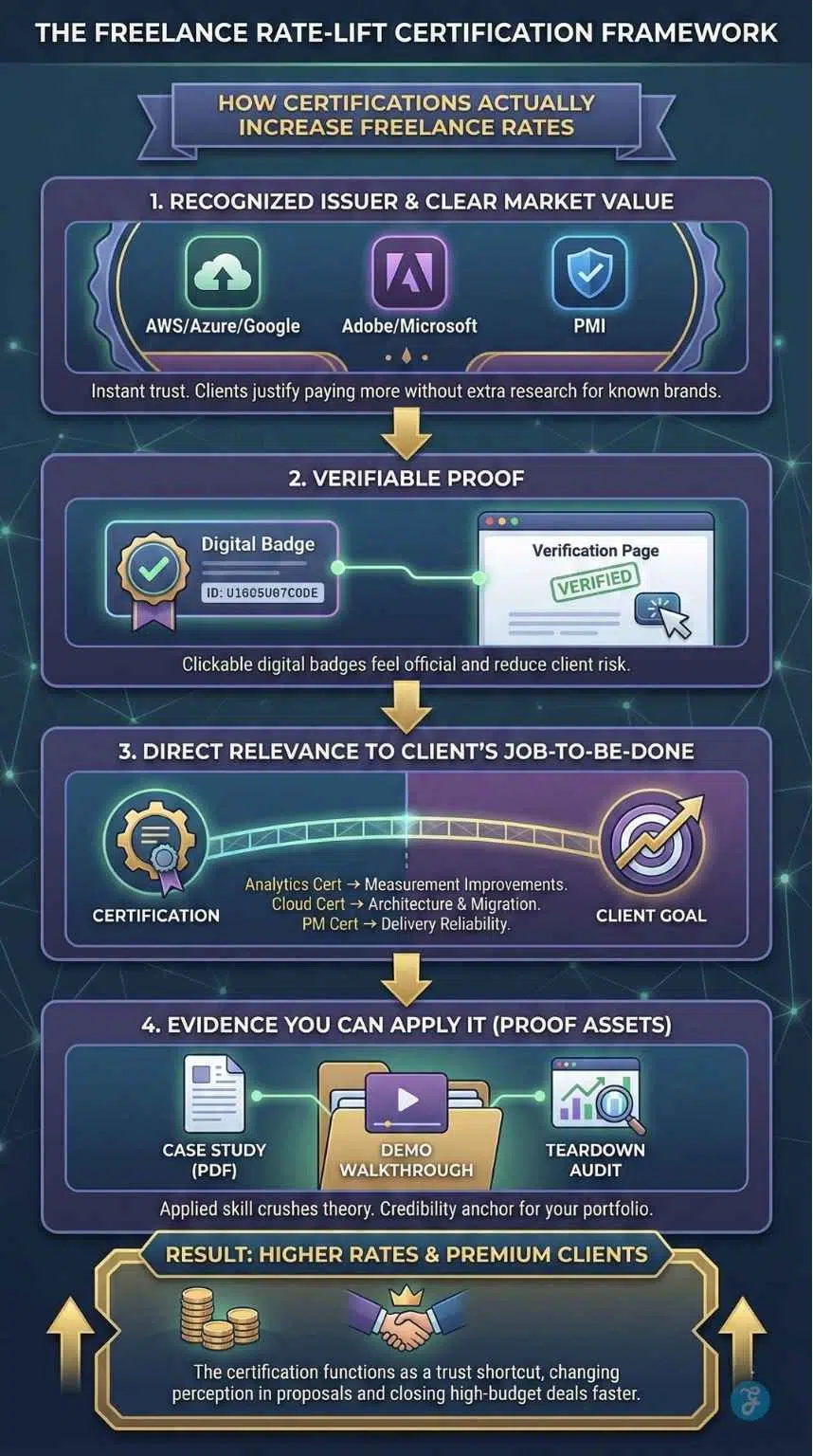
A certification boosts your rates when it changes how clients perceive you in the first 30 seconds. That usually happens in proposals, discovery calls, and platform searches where buyers filter fast. Your job is to make the certification function like a trust shortcut.
Here are the strongest “rate-lift” signals clients consistently respond to.
Recognized Issuer and Clear Market Value
A credential from a known issuer is easier for clients to understand. If a buyer recognizes AWS, Google, Microsoft, Adobe, or PMI, they can justify paying more without researching your background. That matters even more for enterprise clients, agencies, and procurement-heavy teams.
Unknown course brands can still be useful for your skills. But they rarely raise your rates by themselves unless you convert them into outcomes and case studies.
Verifiable Proof
Buyers increasingly expect proof they can click or verify. Digital badges, credential IDs, and public verification pages are useful because they feel “official.” This is also why platform badges can outperform many external certificates.
Direct Relevance to the Client’s Job-To-Be-Done
A certification is not valuable in isolation. It becomes valuable when it matches the buyer’s real problem.
- A Google Analytics credential matters when you sell measurement, attribution, and conversion improvements.
- A cloud certification matters when you sell architecture, migrations, performance, or security.
- A project management credential matters when you sell ownership, delivery reliability, and stakeholder control.
Evidence You Can Apply It
Clients want applied skill, not theory. The fastest way to make a certification raise your rate is to pair it with one concrete proof asset:
- A one-page case study
- A teardown audit
- A before-and-after result
- A demo video walkthrough
- A mini project portfolio piece
When you do that, the credential becomes a credibility anchor for your proof.
Recency and Continuous Learning
Certifications lose power when they look outdated. In tech, updates happen quickly. Some credentials even retire. Recency signals that you can work with current tools, current policies, and current best practices.
How to Choose the Right Certification [The ROI Framework]
Most freelancers choose certifications based on what looks impressive. That is backwards. Choose based on your offer, your target client, and the fastest path to measurable revenue.
Use this framework before you pay for anything.
Step 1: Start With Your Offer and Price Tier
Your target price tier determines what kind of proof you need.
- Entry tier: Clients want basic competence and reliability. Low-cost credentials and platform proof help.
- Mid-tier: Clients want proven systems and results. A strong certificate plus portfolio proof wins.
- Premium tier: Clients want risk reduction. They look for recognized issuers, platform vetting, and deep case studies.
- Enterprise tier: Clients want credibility, security awareness, and a delivery process. Vendor certifications and rigorous badges matter more.
If your goal is premium pricing, stop collecting random certificates. Build a tight stack that supports a premium offer.
Step 2: Match the Certification to Client Demand
Do not guess what clients want. Pull up real job posts and look for repeated requirements:
- Tools mentioned over and over
- Platforms clients request by name
- “Nice to have” skills that appear frequently
- Compliance or security hints (common in enterprise work)
Then select certifications that map to those requirements.
This is where Best Certifications For Freelancers becomes practical. The “best” depends on what buyers in your niche repeatedly ask for, not what is popular on social media.
Step 3: Calculate Payback, Not Prestige
Use a simple payback estimate:
- Total cost = course fees + exam fees + time cost
- Rate increase = expected hourly or project uplift
- Payback = total cost divided by extra monthly profit
If a certification costs $300 and it helps you raise your average project by $150, you need only two projects to break even. That is a strong ROI. If a certification costs $2,000 and you cannot clearly explain how it creates revenue, it is not an investment. It is entertainment.
Step 4: Choose Credentials That Create Proof Assets
A good certification should naturally produce outputs you can show:
- Dashboards
- Architecture diagrams
- Project plans
- Design systems
- Tracking setups
- Automation workflows
- Audits and recommendations
If the certification does not help you create proof, it will not help you raise rates. So, choose accordingly, free Google certifications vs. paid bootcamps, and see which one actually gets clients.
Turn Any Certification Into a High-Paying Offer [The 3-Step Mapping Method]
A certification doesn’t raise your rate by existing. It raises your rate when it upgrades your offer from “I can do tasks” to “I deliver outcomes.” Use this simple mapping method to connect any credential to a client-ready service.
Step 1: Pick One Buyer Outcome
Choose one specific outcome buyers already pay for. Examples:
- “Accurate conversion tracking in GA4”
- “Lower ad waste by fixing attribution”
- “Cloud cost reduction with better architecture”
- “A faster design production workflow”
- “Reliable project delivery with fewer delays”
- “AI automation that saves the team hours each week”
Step 2: Convert the Outcome Into a Productized Service
Turn that outcome into a package with clear deliverables. Use this structure:
Package Name → Problem → Deliverables → Timeline → Price Range
Example:
GA4 Tracking Fix Sprint
Problem: “We can’t trust our numbers.”
Deliverables: audit + event map + implementation plan + testing checklist
Timeline: 7–10 days
Price Range: premium project fee
Step 3: Build One Proof Asset That Mirrors Real Client Work
Choose one proof asset that looks like the client’s world:
- A sample dashboard
- An audit template
- A short case study
- A demo walkthrough video
- A “before/after” result slide
If you do this, the certification becomes a “trust stamp” on top of proof instead of a weak claim.
Best Certifications For Freelancers: The Credential Types That Win
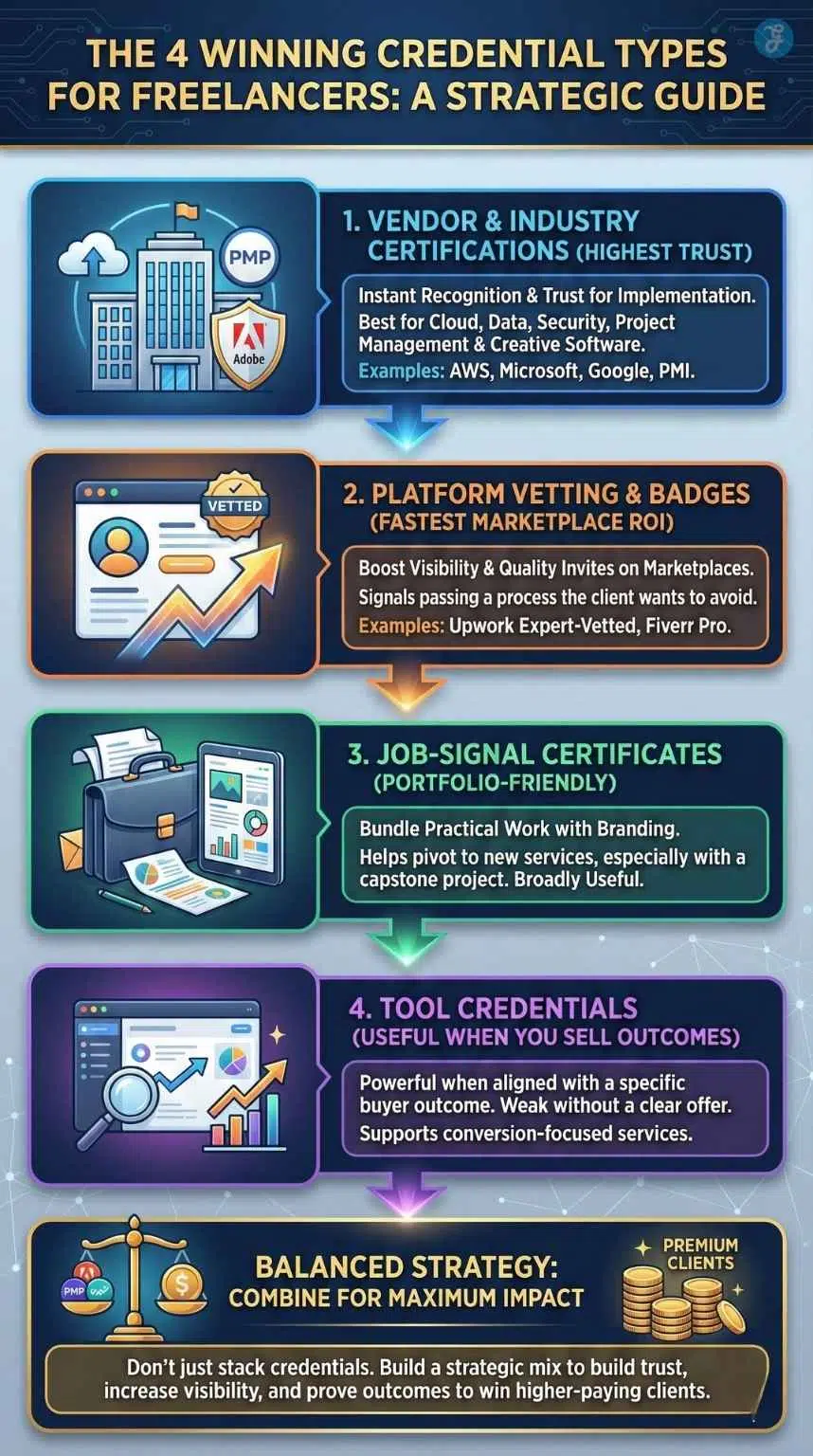
Not all credentials function the same. The winners fall into four categories. This helps you build a balanced strategy instead of stacking credentials that do the same job.
1) Vendor and Industry Certifications (Highest Trust)
These carry instant recognition. They work well for freelancers selling implementation work in cloud, data, security, marketing tools, and project management.
Examples include cloud certifications, project management credentials, and recognized creative software credentials.
2) Platform Vetting and Badges (Fastest Marketplace ROI)
On marketplaces, platform trust signals can increase your visibility and the quality of invites you receive. Some badges signal that you passed a process that the client does not want to do themselves.
This is why platform vetting can raise rates faster than a traditional certificate. Learn and earn verified badges, Upwork expert-vetted, or Fiverr Pro to gain trust.
3) Job-Signal Certificates (Portfolio-Friendly, Broadly Useful)
Some certificate programs are strong because they bundle practical work with recognizable branding. They often help freelancers pivot into new service lines, especially when paired with a capstone project.
4) Tool Credentials (Useful When You Sell Outcomes)
Tool certifications work best when they align with a specific buyer outcome. A tool badge without a clear offer is weak. A tool badge that supports a conversion-focused offer can be powerful.
Platform Credibility: Badges That Can Raise Rates Faster Than Certificates
If you earn income from Upwork, Fiverr, or similar platforms, your biggest bottleneck is often not skill. It is trust and visibility. Badges and vetting programs can move you into better client segments, which gives you leverage to raise rates.
Upwork Expert-Level Badges and Vetting
Upwork’s higher-trust tiers can signal stronger quality to clients scanning search results. Enterprise buyers often prefer vetted talent because the platform has already reduced risk. If your niche fits enterprise budgets, treat platform vetting as part of your credential strategy.
Fiverr Pro and High-Tier Positioning
On Fiverr, vetted programs and Pro positioning can change who sees you and what buyers expect to pay. It also pushes you away from bargain shoppers and toward clients who want premium work.
Fiverr Skill Tests and Category Requirements
Many freelancers still talk about platform tests as if they work the same way they did years ago. Treat tests as one possible filter, not the main strategy. You can pass Fiverr skill tests using some tips and tricks. Your bigger advantage comes from portfolio proof, strong gig packaging, and visible outcomes.
Best AI and Prompt Engineering Certifications for Freelancers
AI is no longer only for “AI engineers.” Clients expect freelancers in marketing, content, operations, analytics, and development to work faster and smarter using AI-assisted workflows.
AI credentials increase rates when they do two things:
- Prove you can use AI responsibly and effectively
- Prove you can implement AI into business workflows, not just write prompts
Who Should Prioritize AI Credentials
Prompt engineering certifications and AI-focused credentials can directly raise rates for:
- Marketers who build AI-assisted campaigns, testing, and reporting
- Writers who deliver research, outlines, and content systems faster
- Analysts who use AI to speed up cleaning and insights
- Operations freelancers who automate internal workflows
- Developers who build AI features or integrate AI tools
- Consultants who lead AI adoption and change management
What to Look for in an AI Credential
Choose programs that include:
- Workflow design and real use cases
- Evaluation and quality control methods
- Privacy and data handling guidance
- Practical exercises that create portfolio outputs
If you cannot show an artifact, clients will treat it like a hobby badge.
The AI Credential Stack That Sells
For many freelancers, the best stack is:
- One AI fundamentals credential for credibility
- One hands-on credential or project for proof
- One niche-specific proof asset that matches the service you sell
Best Certifications For Freelancers increasingly include an AI component, even if your core service is not technical.
Best Marketing, SEO, and Analytics Certifications for Freelancers
Marketing certifications only raise rates when you sell results. Clients do not pay extra for “knowing ads.” They pay extra for lower acquisition costs, higher conversion rates, better tracking, and better decision-making.
Analytics and Measurement Credentials
If you sell growth work, measurement is leverage. Certifications that validate analytics knowledge can support higher retention because they reduce the risk of wasted spend.
Focus on credentials that align with:
- GA4 setup and property structure
- Reporting and insights
- Conversion measurement and event tracking
- Attribution understanding
Then build one proof asset:
- A sample dashboard
- A tracking audit template
- A short “insights report” case study
Performance Marketing and Ads Credentials
Ads certifications help when you sell:
- Conversion-focused campaign setup
- Landing page and funnel improvements
- Creative testing systems
- Reporting and optimization cadences
Pair your credential with proof:
- Example account structure
- Sample testing plan
- A mini case study using anonymized data
SEO Credentials That Actually Help
SEO is messy because there is no single universally “official” SEO certification that clients trust the way they trust cloud or PMI credentials. In practice, SEO certifications raise rates when they support a clear offer:
- Technical SEO audits
- Keyword research and content strategy
- On-page optimization and internal content systems
- Analytics-driven SEO reporting
If you are writing this pillar for SEO audiences, make it practical. Explain that the credential is the start, but the real rate increase comes from your systems and proof.
Best Cloud Certifications for Freelancers [AWS vs. Azure and More]
Cloud certifications often have the highest rate ceilings because cloud projects can be expensive and risky. A strong cloud credential can justify premium pricing, especially when clients worry about security, downtime, and architecture decisions.
Who Benefits Most From Cloud Certifications
Cloud credentials raise rates for freelancers doing:
- Solutions, architecture, and system design
- Migrations
- DevOps and infrastructure automation
- Performance tuning and reliability work
- Security and compliance support
- Data engineering and ML infrastructure
AWS vs. Azure: How Freelancers Should Choose
Your choice should match the client’s reality:
- If your clients are startups, SaaS teams, and product companies, AWS demand is often strong.
- If your clients are enterprise, Microsoft-heavy, or already using Azure tools, Azure can be the better path.
- If you serve data-heavy organizations or teams deep into Google’s ecosystem, Google Cloud credentials can matter.
Do not pick based on hype. Pick AWS vs. Azure based on where your buyers already spend money.
Watch Out for Retiring Certifications
Some certifications retire. That matters because you do not want to invest months into a credential that is about to disappear. A practical example is AWS’s machine learning specialty certification retirement timeline. If you want an ML signal on AWS, plan your credential path accordingly.
The Best Certifications For Freelancers are the ones that align with real client stacks and current exam paths, not outdated lists copied from old blogs.
Best Design and Creative Certifications [Including Adobe Credentials]
Design clients care about taste, output quality, and reliability. Many clients value a strong portfolio more than a certificate. Still, creative certifications like the Adobe Certified Professional Badge can raise rates in three situations:
- You work with agencies or enterprise teams that want formal validation
- You teach or consult and need credibility
- You compete in crowded marketplaces where a badge helps you stand out
When Adobe Credentials Are Worth It
An Adobe credential can help when you sell:
- Production-heavy work at scale
- Brand consistency systems
- Repeatable asset creation workflows
- Professional-grade file management and export standards
It can also support premium positioning when paired with strong proof like a design system, brand guideline samples, or a before-and-after redesign case study.
When It Is Not Worth It
If your clients hire you primarily for style and creative direction, the certificate rarely closes the deal alone. Your rate will rise faster from:
- Strong portfolio curation
- Clear niche positioning
- Proof-based case studies
- A smooth client experience
Project Management Certifications for Freelancers: Charge for Ownership
Project management credentials raise rates because they change your role. You stop being “a doer” and start being “the person who makes the project succeed.” That shift is one of the most reliable ways to move from hourly pricing to premium retainers.
When PM Certifications Raise Rates Fast
PM credentials are especially valuable when you handle:
- Multi-stakeholder projects
- Cross-functional work with designers, developers, and marketing teams
- Timelines, risk, and scope control
- Vendor coordination
- Process building and operations
Clients pay for reduced chaos. That is premium value.
Google Project Management vs. PMP
Think of these as different lanes, Google Project Management vs. PMP, which one boosts freelancing rates:
- A Google project management certificate can be a strong on-ramp for freelancers moving into PM, ops, or coordinator roles.
- PMP is often a premium enterprise trust signal for experienced PMs and delivery leaders.
If you want the highest rate impact, pair a PM credential with a visible delivery system:
- Kickoff templates
- Risk registers
- Weekly update formats
- Stakeholder communication routines
Free Certifications vs. Paid Programs: What Actually Gets Clients
You deserve clarity because freelancers waste money here. A free certification can absolutely help you raise rates if it is tied to an offer that buyers already understand. A paid program can fail completely if it produces no proof and no client-facing positioning. Compare both a free Google certification vs. a paid bootcamp and find out which one gets you more clients.
Free Can Win When the Credential Is Recognized
Free or low-cost training works when it produces a badge tied to a well-known platform or tool. Clients often trust these because they already use the tool.
Paid Can Win When It Produces Portfolio and Positioning
Paid programs win when they provide:
- Practical projects you can show
- A structure that forces completion
- A capstone that looks like real client work
- A story you can use in proposals and on LinkedIn
If the program does not help you sell, it does not matter how expensive it is.
Course Scams: How to Spot Fake Gurus and Useless Certificates
The certification market is noisy. Scammers sell “certificates” that look official but have zero market value. You do not need paranoia. You need a simple filter to understand a course scams in 2026.
Red Flags That Usually Signal a Scam
- “Guaranteed clients” or “guaranteed income”
- No clear issuer identity or verification method
- No syllabus, no skills list, no exam details
- No portfolio outputs
- Heavy pressure tactics and fake urgency
- Testimonials that feel vague or duplicated
- Claims that conflict with industry reality
A Simple Vetting Checklist Before You Pay
Ask these questions:
- Can a client verify the credential publicly?
- Is the issuer recognized in your niche?
- Does it produce proof assets you can show?
- Will it improve your offer or positioning in one sentence?
- Can you calculate payback with a realistic rate uplift?
If you cannot answer these clearly, skip it. This is also where the Best Certifications For Freelancers concept becomes protective. A tight credential plan keeps you from chasing shiny objects.
How to Add Certifications to LinkedIn and Freelance Profiles [So They Convert]
A certification that no one sees has no value. Presentation is part of the strategy.
You want your credentials to show up where buyers actually decide:
- Marketplace profile previews
- LinkedIn search results
- Proposals
- Discovery calls
- Your portfolio site
LinkedIn Placement That Drives Inbound
Use certifications in three places on LinkedIn to attract recruiters:
- Headline and About section: Mention the credential only if it supports your offer.
- Licenses and Certifications: Add the credential with the issuer and dates.
- Featured section: Add a proof asset that shows the result of your skill, not just the badge.
A helpful pattern is: credential + outcome + proof. For example, “GA4 certified, builds conversion tracking systems, see sample dashboard.”
Proposal and Portfolio Integration
In proposals, do not list ten certifications. Mention the one that matches the job’s biggest risk.
Then attach a proof asset:
- A short audit example
- A mini case study
- A screenshot of a deliverable
- A one-page process overview
That is how a credential becomes money.
How to Mention Certifications Without Lowering Your Perceived Value
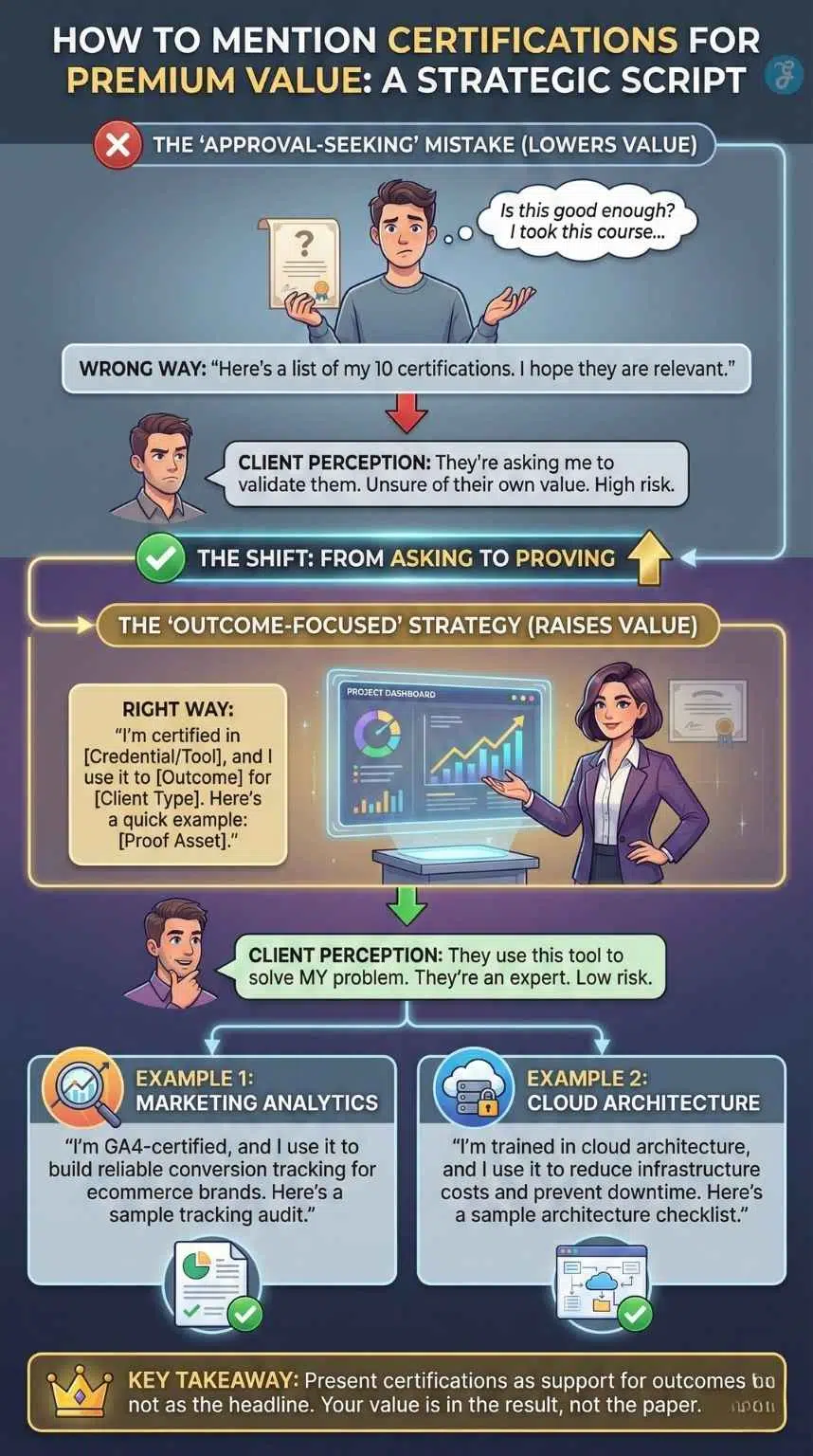
Never present certifications like you’re asking for approval. Present them as support for outcomes.
Use This Simple Script
- “I’m certified in [credential/tool], and I use it to [outcome] for [client type].”
- “Here’s a quick example: [proof asset].”
Examples:
- “I’m GA4-certified, and I use it to build reliable conversion tracking for ecommerce brands. Here’s a sample tracking audit.”
- “I’m trained in cloud architecture, and I use it to reduce infrastructure costs and prevent downtime. Here’s a sample architecture checklist.”
What to Avoid
- Listing 10 certifications with no explanation
- “I took this course” language
- Making credentials the headline instead of results
What to Build After You Get Certified [Proof Assets That Win Clients]
Your certification should trigger one immediate output you can publish, attach, or show on a call.
Marketing and Analytics
- Tracking audit template (PDF)
- Sample dashboard (screenshots + short Loom walkthrough)
- “90-day testing plan” one-pager
SEO and Content Strategy
- Keyword map + content brief template
- On-page audit checklist
- One published case study showing improvement (even from a small project)
Cloud and DevOps
- Architecture diagram (sanitized example)
- Deployment or migration checklist
- Cost-optimization report template
AI and Automation
- Workflow demo (video or mini case study)
- “AI policy and privacy checklist”
- Evaluation checklist (how you test outputs for quality)
Design and Creative
- Mini brand system (typography + color + components)
- Before/after redesign with explanation
- Production workflow board (how you deliver fast)
Project Management
- Kickoff packet template
- Weekly status report template
- Risk register and scope-control checklist
This makes buyers feel safe because they see what you actually produce.
The 30-Day Certification Plan to Raise Your Rates
Most freelancers fail here because they try to do everything at once. Your goal is not to collect badges. Your goal is to build a revenue story.
Here is a simple 30-day plan you can repeat each quarter.
Week 1: Choose One Primary Credential and One Proof Output
- Pick one certification that matches your target client’s stack.
- Decide on the proof asset you will produce by the end of the month.
Examples of proof assets:
- Marketing: tracking audit + dashboard template
- Cloud: architecture diagram + migration checklist
- PM: kickoff pack + weekly update system
- Design: mini brand system + before-and-after redesign
- AI: workflow demo + evaluation checklist
Week 2: Build a Client-Facing Offer Around It
Write a tight offer statement:
- “I help [client type] achieve [outcome] using [system/tool].”
Then create a simple package:
- Scope, timeline, deliverables, price
Week 3: Update Your Profiles and Pitch Materials
- Update your profile overview to include the offer statement.
- Add the certification in the right sections.
- Add the proof asset to the featured media or portfolio.
Week 4: Test Pricing and Outreach
Raise your rates in a controlled way:
- Increase new client pricing by 10% to 20%
- Pitch 20 prospects with your proof asset
- Track replies, call bookings, and close rate
If the market responds well, raise again. By the end of this process, your certification turns into a story. That story is what increases pricing power.
Quick Comparison Table: Choose Certifications by Outcome
| Goal | Best Credential Type | What to Show Clients | Best Pricing Model |
| Higher Upwork or Fiverr rates | Platform badge or vetting | Profile proof + case studies | Project pricing |
| Higher marketing retainers | Analytics and ads credentials | Dashboards, audits, performance wins | Monthly retainer |
| High-ticket tech projects | Cloud and security credentials | Architecture, checklists, deployments | Project + support retainer |
| Premium design work | Creative tool + portfolio proof | Design systems, before/after, process | Package pricing |
| Leadership and ownership work | PM credentials + delivery system | Templates, plans, reporting cadence | Retainer or PM fee |
Build a Smart Certification Stack (Without Collecting Random Badges)
The fastest way to waste time is stacking certifications that don’t change what clients pay you. A smart stack is small, intentional, and designed to support a specific offer.
Use this structure:
The 3-Part Stack That Actually Increases Rates
1) One Core Credential (Revenue Driver)
This is the certification that matches your highest-paying service line. It should connect to a buyer outcome in one sentence.
2) One Supporting Credential (Trust Booster)
This credential reduces objections. It might prove measurement skill, security awareness, professional workflow, or delivery capability.
3) One Proof Asset (Deal Closer)
This is the visible output that makes the credential real. Without proof, the certification becomes a claim—and claims don’t raise rates.
How to Pick Your Stack in 5 Minutes
Ask yourself:
- What do my best clients actually pay for?
- What tool, platform, or system do they already trust?
- What is the biggest risk they worry about (wasted budget, downtime, bad data, delays, weak quality)?
- What proof could I show to reduce that risk immediately?
If you can’t answer those questions, you’re not ready to choose a credential yet. Start by refining your offer first.
The “Two-Cert Rule”
For most freelancers, the best strategy is two credentials max at a time:
- Core: supports your main service and pricing tier
- Supporting: strengthens trust and reduces objections
Anything beyond that usually becomes busywork unless it unlocks a new service line or a higher client tier.
Why This Works
Clients don’t reward you for learning. They reward you for:
- Faster delivery
- Fewer mistakes
- Clearer outcomes
- Smoother communication
- Lower risk
Your stack is only valuable if it helps you sell those benefits.
Top 10 Certification Bundles by Freelancer Type [Built to Raise Rates]
These bundles are designed around one idea: one core credential that matches what clients pay for + one supporting credential that strengthens trust + one proof asset that makes it sellable. Pick the bundle closest to your real service and client type, then build a visible result.
1) SEO Content Strategist (Pillar + Topical Authority + Measurable Growth)
- Core credential direction: Analytics + Measurement (GA4-focused)
- Supporting credential direction: AI workflow / prompt engineering fundamentals
- Why this bundle raises rates: Clients pay more when you can connect content to outcomes, not just words.
- Proof asset to build: A “Content ROI Pack” (keyword map + brief template + sample reporting dashboard screenshots)
2) SEO Specialist (Technical + On-Page + Audits)
- Core credential direction: Analytics + Tagging/Tracking basics
- Supporting credential direction: Structured SEO auditing workflow (process-based certificate or recognized training)
- Why it raises rates: Technical clarity reduces risk and shortens time-to-results.
- Proof asset to build: A Technical SEO Audit sample (sanitized) + checklist + before/after case study format
3) Performance Marketer (Google Ads / Paid Social)
- Core credential direction: Ads platform certification (Google Ads / Meta-style skill validation where relevant)
- Supporting credential direction: GA4 + conversion tracking
- Why it raises rates: You become the person who not only runs ads but also proves what’s working.
- Proof asset to build: A “90-Day Growth Sprint Plan” + reporting template + testing calendar
4) Marketing Analytics / Tracking Specialist (High Retainer Potential)
- Core credential direction: GA4 + measurement and reporting
- Supporting credential direction: Tag Manager/event mapping workflow (or structured analytics program)
- Why it raises rates: Tracking fixes and attribution clarity are painful problems with a real budget.
- Proof asset to build: A tracking audit + event taxonomy doc + QA checklist
5) AI Automation Freelancer (Operations, Marketing, or Support Workflows)
- Core credential direction: AI fundamentals + workflow design (vendor-aligned if possible)
- Supporting credential direction: Cloud basics or security fundamentals (to reduce “risk” objections)
- Why it raises rates: Automation saves time; clients pay for time saved and errors avoided.
- Proof asset to build: A demo automation with a short walkthrough + “AI safety & privacy checklist.”
6) Cloud Freelancer (Solutions Architect / Infrastructure Consultant)
- Core credential direction: Cloud architecture path (AWS or Azure, depending on client base)
- Supporting credential direction: Security fundamentals (or a security-focused track)
- Why it raises rates: Architecture + security is premium. It signals reliability for serious projects.
- Proof asset to build: A reference architecture diagram + migration/runbook checklist
7) DevOps / Site Reliability Freelancer (Premium Tech Contracts)
- Core credential direction: Cloud + DevOps track
- Supporting credential direction: Linux/networking fundamentals or security baseline
- Why it raises rates: You’re selling uptime, deployment stability, and incident prevention.
- Proof asset to build: CI/CD pipeline outline + incident response checklist + monitoring plan
8) UX/UI Designer (Higher-End Product Teams)
- Core credential direction: UX credential path (structured program)
- Supporting credential direction: Adobe/Figma workflow credential (only if it supports your niche)
- Why it raises rates: UX cert + strong artifacts make you look like a product partner, not a “screens” person.
- Proof asset to build: A mini case study with problem → wireframes → UI → rationale → outcome
9) Graphic / Brand Designer (Agency + Enterprise Credibility)
- Core credential direction: Adobe Certified Professional (if your buyers value it)
- Supporting credential direction: Brand systems/process training
- Why it raises rates: It signals professional production standards and repeatable delivery.
- Proof asset to build: A mini brand system (logo usage + type + color + components) + export standards checklist
10) Freelance Project Manager / Delivery Lead (Ownership Pricing)
- Core credential direction: PM certification path (Google PM as on-ramp; PMP as premium target)
- Supporting credential direction: Agile/Scrum fundamentals
- Why it raises rates: You’re selling “smooth delivery” and executive communication.
- Proof asset to build: Kickoff pack + weekly update template + risk register + scope control workflow
How to Use These Bundles (Fast):
- Pick one bundle that matches your current offers
- Commit to one core credential + one proof asset in 30 days
- Add a supporting credential only if it helps you win a higher client tier
- Then update: profile, proposals, and one featured proof item (this directly supports your LinkedIn cluster)
Certification Watchlist: How to Stay Current Without Chasing Every Trend
Certifications change. Some update their exams, rename tracks, or retire older versions. The best strategy is not “collect more.” It is “stay current in the credentials that match your niche.”
How to Stay Current
- Review your niche’s job posts every quarter
- Keep one “core credential” updated
- Add one “supporting credential” only if it unlocks a new service line
- Refresh your proof assets whenever a tool changes significantly
Avoid This Trap
If you keep getting new certifications but you don’t have new proof assets or better clients, you’re doing education, not business building.
Wrap-Up: Certifications That Pay Off
The Best Certifications For Freelancers are not the most popular ones. They are the ones that match your client’s stack, reduce their risk, and help you prove outcomes quickly.
Pick one credential, build one proof asset, and update your positioning. Then raise your rates in small controlled steps while you measure market response. That is how certifications turn into premium pricing.