

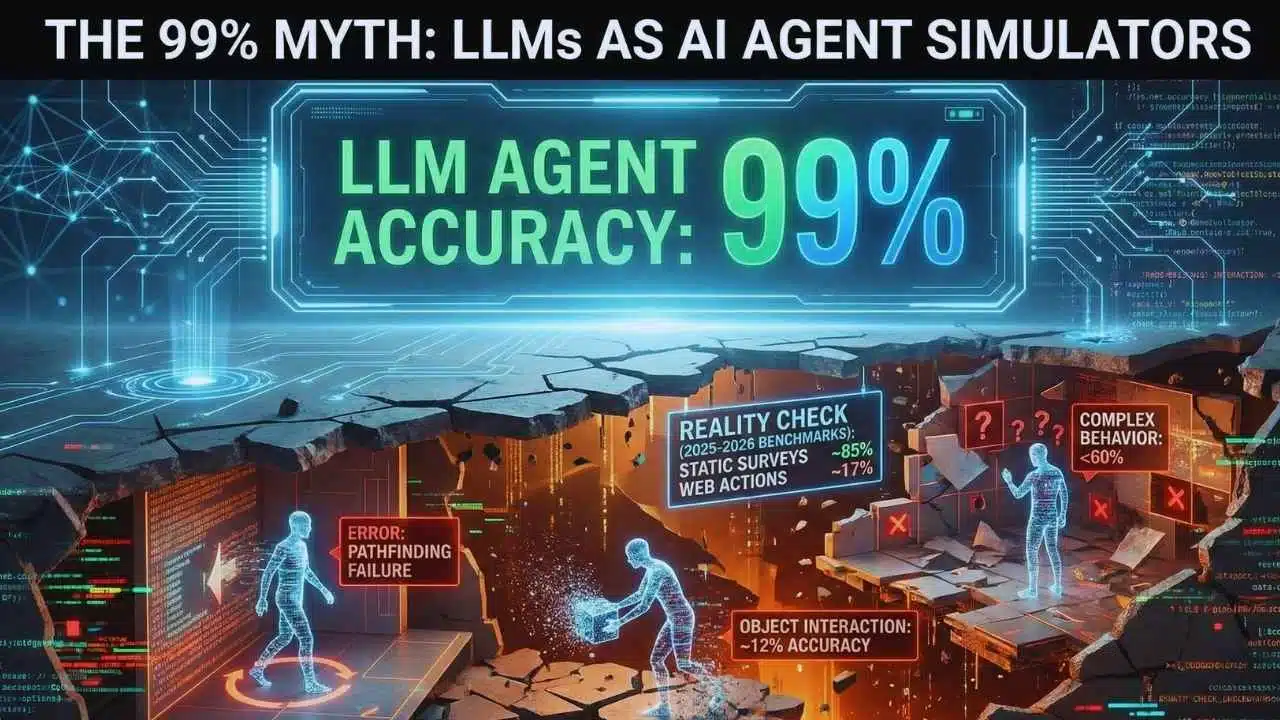
New studies show an AI Agent Simulator built on large language models can match tightly defined scenarios with near-99% agreement in certain evaluations. But results vary sharply across domains, and “accuracy” often measures narrow consistency—not broad real-world reliability.
What An AI Agent Simulator Is, And Why It Matters Now?
An AI Agent Simulator uses a large language model (LLM) to imitate a person or role—such as a patient describing symptoms, a customer shopping online, or a user navigating a support chatbot. Instead of recruiting humans for every test, teams run thousands of simulated conversations to see how an AI product behaves across many situations.
The momentum behind this idea is simple: modern AI tools are shifting from “one answer” systems to agents that take steps, ask follow-up questions, follow policies, and sometimes use external tools. When an AI system has to act across multiple turns, small mistakes early in a conversation can lead to big failures later. Simulation promises a faster way to identify those failures before real users encounter them.
Organizations are also looking for safer ways to test sensitive workflows. In areas like healthcare, customer support, and finance, teams want evaluation data without exposing personal details or relying on small, expensive user studies. Simulators can generate standardized test interactions repeatedly and consistently, which helps compare versions of a system during development.
That said, simulation can create a false sense of certainty if readers assume the simulated “user” behaves like a real human. Human behavior is inconsistent, emotional, distracted, and sometimes illogical. A simulator that appears “correct” in a structured test may still miss exactly those messy behaviors that break real products.
Where The “99% Accuracy” Claims Come From?
When people see “99% accuracy” attached to LLM-based simulators, it usually refers to one specific metric inside one specific setup, not a universal measure of truth.
In healthcare-style simulation research, for example, a model may be asked to behave like a patient described in a short clinical vignette. Expert reviewers then judge whether the simulated conversation stayed consistent with that vignette. Under those conditions, results can be very high—because the task is constrained, the target behavior is known, and the evaluation is often focused on alignment with the scenario rather than perfect medical correctness.
But “99%” can also refer to something narrower than the conversation itself, such as whether a generated summary includes the relevant points from the dialogue. A summary can be “highly relevant” even if the conversation drifted in subtle ways. In other words, the simulator might be good at producing plausible text that matches the expected shape of a case, while still missing the unpredictability of real users.
The most important takeaway is that “accuracy” is not a single standard term in this space. Different teams report different measurements:
- Scenario consistency: Did the simulator stick to the given persona or vignette?
- Information coverage: Did it mention the key facts a tester expects?
- Action prediction: Did it choose the same next step a real user took?
- Outcome match: Did the simulated session end the same way as a human session?
Those measurements are not interchangeable. A simulator can score extremely high on scenario consistency and still be weak at predicting real behavior in messy, open-ended environments.
Why A Simulator Can Score “99%” Without Being “99% Reliable”?
| What’s Being Scored | What A High Score Usually Means | What It Does Not Guarantee |
| Vignette/Persona Consistency | The simulator stayed faithful to a predefined script-like scenario | That real humans would behave the same way |
| Summary Relevance | The summary captured expected topics from the dialogue | That every detail in the dialogue was correct |
| Next-Step Accuracy | The simulator picked the same immediate action as the dataset’s user | That it will generalize to other sites, products, or users |
| End-Outcome Match | The flow reached the same end state as a recorded session | That the reasoning was correct or safe |
What The Broader Evidence Shows Across Domains?
When you look across research directions, a pattern emerges: high performance often appears in tightly framed simulations, while performance drops in open-world behavior imitation.
Healthcare And Structured Roleplay
Healthcare simulation tends to be more structured. If a vignette says a patient has a specific symptom set, the simulator’s job is to express those symptoms consistently, answer questions in a coherent way, and avoid contradicting itself. If clinicians evaluate whether the conversation “fits” the scenario, a well-tuned LLM can do very well.
This can be useful for early-stage testing of triage scripts, conversational flows, and documentation pipelines. It can also help teams stress-test how a system handles rare combinations of symptoms or edge cases that are hard to capture with small human studies.
But there are limits. Simulated patients do not experience real pain, anxiety, or confusion. They also don’t have genuine uncertainty, memory lapses, or miscommunication patterns that human patients routinely show. So even if simulation is strong as a consistency tool, it still needs careful validation before anyone treats it as a stand-in for real clinical interactions.
Consumer Behavior And Shopping Sessions
In consumer behavior simulation, the challenge becomes harder. Real shoppers do not follow a single “correct” path. Many actions are plausible: compare products, read reviews, change filters, abandon a cart, return later, or switch platforms entirely.
In datasets built from real online shopping sessions, the task is often framed as predicting the next user action from the session context. That is a strict test: the simulator must guess the exact next click or step a person took. Under that lens, performance can look much lower—even when the simulator’s alternative action would still be reasonable for a human.
This difference is crucial for interpreting headlines. A simulator might generate a believable shopper conversation while still scoring low on “exact next-step match.” That doesn’t mean the simulator is useless, but it does mean the reported metric should be read carefully. It also highlights a deeper issue: human behavior is multi-modal—many possible next steps can make sense, but the dataset records only one.
Agentic Safety And Multi-Step Workflows
As AI systems become more agent-like, evaluators increasingly care about multi-step safety: data privacy, policy adherence, fraud resistance, and the ability to refuse unsafe actions consistently.
Here, simulation becomes both powerful and risky. It is powerful because it can scale testing and probe many policy edge cases. It is risky because simulated “users” can behave in more orderly ways than real adversarial users, and simulated environments might not capture the complex incentives that exist in the real world.
A major practical challenge is that agent failures are often trajectory failures—the final answer might look acceptable, but along the way the system may have exposed sensitive information, used a forbidden tool, or followed an unsafe instruction. Simulation frameworks are increasingly designed to score these multi-step behaviors, not just final outputs.
Reasoning Under Complexity: When Performance Can Drop Suddenly?
Another thread relevant to simulators is how LLM behavior changes as tasks become more complex. In many areas, models can look strong on simple or moderate tasks, then fail sharply at higher complexity. This matters for agent simulation because real users often push systems into complex situations: contradictory requirements, partial information, multi-constraint requests, and long back-and-forth sessions.
For a simulator, complexity can create drift: a persona starts consistent, then gradually changes details; a goal shifts; preferences become inconsistent; or earlier facts are forgotten. These failure modes may not show up in short tests but become obvious over long interactions.
How To Judge Simulator Claims Like A Pro?
If you’re reading research or product claims about an AI Agent Simulator, there are a few questions that quickly reveal whether the result is broadly meaningful or narrowly defined.
A Reader’s Checklist For Interpreting “High Accuracy” Claims
| Question To Ask | Why It Matters | What A Strong Answer Looks Like |
| What exactly was measured? | “Accuracy” can mean many different things | Clear metric definition + examples |
| How open-ended was the task? | Narrow roleplay is easier than real behavior imitation | Multiple environments + varied user types |
| Was evaluation done by humans, models, or both? | Automated judges can miss subtle errors | Mixed evaluation with inter-rater detail |
| How long were conversations? | Drift appears more in long, multi-turn sessions | Long-horizon tests included |
| Were failure cases shown? | High averages can hide dangerous tail risks | Transparent error analysis |
| Does it generalize across domains? | A medical vignette score doesn’t transfer to shopping | Cross-domain or out-of-domain checks |
A strong simulator paper or claim also clearly states what the simulator is not meant to do. For example, “This system is for testing triage conversation structure, not for clinical diagnosis.” Those boundaries matter because simulation can create persuasive text that feels correct even when it isn’t.
The rise of the AI Agent Simulator is part of a bigger shift AI is moving from answering questions to taking actions across real workflows. Simulation is becoming a key tool for testing those multi-step behaviors at scale.
But “99% accuracy” headlines often compress a complex story into one number. In many cases, the near-99% results come from narrow, structured tests where a simulator is judged on scenario consistency or summary relevance. In more open-ended domains—where humans behave unpredictably and many choices are reasonable—performance can look much weaker, especially under strict “exact match” scoring.
The safest way to interpret the trend is this LLM simulators are getting impressively good at controlled imitation, and they are genuinely useful for rapid testing. Yet they are not a universal substitute for real users, and they should not be treated as proof that an AI system is broadly reliable in the wild. The most responsible work in this space will be the work that pairs simulator scale with transparent metrics, long-horizon testing, and real-world validation.





















