Mobile gaming is no longer “small.” It is competitive, social, and constant. Streaming is no longer passive either. People watch live matches, jump into games, and share clips within minutes. That loop has become normal behavior, not a niche habit.
Now 5G is pushing that loop forward. The biggest change is not just faster downloads. It is how 5g cloud gaming in mobile gaming and streaming can feel smoother, quicker, and more reliable in more places. It can reduce the gap between what you want to do and what your connection allows you to do.
At the same time, the hype can get loud. Many people expect instant perfection everywhere. Real networks do not work that way. Coverage, congestion, and device limits still matter.
This guide stays practical. You’ll learn 10 clear ways 5G can change mobile gaming and streaming, plus the limits you should know before you upgrade your plan or phone. You’ll also get tips to improve results with the network you already have.
| What This Article Covers | Why It Matters | What You’ll Do With It |
| 10 real transformations | Better play, smoother streams | Use it to set expectations |
| Gaming + streaming together | New habits and features | Pick settings that fit your life |
| Trade-offs and tips | Avoid frustration and data shock | Improve quality with simple tweaks |
Quick Snapshot: What 5G Improves (And What It Doesn’t)
When people say “5G is faster,” they are usually thinking about download speed. That matters, but it is not the whole story. Gaming and streaming are more sensitive to stability than raw peak speed. A connection that stays steady often feels better than a connection that spikes high and drops low.
The most important improvements tend to be latency, jitter, and network capacity. Latency is the delay between your action and what the server returns. Jitter is how much that delay jumps around. Capacity is how well the network handles many users at the same time.
But 5G is not magic. It will not fix bad game servers. It will not rewrite how far you live from a data center. It will not automatically make your phone cooler during long sessions. It will not overcome weak indoor coverage in every building.
Think of 5G as a stronger foundation. When the foundation is good, everything on top can improve. When the foundation is shaky, you may still see problems. This section helps you understand what to expect, so the next 10 points make more sense.
| Metric | Why It Matters | What 5G Can Change |
| Download speed | Installs, patches, big files | Often faster peaks and better bursts |
| Upload speed | Live streams, clip uploads | Often higher, but varies by network |
| Latency (ping) | Input feel, cloud gaming | Can drop, especially on newer setups |
| Jitter | Smoothness and consistency | Often improves with better scheduling |
| Capacity | Crowded places | Better handling of many users |
| Indoor signal | Whether 5G works inside | Still depends on spectrum and building |
| Server distance | Ping to game servers | Mostly unchanged by radio tech alone |
10 Ways 5G Will Transform Mobile Gaming And Streaming
This is the heart of the article. Each transformation is practical and tied to something you can feel. Some changes will be immediate, like faster updates. Others will grow over time, like new edge-powered experiences.
It also helps to remember that “5G” is not one identical thing everywhere. Some networks are built to prioritize coverage. Others chase performance in dense cities. Your device’s modem and antenna design also matter.
So the goal here is not to promise perfection. The goal is to show how 5G shifts the ceiling upward. It can make higher quality possible more often. It can make new features more realistic for developers. It can reduce friction, which changes habits.
Read these 10 points like a menu. You may feel all of them. Or you may feel only a few, depending on where you live and how you play. Either way, this list will help you understand what to test and what to optimize.
| # | Transformation | Biggest Impact For |
| 1 | Lower latency feel | Competitive play, quick reactions |
| 2 | More usable cloud gaming | AAA gaming without installs |
| 3 | Faster downloads and updates | Live-service and large games |
| 4 | Higher-quality streaming | Video + cloud game visuals |
| 5 | Better in crowded places | Events, campuses, commutes |
| 6 | Cleaner creator uploads | Streamers and clip makers |
| 7 | Edge computing experiences | New features, lighter phones |
| 8 | Bigger AR and location games | Shared experiences outdoors |
| 9 | More consistent “priority” options | Premium plans, venues |
| 10 | Stronger “play anywhere” habits | Cross-play lifestyles |
1. Lower Latency That Makes Real-Time Play Feel More “Instant”
Latency is the silent deal-breaker in many games. You may have great graphics and high frame rate, yet the game still feels off. That is often latency. It shows up as delayed shots, late dodges, and awkward timing.
In competitive games, you feel latency in your hands. Your brain expects the result right away. When it arrives late, you overcorrect. That makes you miss more. It can also make you blame yourself when the connection is the real problem.
5G can reduce latency under the right conditions. The improvement is often more noticeable when you switch from a weak 4G signal to a strong 5G signal. It can also be noticeable when the network is less congested and your route to the server is efficient.
You may notice smoother aim, quicker movement response, and fewer “rubber band” moments. But remember: your ping to a game server still depends on distance and routing. So 5G can help, but it does not erase geography.
Practical examples where lower latency matters most:
- Competitive shooters and battle royale
- Fighting games and timing-heavy duels
- Rhythm games and music-based taps
- Sports games where passes and tackles are time-sensitive
2. Cloud Gaming Becomes More Usable On The Go
Cloud gaming turns your phone into a streaming screen for a powerful remote machine. The game runs elsewhere. Your phone receives the video stream and sends your controls back. That means cloud gaming is sensitive to both speed and responsiveness.
Before 5G, cloud gaming often felt like a “Wi-Fi only” feature. It could work well at home. But it could fail quickly outside, especially during commutes or in busy areas. The session might blur, stutter, or lag behind your inputs.
With 5G, cloud gaming can become more practical in everyday life. It can be easier to start a session without waiting. It can be more stable in places where 4G struggled. It can also reduce those sudden quality drops when the network gets busy.
This matters because cloud gaming changes what “mobile gaming” can be. You are not limited to games made for phones. You can access bigger titles without huge downloads, and you can jump in for short sessions.
Still, cloud gaming has two big realities:
- It can use a lot of data.
- It feels best when latency and jitter are stable.
If you want cloud gaming to feel good, treat stability like the top goal. Many players get better results at 720p with steady performance than at 1080p with constant drops.
3. Faster Downloads And Near-Instant Updates Reduce Friction
Modern games ship in pieces. You install the base game, then download updates, patches, and seasonal content. Some mobile games now take as much space as older console titles. If your connection is slow, the waiting can become part of the experience.
5G can reduce that friction. Faster downloads mean you spend more time playing and less time staring at progress bars. It also makes “try and delete” easier. You can experiment with more games without feeling punished by long installs.
Updates matter even more than installs. Live-service games push frequent changes. One patch might fix bugs. Another adds new maps. Another introduces a new season. If those updates take too long, you may skip playing altogether.
Faster updates also help streaming habits. You can download a game because you watched it on a stream, then join your friends quickly. That shortens the time between discovery and action, which keeps people engaged.
However, peak speed is not guaranteed all the time. Congestion can slow downloads. Servers can cap download rates. Your phone can also throttle if it overheats. 5G helps most when the full path from server to device is strong, not just the “signal bars.”
4. Higher-Fidelity Game Streaming And Video Streaming
Streaming quality is a moving target. Most platforms use adaptive bitrate. That means the stream constantly adjusts quality based on your connection. When your connection dips, quality drops to avoid buffering. When your connection improves, quality climbs.
With 5G, the stream has a better chance to stay in a higher quality range. This can mean sharper video, clearer text, and less blocky motion. For game streaming, it also means fast camera movement looks cleaner. For cloud gaming, it means fewer compression artifacts in dark scenes.
Higher quality also improves how you learn games. Watching a tutorial in crisp detail helps you see small mechanics. Watching esports in higher clarity helps you track plays. Streaming is not just entertainment. It is how many players improve.
But quality is not only about download speed. It is about stability. A connection that fluctuates wildly will still trigger quality drops. Also, indoor signal can change minute to minute. Even a great network outdoors might weaken inside.
If you want the best result:
- Use a realistic resolution for your situation.
- Let adaptive bitrate work instead of forcing maximum quality.
- Prioritize smooth playback over bragging rights.
In many cases, a stable 1080p stream feels better than a shaky 4K stream that constantly shifts.
5. More Reliable Multiplayer In Crowded Places
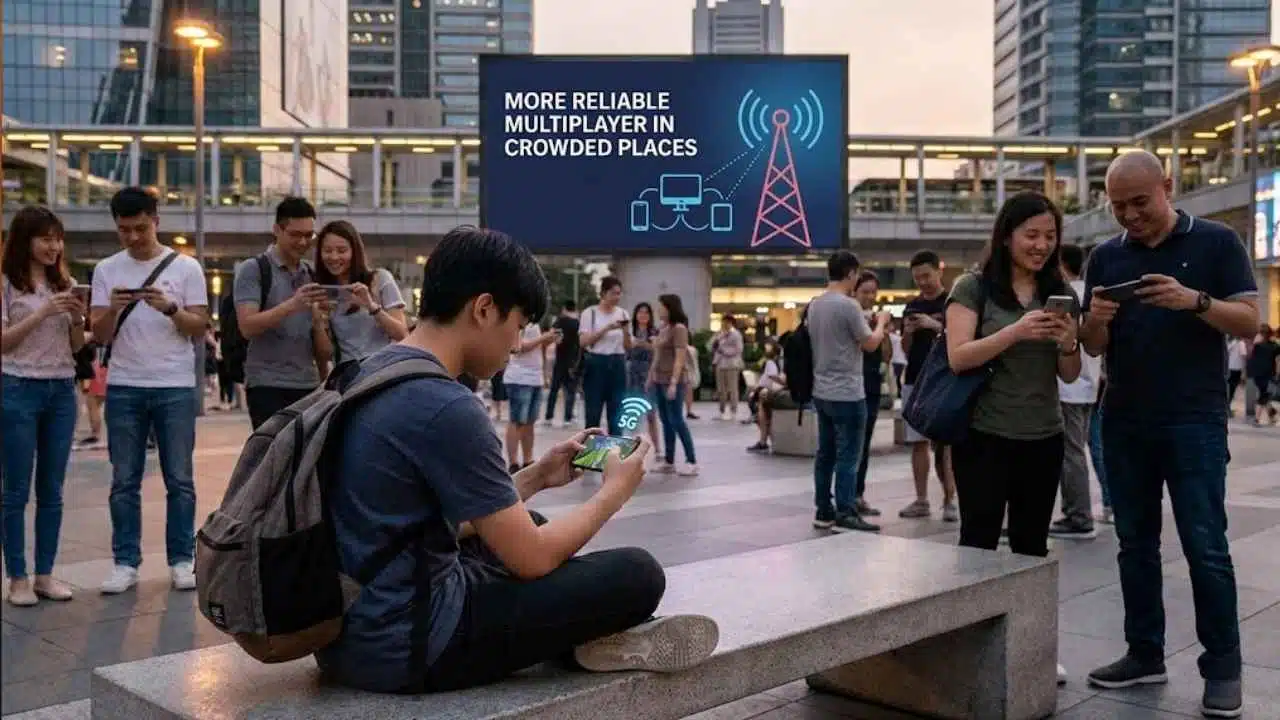
Crowded places can ruin online experiences. A concert, stadium, mall, or transit hub can overload networks. You may have full signal and still get lag because thousands of devices are sharing resources.
5G networks are designed to handle more devices more efficiently. When deployed well, they can reduce the chaos of busy areas. That can lead to fewer disconnects and fewer sudden ping spikes.
This matters for mobile gaming because people play everywhere. You might queue for a match on a train. You might join friends while waiting at a café. If the connection collapses every time the area gets busy, mobile multiplayer becomes stressful.
Reliable multiplayer also helps watch parties. Many people stream the same event at the same time. Better capacity can reduce buffering and quality drops. That keeps the social experience intact.
Still, reliability is not automatic. Some cell sites are better provisioned than others. Backhaul capacity matters. Local infrastructure matters. So think of 5G as an upgrade that increases the chance of stability, not a promise of stability in every crowd.
6. Better Uploads For Creators: Mobile Live Streaming Gets Cleaner
Creators are now a major part of gaming culture. People stream from phones, upload highlights, and share short clips daily. Upload performance is often the hidden bottleneck, especially when the network is busy.
5G can improve the upload side in many places. That can make mobile live streaming more reliable. It can also shorten the time it takes to post clips, send files to editors, or back up content.
Upload stability affects viewer trust. If the stream drops, viewers leave. If audio breaks, people swipe away. If video becomes pixelated, the moment is lost. Better mobile upload can make creators more consistent, especially when they stream from events or outdoor locations.
It also changes what creators can attempt. Higher upload can support:
- Cleaner 1080p live streams
- More stable IRL streams
- Faster posting of high-quality highlights
- More interactive live sessions with fewer delays
But creators still need smart settings. If you stream at a bitrate your connection cannot sustain, you will still drop frames. A stable, slightly lower bitrate often performs better than a risky high bitrate.
7. Edge Computing Experiences: Faster Response Without Console-Level Hardware
Edge computing is about moving compute closer to users. Instead of sending everything to a far-away data center, some processing happens in a nearby location. That can reduce delay and improve consistency for interactive services.
For games, this can matter in several ways. One is cloud gaming responsiveness. Another is AI features that react quickly. Another is real-time personalization without making your phone do heavy work.
Edge computing can also support new types of multiplayer. When the “brain” of an experience is closer, synchronization can improve. That can make shared experiences feel more natural, especially when timing matters.
This shift is also friendly to mid-range devices. Not everyone buys a flagship phone. If edge services handle more heavy lifting, more people can access higher-quality experiences without premium hardware.
Edge gaming will grow gradually. It depends on partnerships, deployments, and business models. But the direction is clear: more services will try to reduce distance between player and compute, because distance is one of the biggest enemies of responsiveness.
8. AR And Location-Based Games Get More Ambitious
AR games are exciting because they blend digital play with the real world. But they are hard to build and hard to run. They need fast sensor processing, stable tracking, and smooth networking if multiple players share the same experience.
5G can help by improving the network part. It can make shared AR sessions smoother. It can support faster loading of assets. It can also make location-based events more reliable, where many people join the same in-game activity.
AR also benefits from better upstream and downstream together. Players may upload camera-driven data and receive responses quickly. That matters for shared AR interactions, where timing must match what people see in real life.
Still, AR has practical limits:
- It drains battery quickly.
- It can heat phones during long sessions.
- It requires careful privacy choices, since it uses camera and location.
As 5G coverage improves, AR developers may take bigger risks. You may see more outdoor events, shared mini-games, and “live” experiences tied to real places. When it works, it feels magical. When it fails, it feels awkward. Strong networks increase the chance that it works.
9. Network Slicing And “Gaming Packs” Could Improve Consistency
In simple terms, network slicing can allow a network to treat different traffic differently. A slice can be tuned for low latency, high reliability, or specific service needs. For gaming, that raises an interesting possibility: more predictable performance.
If implemented well, slicing could reduce jitter during busy hours. It could keep your ping steadier. It could also make cloud gaming sessions less fragile when the network is under load.
This might show up as:
- Premium “gaming boost” options
- Better performance at venues like arenas and stadiums
- More consistent service for events and tournaments
But slicing is also an easy concept to market without meaningful results. So users should think like testers. If you pay extra, measure whether your ping and jitter actually improve. If they don’t, the feature is not delivering value.
The best version of slicing is invisible. You do not need to understand it. You just feel that your match is smoother in situations that used to be messy. That is the standard to hold it to.
10. Cross-Platform Play And “Play Anywhere” Habits Accelerate
Gaming is becoming less device-bound. Many players already shift between phone, tablet, PC, and console. They use cloud saves, cross-progression, and shared accounts. Better connectivity makes that lifestyle easier.
With 5G, “play anywhere” becomes more realistic. You can watch a match, then jump into the game quickly. You can start a session on your phone while waiting, then continue later on a larger screen. You can share clips without waiting for Wi-Fi.
This also changes streaming. Viewers become participants faster. A streamer plays a mode, you join the same mode. A creator starts a challenge, you try it right away. The barrier between watching and doing gets smaller.
Over time, this habit shift may matter as much as the technical improvements. When it becomes easy to jump into gaming anywhere, people play in more short bursts. Games may adapt to that pattern. Platforms may build features to support it.
This is another place where 5g cloud gaming in mobile gaming and streaming becomes a lifestyle change, not just a network upgrade.
5G Cloud Gaming In Mobile Gaming And Streaming
This section zooms in on the focus keyword because it sits at the center of the entire shift. Cloud gaming is the most demanding everyday use case for a mobile connection. It needs good speed, but it also needs stable latency and low jitter. That makes it a perfect test of what 5G can really deliver.
Cloud gaming also blurs the line between “gaming” and “streaming.” You are literally streaming the game, but you are also controlling it. That adds complexity. It is why cloud gaming feels amazing when it works and frustrating when it doesn’t.
The streaming side is changing too. People now watch more interactive content: live matches, co-streams, reaction videos, and short clips. Better networks support higher quality and faster sharing. That keeps audiences engaged.
The most important idea to remember is simple: stable performance beats peak performance. A steady 40 ms can feel better than a connection that jumps between 20 ms and 120 ms. So the best goal is consistency, not the highest number on a speed test.
If you want to adopt 5g cloud gaming in mobile gaming and streaming today, focus on three things: strong coverage where you play, sensible quality settings, and a plan that won’t punish you with surprise limits.
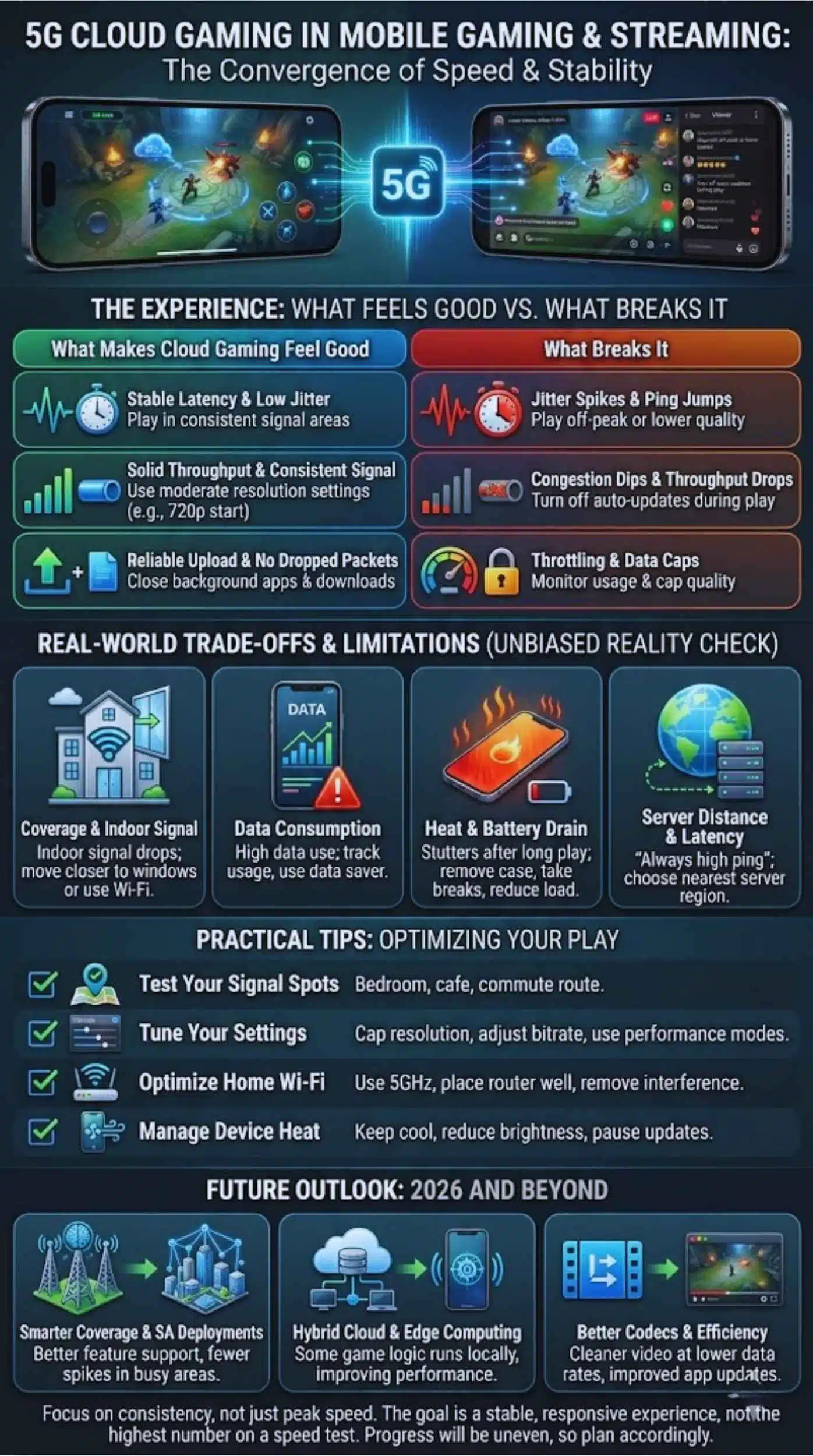
| What Makes Cloud Gaming Feel Good | What Breaks It | Best Practical Fix |
| Stable latency | Jitter spikes | Play in consistent signal areas |
| Solid throughput | Congestion dips | Use moderate resolution settings |
| Reliable upload | Dropped packets | Close background apps and downloads |
| Reasonable data plan | Throttling/caps | Monitor usage and cap quality |
| Cool device | Heat throttling | Take breaks and reduce load |
Real-World Trade-Offs And Limitations (Unbiased Reality Check)
It is easy to get excited about 5G. But you will enjoy it more if you understand the limits. Most frustrations come from expectation gaps, not from the tech itself. When you know what can go wrong, you can plan around it.
Coverage is the first reality. 5G is not equally strong everywhere, and indoor performance can be very different from outdoor performance. Some buildings weaken signals. Some areas have strong 5G but weak backhaul. Some places show “5G” on your phone but perform like good 4G.
Data is the second reality. Cloud gaming and high-quality streaming can consume a lot of data quickly. If your plan has caps or throttling rules, performance can change mid-month. That can make a service feel inconsistent even if the network is fine.
Heat and battery are the third reality. Long gaming sessions already stress phones. Add 5G radios, high refresh rate screens, and bright displays, and heat becomes a factor. Heat can reduce performance and increase lag indirectly.
The last reality is server distance. Even with perfect 5G, you still need to reach game servers. If the nearest server is far, latency will still be higher. That is why region selection matters in competitive games.
| Limitation | How It Shows Up | What You Can Do |
| Indoor signal drops | Sudden quality dips | Move closer to windows or use Wi-Fi |
| Congestion | Ping spikes at peak hours | Play off-peak or lower quality |
| Data caps | Throttled speed later | Track usage, use data saver |
| Battery/heat | Stutters after long play | Lower FPS/brightness, cool device |
| Server distance | “Always high ping” | Choose nearest server region |
| Device limitations | Weak bands/modem | Check band support before buying |
Practical Tips: How To Get The Best 5G Gaming And Streaming Experience
You do not need to be a network expert to get better results. Small choices can make a big difference. The goal is to reduce instability, because instability is what feels like “lag” most of the time.
Start by testing the places you play most. Your bedroom, your living room, your commute route, and your favorite café can all behave differently. Once you find strong spots, you can plan cloud gaming sessions around them.
Next, tune your settings. Many apps let you cap resolution, adjust bitrate, or choose performance modes. These controls exist for a reason. They help you match quality to your real connection, not an ideal connection.
Also, don’t ignore your home Wi-Fi. Many people blame “5G lag” when the problem is actually a noisy Wi-Fi channel, a weak router, or a crowded household network. Fixing Wi-Fi can improve gaming more than switching carriers.
Finally, manage heat. Heat affects performance. Performance affects frame timing. Frame timing affects your perception of lag. So keeping your device cool can make your sessions feel more responsive.
| Tip | Why It Helps | Quick Action |
| Track ping and jitter | Predicts gaming feel | Use in-game network stats |
| Cap cloud resolution | Prevents sudden drops | Start at 720p then increase |
| Pause background updates | Avoids spikes | Turn off auto-updates during play |
| Improve indoor signal | Reduces drops | Test rooms, use Wi-Fi indoors |
| Optimize Wi-Fi | Removes hidden bottleneck | Use 5 GHz, place router well |
| Reduce heat | Prevents throttling | Remove case, take breaks |
What To Expect Next (2026 And Beyond)
The next phase of 5G is not just “more coverage.” It is smarter coverage. Networks will keep improving capacity in busy areas. Devices will keep improving modems and efficiency. Platforms will keep refining streaming codecs and cloud pipelines.
For gaming, that means cloud gaming should gradually become more normal. It will still depend on business models, pricing, and content availability. But technically, the path points toward better responsiveness and fewer interruptions.
For streaming, the growth will be even more obvious. More people will stream from phones. More creators will go live from events. More viewers will expect quick, high-quality playback anywhere.
We will also likely see more “hybrid” experiences. Some game logic runs locally. Some runs in the cloud. Some features run at the edge. This mix can improve performance while keeping costs manageable.
But progress will remain uneven. Cities tend to improve faster than rural areas. Major carriers tend to upgrade faster than smaller ones. So it is wise to think of 5G as a moving target. Your experience this year may be very different next year, even with the same phone.
| Likely Trend | What It Changes | What To Watch |
| More SA deployments | Better feature support | Device compatibility |
| Better mid-band reach | More consistent quality | Indoor improvements |
| Smarter congestion control | Fewer spikes at peak hours | Venue performance |
| Better codecs | Cleaner video at lower data | App updates |
| Hybrid cloud features | New game mechanics | Platform partnerships |
Final Thoughts: The Biggest Wins For 5G Cloud Gaming And Streaming
5G can meaningfully upgrade mobile gaming and streaming, but the biggest wins are not always flashy. The real improvements are often about flow. You start faster. You buffer less. You disconnect less. You feel more in control.
For many people, the most exciting change is choice. You can play more types of games in more places. You can stream higher quality when the network is strong. You can upload clips faster. You can watch and play in the same moment.
At the same time, the smart approach is realistic. Test your typical locations. Use settings that match your connection. Watch your data usage. Keep your device cool. Those habits make the biggest difference.
If you remember one sentence, make it this: 5g cloud gaming in mobile gaming and streaming feels best when performance is stable, not just fast. Stability is what makes gaming feel fair and streaming feel effortless.
Use 5G as a tool, not a promise. When you treat it that way, you’ll get more value and less frustration.
| Biggest Win | Who Benefits Most | Why It Matters |
| Lower perceived lag | Competitive players | Better control and timing |
| More usable cloud gaming | AAA-on-phone users | Play without installs |
| Better stream quality | Viewers and creators | Cleaner visuals and fewer drops |
| Faster updates | Live-service fans | Less waiting, more playing |
| Better on-the-go sessions | Travelers and commuters | Entertainment anywhere |
FAQs
Is 5G Better Than Wi-Fi For Mobile Gaming?
Sometimes. At home, Wi-Fi can be more stable, especially if your 5G signal is weak indoors. On the go, 5G can be more reliable than public Wi-Fi, which is often crowded and inconsistent. The best option is the one with lower jitter and fewer spikes. Test both and choose what feels smoother. For competitive play, stability usually wins.
How Much Data Does Cloud Gaming Use On 5G?
It depends on resolution, bitrate, and the service you use. Higher quality uses more data, just like higher-quality video streaming. If your plan has limits, it is smart to start at 720p and move up only if performance stays stable. Many apps offer data-saving modes. Watching your monthly usage early helps avoid surprises later.
What Latency Is “Good” For Competitive Play And Cloud Gaming?
Lower is better, but consistency matters most. A stable latency can feel great even if it is not the lowest number. Problems usually come from spikes, not from a slightly higher baseline. If your ping jumps often, your inputs will feel inconsistent. That is why jitter is as important as ping for cloud gaming.
Do I Need Standalone 5G To Enjoy These Benefits?
Not necessarily. Many people will see improvements on non-standalone networks too. Standalone can enable more advanced features, but coverage and device support vary. The key is your real-world experience in your typical locations. If your network is stable and fast where you play, you can benefit without chasing labels.
Will 5G Make Game Downloads And Updates Faster?
Often yes, especially in strong coverage areas. But download speed can still be limited by congestion, server caps, and your device’s thermal limits. Updates may also be staged or throttled by app stores. The biggest improvement is usually reduced waiting, not instant downloads. Over time, that reduction changes habits and makes gaming feel more accessible.