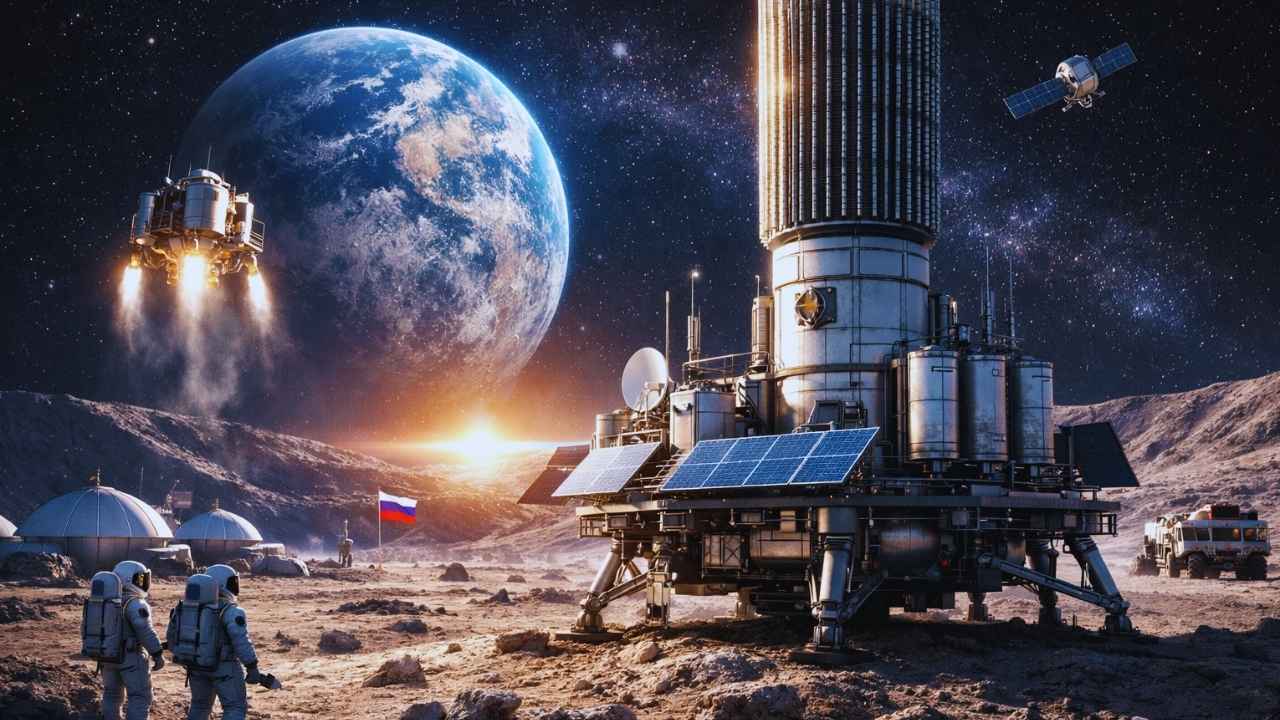
Roscosmos says it has signed a 2025–2026 state contract with NPO Lavochkin to advance plans for a Russia nuclear power plant on the Moon, with a stated goal of deploying lunar power infrastructure by 2036.
What Roscosmos signed and what it means now?
Russia’s state space corporation, Roscosmos, says the new agreement is a state contract with NPO Lavochkin, a major Russian spacecraft and deep-space engineering contractor. Roscosmos frames the deal as a practical step in turning a long-discussed concept—reliable lunar power—into a defined work program.
According to Roscosmos’ public description, the contract period covers 2025 and 2026. The agency says the work includes developing spacecraft-related components, running ground trials, carrying out test flights, and preparing the steps needed to deploy infrastructure on the Moon. The headline target attached to the program is 2036.
What stands out is the combination of a near-term contract window and a far-term delivery goal. That structure suggests Roscosmos is trying to lock in early engineering decisions now—system design, testing methods, and mission architecture—while leaving later mission sequencing to evolve as budgets, launch plans, and international coordination change.
At this stage, important technical details are still not publicly spelled out. Roscosmos has not released a confirmed power output, a clear reactor type, a mass estimate, or a full end-to-end mission plan that explains how the system will be launched, landed, assembled, and connected to other equipment. That does not mean those details do not exist internally, but it does mean outside observers cannot yet validate the maturity of the plan from public documents alone.
A key context point is that Russia has had setbacks in lunar exploration. The Luna-25 mission, launched in August 2023, ended in a crash on the Moon. That failure highlighted how difficult lunar landings remain, especially for programs rebuilding capabilities after long gaps. The new power contract signals intent to keep pushing for lunar infrastructure despite recent disappointment.
Why a lunar power plant is a big deal for long-term Moon operations?
If a country wants more than quick “flags-and-footprints” style missions, power becomes one of the first hard constraints. On the Moon, sunlight is not constant everywhere. Many locations experience long periods of darkness tied to the lunar day-night cycle. During darkness, solar panels stop producing electricity. Batteries can store energy, but large-scale storage adds weight, complexity, and cost—especially if a site must keep equipment warm and running for long stretches.
Stable power unlocks several capabilities at once:
- Continuous science operations: Instruments can run through lunar night instead of shutting down.
- Thermal survival: Electronics and mechanisms can be kept within safe temperature ranges when the surface cools sharply.
- Reliable communications and navigation: A powered relay or beacon is more useful when it does not “sleep” for weeks.
- Industrial-style experiments: Activities like drilling, processing regolith, or testing resource extraction methods often need steady electricity rather than short bursts.
When Roscosmos talks about infrastructure, it often bundles rovers, scientific observatories, and surface systems into the same vision. That is consistent with how most space agencies now describe the Moon: not just a destination, but a platform for sustained operations, resource experiments, and technology demonstrations relevant to deeper-space travel.
Below is a simplified look at why lunar power planning is increasingly central to lunar strategy:
| Lunar need | Why it matters | What steady power changes |
| Survive lunar night | Darkness can last long enough to drain batteries and freeze systems | Keeps key systems warm and functioning continuously |
| Scale up surface activity | Bigger missions need more energy than small landers | Enables longer rover drives, heavier instruments, and sustained work cycles |
| Run communications reliably | Relays and base stations need uptime | Supports continuous data links and navigation aids |
| Prepare for crewed presence | People require robust life support and redundancy | Makes habitats, emergency systems, and logistics more feasible |
How it fits into Russia–China lunar plans and the 2036 timing?
Roscosmos’ 2036 target lines up neatly with the broader idea of a permanent or semi-permanent lunar research site in the mid-2030s. Russia and China have promoted the International Lunar Research Station (ILRS) concept as a long-term project intended to support multidisciplinary research and long-duration operations on or around the Moon.
A lunar power plant fits naturally into that kind of architecture. A research station—especially one meant to host multiple experiments, communications systems, and surface mobility—benefits from a dependable energy backbone. Even if early ILRS activities rely on solar and batteries, many planners see nuclear power as one of the few options that can scale up without being tightly bound to sunlight and storage.
China has also discussed lunar infrastructure needs in ways that imply a mix of solutions: solar arrays, power distribution systems, and potentially nuclear energy for baseline supply. In that model, a nuclear unit is not necessarily “the only” source of electricity, but it can function as the stabilizing part of a broader microgrid—supporting critical systems while solar handles peak demand.
For Russia, the 2036 date also has another implication: it is far enough out to allow extensive Earth testing, multiple design iterations, and phased demonstration missions. Space nuclear systems face added scrutiny because safety and reliability expectations are extremely high. If Roscosmos and its partners want to persuade internal stakeholders, regulators, and international partners, they will likely need a slow, methodical development story with clear milestones.
One more layer is geopolitical. Russia has said it wants to preserve strategic relevance in space at a time when the United States and China are moving quickly with lunar plans. A high-visibility infrastructure project—especially one tied to reliable power—signals ambition and could strengthen Russia’s bargaining position in international partnerships, even if the path is long and technically demanding.
What “nuclear” likely involves and the main technical hurdles?
Roscosmos’ contract language is centered on a “lunar power plant,” and Russian officials have previously connected lunar power to a broader national effort that involves nuclear research institutions. Public statements have pointed to collaboration with major Russian nuclear and research organizations, which is why many observers interpret the project as nuclear-powered even when some official announcements use more general wording.
A nuclear surface power unit on the Moon typically raises several engineering challenges that do not fully apply to solar systems:
Launch and activation safety
A major design question is how the system is launched safely and how it is activated. Many concepts keep the reactor in a safe configuration during launch and only initiate full operation after landing and verification. This adds procedures, sensors, and fail-safes.
Radiation shielding
Shielding protects sensitive electronics and, eventually, people. But shielding adds mass. Designers must balance safety against launch limits, which are especially strict for lunar landing missions.
Heat rejection
A reactor produces heat that must be managed. On the Moon, the vacuum environment makes thermal design different from Earth. Engineers often rely on radiators and carefully planned heat-flow paths to keep the system stable.
Dust and mechanical wear
Lunar dust is abrasive and clingy. Any power system with moving parts, exposed radiators, connectors, or deployment mechanisms must be built to tolerate dust contamination over long periods.
Landing, placement, and power distribution
Even a perfectly functioning power unit is only useful if it can be delivered and integrated. That means safe landing, stable placement, and a plan for distributing power—cables, connectors, or modular links—to other systems that may land later.
It also matters what scale Roscosmos is targeting. A modest system could power a limited set of instruments and basic communications. A larger system could support multiple rovers, a cluster of experiments, and early habitat demonstrations. Because the power output has not been publicly confirmed, the intended scale remains one of the most important unknowns.
For comparison, the United States has described its own lunar fission surface power work in terms of tens of kilowatts of continuous power—enough to run a small collection of critical systems steadily for years. That benchmark shows why kilowatt-level decisions matter: the jump from small power to “base-level” power is not incremental; it changes mass, thermal needs, and mission complexity.
What to watch next: milestones, risks, and credibility signals?
A contract announcement is meaningful, but long-range space infrastructure projects gain credibility when they show measurable progress. Over the next 12 to 24 months, several signals will help readers evaluate whether the 2036 target is becoming more realistic.
Here are the milestones that would most strongly indicate momentum:
| What to watch | Why it matters | What “progress” would look like |
| Public system parameters | Confirms scale and intent | A stated power output range, mass, and operational lifetime |
| Testing milestones | Reduces technical uncertainty | Announced ground tests, reactor simulator tests, thermal trials |
| Demonstration mission planning | Shows the path to the Moon | A phased plan: tech demo → partial deployment → full unit |
| Landing and integration concept | Connects power to actual lunar work | Clear microgrid approach, distribution plan, and partner roles |
| ILRS coordination details | Aligns timelines and responsibilities | Shared schedules and compatible infrastructure standards |
There are also clear risks.
Funding and schedule continuity can change, especially over a decade-long timeline. Lunar projects are expensive, and they compete with other national priorities. Technical setbacks—like the kind seen in lunar landing attempts worldwide—can delay even well-funded programs. And any nuclear-related space system adds a layer of regulatory and public scrutiny.
Still, the underlying strategic logic is easy to understand. If Russia and its partners want a serious lunar footprint, they need dependable power. Solar-only architectures can work for some missions, but they become harder to scale for continuous operations. A nuclear power unit, if proven safe and reliable, offers a path to steady electricity that can support long-duration systems while crews are still years away.
If Roscosmos provides clearer specifications, demonstrates hardware progress through testing, and ties the power system to concrete lunar mission steps, the story will shift from “a declared ambition” to “an infrastructure program with trackable delivery.”