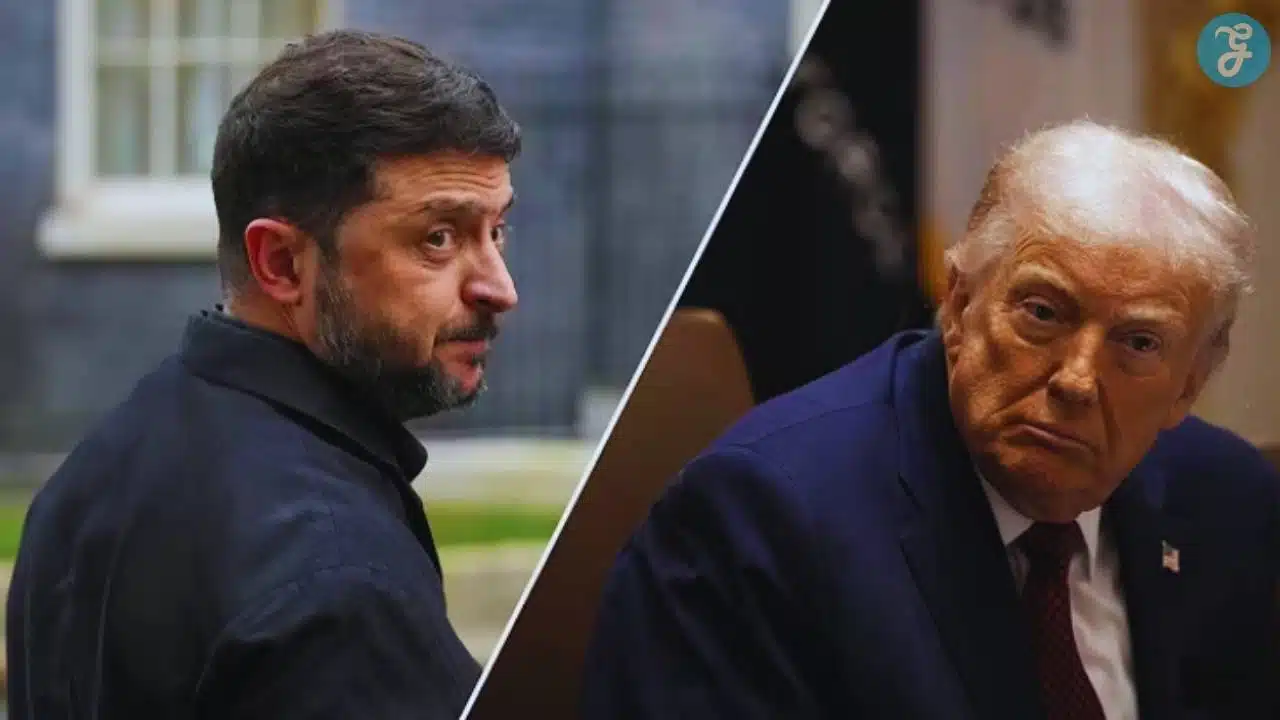
President Donald Trump, the current U.S. president, is ramping up pressure on Ukraine to strike a peace deal with Russia that involves handing over significant territory, particularly in the eastern Donetsk region, amid mounting frustration with the slow pace of negotiations. Over December 11-12, 2025, the White House publicly aired Trump’s exasperation, with officials declaring he is “sick of meetings just for the sake of meetings” and demanding immediate action to wrap up the nearly four-year conflict that has devastated Ukraine and strained global resources.
This blunt rebuke signals a sharper U.S. push on Kyiv to swallow a tough compromise framework, as talks involving American envoys like Steve Witkoff drag on without breakthrough, highlighting the high stakes for all parties as winter deepens and economic pressures mount worldwide.
Trump’s Frustration and Push for Action
Trump’s impatience has boiled over into public statements and direct communications with world leaders, reflecting a broader strategy to force a resolution before the end of 2025. White House Press Secretary Karoline Leavitt captured this sentiment during a Thursday briefing, explaining that the president is “extremely frustrated with both sides of this war,” tired of endless dialogue that yields no results, and insistent on concrete steps to halt the fighting that has claimed countless lives and disrupted global food and energy supplies. She emphasized Trump’s desire for swift outcomes, noting his recent phone calls with key European figures—France’s Emmanuel Macron, Britain’s Keir Starmer, and Germany’s Friedrich Merz—to align on accelerating the process, potentially aiming for a Christmas breakthrough that could stabilize markets and refocus U.S. priorities elsewhere.
This approach builds on earlier Miami talks and revised proposals, where Trump has repeatedly set informal deadlines, warning that prolonged stalemate risks further U.S. aid fatigue and emboldens Russia’s battlefield gains. Behind the scenes, Trump’s team has shuttled between Kyiv, Moscow, and European capitals, blending carrots like economic incentives with sticks such as threats to scale back military support, all while navigating domestic calls for America First policies that prioritize ending overseas entanglements.
Ukraine’s Peace Plan and Core Disputes
Ukraine responded by submitting a detailed revised 20-point peace plan to Washington on December 11, a streamlined version from an initial 28 points hammered out in consultations with European allies, covering everything from immediate ceasefires and prisoner swaps to long-term economic rebuilding and NATO-like protections. President Volodymyr Zelenskyy, speaking at a Kyiv press conference, acknowledged the submission but stressed unresolved flashpoints, particularly around territory where the U.S. envisions Ukrainian troops withdrawing from controlled areas in Donetsk to establish a “free economic zone”—a neutral buffer that Russia interprets as a demilitarized zone free of Ukrainian military presence. Zelenskyy highlighted the governance vacuum in this plan, questioning who would administer the land and insisting that any concessions must come from the Ukrainian people themselves through democratic means like nationwide elections or local referendums, a stance rooted in preserving national sovereignty after years of invasion.
Russia, however, dismissed the referendum idea outright; Putin’s foreign policy adviser Yuri Ushakov declared on Friday that Donetsk is already “Russian territory,” revealed Moscow hadn’t even fully reviewed the updated U.S.-Ukraine tweaks, and floated alternatives like deploying Russian National Guard or police forces there instead of full military occupation. These clashing visions underscore deeper divides: Ukraine seeks reversible pauses with ironclad reversals if Russia reneges, while Moscow demands permanent recognition of its annexations, complicating efforts to demine fields, restart trade routes, and rebuild shattered infrastructure in the war-torn east.
Nuclear Plant Tensions and Security Demands
The Zaporizhzhia Nuclear Power Plant, Europe’s largest facility and a ticking safety timebomb under Russian occupation since early 2022, emerges as a pivotal impasse with radiation risks looming over millions if mishandled amid shelling or sabotage. The U.S. proposal floats joint international management to ensure safe operations and prevent it from becoming a weaponized asset, but Zelenskyy has drawn a red line, stating flatly that the plant “will not operate” under exclusive Russian control and conditioning any U.S. role on a full Moscow troop pullout to avert Chernobyl-style disasters. This standoff ties into broader security architecture, where Ukraine demands guarantees ratified by the U.S. Congress for unbreakable legal force—learning from the unfulfilled 1994 Budapest Memorandum that left it vulnerable after surrendering Soviet nukes—rather than vague executive promises that could vanish with political shifts.
Volodymyr Zelenskyy pitched this during a virtual Coalition of the Willing summit, arguing congressional approval would deliver “real, solid” shields against future aggression, possibly including arms stockpiles, training, or even multilateral defense pacts involving Europe. Trump has hinted at U.S. backing for such measures if a deal materializes, but conditioned attendance at upcoming European talks—like the December 15 Berlin summit with Zelenskyy and EU heavyweights—on tangible progress, vowing no more time-wasting sessions. As envoys eye a “decisive moment,” the interplay of these issues could dictate not just Ukraine’s borders but Europe’s energy grid, Black Sea shipping lanes, and global nuclear nonproliferation norms for years ahead.