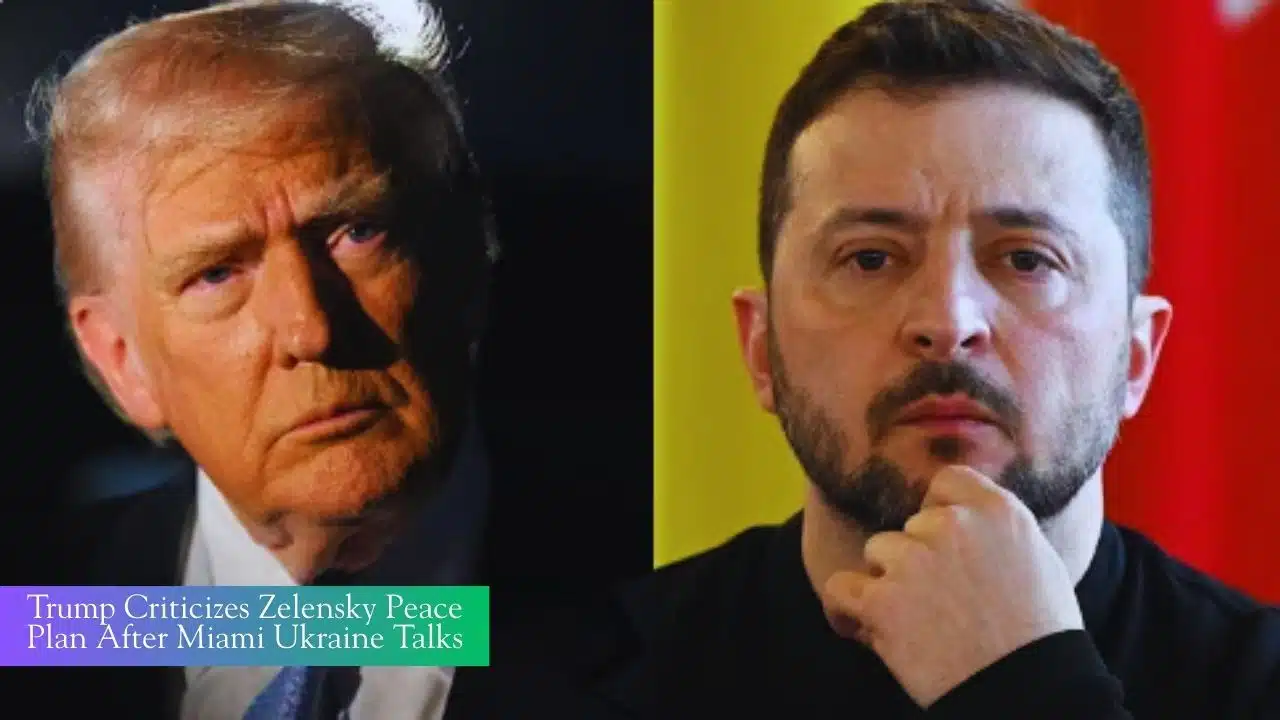
President Donald Trump, recently reelected to the White House, gave a candid assessment of the ongoing efforts to broker peace in the Russia-Ukraine war during his remarks at the Kennedy Center Honors in Washington on December 7, 2025. He openly criticized Ukrainian President Volodymyr Zelensky for not having read the latest U.S. peace proposal, a comprehensive plan crafted to address the most contentious issues between Kyiv and Moscow. According to Trump, “His people love it, but he hasn’t read it,” a statement underlining Trump’s frustrations after learning that, despite apparent endorsement from members of Zelensky’s administration, the Ukrainian leader remains uncommitted.
The U.S. peace proposal emerged amid renewed diplomacy and intensive three-day negotiations between American representatives and a Ukrainian delegation in Miami. The talks, led by Steve Witkoff and Jared Kushner, Trump’s son-in-law, resulted in no definitive breakthroughs. Zelensky himself labeled the talks “lengthy and meaningful” but declined to announce any agreements, instead pledging to pursue “real peace” in future discussions. The Miami negotiations followed meetings between Witkoff and Kushner with Russian President Vladimir Putin in Moscow, where the Kremlin refused certain elements of the proposal while expressing openness to Trump’s broader strategic approach.
Special attention was paid to the remarks of Trump’s outgoing special envoy, General Keith Kellogg, who described the negotiations as nearing completion but hinging on two principal matters: the fate of the embattled Donbas region and the future of the Zaporizhzhia Nuclear Power Plant. Kellogg likened the negotiations to “the last 10 meters” of a marathon, emphasizing the proximity of a possible peace deal. Despite these claims of progress, the Kremlin continues to object to terms it regards as unfavorable, particularly those requiring Moscow to relinquish control over occupied territories.
European Diplomacy and Security Tensions
Diplomatic activity is poised to intensify further as Zelensky travels to London to confer with British Prime Minister Keir Starmer, French President Emmanuel Macron, and German Chancellor Friedrich Merz. These consultations, scheduled for December 8, underscore the international dimensions of the peace initiative and highlight the pivotal roles played by Europe’s leading governments. European allies see the U.S. proposal as a workable foundation but insist on amendments to safeguard Ukraine’s sovereignty and provide robust security guarantees, including potential NATO-like defense mechanisms.
While diplomacy takes center stage, the humanitarian fallout from ongoing conflict remains severe. Russian military operations, including drone attacks in Chernihiv and artillery barrages in Kharkiv, resulted in at least seven deaths and exacerbated the challenges facing Ukraine’s civilian infrastructure as winter approaches. Ukrainian officials accuse Moscow of deliberately targeting vital facilities to undermine resilience, leaving provinces without reliable heating or electricity.
Amid these pressures, President Zelensky insists on a “dignified peace” settlement: one that secures Ukraine’s rights and demands tangible accountability from Russia for military aggression and occupation. Yet, with Russian forces retaining control over large sections of Donbas—including Donetsk and Luhansk, annexed in 2022—and actively managing the Zaporizhzhia nuclear site, the prospects for immediate resolution remain faint. The peace plan’s territorial concessions remain a particularly divisive aspect of negotiations, drawing scrutiny from Ukrainians who fear lasting repercussions for national sovereignty.
Kremlin Responds Favorably to Trump’s Security Strategy
On the Moscow side, Russian authorities have welcomed President Trump’s newly unveiled National Security Strategy, which prioritizes negotiation and de-escalation over confrontation. Kremlin spokesperson Dmitry Peskov said the strategy aligns with Moscow’s aspirations for “good relations” and a return to constructive dialogue with the U.S., a marked shift from years of strained ties precipitated by the war and economic sanctions. The strategy identifies the peaceful conclusion of the Russia-Ukraine war as a primary U.S. national interest, aiming for stability and normalization between global powers.
Though Russia’s endorsement signals diplomatic progress, the situation on the ground remains fraught. President Trump’s push for a rapid peace process has been interpreted by some in Washington as encouraging Ukrainian territorial concessions to hasten an end to hostilities. This approach has drawn criticism from those in Kyiv wary of compromising too quickly—and from European partners who advocate for peace with enforceable security guarantees.
Both U.S. and Ukrainian officials have agreed to continue discussions on the basis of the Miami negotiations, with Zelensky confirming a commitment to further talks with the American peace envoy team. As the outcome of these negotiations remains uncertain, global attention focuses on the high-level meetings in London, where Western leaders hope to clarify Ukraine’s terms and secure meaningful movement toward a durable peace deal.