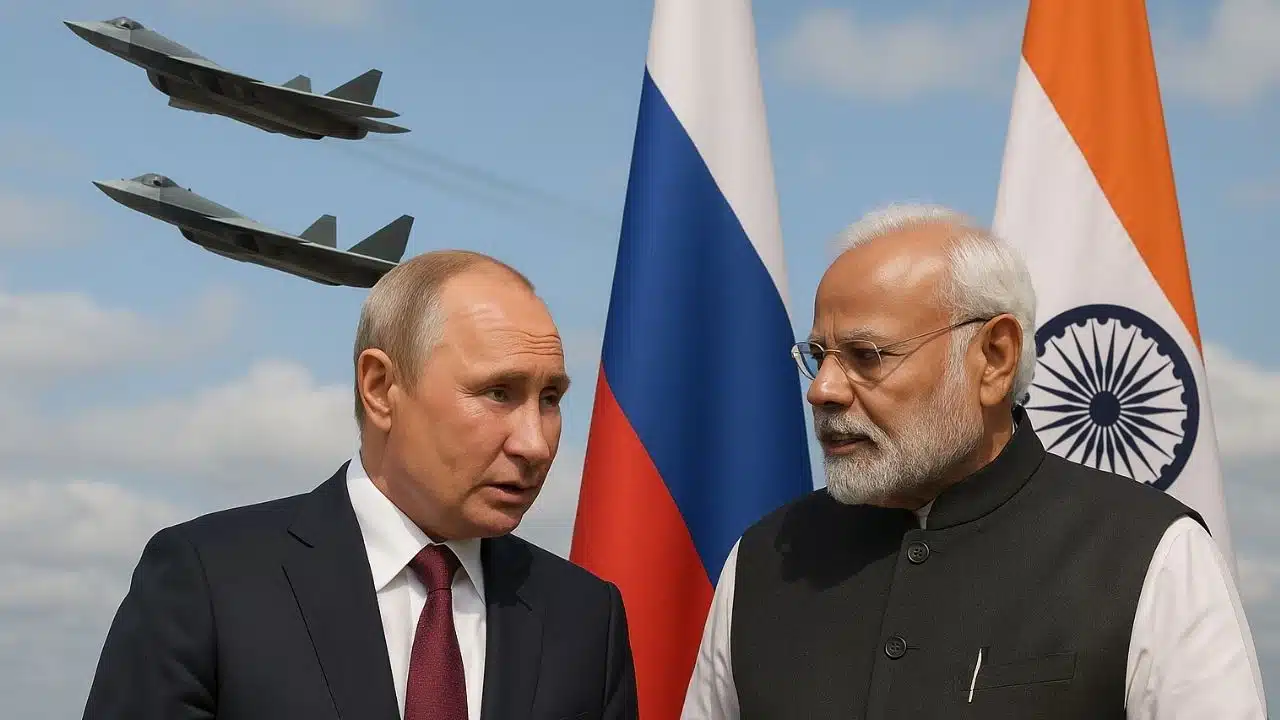
Russian President Vladimir Putin arrives in New Delhi for a two-day visit that marks his first trip to India since the outbreak of the Russia-Ukraine war. His presence signals a significant moment in India-Russia relations, with both nations preparing for an intensive round of discussions under the 23rd India-Russia Annual Summit framework. Putin is scheduled to land in the capital on Thursday evening, where he will be received for a private dinner hosted by Prime Minister Narendra Modi. He will also meet President Droupadi Murmu as part of the official engagements. This visit carries deeper political and economic implications, coming at a time when India is navigating global geopolitical pressures and recent trade tensions, including the United States’ decision to impose steep 50% tariffs on several Indian imports.
A major focus of the summit will be the future of defence cooperation between India and Russia. Moscow has indicated that the possibility of supplying India with its fifth-generation Su-57 fighter jets will be discussed. India, which is in the process of modernizing its air force, has shown interest in acquiring advanced stealth aircraft to complement its existing fleet. The talks may also explore long-term collaboration, technology partnerships, and avenues for joint production, all of which would deepen defence industrial ties. Beyond military hardware, both sides are expected to examine broader defence frameworks, including maintenance agreements, parts supply security, and the viability of new strategic projects amid shifting global alignments.
Trade and economic engagement form another major pillar of the agenda. With bilateral trade currently around $68 billion, India and Russia aim to raise it to $100 billion by 2030. The summit will look at ways to streamline trade mechanisms, reduce bottlenecks, and strengthen settlement systems using local currencies. This is especially relevant as both nations seek to shield transactions from disruptions caused by Western sanctions. The leaders are expected to evaluate new areas of economic cooperation, including industrial manufacturing, digital and innovative technologies, transportation infrastructure, mining projects, and expanded energy partnerships. Oil trade will be a crucial discussion point, as India aims to balance its dependence on discounted Russian crude with the risks of attracting punitive sanctions from Western countries.
Putin’s itinerary includes participation in the Russia-India Business Forum, where government officials and industry leaders will explore fresh opportunities in sectors such as space research, healthcare solutions, labour mobility, and environmentally safe mining technologies. The launch ceremony for the RT television channel in India is also on the agenda, reflecting Moscow’s interest in strengthening its media presence and soft power influence in the region. One important outcome of the visit may be an agreement facilitating the movement of Indian skilled workers to Russia, a step aimed at addressing Russia’s labour shortages while creating new employment avenues for Indian professionals. New Delhi and Moscow may also discuss India’s proposed free trade agreement with the Eurasian Economic Union, which could significantly boost market access for both sides.
As the summit unfolds, both nations are expected to sign several agreements covering defence, energy, economic cooperation, and migration frameworks. The visit underscores the strategic depth of India-Russia ties, built on decades of cooperation yet continually adapting to global change. For New Delhi, the challenge will be to reinforce its long-standing partnership with Moscow while balancing its evolving relationships with Western powers, especially amid rising geopolitical tensions. For Russia, the visit reaffirms India’s importance as a stable and trusted partner at a time when Moscow seeks to diversify economic ties and sustain its global influence.