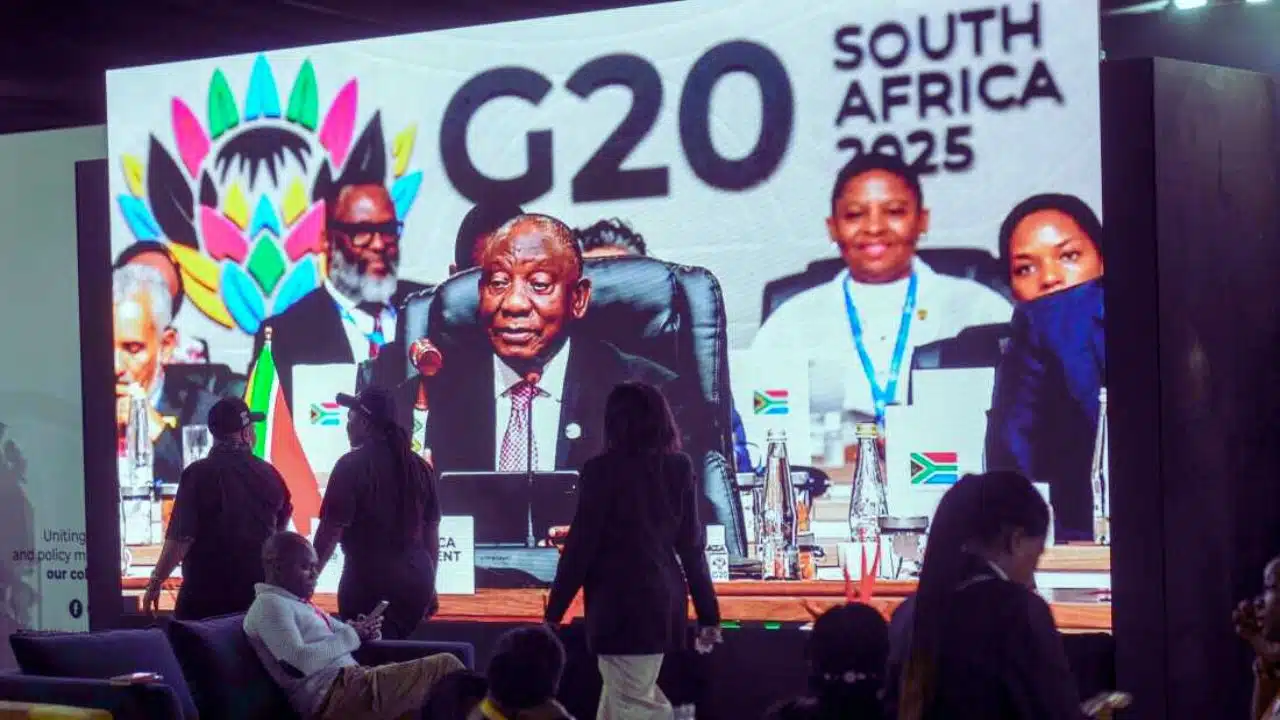
The G20 summit in South Africa has wrapped up with a landmark declaration on climate, debt and development, but the gathering’s historic first edition on African soil was overshadowed by the conspicuous absence of the United States after President Donald Trump ordered a boycott. Leaders pressed ahead with an agreement that put Africa and the wider Global South at the center of the agenda, even as Washington’s empty chair raised fresh questions about the future of the forum and U.S. global leadership.
Historic first G20 in Africa
Johannesburg hosted the first-ever G20 leaders’ summit on the African continent, a moment South African President Cyril Ramaphosa framed as a chance to inject developing-country priorities into the club of major economies. Around 20 G20 leaders and invited heads of state gathered at a convention center near Soweto for two days of talks on climate, debt, food security and digital transformation.
Ramaphosa used his closing gavel strike to underscore that “Africa and the Global South” had moved closer to the heart of global economic governance, even if many delegates privately admitted the meeting had been overshadowed by geopolitics and the U.S. no-show.
Why the U.S. skipped the summit
President Trump’s decision to boycott the summit stemmed from his repeated and widely debunked claims that South Africa’s government is seizing land from white farmers and tolerating violence against the Afrikaner minority. The White House also bristled at South Africa’s emphasis on diversity, equity and inclusion as well as climate and wealth inequality, casting parts of the agenda as hostile to U.S. interests.
Washington made a late offer to send a lower-ranking embassy official to at least take part in the ceremonial handover of the G20 presidency, but Pretoria refused, saying it would be inappropriate for Ramaphosa to pass the gavel to anyone other than a head of state or senior minister.
An awkward G20 handover
The U.S. absence created an unprecedented procedural headache: there was no American representative in the room to receive the gavel as the United States prepares to chair the G20 next year. South African officials said the physical handover could take place later via diplomatic channels, while Ramaphosa still formally announced the U.S. as incoming president from the podium.
The Trump administration has already said it plans to host the 2026 G20 summit at the president’s Doral golf resort in Florida, a move likely to reignite domestic controversy over conflicts of interest and further politicize the forum.
Declaration agreed despite boycott
In a break with tradition, leaders endorsed their final declaration on the opening day rather than waiting until the end of the talks, a move partly designed to guard against last-minute disruption amid U.S. opposition. The text, published by South Africa’s foreign ministry and the official G20 website, commits members to accelerate action toward net-zero emissions “by or around mid-century” and reaffirms the Paris Agreement temperature goals.
The declaration also highlights the estimated USD 5.8–5.9 trillion in financing needs for developing countries to implement climate plans before 2030 and calls for scaled-up support through multilateral development banks and private capital. G20 leaders backed an IMF–World Bank review of debt sustainability tools for low‑income countries and endorsed a finance ministers’ deal on debt treatments intended to speed up relief for vulnerable states.
Focus on Africa, inequality and development
South Africa’s presidency was built around three broad pillars: tackling climate change, overhauling global debt rules, and narrowing the gap between rich and poor countries. The final text stresses investment in African infrastructure, support for smallholder farmers, and efforts to strengthen food security through better land, water and energy management.
Leaders also pledged to promote fairer international taxation, expand digital public infrastructure and push for more inclusive global trade rules, while stopping short of endorsing some of Pretoria’s most ambitious ideas, such as a new permanent global body focused specifically on wealth inequality.
Gender, DEI and digital regulation
Despite U.S. objections, the declaration contains strong language on gender equality, vowing to eliminate violence against women and girls and increase women’s participation in political and economic decision‑making. It also reaffirms earlier G20 principles on artificial intelligence and emerging technologies, promising to deepen cooperation on AI governance while seeking to ensure that digital tools benefit developing countries.
The inclusion of diversity, equity and inclusion themes—alongside climate and inequality—became one of the starkest points of divergence with the Trump administration, which has portrayed such language as ideologically driven.
Allies, skeptics and the G20’s future
Argentina’s libertarian President Javier Milei, a close Trump ally, also stayed away from Johannesburg and criticized the declaration, aligning Buenos Aires with Washington’s stance even as most G20 members moved ahead. European and Asian leaders, by contrast, largely backed South Africa’s efforts, seeing the summit as a test of whether the G20 can still deliver joint positions in an era of deep geopolitical fractures.
Analysts warn that repeated boycotts or symbolic snubs from major powers could slowly erode the G20’s credibility, but many in Johannesburg argued that this year’s gathering showed the bloc can function—and even evolve—without automatic U.S. buy‑in. South African officials framed the outcome as proof that, while Washington’s participation remains crucial, Africa and the broader Global South are no longer content to sit on the margins of global economic decision‑making.