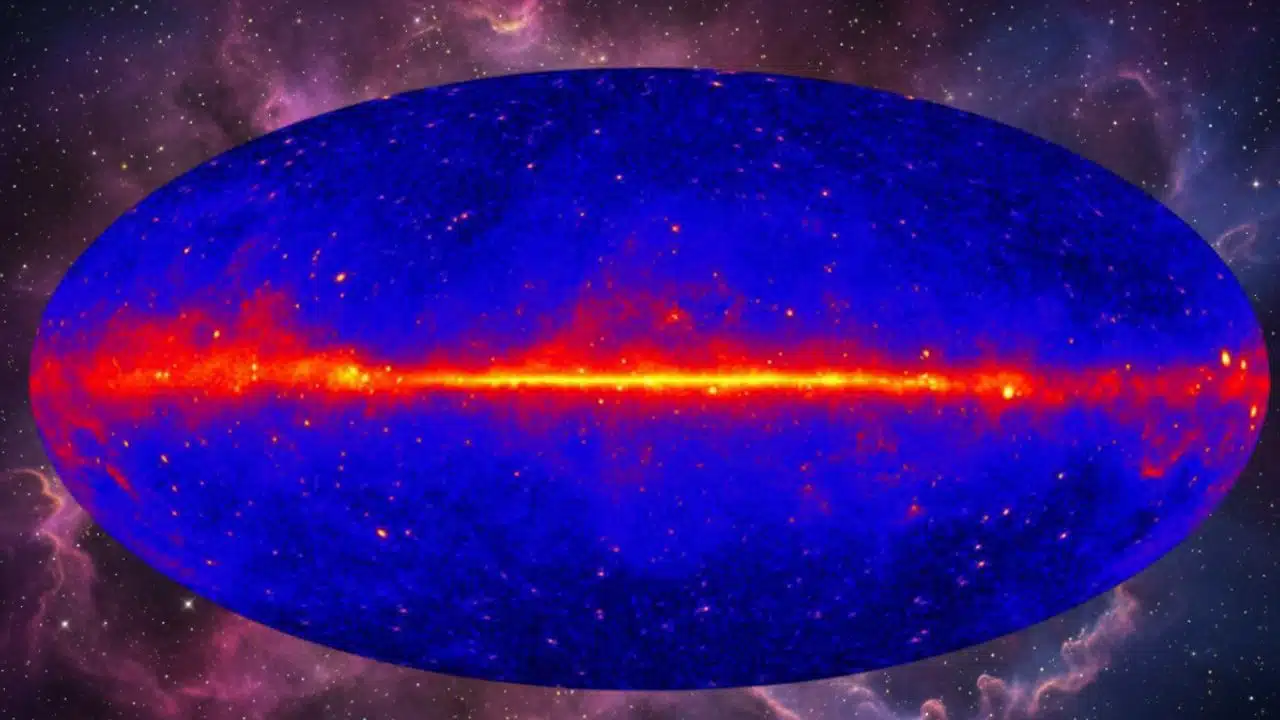
An international team of astronomers has captured the first-ever direct image of a faint filament of dark matter, the elusive cosmic scaffolding that makes up over a quarter of the universe. This groundbreaking observation, confirming a core prediction of cosmological models, provides the strongest evidence yet that galaxies are connected by a vast, invisible web.
In a landmark discovery, researchers using the Keck Observatory in Hawaii have visualized a tendril of the mysterious substance stretching between two galaxies in the Abell 2218 cluster. The findings, published in the journal Nature, offer a stunning glimpse into the large-scale structure of the universe and open a new chapter in our quest to understand the fundamental nature of dark matter, seen for the first time not just by its gravitational influence, but as a tangible, albeit ghostly, bridge.
Key Facts: A Quick Take
- What was observed? A filament of dark matter, part of the theorized “cosmic web,” was directly imaged.
- How was it done? Astronomers used the gravitational lensing effect, where the massive dark matter filament bent the light from a distant background galaxy, allowing its shape to be mapped.
- Who made the discovery? An international team led by astronomers from the University of Waterloo, Yale University, and the University of Toronto.
- Why is it significant? It provides the first visual evidence for the cosmic web theory, which posits that galaxies are embedded within a vast network of dark matter filaments.
- What is dark matter? An invisible substance that does not emit or reflect light but is believed to constitute about 27% of the universe’s mass. Its existence has been inferred from its gravitational effects on visible matter.
- The technology: The observation was made possible by the powerful Keck I telescope in Mauna Kea, Hawaii, utilizing its Low Resolution Imaging Spectrometer (LRIS).
The Discovery: Seeing the Invisible
For decades, the standard model of cosmology has predicted that matter in the universe is distributed in a complex network resembling a spider’s web. In this model, vast filaments of dark matter crisscross the cosmos, with galaxies forming at the dense intersections, or nodes, of this web. While computer simulations have consistently produced this structure and indirect evidence has been mounting, no one had ever directly seen a piece of it—until now.
The team, led by Dr. Mike Hudson from the University of Waterloo, focused their efforts on the galaxy cluster Abell 2218, a massive congregation of galaxies located approximately 2 billion light-years from Earth. By analyzing how the light from even more distant background galaxies was distorted as it passed through the cluster, they could map the distribution of mass—both visible and invisible.
This technique, known as weak gravitational lensing, relies on Albert Einstein’s theory of general relativity. Massive objects, including filaments of dark matter, warp the fabric of spacetime. Light from a distant object traveling through this warped space is bent, causing the object’s apparent shape to be slightly distorted. By measuring these subtle distortions across thousands of background galaxies, the astronomers were able to reconstruct a map of the intervening mass.
“For decades, we have been predicting the existence of these dark matter filaments that connect galaxies,” said Dr. Hudson in a press release. “This image moves us beyond predictions to something we can see and measure.
Data & Statistics: Quantifying the Ghostly Bridge
The breakthrough was not just qualitative but also quantitative, providing tangible numbers to a theoretical concept. The analysis yielded several key statistics that underscore the significance of the finding:
- Filament Mass: The detected dark matter filament is estimated to have a mass density several times the average for the universe. The team calculated its significance at a level of 4.5 sigma, a statistical measure indicating a very high confidence level (less than a 1-in-100,000 chance of being a random fluctuation.
- Cosmic Composition: The observation reinforces established cosmological parameters. Current models, such as the Lambda-CDM model, estimate that the universe is composed of approximately 5% ordinary (baryonic) matter, 27% dark matter, and 68% dark energy. This direct detection of a dark matter structure strongly supports these proportions.
- Lensing Signal Strength: The weak lensing signal measured by the team was incredibly faint, representing a tiny distortion in the shapes of background galaxies. The collective signal from the filament was strong enough to be mapped by stacking the images of nearly 23,000 background galaxies, a testament to the power of the Keck telescope and the sophisticated data processing algorithms developed by the team.
Expert Analysis and Future Implications
The discovery has been hailed by the astronomical community as a monumental achievement. Dr. Seth Shostak, Senior Astronomer at the SETI Institute (who was not involved in the study), commented in a related podcast that this moves dark matter from a “necessary inference to a directly mapped reality.” The ability to visualize these structures is a game-changer.
This technique pioneers a new way to study the cosmos on the largest scales. By mapping more of these filaments, scientists can:
- Test Theories of Gravity: Further investigate whether Einstein’s theory of general relativity holds true over these vast cosmic distances.
- Understand Galaxy Evolution: Study how the flow of matter along these cosmic highways fuels galaxy growth and influences their formation and orientation.
- Constrain the Nature of Dark Matter: While the image shows where the dark matter is, it doesn’t reveal what it is. However, by measuring the properties of these filaments (their density, clumpiness, and shape), researchers can rule out certain theoretical dark matter particle candidates.
“This is a critical first step,” paraphrased from the research paper’s conclusion, “future surveys with next-generation telescopes like the Euclid satellite and the Nancy Grace Roman Space Telescope will be able to map these structures across the entire sky, giving us a complete blueprint of the cosmic web.”
The Human Element: A Glimpse into the Unknown
For the public, the image provides a humbling perspective on our place in the universe. It’s one thing to hear that 95% of the cosmos is invisible and mysterious; it’s another to see a representation of that invisible architecture.
“It’s an eerie, ghostly image,” remarked a visitor at a recent planetarium show discussing the discovery in Dhaka. “To think that our own Milky Way is just a bright spot in a web like that is both terrifying and awe-inspiring.” This sentiment captures the profound impact of making the unseen, seen.
What to Watch Next
The immediate next step for the research team and others in the field is to apply this technique to other galaxy clusters. Finding and mapping more filaments will confirm whether this was a one-off success or a repeatable method for charting the universe’s skeleton. Future observatories, with their wider fields of view and greater sensitivity, are expected to turn this trickle of data into a flood, potentially creating a full 3D map of the local cosmic web within the next decade. The quest to identify the dark matter particle itself continues in underground laboratories, but this astronomical achievement provides the clearest picture yet of the world it has built.