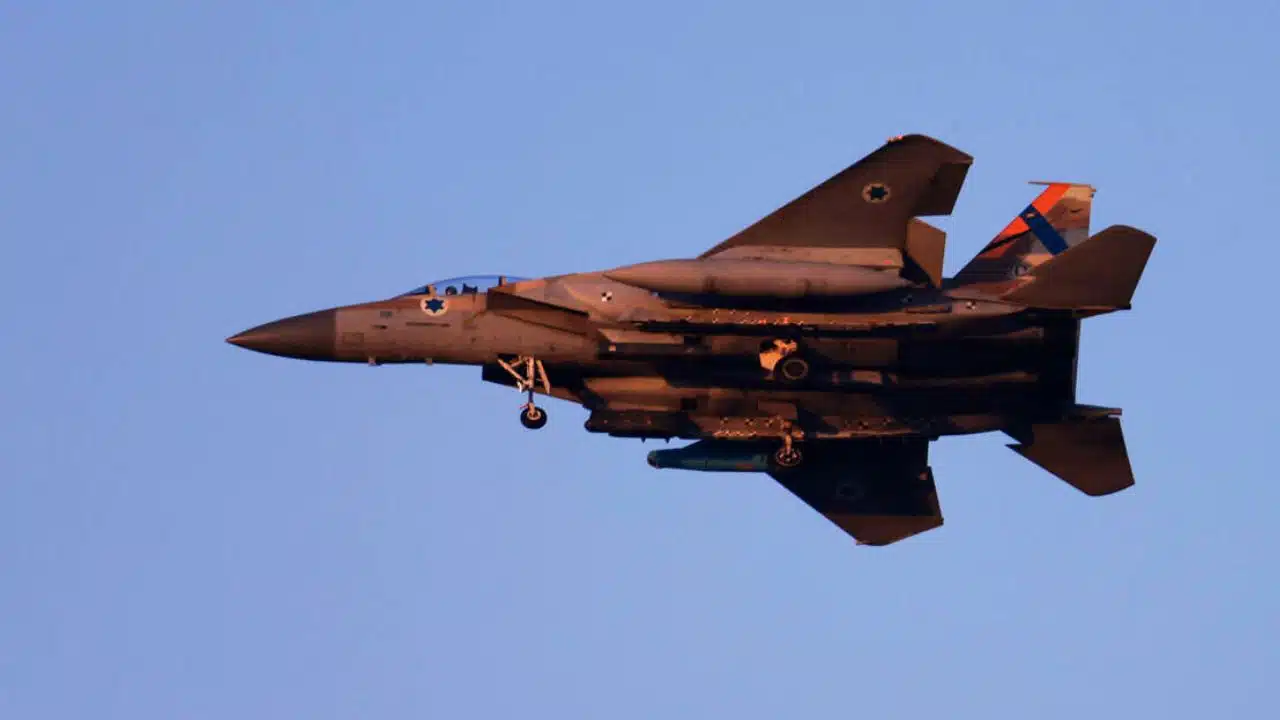
On September 9, 2025, Israeli fighter jets carried out one of the most complex and controversial operations of the Israel-Hamas conflict to date. Launching from positions over the Red Sea, the aircraft fired a volley of air-launched ballistic missiles toward Doha, Qatar, where senior Hamas figures were meeting to evaluate a potential ceasefire proposal. The missiles struck the Qatari capital with devastating speed, killing six people and severely undermining months of delicate diplomacy that Qatar had been hosting.
The deaths included Qatari security officers and aides connected to Hamas negotiators, but the top Hamas leaders survived. This survival both reduced the strike’s immediate tactical effect and heightened its symbolic and diplomatic consequences.
A Novel Method: Why the Red Sea Launch Was Chosen
The most striking feature of the operation was the method of delivery. Rather than flying over Gulf state airspace, which would have risked confrontation or diplomatic fallout, Israeli jets fired ballistic missiles upward into the atmosphere from hundreds of kilometers away.
These missiles arced into space before descending at hypersonic speeds toward their targets. The use of a west-to-east trajectory meant the projectiles approached Qatar from a direction its air defense systems were not optimized to monitor. This approach avoided the heavily surveilled air corridors typically guarded against threats from Iran to the north or Houthi-controlled areas of Yemen to the south.
This method had two primary goals:
-
Strategic surprise. Air defense systems in Qatar and nearby U.S. installations were not positioned to anticipate an attack from the west.
-
Diplomatic caution. By not crossing into Saudi Arabian or Emirati airspace, Israel avoided breaching sovereignty, which could have jeopardized its long-term ambitions for normalization with Gulf states.
The Limits of Qatar’s Defenses
Qatar maintains Patriot missile batteries as part of its national defense infrastructure, supported by the U.S. Central Command forward base at Al Udeid Air Base. These systems are capable of intercepting aircraft and many missile types but are not designed to stop ballistic missiles descending from the edge of space at extreme speeds.
The only effective countermeasure in such a case would have been the Terminal High Altitude Area Defense (THAAD) system, which Qatar had previously ordered but had not yet fully deployed. Without THAAD in place, interception of the September 9 strike was virtually impossible once the missiles were airborne.
The Scale of the Operation
Reports indicate that around ten aircraft participated in the mission, firing approximately ten missiles. The number of missiles was large enough to overwhelm any potential local defense responses and ensure that at least some reached their intended targets.
Analysts have suggested that Israel employed one of several air-launched ballistic missile systems in its arsenal. These include the Golden Horizon, the IS02 Rocks, and potentially a modified version of the Sparrow system, known for its ability to carry both live and inert warheads.
-
The Golden Horizon has been assessed as capable of long-range precision strikes, designed specifically to hold distant adversaries at risk.
-
The Rocks system combines standoff range with maneuverability during descent.
-
The Sparrow, with a potential inert warhead configuration, could explain why surrounding civilian infrastructure, including a nearby fuel station, did not ignite or cause secondary explosions despite the kinetic force of the strike.
The estimated range of such missiles, at 1,500–2,000 kilometers, is consistent with a Red Sea launch reaching Doha.
Casualties and Immediate Damage
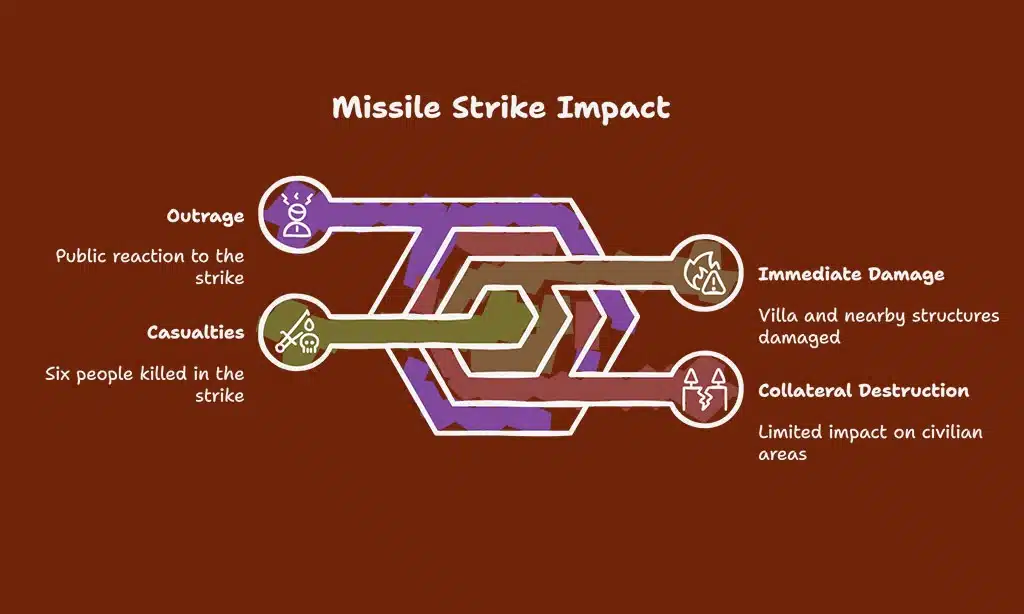
The strike killed six people, including relatives of Hamas political leaders, aides, and local security staff. Several family members were wounded, and the targeted villa in Doha’s Leqtaifiya district sustained major damage. Nearby civilian structures were also affected, but collateral destruction was limited compared to the scale of the missile barrage.
The choice of using potentially inert or low-explosive warheads may have been deliberate, maximizing the ability to neutralize specific individuals while limiting collateral devastation. However, the human cost and the violation of Qatari territory sparked immediate outrage.
Diplomatic Fallout and Regional Anger
Qatar, long a host for delicate ceasefire negotiations between Israel and Hamas, saw its mediator role shattered overnight. The strike created a perception that diplomatic hosts could no longer be considered neutral or safe, casting doubt on Qatar’s ability to continue as a trusted broker.
Across the region, governments expressed alarm. Neighboring Gulf states feared that they too could become targets if they were perceived to shelter adversaries or play host to negotiations unwanted by Israel. The operation also reignited anger across the Arab world, already inflamed by Israel’s simultaneous ground offensive into Gaza City launched roughly a week later.
For the United States, the incident posed challenges as well. With its largest Middle East base located in Qatar, Washington had to balance support for Israel with reassurance to its Qatari ally. Conflicting reports emerged over whether U.S. officials warned Doha in advance or only after the missiles struck. The lack of clarity fueled mistrust in Qatar’s leadership and strained relations with Washington.
The Broader Military Context
This was not the first time Israel employed long-range standoff weapons in its conflicts. Earlier in June 2025, Israel waged a 12-day campaign against Iran using similar missile technology, including air-launched ballistic systems to avoid flying into Iranian airspace. Debris recovered in Iraq confirmed the use of such advanced munitions.
Globally, the concept of air-launched ballistic missiles (ALBMs) is not new. Russia has used them extensively in its war against Ukraine, leveraging the high speed and long reach to challenge Ukrainian defenses. China recently displayed its own nuclear-capable ALBM during a national parade, signaling its strategic value. By employing the same method in Doha, Israel joined this trend of using ALBMs as a way to strike deep targets without exposing aircraft to modern air defenses.
Why the Attack Matters Strategically
The Doha strike represents a turning point in several ways:
-
Erosion of Neutral Mediation. Qatar’s credibility as a host for negotiations has been damaged, and Hamas may now seek alternative venues.
-
Expansion of Israel’s Strike Envelope. The use of long-range ALBMs shows Israel can reach deep into the region without crossing into contested airspace.
-
Pressure on Gulf Defenses. Countries like Qatar, Saudi Arabia, and the UAE may now accelerate investments in THAAD or other advanced anti-ballistic systems to counter similar threats.
-
Signal to Adversaries and Allies. Israel demonstrated that it can hit targets far beyond Gaza or Lebanon, projecting deterrence to Iran, Hamas, and Hezbollah while sending a message to mediators and regional states.
Unresolved Questions
While the strike showcased Israel’s military reach, significant uncertainties remain:
-
The exact missile type used has not been publicly confirmed.
-
Whether Israel intended to kill Hamas leadership or send a warning remains unclear.
-
The level of prior U.S. knowledge and coordination is still disputed, leaving questions about Washington’s role.
-
How Hamas will adapt its leadership’s movements and negotiation strategy is yet to be seen.
Escalation With Regional Ripples
The September 9 ballistic missile strike in Doha was more than a targeted military operation. It represented a new phase of conflict where diplomatic venues, foreign capitals, and advanced standoff weapons are all part of the battlefield. By firing from the Red Sea and striking within minutes, Israel both demonstrated military innovation and ignited fresh diplomatic crises.
The attack not only killed six and disrupted ceasefire talks but also unsettled the wider region, forcing Gulf states to reconsider their defenses and redrawing the lines of what can be considered safe space. For Israel, it was proof of reach and determination. For Qatar and its allies, it was a reminder that in today’s Middle East, no place is beyond the conflict’s grasp.