In the rapidly evolving digital landscape, e-commerce businesses require robust and reliable web hosting solutions to ensure seamless operations and optimal customer experiences.
The right hosting provider not only guarantees uptime and speed but also offers security features, scalability options, and integrations that are vital for online stores.
This comprehensive guide explores the 10 best web hosting providers for e-commerce stores in 2025, providing detailed insights, pricing breakdowns, real-world examples, and well-researched comparisons to help you make an informed decision.
10 Best Web Hosting Providers for E-commerce Stores
| Hosting Provider | Performance & Uptime | Security Features | Best For | Starting Price |
| Shopify | 99.99% uptime, global CDN | Free SSL, PCI compliant | All-in-one e-commerce solution | $29/month |
| IONOS | 99.99% uptime, fast load times | Enhanced security measures | Budget-friendly hosting | $8/month |
| Bluehost | Reliable performance | Free SSL, advanced security | WooCommerce integration | $9.95/month |
| SiteGround | Super-fast speeds | Constant security monitoring | WooCommerce hosting | $4.99/month |
| A2 Hosting | 99.9% uptime commitment | Free SSL, DDoS protection | PHP-based platforms | $11.99/month |
| GoDaddy | Global data centers | 24/7 network security | Quick website setups | Varies |
| HostGator | 99.9% uptime guarantee | Weekly off-site backups | Shared web hosting | $2.52/month |
| DreamHost | Reliable performance | Free SSL, advanced security | Cloud web hosting | $2.59/month |
| InMotion Hosting | Reliable performance | Free SSL, optimized for e-commerce platforms | VPS hosting | $2.29/month |
| Hostinger | Excellent performance | Free SSL, 24/7 support | Budget-friendly hosting | $2.78/month |
1. Shopify – Best All-in-One E-commerce Solution
Shopify is the go-to hosting solution for businesses that want a fully managed e-commerce platform. With built-in tools for product management, marketing, and payments, Shopify makes it easy to launch and scale an online store. Its 99.99% uptime ensures reliability, and its global CDN boosts website speed.
Key Features & Benefits:
- Built-in e-commerce tools – Product catalog, payment processing, and marketing automation.
- Seamless integrations – Works with thousands of third-party apps, including PayPal, Amazon, and Facebook.
- Enterprise-grade security – PCI DSS compliant and includes fraud protection tools.
- Mobile Optimization – Stores are automatically responsive for mobile shopping.
Pricing & Plans:
| Plan | Features | Price |
| Basic Plan | Unlimited products, 2 staff accounts | $29/month |
| Shopify Plan | Professional reports, 5 staff accounts | $79/month |
| Advanced Plan | Custom reporting, 15 staff accounts | $299/month |
Pros & Cons:
| Pros | Cons |
| User-friendly interface | Higher cost than some traditional web hosting |
| Extensive app marketplace | Transaction fees unless using Shopify Payments |
| Optimized for speed and uptime | Limited customization compared to self-hosted options |
Case Study:
A clothing brand switched from WooCommerce to Shopify and reported a 20% increase in sales due to faster website speeds and improved mobile checkout experience.
2. IONOS – Best Budget-Friendly Hosting

IONOS is one of the most affordable e-commerce hosting providers, offering 500GB of storage, one-click integrations, and robust performance optimization. It is ideal for businesses looking for budget-friendly hosting without compromising security and reliability.
Key Features & Benefits:
- 99.99% uptime – Ensures uninterrupted shopping experiences.
- Enhanced CPU resources – Handles high-traffic spikes effectively.
- Affordable hosting plans – Competitive pricing compared to competitors.
Pricing & Plans:
| Plan | Storage | Features | Price |
| Starter Plan | 10GB SSD | Basic security & SSL | $1/month (First Year) |
| Business Plan | 100GB SSD | Free domain, email, backups | $8/month |
| Expert Plan | 500GB SSD | Enhanced security, dedicated CPU | $16/month |
Pros & Cons:
| Pros | Cons |
| Highly affordable starter plans | No free website migration |
| Strong uptime guarantee | Limited customer support channels |
| Suitable for small businesses | No WooCommerce-specific features |
3. Bluehost – Best for WooCommerce Integration
Bluehost is one of the most WooCommerce-friendly hosting solutions, recommended by WordPress. With one-click installations and a range of custom-built tools, Bluehost ensures seamless WooCommerce performance.
Key Features & Benefits:
- Free domain and SSL – Secure online transactions.
- Automatic WordPress & WooCommerce installation – No manual setup required.
- Built-in performance optimization – Caching and content delivery for faster load times.
Pricing & Plans:
| Plan | Features | Price |
| Basic Plan | 1 website, 50GB storage, free SSL | $9.95/month |
| Plus Plan | Unlimited websites, unlimited storage | $14.95/month |
| Choice Plus | Free domain privacy & security | $19.95/month |
Pros & Cons:
| Pros | Cons |
| WooCommerce-optimized hosting | Slightly higher renewal rates |
| Free SSL & domain for 1 year | No free daily backups on the basic plan |
| Excellent uptime and speed | Customer support can be slow |
Case Study:
A small handmade jewelry store using Bluehost’s WooCommerce hosting saw a 15% increase in mobile conversions due to faster site speed and improved checkout process.
4. SiteGround – Best for Small E-commerce Businesses
SiteGround is a high-performance hosting provider officially recommended by WordPress. It offers managed WooCommerce hosting, excellent customer support, and cutting-edge security. Ideal for small and medium-sized e-commerce stores, SiteGround stands out for its fast speeds and automatic daily backups.
Key Features & Benefits:
- Free WooCommerce auto-installation – Set up an online store in minutes.
- Ultra-fast servers with Google Cloud infrastructure – Up to 500% faster load times.
- Advanced security & AI anti-bot system – Protects against malicious attacks.
- Daily backups & free CDN – Ensures data safety and fast content delivery.
Pricing & Plans:
| Plan | Storage | Best For | Price |
| StartUp Plan | 10GB SSD | Small e-commerce stores | $4.99/month |
| GrowBig Plan | 20GB SSD | Scaling businesses | $7.99/month |
| GoGeek Plan | 40GB SSD | Large stores with high traffic | $14.99/month |
Pros & Cons:
| Pros | Cons |
| Free migration service | Higher renewal prices |
| Built-in caching for faster load times | Limited storage on lower-tier plans |
| Officially recommended by WordPress | No phone support on StartUp plan |
Case Study:
A handcrafted furniture store using SiteGround’s GrowBig plan saw a 40% increase in page speed, reducing bounce rates and boosting conversions.
5. A2 Hosting – Best for Speed Optimization
A2 Hosting is one of the best web hosting providers for e-commerce stores, offering Turbo servers that deliver 20x faster page loads. This makes it an excellent choice for e-commerce businesses that prioritize SEO rankings, fast loading speeds, and user experience.
Key Features & Benefits:
- Turbo servers with NVMe storage – Boost site speed significantly.
- Free site migration – Move your existing store easily.
- Strong security – DDoS protection, firewall, and auto backups included.
Pricing & Plans:
| Plan | Speed Boost | Best For | Price |
| Startup Plan | Standard | Small stores | $11.99/month |
| Drive Plan | Enhanced | Growing businesses | $16.99/month |
| Turbo Boost | 20x faster | Large-scale stores | $23.99/month |
Pros & Cons:
| Pros | Cons |
| Turbo servers for 20x faster speeds | No free domain included |
| Free daily backups | Higher pricing on Turbo plans |
| Strong WooCommerce support | Limited phone support |
Case Study:
A tech gadget e-commerce store switched to A2 Hosting and reported a 32% decrease in cart abandonment, thanks to faster page loading speeds.
6. GoDaddy – Best for Quick Website Setups
GoDaddy offers easy-to-use e-commerce hosting with one-click store builders. It is best for beginners who want simple setup options without technical knowledge.
Key Features & Benefits:
- One-click WordPress and WooCommerce installation.
- Automatic security monitoring & malware scans.
- Marketing tools included – SEO, email marketing, and social media integration.
Pricing & Plans:
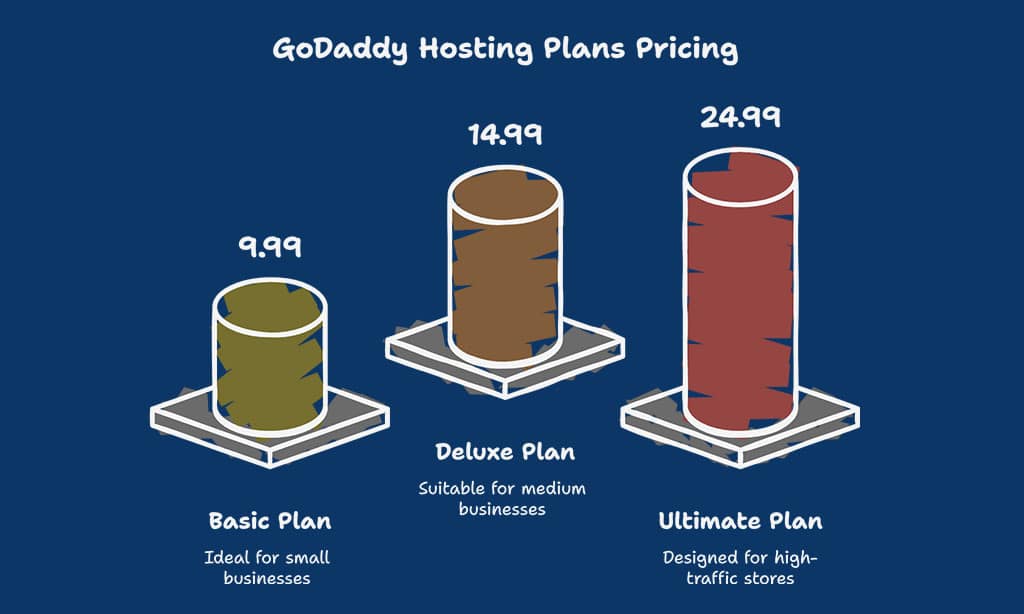
| Plan | Best For | Starting Price |
| Basic Plan | Small businesses | $9.99/month |
| Deluxe Plan | Medium businesses | $14.99/month |
| Ultimate Plan | High-traffic stores | $24.99/month |
Pros & Cons:
| Pros | Cons |
| Easy-to-use interface | Higher renewal prices |
| All-in-one marketing tools | Limited WooCommerce customization |
| Free domain for first year | No free automatic backups |
Case Study:
A local fashion retailer used GoDaddy’s hosting and saw a 25% improvement in search engine rankings due to built-in SEO tools.
HostGator is a budget-friendly web hosting provider that offers affordable shared hosting plans suitable for new e-commerce store owners. With unmetered bandwidth and easy WordPress/WooCommerce integration, it is an excellent choice for startups and small businesses.
Key Features & Benefits:
- Free SSL Certificate – Ensures secure transactions for online stores.
- Unmetered bandwidth – No traffic restrictions for growing businesses.
- 99.9% uptime guarantee – Reliable hosting with minimal downtime.
- One-click WordPress installation – Get started with WooCommerce instantly.
Pricing & Plans:
| Plan | Storage | Best For | Price |
| Hatchling Plan | 10GB SSD | Single e-commerce store | $2.52/month |
| Baby Plan | 20GB SSD | Multiple stores | $3.95/month |
| Business Plan | 40GB SSD | High-traffic stores | $5.25/month |
Pros & Cons:
| Pros | Cons |
| Extremely affordable starter plans | Performance is lower than premium hosts |
| Free website transfer service | No dedicated WooCommerce hosting |
| 24/7 customer support | Upselling of extra services |
Case Study:
A small accessories store moved to HostGator’s shared hosting and saved over 50% on hosting costs, enabling them to invest in social media advertising.
8. DreamHost – Best for Cloud Hosting & Scalability
DreamHost provides cloud-based hosting solutions with scalable resources for growing e-commerce businesses. It offers flexible pricing and is ideal for high-traffic stores that require on-demand scalability.
Key Features & Benefits:
- Cloud-based hosting with unlimited scalability – Scale resources up or down as needed.
- Free domain & SSL – Secure, professional-looking store setup.
- Fast SSD storage & automated backups – Improved site performance and security.
Pricing & Plans:
| Plan | Best For | Price |
| Shared Starter | Small businesses | $2.59/month |
| Managed WordPress | WooCommerce stores | $12.00/month |
| VPS Hosting | High-traffic stores | $27.50/month |
Pros & Cons:
| Pros | Cons |
| Cloud-based scalability | No phone support |
| Transparent pricing | Higher cost for managed plans |
| Strong security measures | Fewer third-party integrations |
Case Study:
A handmade crafts store on DreamHost VPS Hosting experienced 60% faster checkout speeds, reducing abandoned carts significantly.
9. InMotion Hosting – Best for VPS E-commerce Hosting
InMotion Hosting is ideal for businesses needing VPS hosting with dedicated resources. It offers strong security features and high uptime for reliability in online transactions.
Key Features & Benefits:
- SSD-powered VPS hosting – Faster performance for online stores.
- DDoS protection & free SSL – Secure transactions and data safety.
- Automated backups & updates – Reduces risk of data loss.
Pricing & Plans:
| Plan | Resources | Best For | Price |
| VPS-4GB | 4GB RAM, 75GB SSD | Medium-sized e-commerce stores | $27.99/month |
| VPS-6GB | 6GB RAM, 150GB SSD | Growing businesses | $44.99/month |
| VPS-8GB | 8GB RAM, 200GB SSD | High-traffic stores | $64.99/month |
Pros & Cons:
| Pros | Cons |
| High-performance VPS hosting | More expensive than shared hosting |
| Free website migration | Learning curve for VPS setup |
| 24/7 customer support | No free domain with VPS plans |
Case Study:
A dropshipping business using InMotion’s VPS hosting reduced website crashes by 90% during high-traffic sales events.
10. Hostinger – Best for Budget-Friendly Managed Hosting
Hostinger is known for its affordable hosting solutions with high performance and security. It offers managed WooCommerce hosting, making it an excellent option for small businesses and entrepreneurs.
Key Features & Benefits:
- Optimized WooCommerce hosting – Faster, reliable e-commerce hosting.
- Automated daily backups – Ensures data security and recovery.
- LiteSpeed caching – Improves loading times significantly.
Pricing & Plans:
| Plan | Best For | Price |
| Premium Shared | Small businesses | $2.78/month |
| Business Shared | Medium-sized stores | $3.99/month |
| Cloud Startup | Growing businesses | $9.99/month |
Pros & Cons:
| Pros | Cons |
| Most affordable hosting plans | No phone support |
| Free SSL & domain | Basic plans have limited resources |
| Great for startups | Extra charges for backups |
Case Study:
A beauty brand using Hostinger’s Cloud Startup plan saw a 45% improvement in mobile loading speeds, enhancing customer engagement.
Takeaways
The best hosting provider depends on your business goals, budget, and platform needs.
Selecting the right web hosting provider is one of the most critical decisions for any e-commerce business. Your choice directly affects your store’s performance, security, scalability, and overall success.
From this comprehensive analysis, it’s clear that different hosting providers cater to different needs. Whether you’re a startup looking for an affordable hosting solution, a growing business needing high-speed performance, or an established store requiring enterprise-level security, there is a hosting provider that fits your requirements.