Listen to the Podcast:
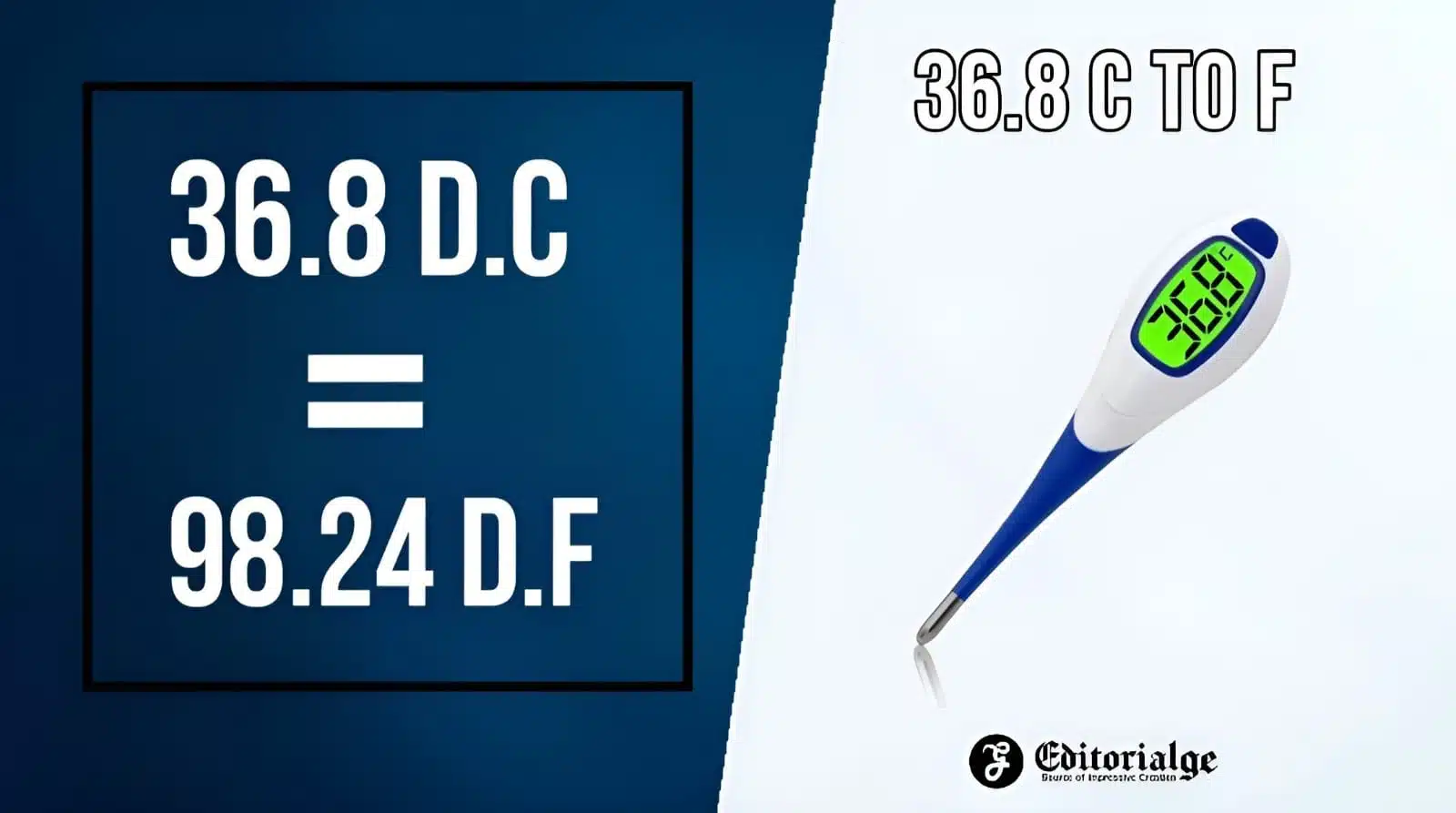
How to convert 36.8 c to f? The normal temperature of the human body is 36.8° Celsius or 98.24° Fahrenheit. Most people think they are 37° Celsius or 98° Fahrenheit, but these are the exact numbers.
A thermometer used in medicine to measure a person’s body temperature is often set up with Fahrenheit units. So, a high fever would be shown by a thermometer reading above 98.24° Fahrenheit. When someone or something has a high fever, their body temperature exceeds what it should be. This could happen because of things outside of themselves. The body sometimes raises its temperature to protect itself from pathogens. This article teaches us about the temperature conversion of 36.8 C to F (Degrees Celsius to Fahrenheit).
Introduction
You can change 36.8 c to f in two ways, and you can use a calculator or a chart to help you figure it out. You can use an online temperature converter to get the exact number. After you’ve put in the right temperature, you can use a calculator to double-check your results. When you need to convert between different temperatures, a conversion chart can be very helpful. Use this chart to figure out how to change 36.8 c to F or any other temperature unit.
How do Celsius and Fahrenheit Work?
Temperatures in Celsius are written as several degrees followed by °C or just C. On the Celsius scale, it takes 100 degrees for water to boil and 180 degrees for it to freeze. This means that 1.8 degrees Fahrenheit is equal to 1 degree Celsius.
What is Celsius (°C)?
In the metric system, the unit for temperature is Celsius (C), which can also be written as centigrade. This temperature scale is based on the fact that water freezes at 0 degrees Celsius and boils at 100 degrees Celsius.
“C” is the letter that stands for Celsius. For example, 36.8 C can be used to write the temperature.
What is Fahrenheit (F)?
In the Imperial System of Measurement, the temperature is measured in degrees Fahrenheit (F). The temperature scale created by physicist Daniel Gabriel Fahrenheit is the basis for this system. In the Fahrenheit system, water freezes at 32 degrees Fahrenheit and boils at 212 degrees Fahrenheit. The letter “F” is the symbol of Fahrenheit. For example, 36.8 F stands for 36.8 degrees Fahrenheit.
Calculating 36.8 C to F
You can use the formula below to change temperatures from Celsius to Fahrenheit. The formula for going from Celsius to Fahrenheit is 36.8 x 1.8 + 32. This formula helps you focus on what you want to work on. You can also use a calculator to check your work. You can figure out 36.8 C to F either by hand or with a calculator. People often make the mistake of converting from Celsius to Fahrenheit in their heads. It’s really not that hard. Everything is in the name. To figure out the right temperature for your home, you’ll need to know both Celsius and Fahrenheit. If you are in the United States, 97.6 degrees Fahrenheit is as close as you can get. But if you live in a different country, you can go straight from Fahrenheit to Celsius.
Read More: Fever Dream
Celsius to Fahrenheit Formula
The Celsius to Fahrenheit formula is the way to convert a temperature given in °C to a temperature given in °F. We know that the freezing point of water is 0 degrees on the Celsius scale and 32 degrees on the Fahrenheit scale, while the boiling point of water is 100 degrees on the Celsius scale and 212 degrees on the Fahrenheit scale. Here is the formula for converting Celsius to Fahrenheit:
°F = °C × (9/5) + 32.
Using this formula, we can change any Celsius temperature to a Fahrenheit temperature (C to F).
What is the Simplest Way of Converting Celsius into Fahrenheit?
In Celsius, the temperature at which water boils is between 0 and 21 Fahrenheit. So, the easiest way to figure out the difference is
F = C X (9/5) + 32
But this isn’t the only way to convert since some people think this formula doesn’t give the exact number.
– is another formula that people think is easy and quick.
Celsius Temperature X 2 + 32 = Fahrenheit
You can use this formula to change the temperature from Fahrenheit to Celsius: Fahrenheit Temperature – 30 / 2 = Celsius Temperature.
Even though there are other ways to measure temperature, like Kelvin, Réaumur, and Rankine, the most common ones are Degrees Celsius and Degrees Fahrenheit.
Celsius is used more often in the rest of the world than Fahrenheit is in the US and its territories. The numbers that show how hot or cold it is on these two different scales are very different.
For instance, water freezes at 0 degrees Celsius and boils at 100 degrees. In Fahrenheit, the freezing point of water is 32 degrees, and the boiling point is 212 degrees.
How do you Convert F to C Mentally?
How to use mental math to convert Fahrenheit temperatures to Celsius temperatures as closely as possible:
- To make up for the difference in the Fahrenheit scale, subtract 32o.
- Divide the temperature between Celsius by 2 (multiplied by 0.5).
- Add 0.05 to the number above, equal to 1/10 of this number (0.5 * 1/10 = 0.05).
Common °F and °C Temperature Table
|
°C |
°F |
Represents |
|
-40 |
-40 |
It represents an extremely cold day |
|
−18 |
0 |
Average cold winter day |
|
0 |
32 |
Freezing point of water |
|
10 |
50 |
Pleasant cool day |
|
21 |
70 |
Typical room temperature |
|
58 |
136 |
Highest temperature ever recorded on Earth |
|
-88 |
-126 |
Lowest temperature ever recorded on Earth. |
|
15 |
59 |
Surface temperature of Earth |
|
30 |
86 |
Hot day |
|
37 |
98.6 |
Normal body temperature |
|
40 |
104 |
Hot shower temperature |
|
100 |
212 |
Boiling point of water |
|
180 |
356 |
Baking temperature in an oven |
Body Temperature Conversions
|
Body Temperature |
Celsius (C) |
Fahrenheit (F) |
Kelvin (K) |
|
Hypothermia |
Below 35 C |
Below 95 F |
Lower than 308.15 K |
|
Normal Range |
36.4-37.6 C |
97.6 – 99.6 F |
309.594-310.706 K |
|
Fever |
38 C |
100.4 F |
311.15 K |
|
High Fever |
39.5 C |
103.1 F |
312.65 K |
|
Very High Fever |
41 C |
105.8 F |
314.15 K |
What Temperature is Considered a Fever?

If you have a fever, a thermometer reading that is higher than usual can be a sign.
The American College of Critical Care Medicine (ACCCM)
Trusted Source says that someone has a fever if their temperature is 100.9°F (38.3°C) or higher. As we’ve already said, the exact reading depends on a few things. If your temperature is higher than what the article says is normal, you may have a fever.
In general, a temperature that is 2°F (1.1°C) higher than normal is a sign of a fever.
Read Also: Dengue Fever Protection
Symptoms of Fever
Mild fever (38 to 38.9 degrees Celsius)
If you have a mild fever, your cheeks might be red, you might feel tired, and you might feel warm to the touch. You will be able to do most things that people do every day.
High fever (39 to 39.9 degrees Celsius)
You will feel hot to the touch if you have a high fever. You might not feel good enough to go to work, and your body might hurt.
Very high fever (40 degrees Celsius or higher)
If you have a very high fever, you’ll probably want to stay in bed or do nothing because you won’t feel well enough to do normal things. You will feel hot to the touch, and you might not be hungry.
Causes of Fever
Most of the time, a virus or bacterial infection causes a fever. Your body fights infection by giving you a fever. The virus or bacteria that is causing the infection is killed when your body’s temperature goes up.
Some common things that can cause fevers are:
- respiratory tract infections
- flu (influenza) and flu-like conditions
- colds
- stomach bugs (gastroenteritis)
- ear infections
- infection of your tonsils (tonsillitis)
- kidney or urinary tract infections
- common childhood illnesses, such as chickenpox, scarlet fever, rubella (German measles), whooping cough, and rheumatic fever
After getting a shot, you might have a mild fever. Before or after getting a shot, adults shouldn’t take paracetamol. It could hurt how well the vaccine works.
Treating a Fever at Home
If your baby is older than three months and seems healthy, you can treat a fever at home.
- Babies who are breastfed or fed formula should eat less but more often.
- Babies who are older than six months should drink small amounts of clear fluids like water often.
- Don’t worry if they don’t want to eat. But you should worry if they don’t want to drink.
- If your baby has a fever and is in pain, you can give them paracetamol to make them feel better. Make sure to follow the instructions on the package about how much to give, and don’t give it for more than 2 days without seeing a doctor. Ibuprofen can also be given to babies who are over three months old.
Doctors now say that you shouldn’t sponge babies or use fans to make them feel better when they have a fever. The Australian College of Nursing also says that children who don’t seem to be in trouble shouldn’t always get medicine just to bring down their fever. For more information, talk to your doctor or check out the Choosing Wisely Australia website.
When Should You See a Doctor About a Fever?
You should call a doctor if you or your child have a high temperature (fever) and:
- Your kid is having a fit.
- You or your child gets a rash that does not go away when you press a glass against it (a non-blanching rash).
- Either you or your child is getting sicker.
- The fever lasts for longer than five days.
If you have a fever and your symptoms get worse, like a rash, stiff neck, shortness of breath, or chest pains, you should see a doctor.
Conclusion
This is the formula used to figure out “How to Convert 36.8 C to F,” but there are a few exceptions, and it’s not always a perfect conversion, so it’s a little harder than it looks.
A low-grade fever helps the body fight off infections most of the time. But if a fever keeps getting higher after a certain point, bad things can happen. Also, it’s important to keep an eye on how quickly the temperature is rising. A high fever that gets worse quickly or doesn’t go away (usually within a few days) is a reason to worry. If you have any questions or concerns about how to treat a fever, you can always talk to a healthcare professional.
Frequently Asked Questions (FAQs) about 36.8 c to f
What is 36.8 C transferred in Fahrenheit?
The normal temperature of the human body is 36.8° Celsius or 98.24° Fahrenheit.
Is 36.8 considered a fever?
The normal temperature of your body is between 36 degrees Celsius and 36.8 degrees Celsius. Most people have a high temperature or fever when their body temperature is at least 38 degrees Celsius. This could mean that you are sick. Most of the time, it means you have an infection like a cold.
What is 36.8 C transferred in Fahrenheit?
The normal temperature of the human body is 36.8° Celsius or 98.24° Fahrenheit.
What is the Normal Body Temperature for a Baby?
The American Academy of Pediatrics (AAP) says a healthy baby’s normal body temperature is between 97 and 100.3 °F (37.94 °C). People are said to have a fever if the temperature in their rectal area is 100.4 degrees or higher.
What is the Normal Body Temperature for Children?
A child’s normal body temperature is about 37 degrees Celsius (98.6 degrees Fahrenheit). On average, a child’s temperature is about 36.3 °C (97.4 °F) in the morning and about 37.6 °C (99.6 °F) in the afternoon.
What causes a high temperature in children?
Most of the time, your child’s fever means that his or her body is trying to fight off an infection. After getting their shots, some babies and young children get a fever. This should go away on its own quite fast. Talk to a health visitor or a doctor if you are worried.
What body temperature is too high?
Adults. If your temperature is at least 103 F (39.4 C), you should call your doctor. If you have a fever and any of these signs or symptoms, you should see a doctor right away: bad head pain.