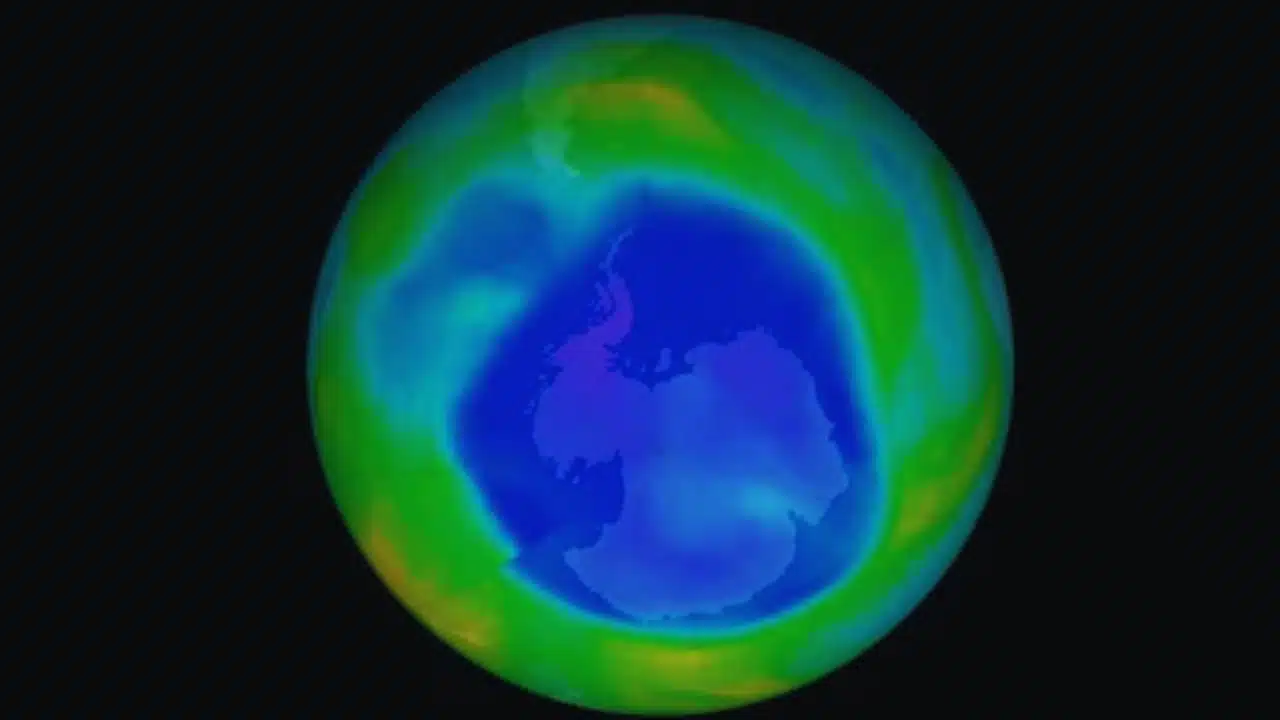
Scientists from NASA and the National Oceanic and Atmospheric Administration (NOAA) have announced that the ozone hole over Antarctica in 2025 stands out as the fifth smallest recorded since 1992, marking a clear step forward in the long-term recovery of Earth’s protective ozone layer. This positive development comes from the first year that global monitoring fully reflects the effects of the Montreal Protocol, the landmark international treaty that began phasing out ozone-damaging chemicals. At its peak on September 9, the hole measured 8.83 million square miles, which is approximately 30% smaller than the massive 2006 record of 12.66 million square miles—about the size of North America at its worst. Over the core depletion period from September 7 to October 13, the average extent reached 7.23 million square miles, roughly twice the area of the contiguous United States, yet this still signals progress amid ongoing seasonal thinning.
The hole’s formation follows a predictable annual cycle driven by unique Antarctic conditions, where cold winter temperatures create polar stratospheric clouds that activate destructive chemicals. NASA’s ozone watch data, updated daily through satellites like Aura, Suomi NPP, NOAA-20, and NOAA-21, confirmed the hole’s early breakup this year—nearly three weeks ahead of the typical timeline from the past decade—allowing ozone levels to rebound faster as spring sunlight strengthens. When extending the record back to 1979, the start of satellite observations, 2025 ranks as the 14th smallest out of 46 years, highlighting how the past few decades have seen more variability but an overall downward trend in severity.
Understanding the Ozone Hole Phenomenon
The term “ozone hole” can mislead—it’s not a physical puncture in the atmosphere but a dramatically thinned region in the stratosphere, the layer between 7 and 31 miles above Earth’s surface, where ozone concentrations plummet below 220 Dobson Units during Antarctic spring. Ozone, a molecule made of three oxygen atoms, naturally forms a shield that absorbs most ultraviolet (UV) radiation from the sun; in depleted areas, levels can drop to as low as 147 Dobson Units, as measured by NOAA weather balloons over the South Pole on October 6 this year. This is a far cry from the global average of around 300 Dobson Units, and the lowest ever recorded was a stark 92 Dobson Units in 2006, underscoring the hole’s extreme nature.
This seasonal event unfolds primarily over Antarctica because the polar vortex—a ring of strong, cold winds—isolates the region in winter, trapping and concentrating harmful substances. As sunlight returns in September, it triggers chemical reactions that rapidly break down ozone molecules, creating the vast depleted zone that expands before starting to refill by November. Researchers emphasize that while the hole affects only a portion of the stratosphere, its global implications are widespread, as ozone depletion elsewhere has been less severe but still notable in the Arctic due to similar, though milder, processes.
Factors Behind the Smaller Size in 2025
A combination of human-driven reductions in harmful chemicals and favorable natural conditions kept this year’s ozone hole more contained than in many recent years. Chief among them is the sharp decline in stratospheric chlorine—down by about one-third since peaking around 2000—largely thanks to bans on ozone-depleting substances. Paul Newman, a senior scientist at NASA’s Goddard Space Flight Center and a veteran of ozone research, noted that without these curbs, the hole would have exceeded 9.83 million square miles, adding over one million square miles of depletion. This estimate draws from atmospheric models that simulate chlorine’s role in catalytic reactions, where a single chlorine atom can destroy thousands of ozone molecules before being neutralized.
Weather patterns also played a supportive role, with August temperatures running warmer than average and a weaker polar vortex failing to trap as much cold air, which reduces the formation of those critical polar stratospheric clouds. Laura Ciasto, a NOAA meteorologist, explained that these milder conditions limited the activation of bromine and chlorine compounds, curbing the chemical frenzy that amplifies ozone loss. Satellite imagery from NASA’s Aura instrument captured these dynamics in real time, showing how dynamic winds and solar activity influenced day-to-day changes, making 2025’s hole form later and dissipate sooner than the early 2000s peaks.
The Montreal Protocol: A Blueprint for Global Recovery
The Montreal Protocol, adopted in 1987 and entering force in 1989 with full implementation by 1992, represents one of humanity’s most successful environmental agreements, uniting 197 countries to eliminate nearly 99% of the 98 ozone-depleting substances in use at the time. These included chlorofluorocarbons (CFCs), halons, and hydrochlorofluorocarbons (HCFCs), which were staples in everyday products like hairsprays, fire extinguishers, and cooling systems before their dangers became clear in the 1970s. Amendments like the 1990 London and 2016 Kigali updates have accelerated the phase-out, introducing safer hydrofluorocarbons (HFCs) and targeting potent greenhouse gases, which not only aids ozone recovery but also averts up to 0.5°C of warming by 2050.
This treaty’s impact is measurable: atmospheric levels of these substances have fallen steadily, with NOAA’s Global Monitoring Laboratory tracking a 50% drop in equivalent effective stratospheric chlorine since 1993. The protocol’s enforcement through trade restrictions and technology transfers to developing nations has ensured equitable progress, preventing an estimated two million additional skin cancer cases annually worldwide. As Newman puts it, the 2025 data validates decades of diplomacy, proving that collective action can reverse widespread environmental damage on a planetary scale.
Historical Context and Ongoing Challenges
Ozone depletion first alarmed scientists in the 1980s, with British researchers discovering the Antarctic hole in 1985 through ground-based spectrometers that revealed unprecedented thinning. By the 1990s, CFCs—stable compounds that rise intact to the stratosphere, where UV light releases their chlorine payload—had caused a 4-6% global ozone loss per decade. Even today, legacy emissions from old refrigerators, insulation, and landfills release lingering CFCs, estimated to persist for 50-100 years, which is why full recovery remains decades away.
Projections from the World Meteorological Organization and UN Environment Programme indicate the Antarctic ozone layer could return to 1980 levels by the 2060s, assuming compliance continues and no major disruptions like volcanic eruptions inject extra chlorine. Challenges persist, including illegal production in some regions and the interplay with climate change, as a warming planet might alter stratospheric dynamics. Nonetheless, tools like the Dobson Unit—measuring ozone thickness in millimeters, where 100 units equals a dime-thin layer—provide precise tracking, with surface observatories at the South Pole delivering complementary data to satellites.
The Critical Role of the Ozone Layer in Protecting Life
Earth’s ozone layer functions like an invisible umbrella, filtering out 97-99% of the sun’s harmful UVB rays that can penetrate deeper into the atmosphere. Located mainly between 9 and 18 miles up, it allows beneficial UVA for vitamin D production while blocking the cancer-causing UVB spikes that increase with depletion. In years of larger holes, southern regions like Australia and New Zealand have seen UV index readings soar above 12—extreme levels that double skin cancer risks and harm phytoplankton, the base of ocean food chains.
Health impacts are profound the World Health Organization links ozone loss to 60,000 extra skin cancer cases yearly, alongside higher cataract incidences and suppressed immune responses in humans and animals. Environmentally, elevated UV damages crops like soybeans by up to 25%, reduces fish stocks through larval mortality, and stresses forests by impairing photosynthesis. This year’s smaller hole, by limiting UV escape, helps mitigate these effects, reinforcing why sustained monitoring through NASA’s ozone watch and NOAA’s balloon launches remains essential for early warnings and policy adjustments.