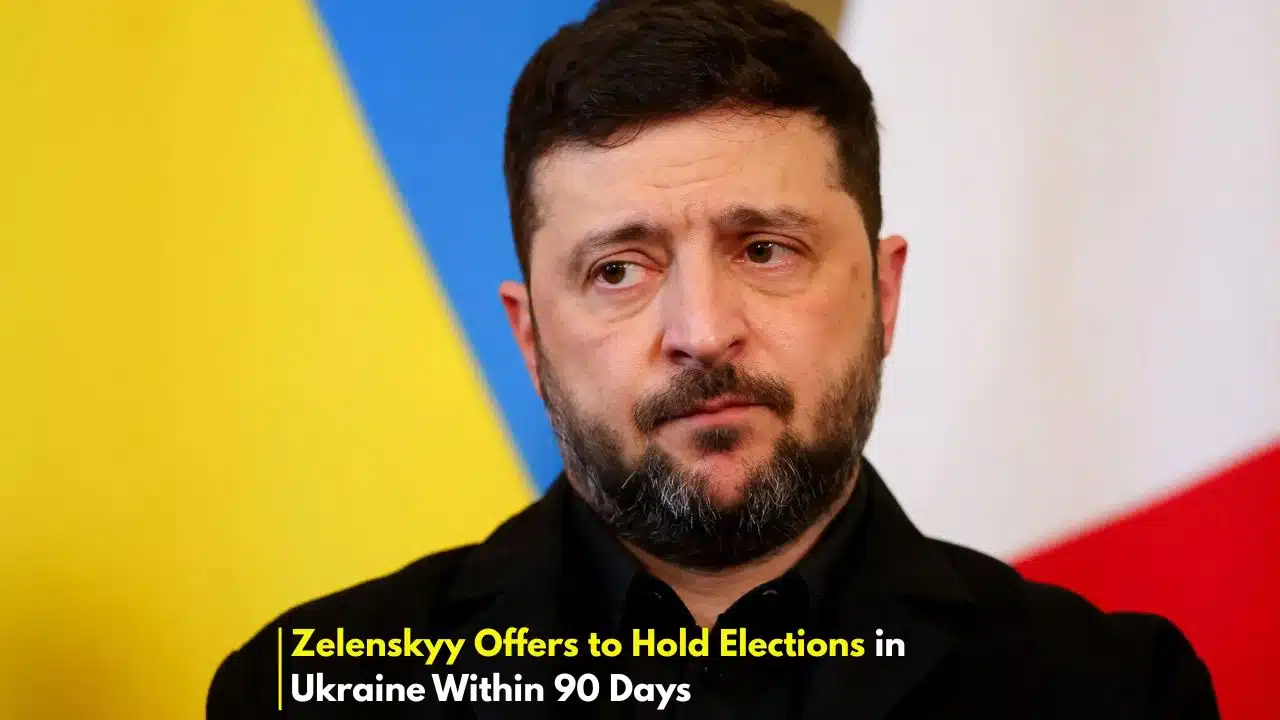
Ukrainian President Volodymyr Zelenskyy has announced his willingness to hold national elections within 90 days, a declaration that has sent ripples through political, diplomatic, and military circles across the world. Speaking in Kyiv during a nationally broadcast address, the wartime leader stated that Ukraine’s commitment to democracy remains unbroken despite nearly three years of devastating conflict with Russia.
Zelenskyy’s proposal comes at a time when Ukraine faces a grinding war of attrition on the eastern front, a humanitarian crisis in its civilian regions, and questions from international partners about the country’s political and institutional future. His statement marks the first time since Russia’s full-scale invasion in February 2022 that the Ukrainian government has publicly outlined a possible timeline for elections — a process largely suspended under martial law.
Democracy During War
Under Ukraine’s Constitution, regular parliamentary and presidential elections were due in 2023 and 2024, respectively. However, martial law — declared on the first day of Russia’s invasion — prohibits elections until it is lifted. The war destroyed electoral infrastructure in many regions, displaced millions of voters, and made it nearly impossible for traditional campaigning or ballot distribution to occur.
International observers, including the Organization for Security and Co-operation in Europe (OSCE) and the European Union, had long acknowledged these barriers. Nonetheless, Western allies, most notably the United States, have occasionally hinted that democratic continuity and political renewal could strengthen Ukraine’s moral position on the global stage.
Zelenskyy’s announcement appears to answer those calls — or at least signal readiness. “If our partners are prepared to help make this happen, if security and logistics are ensured, then we can hold elections within 90 days,” Zelenskyy said, emphasizing that democracy “cannot be frozen, even during war.”
The Challenges Ahead: War, Displacement, and Security
Despite the bold offer, holding credible elections in a country under attack remains a daunting task. Nearly one-fifth of Ukraine’s internationally recognized territory remains occupied by Russian forces, including parts of Donetsk, Luhansk, Zaporizhzhia, and Kherson regions. Millions of Ukrainians have fled abroad — mostly to European countries — or relocated internally.
Organizing elections would therefore pose unprecedented logistical obstacles:
-
Security of polling stations. Active missile and drone attacks across Ukraine could disrupt voting or threaten voters in large urban centers such as Kharkiv, Dnipro, and Odesa.
-
Access for displaced persons. More than 5.5 million Ukrainian refugees reside abroad, mainly in Poland and Germany. Enabling them to participate would require a global network of secure polling locations and digital voting systems.
-
Occupied territories. Conducting a nationwide vote without the occupied regions raises legitimacy questions. Ukrainian officials have clarified that elections cannot occur on occupied lands, which complicates full representation.
Mykhailo Podolyak, adviser to Zelenskyy’s presidential office, explained that the president’s statement is “a declaration of readiness, not a definitive schedule.” He added that Ukraine’s security agencies and foreign partners must first develop mechanisms to guarantee fair participation “without risking lives.”
Military Realities Shape Political Decisions
Analysts say that Zelenskyy’s election statement reflects both domestic and international pressures. Inside Ukraine, fatigue from the prolonged war is growing. Surveys show some decline in the president’s once-sky-high approval ratings, though he remains the most trusted political figure in the country.
Externally, Kyiv faces increasingly complex relations with the U.S. and the EU, where support for additional military and financial aid has become politically sensitive. Washington and Brussels have privately urged Ukraine to show democratic transparency and anti-corruption progress to sustain Western public backing.
Holding elections could thus serve multiple aims: reinforcing Ukraine’s democratic legitimacy, renewing the government’s mandate, and signaling institutional resilience against Russian authoritarianism.
“Democracy doesn’t end when bombs fall — it is tested,” said Kyiv-based political scientist Volodymyr Fesenko. “Zelenskyy and his team want to remind the world of that message.”
U.S. and EU Reactions: Cautious Optimism
The reaction from Western capitals has been generally positive, though tempered with caution. In Brussels, EU High Representative Josep Borrell welcomed Ukraine’s commitment to democratic principles, noting that “transparent elections, whenever they can be safely conducted, are the cornerstone of EU integration.” However, he acknowledged that security and logistics remain critical concerns.
In Washington, State Department spokesperson Matthew Miller described Zelenskyy’s offer as “an encouraging signal of democratic will under the most extreme conditions.” He clarified that the U.S. would “support any credible effort that aligns with Ukraine’s constitution and ensures inclusivity, transparency, and safety.”
European diplomats, meanwhile, are already discussing potential frameworks for supporting such an electoral process. Some possibilities include:
-
Deploying election observers under OSCE auspices.
-
Funding digital or mail voting systems for displaced citizens.
-
Providing logistical assistance for voter registration and ballot counting.
-
Supporting local election commissions in reconstruction and security measures.
Still, diplomats emphasize that any international involvement must not be perceived as interference. “This must remain a Ukrainian-led process,” said one EU official. “Our role is to help, not to dictate.”
Opposition Response and Political Pulse at Home
Ukraine’s wartime politics have been defined by national unity — but also by restrained opposition. Political campaigning has been suspended since the imposition of martial law, and many parties, including those that once held seats in parliament, have had little public visibility.
With elections potentially approaching, the dynamic could shift dramatically. Former President Petro Poroshenko, who has positioned himself as a patriotic critic of the administration, cautiously welcomed Zelenskyy’s statement. “The return to democratic procedures would symbolize that Ukraine remains Europe’s strongest defender of free choice,” he said in a televised interview. However, Poroshenko warned that elections must be “free, fair, and inclusive — not symbolic exercises under fire.”
Yulia Tymoshenko, another veteran political figure, echoed a similar message, stressing that “democracy must be exercised responsibly, not recklessly.” She urged Zelenskyy to outline a transparent plan with participation from all political forces and civil society.
Some lawmakers, especially from regional constituencies near the front line, expressed skepticism. “Our soldiers on the front won’t be able to vote, nor will people in occupied cities,” said Mykola Melnyk, a parliamentarian from the Kharkiv region. “Before talking about ballots, we must ensure survival.”
Global Perception and Media Framing
Internationally, Zelenskyy’s move has reignited debates about democracy under wartime conditions. Western media outlets framed the offer as part of a broader strategy to sustain Western political support heading into 2025, when multiple donor countries face elections of their own.
Commentators on CNN and the BBC suggested that the announcement could counter emerging narratives of “war fatigue” among Western audiences. “It helps Zelenskyy reframe Ukraine’s struggle not just as a military war, but a civilizational one — democracy versus tyranny,” one analyst observed.
Russian state media, by contrast, mocked the proposal as “propaganda theater.” Kremlin spokesperson Dmitry Peskov questioned how elections could be legitimate “under U.S. guidance and missile fire.” Moscow’s narrative seeks to portray the Ukrainian government as controlled by its Western partners — a propaganda line Zelenskyy’s team has repeatedly dismissed as false.
The Constitutional and Legal Hurdles
Ukraine’s Constitution allows elections only under conditions of peace and security. Article 83 explicitly states that the term of the Verkhovna Rada (parliament) may be extended automatically “for the duration of martial law,” and Article 103 contains the same clause for the presidency.
To move forward, Zelenskyy’s administration would need either to lift martial law temporarily, pass emergency legislation, or rely on a special decree validated by the Constitutional Court.
Legal experts say each path is fraught with complexities. “Lifting martial law, even temporarily, could expose Ukraine to internal instability and propaganda attacks from Russia,” said constitutional lawyer Olena Shcherbak. “But proceeding without full legal clarity would undermine the legitimacy of the results.”
Zelenskyy hinted that the government might request a constitutional review to explore whether elections could be held under a modified wartime framework. “We respect the law, but we also respect our people’s right to choose,” he said.
The Role of Technology: Digital Democracy in Wartime
Ukraine has been a pioneer in digital governance, even before the war. Its Diia platform — a multifunctional mobile app that allows citizens to access state services — has become a cornerstone of the government’s effort to maintain connection with citizens displaced by the war.
There has been speculation that Diia or similar digital systems could be used to facilitate electronic voting, especially for refugees abroad. However, experts warn that cybersecurity threats from Russia make such options highly risky.
“The Kremlin’s cyber units would see this as an irresistible target,” said Serhii Demediuk, deputy secretary of Ukraine’s National Security and Defense Council. “Even a minor breach could delegitimize the process.”
Instead, hybrid models — combining digital registration with in-person validation in embassies, consulates, and verified polling centers — are being discussed as potential compromises.
Refugees and the Diaspora Vote
For millions of Ukrainians living abroad, Zelenskyy’s election proposal carries deep emotional significance. Many have settled temporarily in European countries but remain closely connected to their homeland. Giving them a voice in Ukraine’s democratic future is both a logistical and symbolic imperative.
Poland, which hosts roughly 1.3 million Ukrainian refugees, has offered to assist in organizing polling facilities if elections proceed. Germany, the Czech Republic, and Italy have extended similar statements. However, electoral commission officials admit that managing over a hundred diaspora voting centers would require weeks of preparation and intensive coordination.
“The world will be watching how Ukraine includes its people abroad,” said Kateryna Soldatenko, a policy researcher at the Kyiv School of Economics. “If successful, it could become a global model for inclusive democracy under crisis conditions.”
The Frontline Vote: Democracy under Fire
Another pressing issue is the participation of Ukraine’s armed forces. Hundreds of thousands of soldiers — many deployed near front lines — would require special voting mechanisms. Mobile ballot boxes, military field offices, or proxy voting could be considered, though each carries risks of security breaches or coercion.
Commanders and civic groups stress that soldiers must not be disenfranchised. The Ukrainian Armed Forces are widely respected and viewed as defenders of both sovereignty and democracy. “Our soldiers fight for the right to vote; they must not lose that right,” said Colonel Andriy Yermolenko, speaking from Kramatorsk.
The government has promised to consult military leadership before finalizing any procedures. “Every serviceman’s voice matters,” Zelenskyy declared. “They are not just protectors — they are citizens.”
Economic and Institutional Considerations
Economically, organizing a nationwide election amid war is an expensive undertaking. Ukraine’s state budget remains heavily dependent on foreign aid to cover defense and essential social spending. Estimates suggest that a full-scale election, including diaspora voting, could cost more than $200 million.
Some critics argue that such funds should instead support the front lines or reconstruction projects. But supporters contend that a functioning democracy is itself an investment in long-term stability.
Ukraine’s Central Election Commission, which operates with limited staff since the invasion, has requested international assistance to rebuild regional offices and voter databases. The World Bank and European Commission reportedly discussed financing non-political aspects of election infrastructure — such as IT security, logistics, and neutral observation missions.
Historical Precedents: Elections During War
Ukraine’s situation is not unprecedented in world history. Other nations have held elections amid war — with mixed results.
-
The United States in 1864 held a presidential election during its Civil War, re-electing Abraham Lincoln.
-
The United Kingdom in 1918 and 1945 went to polls near the end of world wars.
-
Israel and Sri Lanka have conducted votes amid ongoing conflict or terror threats.
Political historians say such precedents highlight both the resilience and risks of democratic continuity. “Wartime elections test a nation’s identity — whether to pause democracy for survival or to reaffirm it through participation,” explained Oxford political historian Timothy Garton Ash. “Zelenskyy is choosing the latter.”
Russia’s Calculus: Propaganda and Military Timing
While Ukraine’s internal debate unfolds, Moscow will closely watch the political process. Analysts warn that Russia might escalate attacks to disrupt the election or attempt to discredit its legitimacy.
The Kremlin’s information apparatus has already begun framing Ukraine’s election talk as a “performative exercise orchestrated for Western audiences.” Russian telegram channels and state outlets argue that “no real vote” can take place when part of the population remains under occupation.
In military terms, a Ukrainian election could offer Russia tactical advantages. Wartime voting may temporarily redirect Kyiv’s administrative attention, giving Moscow room for intensified offensives or propaganda campaigns. Ukrainian security services are reportedly preparing counterintelligence operations to prevent election-related cyberattacks or disinformation.
Beyond the Ballot: What’s at Stake for Ukraine
Ultimately, Zelenskyy’s election offer is not merely about democratic process but national identity. Ukraine’s modern history — from the 2004 Orange Revolution to the 2014 Maidan uprising — has been defined by struggles for political self-determination. Holding elections now, even symbolically, would reaffirm that legacy.
For many Ukrainians, democracy itself has become an act of resistance. Conducting elections under bombardment, critics say, may seem perilous; but for others, it symbolizes moral defiance against authoritarian aggression.
“Putin wants to prove that democracy is weak,” said civic activist Svitlana Lukash. “If we can vote under fire, we prove the opposite.”
Prospects for 2025 and the Road Ahead
Despite the bold rhetoric, few expect elections to happen before the spring of 2025. Most likely, Zelenskyy’s statement was a strategic positioning move — to reassure allies, manage public expectations, and signal institutional preparedness when conditions improve.
Yet the political conversation it sparked may reshape the country’s postwar landscape. Whether or not the polls occur within 90 days, Ukraine’s democratic debate has been reignited.
As Ukraine enters another winter of war, one fact stands out: even amid destruction and uncertainty, the nation continues to speak the language of democracy — the language that first united its people against tyranny.
“Ukraine will vote again,” Zelenskyy vowed. “Because our strength lies not only in arms but in our voice.”