
The question of Young Dolph net worth refuses to fade.
Even years after his death, new estimates still appear on search pages, some modest, some wildly inflated. For fans, the figure has become a shorthand for the impact and independence of a Memphis rapper who chose ownership over industry shortcuts.
Most reputable financial trackers place Young Dolph’s net worth at around $3 million at the time of his death in November 2021. Celebrity Net Worth, for example, lists his wealth at $3 million when he was killed.
Recent long-form breakdowns that attempt to factor in catalog value, real estate, and private investments usually land in a slightly wider $3–5 million bracket, with some writers suggesting the upper end may have been higher once unpublicized assets are included.
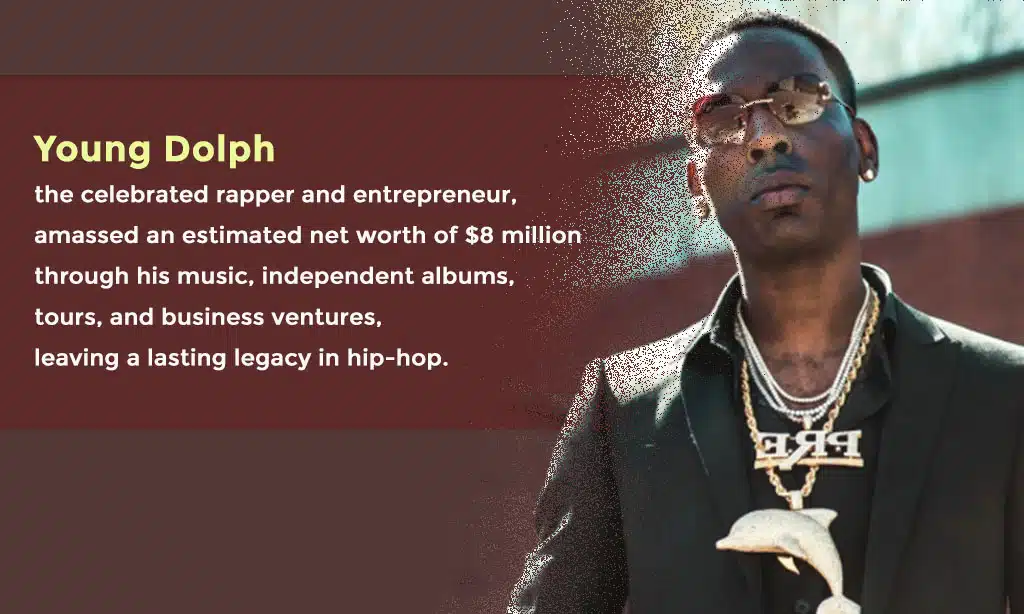
At the same time, rumor-driven posts on social media sometimes claim Young Dolph had $50 million, $80 million, or even $100 million. More careful analyses call those claims exaggerated, putting his likely range closer to $3–8 million and treating the nine-figure numbers as internet myth.
To make sense of these contradictions, it helps to look closely at where his money came from, what he owned, and how his independent strategy shaped both his income and his legacy
What Was Young Dolph’s Net Worth at the Time of His Death?
The $3–5 Million Consensus Range
In the traditional celebrity-finance ecosystem, Young Dolph does not sit in the same tier as global streaming giants or long-running pop acts. Most mainstream net worth trackers, including Celebrity Net Worth and Wealthy Gorilla, estimate his fortune at about $3 million near the time of his death.
Newer editorial pieces that revisit his career with more context argue that this number likely understates the full picture. When they factor:
-
his music catalog,
-
ownership in Paper Route Empire (PRE),
-
real estate and private investments,
They tend to settle on $3–5 million as a more realistic working range for Young Dolph net worth at death.
That range still represents a substantial fortune for an artist who insisted on doing things on his own terms, often without the promotional muscle of major labels.
Why Online Estimates Don’t Agree
There are several reasons why estimates of Young Dolph’s wealth don’t align:
-
No public filings
He was not the CEO of a public company, and his label Paper Route Empire remains privately held. There are no SEC-style disclosures revealing earnings or assets. -
Different methods
Some sites simply multiply rough annual earnings by years active. Others try to estimate the value of streaming royalties, touring, and merchandise. A handful include real estate and business holdings, while many skip them. -
Timing differences
A net-worth snapshot in 2017 looks very different from one in 2021. Dolph’s profile rose sharply after albums like King of Memphis (2016) and Rich Slave (2020) charted, especially once his collaboration projects with Key Glock gained traction. -
Posthumous interest
His music streams spiked following his killing, increasing the long-term value of his catalog. Some articles adjust for that, others focus strictly on his finances at the moment of death.
The result is a SERP filled with numbers, but not always with methodology.
Debunking the “$100 Million” Myth
The most eye-catching figure in casual discussions is the claim that Young Dolph net worth hit $100 million. Sites that systematically review the available evidence push back on this. They note that:
-
Reported figures for his wealth consistently cluster in the low single-digit millions,
-
Even generous high-end estimates cap his holdings around $8 million at most,
-
No reliable documentation or industry reporting backs a nine-figure fortune.
Given the realities of streaming economics and the scale of his touring, a $100 million number would require either a large, publicly known equity stake in a major company or major-label style catalog valuations. Neither appears in credible reporting.
The myth persists online partly because big numbers travel faster than careful analysis—and because Young Dolph carried himself like someone who believed he was worth that much, even if his actual balance sheet did not.
How Young Dolph Built His Money
Independent Music Sales and Streaming
Young Dolph (Adolph Robert Thornton Jr.) built his career as an independent rapper from Memphis. He released a long run of mixtapes before his debut studio album, “King of Memphis” in 2016, which reached No. 49 on the Billboard 200.
The core of Young Dolph net worth came from:
-
Album and mixtape sales (physical, digital, and streaming)
-
Streaming royalties on platforms like Spotify, Apple Music, and YouTube
-
Guest features on tracks with other artists
Unlike many peers who surrendered ownership to major labels, Dolph retained significant control. He later entered a distribution deal with EMPIRE while keeping his own label, Paper Route Empire, giving him a larger share of royalties than a typical artist on a standard recording contract.
This independence limited some mainstream exposure but boosted his per-stream and per-sale income.
Touring, Shows, and Live Appearances
Before his death, Young Dolph toured extensively, particularly across the Southern United States. Live performance fees—club shows, festival slots, and headline tours—formed a second pillar of his income.
Public data on his fees per show is scarce, but similar mid-to-upper-tier rappers often command tens of thousands of dollars per appearance, with larger festival slots paying more. For an independent artist, that performance money can be crucial, since it arrives faster and more directly than catalog royalties.
Paper Route Empire and Ownership Strategy
The biggest strategic decision that shaped Young Dolph net worth was his stubborn commitment to independence. In one widely reported episode, he claimed to have turned down a $22 million label deal, choosing instead to continue with Paper Route Empire and a distribution partnership rather than a full-scale major-label contract.
PRE functioned both as his own vehicle and as a platform for other artists, most notably Key Glock. The label’s About page emphasizes Dolph’s independence and the fact that he “constructed a mansion of his own,” highlighting that between him and Key Glock, the roster claims multiple Platinum and Gold RIAA records, plus a double-Platinum feature on O.T. Genasis’s “Cut It.”
The financial impact of that strategy:
-
Higher royalty share on his own recordings
-
Profit participation in music released through PRE
-
Long-term upside from catalog valuation as streams accumulate
Even if PRE is not worth nine figures, its catalog and brand carry value that continues to generate money for his estate.
Brand Deals, Merch, and Side Hustles
Young Dolph did not rely only on music. While he never became the face of global brands in the way some pop stars do, he monetized his image and street credibility through:
-
Merchandise linked to album campaigns and PRE
-
Limited deals, walkthroughs, and event appearances
-
Business interests, including reported real estate investments aimed at building long-term wealth for his family.
Several in-depth profiles and financial breakdowns note that he prioritized assets that would appreciate over time, framing his approach as “playing the long game” for his children rather than chasing quick checks.
Young Dolph’s Assets: Catalog, Real Estate, and Cars
The Long-Term Value of His Music and Royalties
When assessing Young Dolph estate and wealth, the most important asset is his music catalog:
-
Solo studio albums like King of Memphis, Bulletproof, Thinking Out Loud, and Rich Slave
-
Collaborative projects such as Dum and Dummer with Key Glock
-
Mixtapes that still stream heavily
-
Features, including the breakout hit “Cut It” with O.T. Genasis
Streams surged after his death, a pattern familiar in the industry. As listeners revisited his work and new fans discovered it, the catalog’s royalty stream likely increased, enhancing the long-term value of his estate.
However, catalog valuation is complex. It depends on:
-
Annual royalty flows
-
Growth or decline in streaming
-
Contract terms with distributors
-
Any future catalog sale or licensing deals
Some writers argue that when these factors are considered, the true economic value tied to Young Dolph’s music might push his effective “net worth” higher than surface-level numbers suggest, especially over time.
Real Estate Investments and Property Holdings
Several recent analyses mention real estate as a quiet but important part of Young Dolph net worth. While exact addresses and valuations remain private for security reasons, Dolph reportedly invested in multiple properties as part of a long-term wealth strategy for his children.
For editorial purposes, the key point is not the precise number of houses, but the pattern:
-
He used music income to acquire tangible assets.
-
These holdings likely appreciated, especially in a decade of rising U.S. property prices.
-
Rental income or resale value would continue to benefit his heirs.
Real estate is harder for online net-worth calculators to track, which is one reason many public estimates probably understate his true financial position.
Jewelry, Cars, and Lifestyle Spending
Fans often associate Dolph with high-end cars and extensive jewelry, visible across social media, videos and press images. Luxury vehicles and custom chains certainly cost millions over the span of a career, and they only partly retain value on resale.
From a strict accounting perspective, these purchases:
-
Lower liquid net worth compared to someone who preserved more cash or equity
-
But function as branding tools that reinforce the star image, which in turn supports earnings
In other words, the cars and iced-out chains may reduce balance-sheet efficiency, but for a rapper whose persona blends success and resilience, they also acted as marketing.
The Man Behind the Numbers: Brief Biography
From South Memphis Struggle to Mixtape Hustle
Young Dolph was born August 11, 1985, and grew up primarily in South Memphis.
His early life was marked by instability, but he found an outlet in music. Across the late 2000s and early 2010s, he built a following through mixtapes such as Welcome to Dolph World. Those tapes laid the foundation for the touring circuits and regional popularity that later translated into nationwide attention.
The story matters for understanding Young Dolph net worth because:
-
He did not come from industry connections or inherited wealth.
-
His financial position reflected years of grassroots grinding, merchandise tables, and club performances, not overnight virality.
Turning Down Major-Label Money to Stay Independent
In a widely discussed move, Dolph said he turned down a $22 million major-label deal, choosing instead to keep control of his masters and operate through Paper Route Empire under a distribution arrangement.
For an artist, that kind of decision has trade-offs:
Pros:
- Higher margins on each sale or stream
- Creative control
- Ownership of masters, which can be monetized later
Cons:
- Less upfront cash
- Smaller marketing budgets
- More responsibility for building and managing a team
Dolph’s choice capped the upside that a global, heavily marketed major-label presence might have delivered, but it also meant that each dollar his music generated flowed more directly to him and his company.
Community Work and Support for Memphis
At the time of his death, Young Dolph was in Memphis for his annual Thanksgiving turkey giveaway, an event he hosted to support local families.
He was shot and killed on November 17, 2021, at Makeda’s Homemade Butter Cookies, a bakery he frequently visited and promoted.
These details don’t change his balance sheet, but they shape how people interpret Young Dolph net worth: not just as a private accumulation of money, but as capital that funded both lifestyle and community initiatives.
What Happened After His Death?
Ongoing Royalties and the Value of His Catalog
After Dolph’s killing, his catalog streams jumped, and his music continued to circulate widely. For any artist, death can freeze a career in place while keeping royalties alive. In Young Dolph’s case:
-
Existing contracts still govern how income flows.
-
Paper Route Empire continues to release music and manage its catalog. His heirs benefit from this ongoing flow, particularly as new listeners discover his work.
Several newer features and net-worth breakdowns note that while he died with an estimated $3–5 million, the total value that his catalog will generate over the coming decades may end up higher.
Paper Route Empire After Young Dolph
Following his death, Paper Route Empire leaned into tribute projects and sustained releases from artists like Key Glock, helping maintain brand visibility. The label’s own materials frame PRE as a structure built from Dolph’s independence and highlight its run of Gold and Platinum records.
Financially, that means:
-
PRE remains a live business asset, not just a legacy brand.
-
The label’s ongoing earnings contribute to the long-term strength of Young Dolph estate and wealth.
Because PRE is privately held, outsiders do not have a precise valuation, but it is a meaningful part of the story.
Legal Cases, Media Coverage, and Estate Questions
The legal fallout from his murder has unfolded across multiple trials and headlines. One shooter received a life sentence, while another man accused of organizing the ambush was acquitted in 2025.
Those proceedings affect justice and public perception more than the raw numbers on the estate’s ledger. Still, each new development briefly returns Young Dolph to the news cycle, often sparking fresh streaming spikes that keep his catalog financially active.
What Young Dolph Net Worth Tells Us About Independence in Hip-Hop
Ownership vs. Hype
The story of Young Dolph net worth captures a tension at the heart of modern hip-hop. Major labels can push artists to global fame, but they also take a large share of revenue and control. Independent paths usually produce:
-
Lower headline net-worth numbers,
-
but higher ownership percentages and
-
The possibility of selling a catalog later on favorable terms.
Dolph chose control. His numbers may not match the wealth of superstar moguls, but his assets belong, in large part, to his family and his company rather than to corporations.
Generational Wealth and His Children
Many of the deeper analyses of his finances emphasize how he structured assets with his children in mind, particularly through real estate and ownership stakes rather than fleeting luxury.
From a generational wealth perspective, this matters more than any single net-worth figure:
-
Rental income and property appreciation can outlast touring careers.
-
A well-managed catalog can pay royalties for decades.
-
An active label like PRE can keep creating new value.
These elements make Young Dolph estate and wealth more robust than the $3 million headline might suggest.
Lessons for New Artists
For emerging artists who search “Young Dolph net worth” for inspiration, the lesson is not simply the final number. Instead, his career points to a few key ideas:
-
Understand your contracts. Ownership and distribution deals can matter more than hype.
-
Invest in assets, not only image. Real estate, catalogs, and businesses outlast trends.
-
Community still counts. Dolph’s reputation in Memphis, built through consistency and giving back, has become part of the value of his legacy.
Conclusion
Stripping away rumor and headline-chasing estimates, a balanced view suggests Young Dolph net worth at death sat around $3–5 million, with most mainstream trackers using the lower end of that range.
That figure alone does not capture the full story. It leaves out the emotional value of a catalog that still soundtracks people’s lives, the private growth of real-estate holdings, and the long-term earnings generated by Paper Route Empire. It also misses the symbolism of an artist who walked away from a massive label offer to protect control over his work.
In the end, Young Dolph’s real wealth lies somewhere between what spreadsheets can count and what his independence inspired. The money he left behind matters, especially for his children and his city. But the way he earned it—slowly, stubbornly, on his own terms—is what keeps his name circulating long after the last net-worth headline fades.