The city of Tianjin, China, hosted the largest-ever Shanghai Cooperation Organization (SCO) summit on September 1, 2025, bringing together more than 20 heads of state and government leaders from across Asia, the Middle East, and beyond. Among the prominent attendees were Russian President Vladimir Putin, Indian Prime Minister Narendra Modi, Turkish President Recep Tayyip Erdogan, and Iranian President Masoud Pezeshkian. The presence of such a wide range of leaders highlighted the growing importance of the SCO as a diplomatic platform in an era of multipolar politics.
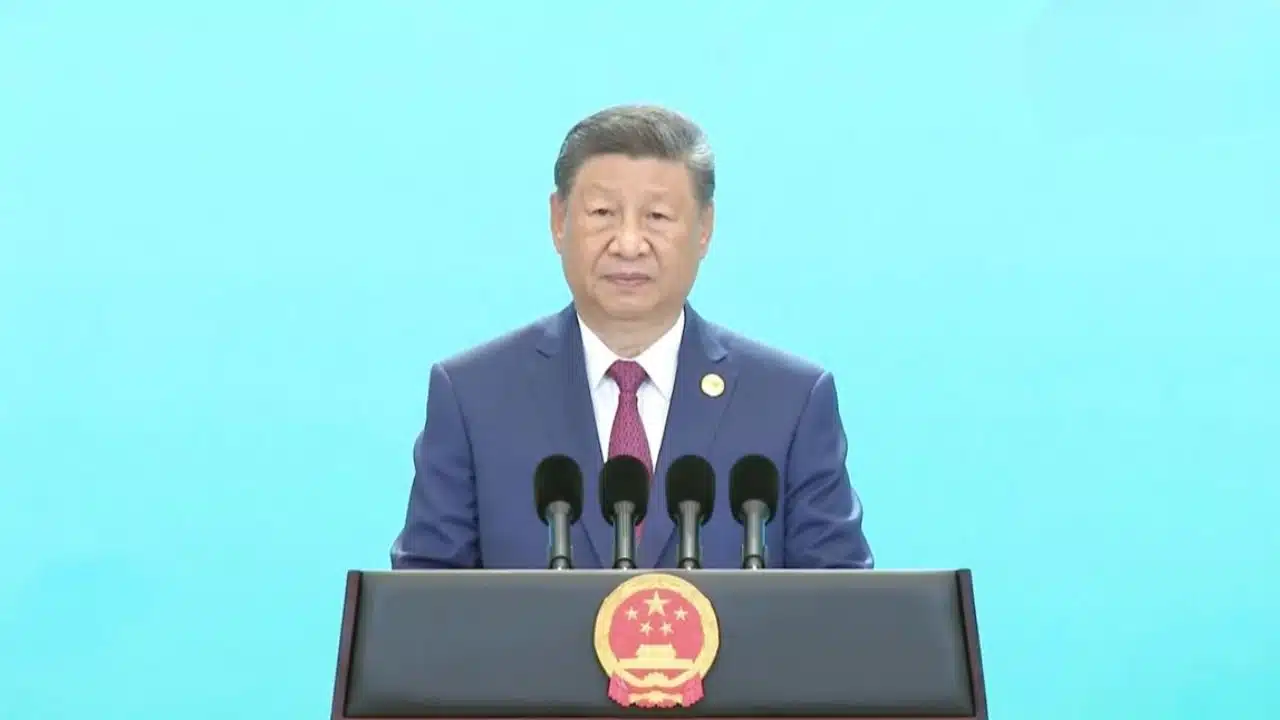
Chinese President Xi Jinping delivered the keynote speech, using the forum to outline his vision for regional cooperation, global peace, and technological advancement. His strongest message was a call for deeper cooperation on artificial intelligence (AI) while firmly rejecting what he described as a “Cold War mentality” and “bloc confrontation.” Xi’s remarks were seen as a direct critique of the U.S. and its alliances, which Beijing views as attempting to contain China’s rise.
Xi’s Push for AI and Technology Partnerships
In his address, Xi emphasized that the future of development and competition lies in emerging technologies, particularly artificial intelligence. He called on SCO member states to jointly develop AI systems, share technological knowledge, and establish ethical standards that reflect “fairness, inclusivity, and mutual benefit.”
China has already invested heavily in technology cooperation across SCO countries. According to official figures, Chinese investment in SCO member states has exceeded $84 billion in recent years. Xi also pledged to support the education of 10,000 foreign students through China’s “Luban Workshop” vocational education program, which focuses on skills training for next-generation industries, including robotics, automation, and AI.
By highlighting AI, Xi positioned China not just as an economic partner but also as a technological leader ready to guide other developing nations through the Fourth Industrial Revolution.
Rejecting the “Cold War Mentality”
One of the central themes of Xi’s speech was a rejection of ideological confrontation. He warned that the world must avoid falling into old patterns of division reminiscent of the Cold War. Instead, Xi called for inclusive globalization, “win-win” cooperation, and new models of security that prioritize dialogue and mutual trust over sanctions and isolation.
This rhetoric reflects China’s broader diplomatic push to counter U.S. strategies in the Indo-Pacific, where Washington has strengthened alliances with countries like Japan, South Korea, and the Philippines. By invoking the Cold War, Xi aimed to frame the SCO as an alternative to Western-led blocs such as NATO and the G7, presenting it as a forum that champions multipolarity and sovereign equality.
Economic Promises: Billions in Aid and Loans
To reinforce his message, Xi announced significant financial commitments:
- 2 billion yuan ($280 million) in free aid to SCO member states for development programs this year.
- 10 billion yuan ($1.4 billion) in new loans through a soon-to-be-launched SCO banking consortium, designed to finance infrastructure, digital connectivity, and green energy projects across Asia.
These pledges build on China’s wider economic strategy of using initiatives like the Belt and Road Initiative (BRI) and SCO development frameworks to strengthen its role as a global financial partner, especially for countries facing Western sanctions or financial constraints.
High-Level Diplomacy: Xi Meets Modi and Putin
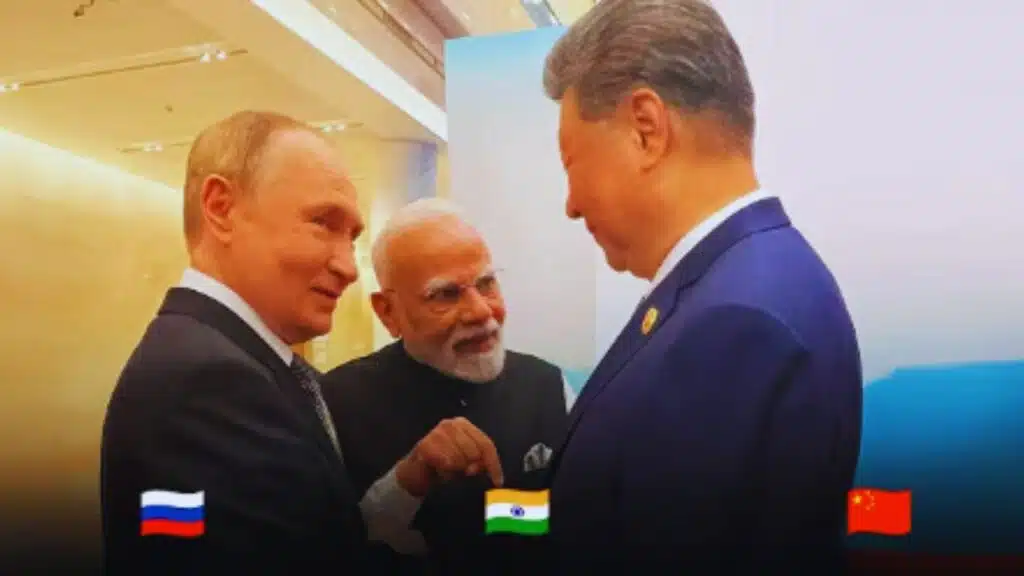
The Tianjin summit also served as a stage for symbolic diplomacy. On the sidelines, Xi held meetings with leaders, including his first face-to-face encounter with Indian Prime Minister Narendra Modi in seven years.
Both sides released statements highlighting their willingness to act as partners rather than rivals, a notable development given the border tensions and trade disputes that have strained India-China relations in recent years. India’s Ministry of External Affairs emphasized that “stable relations and cooperation between India and China, grounded in mutual respect and sensitivity, are necessary for the growth and development of their 2.8 billion people.”
Xi also met Russian President Vladimir Putin, who is staying in China this week to attend a military parade in Beijing marking 80 years since the end of World War II. The symbolism of Putin and Xi together underscores the close alignment between Moscow and Beijing at a time when Russia faces Western isolation over its war in Ukraine.
SCO as a Platform for Multipolarity
The Shanghai Cooperation Organization, founded in 2001, has grown from a regional security pact into one of the world’s largest intergovernmental organizations, spanning nearly half of the global population. Its core members—China, India, Russia, Pakistan, Kazakhstan, Kyrgyzstan, Tajikistan, Uzbekistan, and newly joined Belarus—represent a powerful bloc that challenges Western-led institutions.
Analysts note that Xi is using the SCO to project China as a peacemaker and economic engine for the Global South. Henry Huiyao Wang, president of the Beijing-based think tank Center for China and Globalization, told CNBC that China could even use its ties with Russia and India to help mediate in Ukraine or reduce tensions in South Asia.
Similarly, Marko Papic, chief strategist at BCA Research, said that warming relations between Beijing and New Delhi would give India greater access to critical technologies needed for industrialization. At the same time, he argued that the U.S. is “losing the propaganda battle” by trying to portray China as the global troublemaker.
Symbolism and Global Implications
The summit also carried strong symbolic weight. Leaders gathered for group photos, red-carpet ceremonies, and cultural events designed to showcase unity among diverse nations. The timing—just before the Beijing military parade—reminded the world of China’s historical narrative as a victor of World War II and a champion of sovereignty against foreign aggression.
For Beijing, the SCO summit is more than just a diplomatic meeting; it is a stage to redefine global governance. By pledging financial aid, calling for AI cooperation, and stressing multipolarity, Xi positioned the SCO as a counterweight to Western influence at a time of deep global divisions over Ukraine, the Middle East, and trade wars.
A Platform for China’s Vision of the Future
The 2025 SCO Summit in Tianjin highlights China’s ambition to lead a new global order based on technology, shared prosperity, and resistance to old power blocs. Xi’s rejection of the “Cold War mentality” signals his determination to portray the SCO as an inclusive and constructive alternative to Western alliances.
With billions in financial pledges, an emphasis on AI cooperation, and renewed ties with both Russia and India, the summit represents a critical moment in China’s effort to reshape global politics. The joint statement expected at the close of the meeting will likely reinforce themes of partnership, peace, and development, though whether these promises translate into real change will depend on how SCO members act in the months ahead.
The Information is Collected from CNBC and The Hindu.