Listen to the Podcast:
The European Space Agency (ESA) reports that the loss of ice from Greenland and Antarctica has increased by a factor of five.
In its annual climate report, the World Meteorological Organization, a specialized United Nations agency, warned, “Antarctic sea ice has fallen to its lowest level, and the melting of certain European glaciers has literally broken records.”
The United Nations also issues a warning because the sea level has reached record highs, with an average increase of 4.62 millimeters per year between 2013 and 2022, which is double the increase between 1993 and 2002.
Large areas of the globe are affected by droughts, floods, and heat waves, and the costs associated with them are rising.
In the oceans, where approximately 90 percent of the heat held by greenhouse gases on Earth is released, record temperatures have also been recorded.
The ESA Revealed That The Melting of The Ice in Greenland and Antarctica has Increased Fivefold
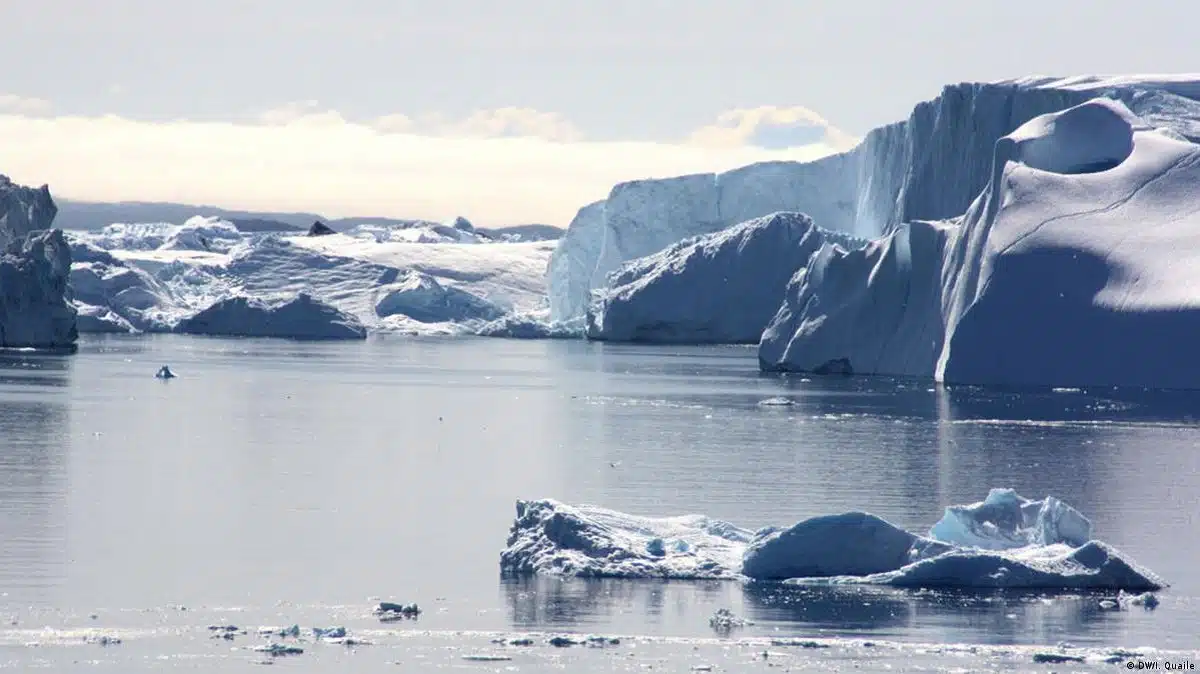
According to a report published by the European Space Agency (ESA), ice loss from Greenland and Antarctica has increased fivefold since the 1990s and is now responsible for a quarter of global sea level rise.
According to the ESA, Greenland, and Antarctica ice sheet melting contributed only a minor portion (5.6%) to sea level rise in the early 1990s. Since then, however, melting has increased fivefold and is now responsible for over a quarter (25.6%) of sea level rise.
The polar ice sheets lost 7,560 billion tons of ice between 1992 and 2020, which is equivalent to a cube of ice 20 kilometers on a side. The Greenland and Antarctic ice sheets lost a staggering 612 billion tons of ice in 2019, however, marking the zenith of the melting process.
This was caused by the Arctic summer heatwave, which caused Greenland to lose a record 444 billion tons of ice in 2019. Due to the sustained acceleration of glaciers in West Antarctica and the record melting of the Antarctic Peninsula, Antarctica lost 168 billion tons of ice in 2019, making 2019 the sixth-highest year on record.
As it has throughout the satellite era, the East Antarctic ice sheet remained close to a state of equilibrium.
Since 1992, the melting of the polar ice sheets has led to a 21mm rise in the global sea level. Greenland ice loss accounts for nearly two-thirds (13.5 mm) of this rise, while Antarctic ice loss accounts for the remaining third (7.4 mm).
“Ice loss from Greenland and Antarctica has accelerated relative to satellite data and is now a significant contributor to sea level rise. Continuous monitoring of ice sheets is essential for predicting their future behavior in a warming world and adapting coastal communities to the associated hazards, according to Inès Otosaka of the University of Leeds in the United Kingdom. United.
Since 1992, when satellite records of ice sheet thaw began, the polar ice sheets have lost ice annually, according to the Agency. In contrast, the most fusion has transpired in the last decade.
According to experts, global warming is causing the polar ice sheets to melt, which is raising sea levels and endangering the world’s coastlines. Hence the significance of utilizing data from satellites such as ESA’s CryoSat and the European Union’s Copernicus Sentinel-1 to assess changes in ice volume and flow, as well as satellites that provide gravity data to determine how much ice is being lost.
If the ice sheets continue to lose mass at this rate, the International Panel on Climate Change (IPCC) projects that they will contribute between 148 and 272 millimeters to the global mean sea level by the end of the century, as reported by the ESA.
ESA and NASA have endeavored in recent years to deploy new satellite missions capable of monitoring the polar regions.
The UN Sees a Ray of Hope
As renewable energy becomes less expensive than fossil fuels, and as the world develops more effective mitigation strategies, the UN claims that the cost of combating climate change is decreasing.
According to him, the planet is no longer headed toward warming between 3 and 5oC, as predicted in 2014, but rather towards warming between 2.5 and 3oC.
32 nations have reduced their emissions, and their economies continue to expand. “There is no longer an automatic correlation between economic growth and increased emissions,” said Petteri Taalas, secretary general of the World Meteorological Organization.
Now, in contrast to world leaders a decade ago, “virtually everyone discusses climate change as a serious problem, and countries have begun to take action,” he added.