As of early 2026, the remote work revolution has settled into a permanent operating model, yet a silent crisis is undermining its economic viability. New data reveals that workplace loneliness is no longer just a personal mental health issue—it is a systemic organizational failure costing the global economy nearly 9% of GDP ($8.9 trillion). This analysis dissects why digital-only leadership is failing to build social capital and why the “efficiency” of remote work is now being eroded by the high cost of isolation.
Key Takeaways
- The “Friendship Premium”: According to KPMG’s 2025 report, 57% of employees would trade 10–20% of their salary for a job with close colleagues, signaling a desperate market craving for social capital over cash.
- Digital Leadership Failure: Manager engagement has plummeted to 27%, creating a “fractured link” where stressed leaders retreat into transactional “check-in” cultures that feel like surveillance to employees.
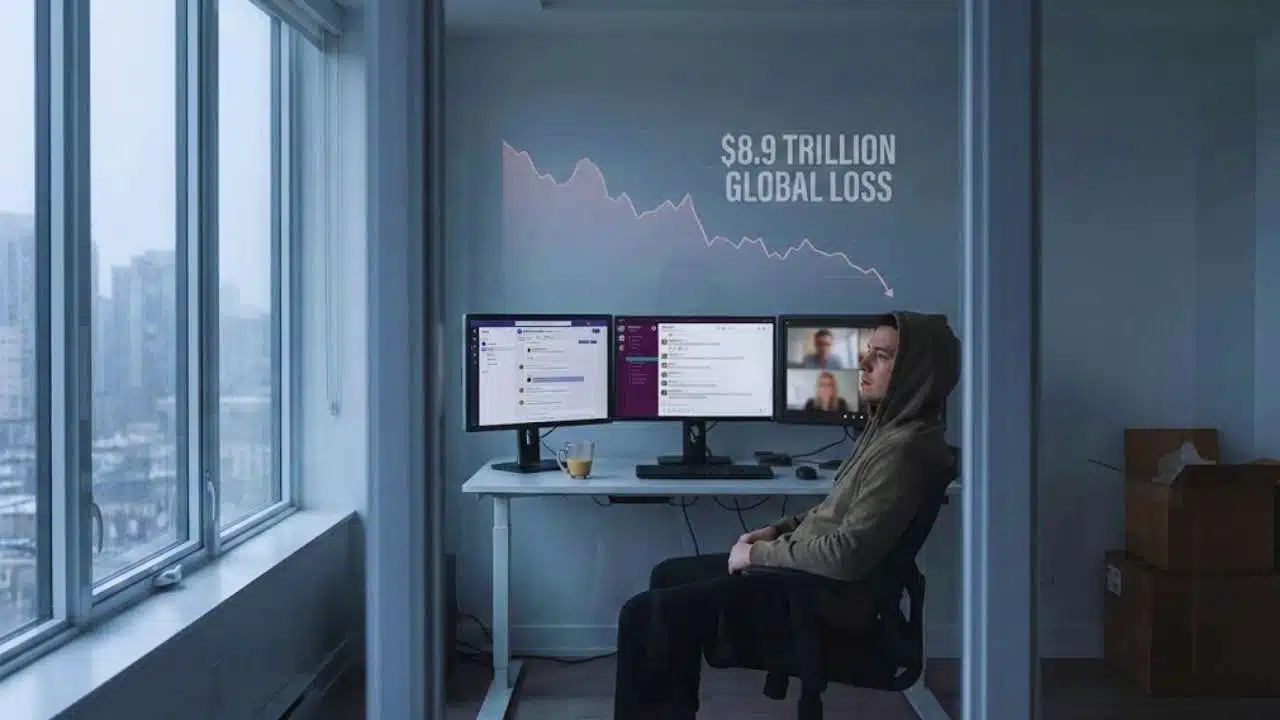
- The Economic Toll: The global cost of disengaged and lonely employees has hit an estimated $8.9 trillion annually, driven by a spike in absenteeism and the “Great Detachment.”
- The AI Paradox: While AI tools (like Copilot and ChatGPT) were meant to free up time for connection, 2025 data suggests they are replacing human interaction, with 99% of workers expressing interest in AI chatbots as “workplace companions.”
The Great Disconnect: How We Got Here
To understand the 2026 loneliness crisis, we must look at the trajectory of the last six years. The narrative of work has shifted through three distinct phases:
- 2020–2022: The Survival Phase. Companies scrambled to digitize tasks. The focus was purely on operational continuity.
- 2023–2024: The Tension Phase. The “Return to Office” (RTO) wars dominated headlines. Executives demanded presence; employees demanded autonomy.
- 2025–Present: The Era of Permanent Isolation. Most companies settled on hybrid models or fully remote structures to save on real estate. However, they made a critical error: they digitized tasks but failed to digitize relationships.
We have successfully engineered the “watercooler moments” out of existence. The result is a workforce that is technically connected via Teams and Slack but psychologically severed. We are witnessing the shift from the “Great Resignation” to the “Great Detachment,” where employees don’t quit their jobs—they just quit caring.
The “Silent Recession”—Economic Impact of Isolation
We must stop viewing loneliness as a “soft” HR issue. It is a “hard” economic variable. The U.S. Surgeon General has equated the mortality risk of loneliness to smoking 15 cigarettes a day. In the corporate context, this toxicity translates directly to the P&L statement.
Gallup’s State of the Global Workplace 2025 report indicates that low engagement—fueled heavily by disconnection—costs the global economy roughly $8.9 trillion annually. This is not just lost productivity; it is the cost of a workforce running on empty.
The Economic Cost of the “Lonely Workforce” (2026 Estimates)
| Cost Category | Financial Impact | Mechanism of Loss |
| Productivity Loss | $8.9 Trillion (Global) | Disengaged employees have 18% lower productivity. |
| Turnover Costs | 1.5x – 2x Annual Salary | Lonely employees are 2.6x more likely to leave within 12 months. |
| Healthcare Claims | +15% Increase | Higher rates of cardiovascular issues, anxiety, and depression. |
| Absenteeism | +37% Higher Rates | “Mental health days” have doubled since 2023 for remote staff. |
Analyst Note: The “Silent Recession” is invisible in quarterly earnings calls because it doesn’t show up as a line item. It manifests as slower decision-making, increased error rates, and a lack of creative problem-solving.
The Psychology of Digital-Only Leadership
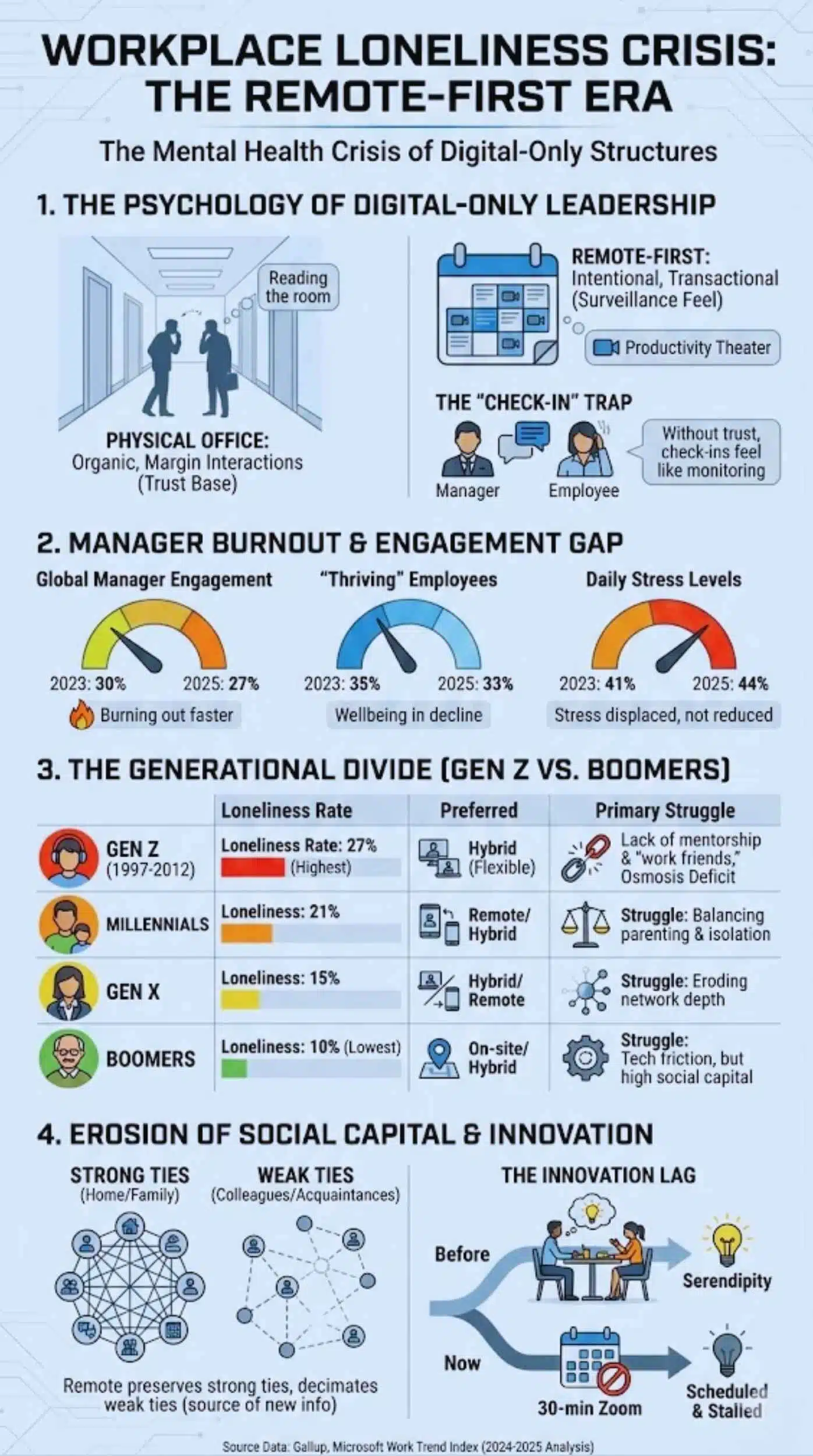
The primary driver of this crisis is not the location of work, but the nature of leadership within it. In a physical office, leadership often happens in the margins—a nod in the hallway or reading the room’s energy. In a remote-first environment, leadership has become purely intentional and often transactional.
The “Check-In” Trap
Many leaders, attempting to solve isolation, have over-indexed on “check-ins.” However, without the foundation of trust built through casual interaction, these check-ins often feel like surveillance. Employees report feeling that their digital visibility is a proxy for productivity, leading to “productivity theater.”
Manager Burnout: The Broken Link
Data shows that managers are actually more likely to be disengaged than their teams. They are squeezed between executive demands for efficiency and employee demands for empathy.
The Engagement Gap (2024–2025 Data Trend)
| Metric | 2023 | 2025 | Trend Analysis |
| Global Manager Engagement | 30% | 27% | Managers are burning out faster than staff. |
| “Thriving” Employees | 35% | 33% | Overall wellbeing is in decline despite flexibility. |
| Daily Stress Levels | 41% | 44% | Remote work has not reduced stress; it has displaced it. |
The Generational Divide (Gen Z vs. Boomers)
The crisis is not distributed equally. Paradoxically, the most digitally native generation is the most socially isolated. Gen Z (born 1997–2012) entered the workforce during a period of disruption and has never experienced “osmotic learning”—learning by watching a senior colleague handle a difficult client call or navigate office politics.
The “Osmosis” Deficit
Gen Z is “robbing” themselves of mentorship. While they prefer hybrid work (71%), they report the highest levels of loneliness. They want to come to the office, but only if their friends and mentors are there—which, often, they are not.
Generational Loneliness & Work Preferences
| Generation | Loneliness Rate (“A Lot of the Day”) | Preferred Work Model | Primary Struggle |
| Gen Z | 27% (Highest) | Hybrid (Flexible) | Lack of mentorship & “work friends.” |
| Millennials | 21% | Remote/Hybrid | Balancing parenting & isolation. |
| Gen X | 15% | Hybrid/Remote | Eroding network depth. |
| Boomers | 10% (Lowest) | On-site/Hybrid | Tech friction, but high social capital. |
The Erosion of Social Capital and Innovation
Sociologists distinguish between “strong ties” (close friends/family) and “weak ties” (acquaintances/colleagues). Remote work preserves strong ties (you are at home with family) but decimates weak ties.
Why Weak Ties Matter
Weak ties are the primary source of new information and innovation. When you only talk to the five people on your immediate team (Strong Ties), you enter an echo chamber. Microsoft’s Work Trend Index (2025) highlights that cross-functional collaboration dips in remote settings. This “siloing” kills serendipity—the accidental discovery of a solution to a problem you didn’t know another department had.
The Innovation Lag
Companies are now seeing a lag in innovation cycles. Ideas that used to spark over lunch now require a scheduled 30-minute Zoom call, which means they often never happen at all.
The AI Paradox—Friend or Foe?

As we integrate AI deeper into workflows in 2026, a disturbing trend is emerging. AI was sold as a tool to automate drudgery so humans could focus on “human” work. Instead, AI is replacing the human connection itself.
- Bot-to-Bot Communication: Employees are using AI to write emails, which are then read by the recipient’s AI summarizer. We are witnessing a loop where humans are merely supervisors of machine dialogue.
- The AI “Friend”: Shockingly, KPMG’s 2025 survey found that 99% of employees expressed interest in an AI chatbot that could serve as a “trusted companion” at work. This indicates a profound void in human connection that technology is rushing to fill.
Critical Insight: The danger is not that AI will replace our jobs, but that it will replace our relationships. If an employee turns to an AI for empathy because their manager is too busy or too distant, the social fabric of the company dissolves.
Future Outlook: The Rise of “Engineered Connection”
What comes next? The “laissez-faire” approach to remote culture is ending. We are moving toward a period of Engineered Connection.
- The “Social Hub” Office: Offices will cease to be places of individual production (rows of desks) and become solely places of connection (lounges, event spaces, workshop rooms). Measuring “badge swipes” will be replaced by measuring “collision rate”—how many meaningful interactions occurred.
- The Chief Connection Officer: We expect to see the rise of C-suite roles responsible specifically for the “social architecture” of the firm. Their KPI will not be efficiency, but belonging.
- Mandated “Gatherings” not “Days”: The arbitrary “3 days a week” mandate will die. It will be replaced by “Intentional Gatherings”—quarterly offsites or monthly “all-hands” weeks where attendance is non-negotiable, but the rest of the time is fully flexible.
Prediction for 2027
The winners of the next decade will not be the companies with the best tech stack, but the companies that solve the loneliness equation. Companies that fail to do so will face a “Brain Drain” as talent migrates to organizations that offer community, not just a paycheck.
Expert Perspectives
- The Pro-Remote Economist: “Loneliness is a societal issue, not a corporate one. The $8.9 trillion figure is inflated; remote work allows for ‘geographic arbitrage’ and higher individual spending power, which benefits the economy.”
- The Organizational Psychologist: “You cannot separate the worker from the human. Humans are biological pack animals. When you isolate them, their cortisol levels rise, and their prefrontal cortex (logic center) shuts down. An isolated worker is biologically incapable of high-level strategic thought.”
- The Tech Futurist: “We are in a transition period. VR and AR workspaces will eventually bridge the gap, making remote presence feel ‘real.’ We just haven’t perfected the hardware yet.”
Final Thoughts
Workplace loneliness in the remote-first era is a signal that our digital tools have outpaced our human biology. The corporate data of 2024–2026 serves as a warning: Efficiency without empathy is unsustainable.
The “Friendship Recession” is not just a sad social trend; it is a massive liability on the balance sheet. Leaders must recognize that belonging is the ultimate retention strategy. If you want to keep your best people, you don’t just need to pay them well—you need to make them feel like they are part of a tribe, not just a node in a network.