
In the aftermath of last year’s high-profile strike by the United Auto Workers against Detroit’s Big Three automakers, a groundswell of activist efforts is taking shape within the labor movement aimed at an even bolder act of collective bargaining power – the possibility of coordinated, cross-industry strikes on an unparalleled scale in 2028.
The idea, proposed by UAW President Shawn Fain as the union’s walkout concluded, is for unions across different sectors of the economy to strategically align their contract expiration dates to fall around April 30th, 2028 – just ahead of May 1st, the international workers’ holiday commonly known as May Day.
By syncing their bargaining calendars in this way, unions could theoretically hold the threat of simultaneous, nationwide strikes with companies facing walkouts on a massively disruptive scale.
For union organizers, it represents a creative way to legally approximate the sorts of sprawling, multi-industry “sympathy strikes” that were outlawed in the U.S. under the Taft-Hartley Act of 1947.
That law banned “secondary” strikes where workers at one company would strike in order to pressure a separate employer tangentially linked as a supplier or business partner.
It was a major blow to organized labor’s power at the time, coming on the heels of a massive postwar strike wave involving millions of workers across industries like autos, energy, food production, and film.
“This is a really innovative way to work within the law to actually achieve the kinds of gains and fight the kinds of fights we haven’t really seen since the days of the Congress of Industrial Organizations (CIO),” said Connor Lewis, a union writer and president of the Seven Mountains Central Labor Council in Pennsylvania.
Lewis references the influential CIO, which helped facilitate industrial unionism and national strike actions involving auto, steel, and other manufacturing workers in the 1930s and 40s – achievements that helped build the American middle class before the CIO merged with the American Federation of Labor.
In the nearly two years since Fain issued his call for coordinated bargaining power, it has steadily gained supporters in pockets of the labor movement around the country.
To date, at least eight local labor councils under the AFL-CIO umbrella have passed resolutions endorsing the 2028 strike concept, encouraging their affiliate unions to bring it up in future contract talks.
The list spans six different states so far, with the most recent being the Louisville, Kentucky metro area which saw UAW workers strike Ford’s assembly plants during last year’s negotiations.
“Unions have really been handcuffed in what we can do to effectively organize to get significant gains for working people, whether they’re union members or not,” Lewis told HuffPost.
“I think this is a really bold call for organized labor to set our aims higher than just managing decline – and to actually fight for raising standards like so many unions are trying to do now.”
A website created by Lewis and other activists called “Bargain Together” has emerged as a rallying point, urging workers to “prepare for mass strikes” on the symbolic May 1st date in 2028.
“UAW issued the call. We’re answering,” the site proclaims.
For the movement’s proponents, the gambit represents one of the only legal pathways remaining for organized labor to amass the sort of coordinated economic leverage not seen since the foundational battles that birthed the labor movement over a century ago.
“At our peak in the 1950s, about one in three U.S. workers belonged to a union,” Lewis said.
“Today that number is below one in ten as corporate opposition and policy changes have drastically reduced our membership over decades. Bigger, aligned strikes are a way to maximize the clout we have left.”
While the proposition may sound far-fetched, last year’s unified job action by UAW workers at General Motors, Ford, and Stellantis (the company formerly known as Fiat Chrysler) provided a template for just how impactful coordinated bargaining can be, said Jake Morrison, president of the North Alabama Area Labor Council.
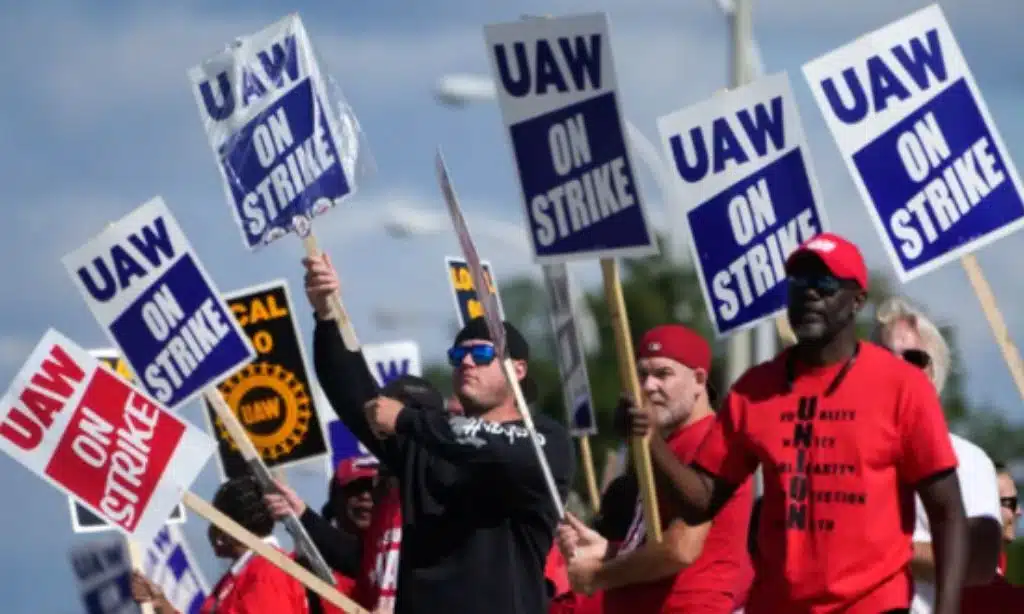
His was the first council to unanimously pass a resolution backing Fain’s vision shortly after the UAW’s 2023 strike ended. At least one union local under Morrison’s jurisdiction has already begun the process of adjusting its contract timeline.
“People are excited to try to prioritize it and be a part of something bigger,” said Morrison, who also hosts “The Valley Labor Report,” a radio show about workers’ issues in Alabama.
By walking out simultaneously at all three Detroit automakers – a first for the 87-year-old UAW – the union’s negotiators were able to credibly play the companies off one another, pressuring them to match terms and leaving strategic room to escalate strikes at certain facilities while letting others return temporarily.
“It was an illustration of what coordinated bargaining can do,” Morrison said. “You can see this even in industries where union density is relatively high, but contracts aren’t aligned – it makes it really easy [for employers] to whipsaw one local against another, one region against another.”
For the 2023 auto talks, the UAW deliberately extended its traditional four-year contracts with Ford, GM and Stellantis by several months, rescheduling the expirations for April 30th, 2028.
The shift allowed the union to align its next push with May 1st and the symbolism of International Workers’ Day – a commemorative date for the global labor movement that traces its origins to the famous 1886 Haymarket Affair in Chicago.
In that seminal event, nationwide strikes for an eight-hour standard workday prompted a brutal crackdown by police after an unidentified person threw a bomb into a crowd, sparking mass riots and violence.
“The fight for a standard workday is a struggle just as relevant today as it was in 1889,” said Fain, referencing the year an original federation of unions officially designated May 1st as an international workers’ holiday in recognition of the Haymarket martyrs.
But beyond the historical significance, the delayed 2028 expiration also served important strategic purposes for the UAW’s ambitious organizing targets in the coming years.
The union has set its sights on sectoring assembly plants owned by foreign automakers like Mercedes-Benz, Toyota, Hyundai and others who have long resisted unionization, particularly across the anti-labor Republican-led states across the American South.
“The negotiations in 2028 won’t be with just the Big Three, but the Big Five or Big Six,” Fain stated, hinting at the UAW’s expansion aims.
Extending the Detroit automakers’ contracts created more runway for the UAW to potentially line up expiration dates with any new collective bargaining agreements secured during this organizing push.
That coordinated timing would theoretically grant the union greater cross-leverage during future negotiations.
The effort scored an early, hard-fought breakthrough just last week when workers at Volkswagen’s plant in Chattanooga, Tennessee, voted by a lopsided 63% margin to join the UAW.
It marked the union’s first-ever successful campaign at a major foreign-owned auto assembly plant in the South after failing in two previous attempts at that same VW facility.
For labor activists like Morrison, the Volkswagen victory signaled the labor movement may finally be positioned to go on the offensive after decades spent on the defensive amid declining memberships, corporate opposition and policy setbacks dating back to the Taft-Hartley restrictions.
“What you can see from VW in Chattanooga, it’s inspiring to people to see that we can win and we can win together,” Morrison said. “This is really an important call for coordination across unions to maximize our bargaining power.”
As ambitious as aligning tens of thousands of labor contracts may seem, Fain’s 2028 proposal notably has support from an array of union activists. But it’s no certainty that the vision will be realized.
Among the hurdles are securing buy-in from rank-and-file members who must endorse adjusting contract timelines as part of broader bargaining goals like higher wages, more generous retirement contributions, and improved workplace policies.
Negotiating those shifts requires the cooperation of employers who may balk at condensing or extending contract terms on a schedule designed to increase future leverage against them.
“It is a demand like any other that will require getting members on board,” said Morrison. “Some companies may be resistant to shortening or lengthening contracts to coincide with this sort of potential coordinated bargaining scenario – especially if they view it as solely about empowering unions.”
Still, in the view of many activists, finding innovative pathways to amplify organized labor’s influence is an existential necessity. Merely playing defense against continued membership declines is unacceptable, they argue.
“I think it’s really a bold call, but also a vital one,” Lewis said. “We have to start setting our sights once again on making transformative gains for the working class – not just managing our long, gradual decline.”