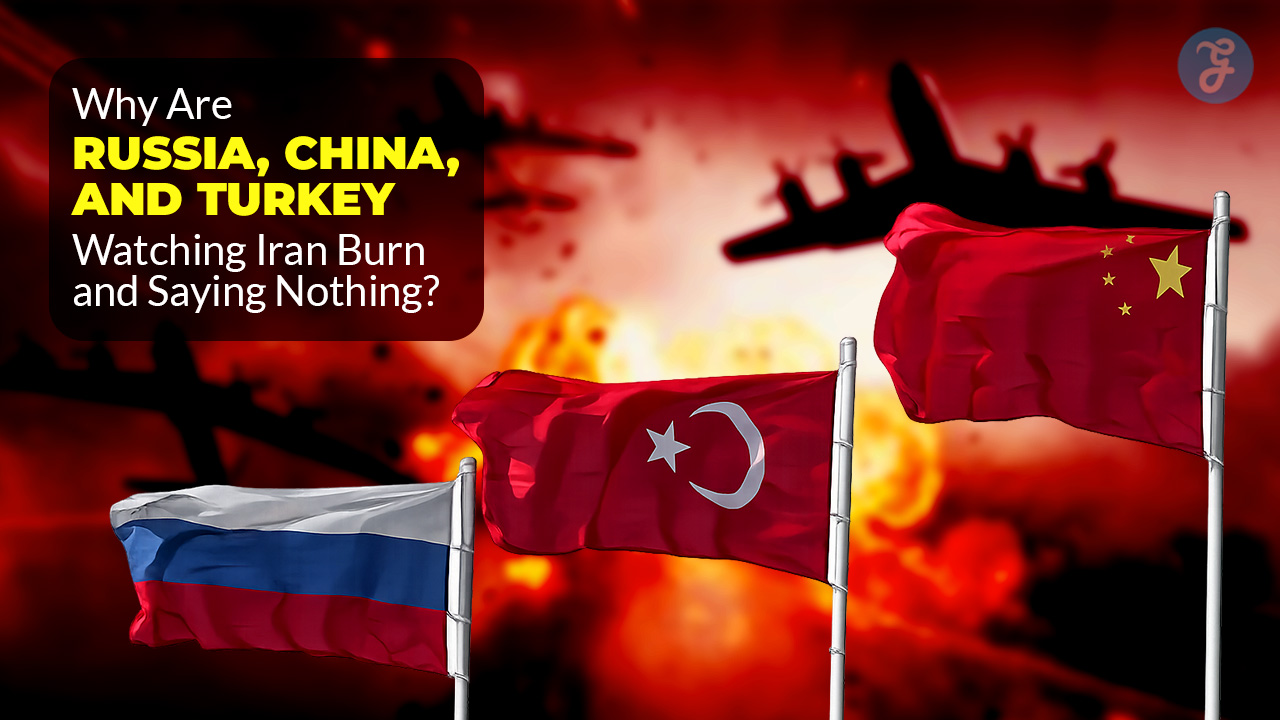
Tehran is on fire. The Supreme Leader is dead. Iranian missiles are raining across the Gulf. And somewhere in Moscow, Beijing, and Ankara, three heads of state are doing something that history will record with either great admiration or damning shame: they are talking — carefully, diplomatically, cautiously — and doing absolutely nothing else.
On February 28, 2026, the United States and Israel launched the most consequential military strike since the 2003 invasion of Iraq. They called it Operation Epic Fury. They killed the Supreme Leader. They bombed nuclear facilities, military infrastructure, IRGC command posts, and leadership compounds across more than 20 Iranian cities. And Iran — bleeding, burning, and enraged — struck back at 27 American military bases across the Middle East and rained missiles into Israeli territory.
The world expected a response from Iran’s three most powerful partners. Instead, it got press releases.
This is the story of that silence — what it means, why it exists, and whether the world is now standing at the precipice of something humanity has never survived before: a Third World War.
The Assassination: Khamenei Is Dead
To understand the magnitude of what happened today, you must first understand who Ali Khamenei was — and what his death means to the architecture of the Islamic Republic.
Khamenei was not merely a head of state. He was the Supreme Leader — a post that in Iran’s theocratic system sits above the presidency, above parliament, above the judiciary. He commanded the Islamic Revolutionary Guard Corps. He controlled foreign policy. He was the final word on Iran’s nuclear ambitions, its support for Hezbollah, Hamas, and the Houthis, and its decades-long confrontation with Israel and the United States. He held the position for 34 years, since 1989.
He was 86 years old. And in the early hours of February 28, 2026, an American-Israeli strike on his compound in Tehran’s Pasteur district killed him.
Iranian state media confirmed his death hours after the strike. Images circulated showing a plume of black smoke rising from the heavily fortified residential and office complex. Israeli Prime Minister Benjamin Netanyahu announced there were “growing signs” Khamenei had been killed. President Trump posted on Truth Social calling it “the single greatest chance for the Iranian people to take back their Country.” Hours later, Iranian state media made it official.
Iran declared 40 days of mourning. And then it declared war on the Middle East.
“Words without swords are meaningless in war. And right now, three of the most powerful nations on earth are offering Tehran words — and nothing else.”
Iran’s Retaliation: The Crushing Response
The Islamic Republic of Iran, weakened but not broken, struck back with a ferocity that surprised military analysts who had expected a more restrained response given the devastation of the initial US-Israeli attack.
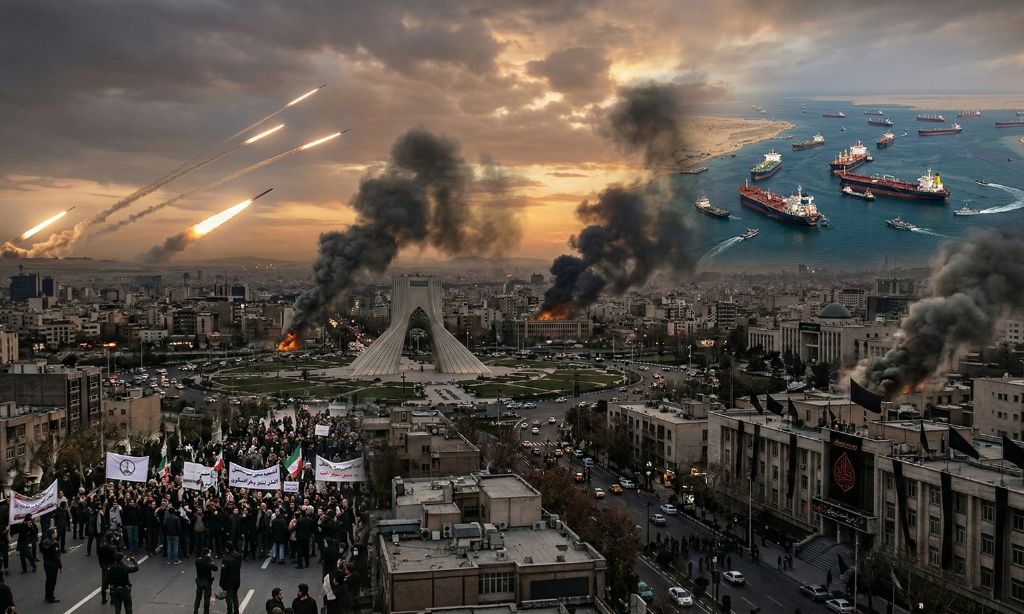
The IRGC announced it had launched strikes against 27 American military bases across the Middle East — in Kuwait, Qatar, the UAE, Bahrain, Jordan, and Saudi Arabia. Explosions were reported across Doha, Manama, and Riyadh. Qatar’s skies lit up as Iranian missiles and Shahed drones attempted to overwhelm air defense systems. An Iranian Shahed drone successfully struck a US military facility in Manama. Saudi Arabia reported incoming missile fire targeting Riyadh and the Eastern Province, with the kingdom saying its air defenses intercepted them.
Israel, simultaneously, faced wave after wave of missile fire from Iran — alongside whatever remained of Hezbollah’s arsenal in Lebanon, which Iran called on to join the fight.
An IRGC general, in a chilling statement, told the world that the missiles fired today were only from Iran’s reserve arsenal — and warned that unprecedented new weapons had yet to be introduced. Whether this was psychological warfare or genuine threat, no one in Washington, Riyadh, or Tel Aviv was willing to dismiss it.
And in one of the most geopolitically consequential announcements of the conflict, the IRGC ordered the complete closure of the Strait of Hormuz — the narrow waterway through which approximately 20% of the world’s oil supply passes every single day. The tremors of that announcement were felt immediately on global energy and financial markets.
The Iranian Foreign Ministry, for its part, was unambiguous: “All American and Israeli assets and interests in the Middle East have become a legitimate target. There are no red lines after this aggression.”
The Background: How the World Got Here
This war did not begin this morning. It has been building for years — through miscalculation, provocation, geopolitical ambition, and catastrophic failures of diplomacy.
The most immediate roots lie in 2024, when Israel and Iran exchanged direct strikes for the first time in history — in April and again in October. Then came the summer of 2025, when Israel launched a 12-day war against Iran itself, and the United States joined with a strike targeting Iran’s nuclear facilities. Israel halted the conflict — but analysts who understood Netanyahu’s thinking knew it was only a pause.
Meanwhile, Iran’s domestic situation deteriorated catastrophically. Beginning in late December 2025, the largest anti-government protests since the 1979 Islamic Revolution erupted across Iran, spreading to over 100 cities. The trigger was economic — a collapsed rial, runaway inflation, and years of sanctions-induced poverty. But the demand was political: regime change. The Iranian government responded with massacres. Estimated death tolls from the crackdown range from over 3,000 to tens of thousands, depending on the source.
The protests gave Trump a moral justification — however contested — for what was coming. He promised the Iranian people he would come to their aid. He began moving an unprecedented military buildup into the region — the largest since the Iraq War. Aircraft carriers, fighter jets, warships.
And then — in a move that will haunt historians — the US simultaneously pursued nuclear negotiations with Iran, mediated by Oman. As recently as February 27, 2026, the day before the attack, Oman announced “significant progress” in talks. Iran had reportedly agreed to never stockpile enriched uranium. A second round of talks was scheduled for Geneva.
Trump, however, told reporters he was “not happy” with Iran’s negotiating position. The Washington Post reported that Saudi Crown Prince Mohammed bin Salman and Benjamin Netanyahu had repeatedly lobbied Trump to launch the attack.
On February 28, at approximately 9:27am Tehran time, the first explosions shook the Iranian capital.
Dmitry Medvedev, Russia’s Security Council deputy chairman, later accused the US of having used the nuclear negotiations as cover to prepare the military operation. Given the timeline, the charge is not easy to dismiss.
The Aftermath: A Region in Freefall
The immediate aftermath of the strikes has produced a crisis of staggering proportions.
Iran’s civilian casualties are mounting by the hour. An Israeli strike hit a girls’ elementary school in Minab, in southern Iran’s Hormozgan province, killing at least 60 children and injuring 80 more. The image of that school — reduced to rubble in a country that did not start this particular war — will define global opinion of this conflict for years. The Red Cross and Red Crescent called urgently on all parties to respect the rules of war.
Iran’s nuclear material, per the head of the IAEA, remains largely intact despite the strikes — raising the terrifying possibility that the stated objective of the operation has not been achieved, while the humanitarian cost has already been catastrophic.
The Strait of Hormuz closure, if sustained, threatens a global oil shock that could push prices to levels not seen in decades, sending inflation spiraling across already fragile global economies.
Gulf states — nominally aligned with the West but geographically exposed to Iranian retaliation — find themselves in an impossible position: they host US military bases that are now being targeted by Iranian missiles, yet they cannot afford to be seen as co-combatants. Qatar, Kuwait, Bahrain, and Saudi Arabia all issued statements condemning Iran’s retaliatory strikes on their soil while carefully avoiding any endorsement of the initial US-Israeli attack.
And in Iran itself, the question of succession is dangerously unresolved. Who leads the Islamic Republic now? Who commands the IRGC? Who controls the nuclear program — whatever remains of it? A power vacuum in a nuclear-adjacent state, under active bombardment, surrounded by enemies, is one of the most dangerous conditions the modern world has ever faced.
The Question That Defines This Moment: Why Are Russia, China, and Turkey Silent?
Here is where analysis must be honest about its own framing. Russia, China, and Turkey are not silent. They have spoken. The question is why they are speaking — and not acting.
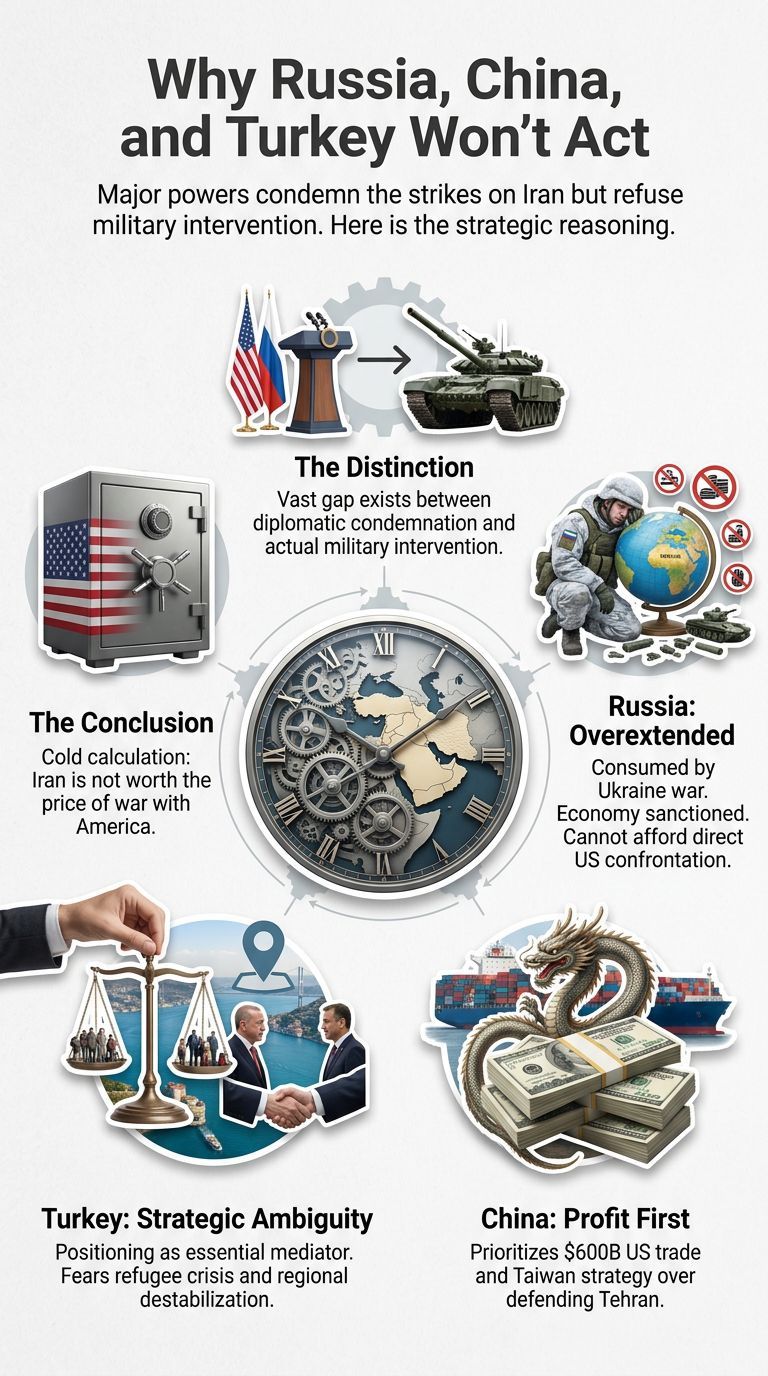
This distinction matters enormously. Because in international affairs, there is a vast and consequential distance between a press release and a weapons shipment. Between a UN Security Council request and a military alliance. Between condemning an attack in the strongest terms and doing anything to stop it.
Russia called the US-Israeli strikes “a pre-planned and unprovoked act of armed aggression against a sovereign and independent UN member state.” It accused Washington and Tel Aviv of “hiding behind” Iran’s nuclear program while pursuing regime change. It called for an emergency UN Security Council session. It warned of “humanitarian, economic and possibly radiological catastrophe.”
But Russian tanks have not moved. Russian aircraft have not scrambled. The Russian warships that participated in joint naval exercises with Iran in the Strait of Hormuz just days ago are watching from a distance.
Why? Because Russia is consumed by Ukraine. Because its military is stretched, its economy is sanctioned, and the last thing Putin can afford right now is a direct military confrontation with the United States — especially with a Trump administration that has simultaneously been pursuing negotiations over Ukraine’s future. Putin’s calculation is coldly rational: condemn loudly, support symbolically, avoid escalation. Iran’s survival is valuable to Moscow. Iran’s war is not Russia’s war.
China said it was “highly concerned,” called for “an immediate stop of the military actions,” and stressed that “Iran’s sovereignty, security and territorial integrity should be respected.” It joined Russia in requesting an emergency UN Security Council session.
And yet Chinese warships — also present in those recent Strait of Hormuz exercises alongside Russian and Iranian vessels — have not engaged. China has hundreds of billions of dollars in Belt and Road investments across the Middle East, including energy deals with Iran that are critical to Beijing’s resource security. A destabilized Middle East is a genuine threat to Chinese economic interests. But China also has $600+ billion in bilateral trade with the United States. The Taiwan Strait remains the single most important strategic issue for Beijing. Xi Jinping will not sacrifice that chess match to defend Tehran.
China’s silence is the silence of cold economic calculation.
Turkey has been the most vocal of the three — and arguably the most genuinely conflicted. President Erdogan condemned the strikes as a violation of Iran’s sovereignty, called them a product of “Netanyahu’s provocations,” and explicitly stated that Turkey would not allow the use of its airspace or territory in the conflict. Turkey closed its airspace and land routes to the operation.
But Erdogan also condemned Iran’s retaliatory missile and drone strikes on Gulf countries as “unacceptable, regardless of the reason.” He called on the Islamic world to prevent the war from expanding. He promised to “accelerate diplomatic efforts.”
Turkey’s position is not silence — it is strategic ambiguity at its most sophisticated. Erdogan has held phone calls with both Trump and Iran’s president. He has sent his Foreign Minister to hold emergency talks with seven regional counterparts. He is positioning Turkey as an indispensable mediator — the same role Oman played before the bombs fell. This is Erdogan’s play: not to fight for Iran, not to fight with America, but to emerge from this war as the region’s most essential diplomatic actor.
Turkey shares a 500-kilometer border with Iran. It hosts over 74,000 Iranians with residence permits. The last thing Ankara wants is a refugee crisis, a destabilized neighbor, or to be caught on the wrong side of a conflict that could redefine the Middle East for a generation.
The silence of Moscow, Beijing, and Ankara, therefore, is not cowardice. It is the sound of three major powers calculating their national interests with extreme precision — and concluding that Iran is not worth the price of a direct confrontation with the United States.
That calculation may be rational. It is also, for Iran, absolutely devastating.
Could This Become World War III?
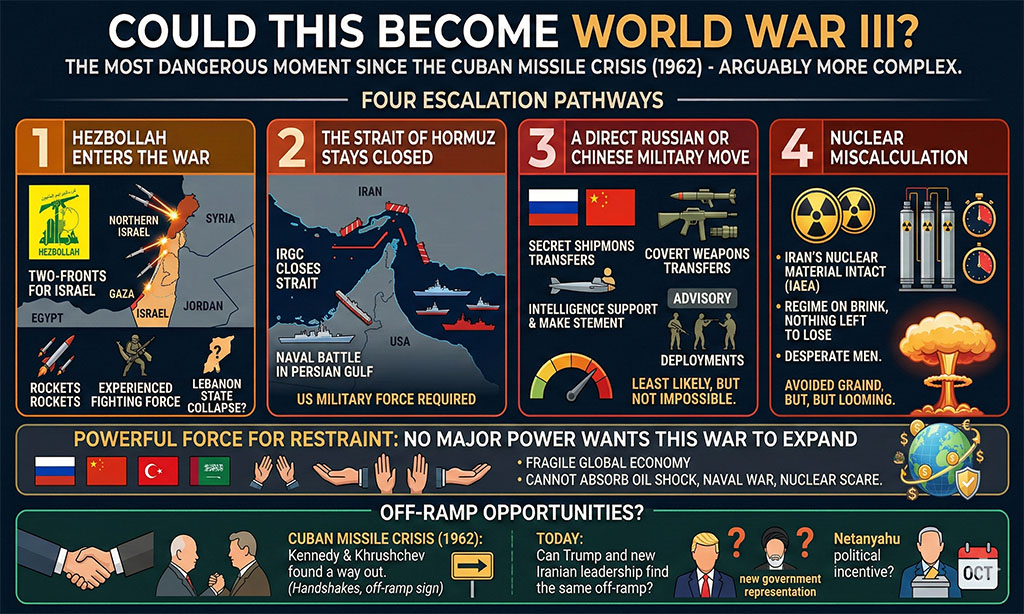
This is the question that 8 billion people are asking tonight. And the honest answer is: it is the most dangerous moment since the Cuban Missile Crisis of 1962 — with critical differences that make it arguably more complex.
There are four escalation pathways that could turn this regional war into something global.
Pathway 1
Hezbollah Enters the War If Hezbollah — Iran’s most powerful proxy, with an estimated 150,000 rockets and an experienced fighting force hardened by years in Syria — launches a full-scale assault on northern Israel, Israel will have to fight on two fronts simultaneously. This dramatically raises the cost and duration of the conflict, strains US commitments, and could pull Lebanon into full state collapse.
Pathway 2
The Strait of Hormuz Stays Closed The IRGC has ordered the closure of the Strait of Hormuz. If this is enforced by Iranian naval assets, the United States will be compelled to use military force to reopen it. A naval battle in the Persian Gulf, with Russian and Chinese vessels potentially present in the area, is exactly the kind of incident that can spiral beyond anyone’s intention.
Pathway 3
A Direct Russian or Chinese Military Move This is currently the least likely pathway — but not impossible. If Iran’s regime faces total collapse, and if either Moscow or Beijing calculates that their strategic position is being irreversibly damaged, the possibility of covert weapons transfers, intelligence support, or “advisory” deployments cannot be ruled out. Every major proxy war in history began with one side providing “advisers.”
Pathway 4
Nuclear Miscalculation Iran’s nuclear material remains largely intact, per the IAEA. A regime on the brink of collapse, with nothing left to lose, and in possession of highly enriched uranium, in a state of existential war — this combination has never existed before in the nuclear age. The question is not whether Iran has a bomb. The question is what desperate men do when they believe annihilation is certain.
Against these pathways, there is one powerful force for restraint: no major power wants this war to expand. Russia doesn’t. China doesn’t. Turkey doesn’t. Even the Gulf states being targeted by Iranian missiles don’t want a regional inferno. The global economy — already fragile — cannot absorb an oil shock, a naval war, and a nuclear scare simultaneously.
The Cuban Missile Crisis was resolved because both Kennedy and Khrushchev gave each other a way out. The question today is whether Trump and whoever now leads Iran’s shattered government can find the same off-ramp — and whether Netanyahu, with Israeli elections looming in October, has any political incentive to let them.
The Dangerous Mathematics of Calculated Silence
History is full of moments where powerful nations stood at the edge of catastrophe and chose calculation over courage — and sometimes that calculation was exactly right. The three great powers watching Iran burn from a safe diplomatic distance may be doing exactly what responsible nuclear-armed states should do: avoiding direct confrontation.
But history is also full of moments where every calculation was perfectly rational — right up until the moment everything went catastrophically wrong. The “guns of August” that started the First World War were not fired by madmen. They were fired by rational leaders who each believed the other would blink first.
Russia, China, and Turkey are not silent because they do not care about Iran. They are silent because they care about themselves more — which is precisely what every great power has always done. The tragedy is that this perfectly rational self-interest may leave Iran to burn, the Middle East to fracture, and the world one miscalculation away from a catastrophe no nation is prepared to survive.
The Strait of Hormuz is closed. Tehran is in mourning. The missiles are still flying.
And in Moscow, Beijing, and Ankara, three heads of state are choosing their words very, very carefully.