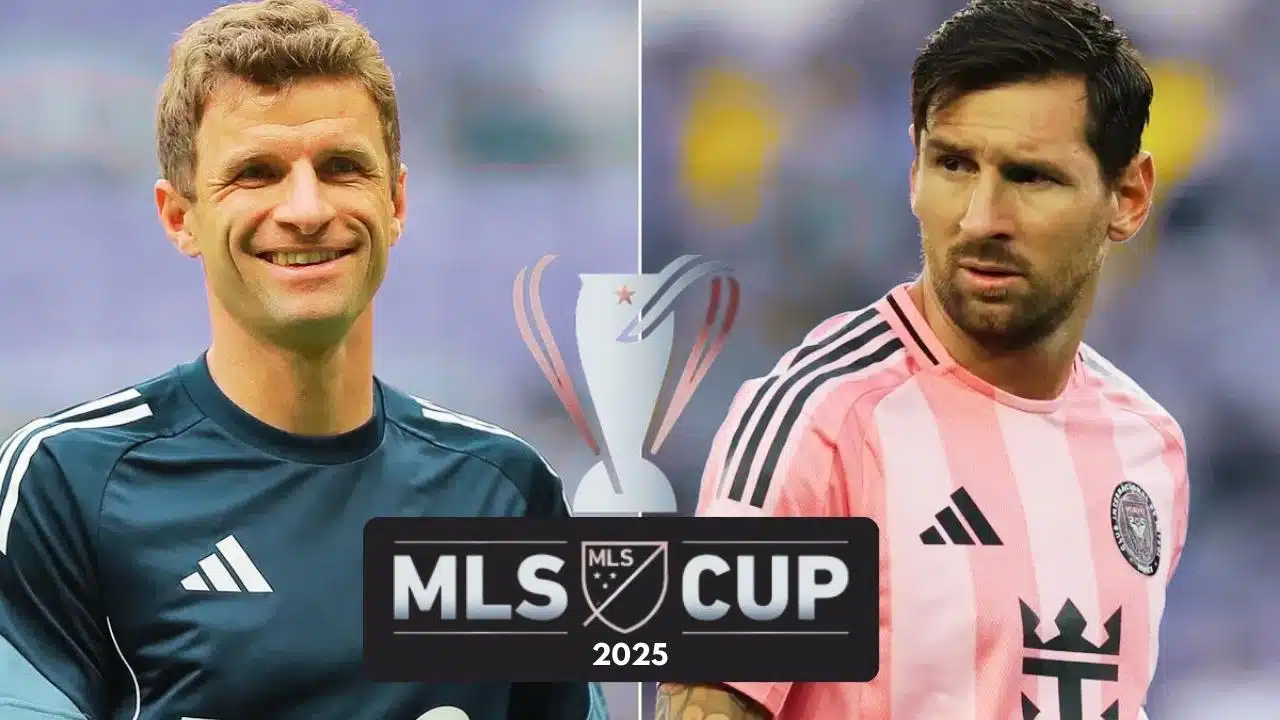
Thomas Müller’s assessment is brutally simple: “Maybe they rely a little bit more on him than we do on me, because we are such a good group.” In one line, the German distills the central tension of the 2025 MLS Cup Final: Inter Miami as Messi-centric juggernaut vs. Vancouver Whitecaps as a collective machine.
Let’s look at that “key difference,” with stats, tactical context, and a clear-eyed prediction of who is actually ahead to win the final.
A Year in the Making: Whitecaps vs Inter Miami MLS Cup Final 2025
The 2025 MLS Cup Final at Chase Stadium in Fort Lauderdale is a dream TV matchup: Lionel Messi’s Inter Miami vs Thomas Müller’s Vancouver Whitecaps. Both clubs are in their first MLS Cup, both led by first-year coaches (Javier Mascherano for Miami, Jesper Sørensen for Vancouver).
The paths:
- Inter Miami
- Round One: edged Nashville over three games
- Semifinal: destroyed FC Cincinnati 4–0 away
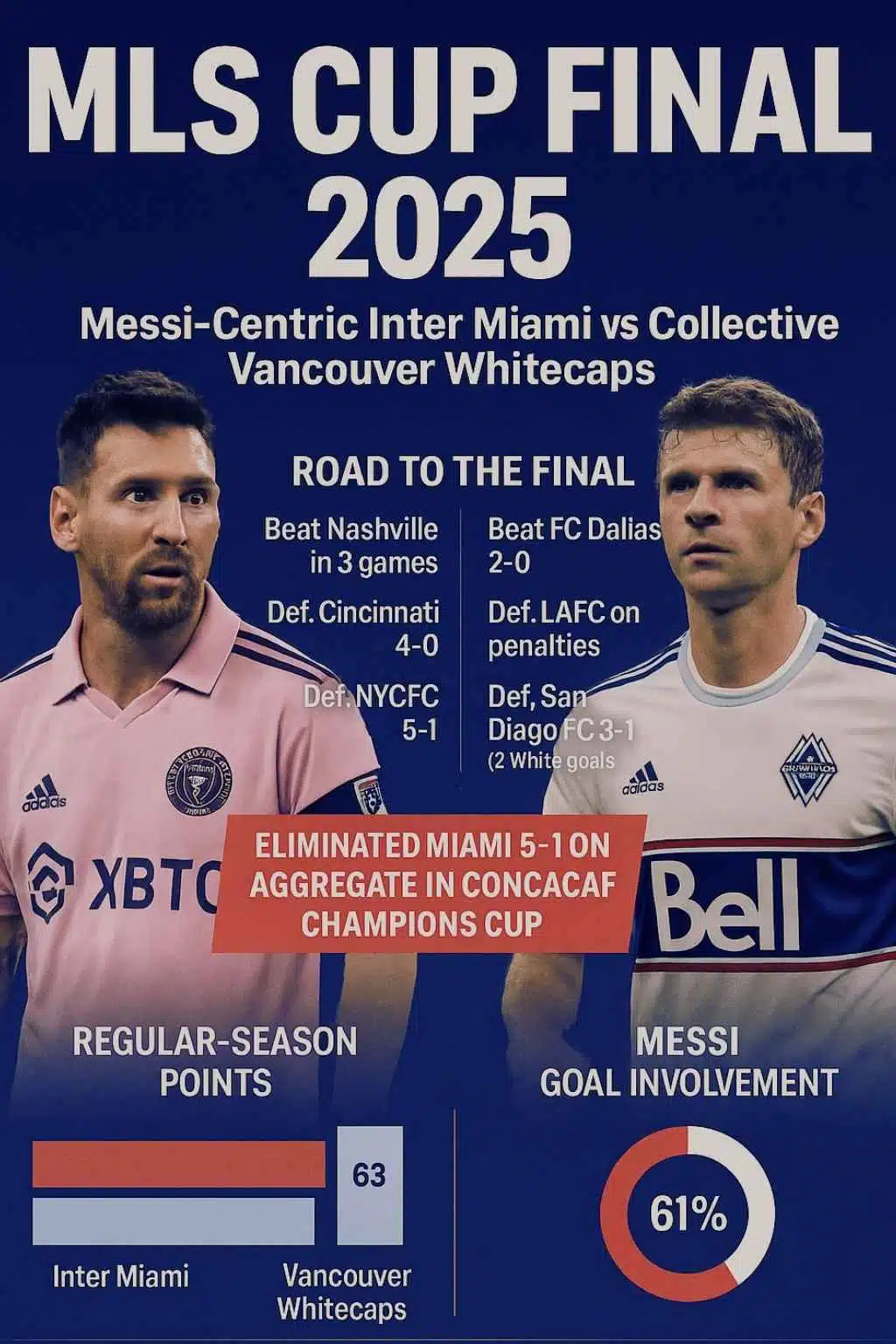
- East Final: thrashed NYCFC 5–1 at home, outscoring their last three playoff opponents 13–1.
- Vancouver Whitecaps
- Round One: 2–0 series over FC Dallas
- Semifinal: survived LAFC on penalties
- West Final: 3–1 at San Diego FC, with Brian White scoring twice.
And crucially, this isn’t their first high-stakes meeting of 2025. In April, Vancouver knocked Miami out of the Concacaf Champions Cup 5–1 on aggregate (2–0 in Vancouver, 3–1 in Fort Lauderdale) – Messi did not score in either leg.
So when Müller says “it’s Miami against the Whitecaps,” not Messi vs Müller, he is speaking with the confidence of someone whose team has already outplayed this opponent over two legs.
What Müller Actually Said – And Why It Matters
After the Western Conference Final win in San Diego, Müller went in two directions at once: respect and challenge.
1. He played down the 1v1 narrative: “It’s not about Lionel Messi against Thomas Müller, it’s Miami against the Whitecaps.”
2. Then came the key line: “Maybe they rely a little bit more on him than we do on me, because we are such a good group.” And he framed it as good for everyone: more viewers, more value for both franchises and the league.
Underneath the politeness, there’s an edge: Miami’s strength is also a potential weakness. If you can disrupt Messi’s influence, does the structure wobble? The numbers say Müller has a point.
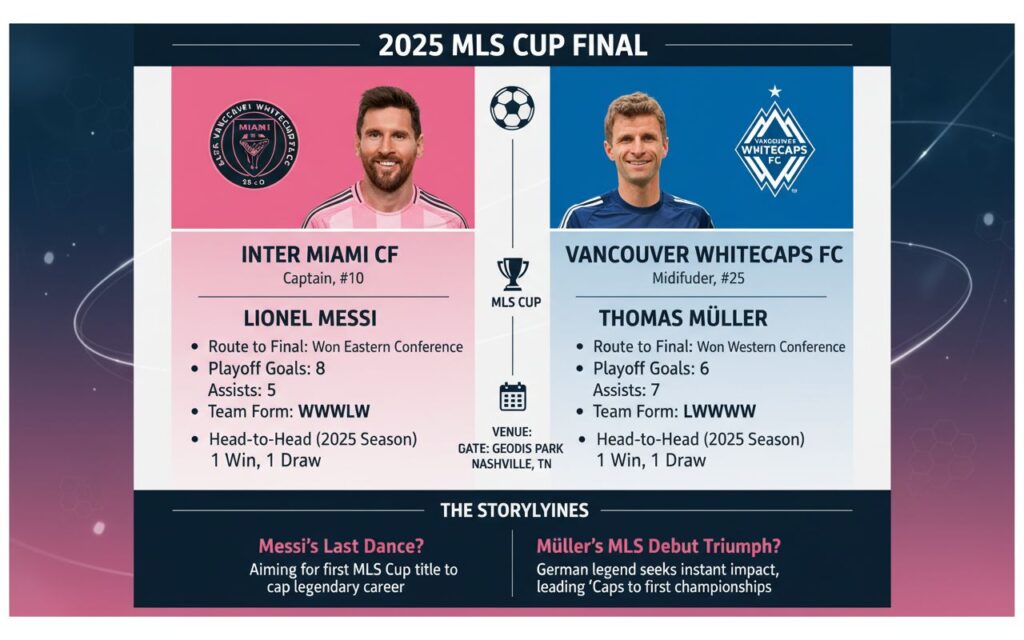
How Messi-Centric Is Inter Miami: Messi’s Output in 2025
Messi’s season is absurd even by his standards:
- Regular season: 29 goals, 19 assists – Golden Boot and likely back-to-back MLS MVP.
- Playoffs: 6 goals, 7 assists (13 goal contributions), an MLS single-postseason record.
World Soccer Talk went a step further. Miami has scored 18 goals in five playoff games, and Messi has directly contributed to 11 of them (either scoring or assisting).
That is 61% of their playoff goals. For a 38-year-old, that’s not just influence – that’s dependence.
Inter Miami’s Style with Messi
Under Mascherano, Miami plays a Messi-centric 4-3-3 / 4-2-3-1 hybrid:
- Messi often plays as a false 9 or free 10, dropping into pockets to dictate the game.
- High technical floor in possession with Busquets–De Paul in midfield and Alba overlapping on the left.
- Vertical runners – especially Tadeo Allende and Mateo Silvetti – attacking space once Messi draws defenders. Allende has 8 playoff goals, equalling the MLS single-postseason record.
Miami’s attack is terrifying when the ball flows through Messi. But you can see why Müller talks about reliance: take Messi out of the rhythm, and you at least test how much the supporting cast can carry the final.
Whitecaps as “Such a Good Group”
If Miami’s story is built around one gravitational force, Vancouver’s is more about the whole ecosystem.
Collective Resilience and “First-Goal” Data
Vancouver’s own stat pack underlines that this is a team wired around structure and mentality, not just one superstar.
- When Whitecaps score first: (all MLS, including playoffs)
- Record: 17W–0L–4D
- Unbeaten when leading at half-time (14W–0L–3D).
- When Miami scores first: 20W–0L–3D – they’re also perfect front-runners.
Both teams kill games once ahead, which makes the first goal feel like a tactical jackpot.
Whitecaps’ scoring profile:
- They score a lot late in halves, especially right before half-time and in the final 15 minutes, when fitness and organization show.
- They’ve both defended leads (80% success) and found equalizers (63% of times they’ve fallen behind), pointing to a balanced mentality rather than “boom-or-bust” chaos.
This is exactly the kind of statistical backbone Müller is referring to: a team that doesn’t crack easily and spreads responsibility across the XI.
Key Figures Beyond Müller
Even with Müller’s star power (9 goals, 4 assists in 12 matches across competitions since joining), he is a piece of the puzzle, not the entire picture.
- Brian White – 24 goals in all competitions, including a brace in the West Final. Classic No. 9, relentless between the posts.
- Ryan Gauld – the captain and creative hub, just back to full speed after a long knee layoff.
- Sebastian Berhalter & Tristan Blackmon – both in the 2025 MLS Best XI; Blackmon also Defender of the Year.
- Ali Ahmed & Andrés Cubas – provide legs, pressing, and line-breaking carries from midfield and wide areas.
- Yohei Takaoka – MLS All-Star goalkeeper, reliable shot-stopper, and organizer.
Müller, then, is a high-IQ connector in an already coherent system – the opposite of a top-heavy, star-dependent side.
Side-by-Side: Team & Star Comparison
Team Snapshot
| Metric | Inter Miami | Vancouver Whitecaps |
| Regular-season points (2025) | 65 (3rd in East) | 63 (5th in West, club record) |
| Playoff GF/GA (2025) | 17–4 in three rounds | 7–4 (incl. PK win vs LAFC) |
| Concacaf Champions Cup H2H | Lost 5–1 on agg to VAN | Won 5–1 agg vs MIA |
| Home/Away in MLS Cup | Hosts at Chase Stadium, Florida | On the road, long travel |
| MLS Cup odds (DraftKings) | –235 favorites | +175 underdogs |
Messi vs Müller in 2025
| Metric | Lionel Messi (Inter Miami) | Thomas Müller (Whitecaps) |
| Age | 38 | 36 |
| Regular-season 2025 | 29g / 19a (Golden Boot) | 9g / 4a in 12 matches (all comps) |
| Playoff 2025 | 6g / 7a (13 contribs, MLS record) | Key link-up play, but goals spread across the Whitecaps’ attack |
| Biggest 2025 tie vs each other | Blanked over 2 legs in CCC semi (MIA out 1–5 agg) | Orchestrated Vancouver’s dominance in the same tie |
| Public framing of the final | Mostly silent, focus on the team via Mascherano’s comments | Emphasizing “group” over star duel, a slight jab about reliance |
Key Tactical Battlegrounds
1. The Messi Zone vs Vancouver’s Block
Miami’s attack lives in the half-spaces between midfield and defense, where Messi drops to receive:
- If Vancouver’s midfield (Berhalter, Cubas, Gauld) can compress the central lanes without losing track of Allende and Silvetti’s runs, they can force Messi to play in front of them, not through them.
- If they step too high, Messi will just slip runners in behind – and Allende is in ridiculous form.
Look for Vancouver to:
- Sit in a compact mid-block rather than pressing suicidally high.
- Use Müller as a first line of pressing trigger, but preserve energy for transitions.
2. Transitions: Whitecaps’ Best Chance
Whitecaps are most dangerous when:
- They win the ball in midfield through Cubas or Berhalter,
- Release Ali Ahmed or Gauld quickly into space,
- And then find either Müller between lines or White attacking the box.
Miami’s fullbacks – especially Alba when he steps high – can leave space behind. Vancouver exploited this kind of imbalance in the Champions Cup semifinal; expect them to target wide counters into left-back/right-back zones, then cutbacks towards the penalty spot.
3. The “45th-Minute” Danger Window
The Whitecaps’ own analytics team highlighted that:
- They tend to finish halves strongly, especially just before half-time, while
- Miami scored and conceded heavily in the final 15 minutes of the first half.
That window – roughly minute 30–45 – could decide the final:
- If Miami dominates and scores late in the half, Vancouver’s game plan gets stretched.
- If Vancouver absorbs pressure and nick a goal just before the break, their unbeaten record when leading at half-time suddenly looks enormous.
4. Set Pieces & Mentality
- Whitecaps: strong aerial threats in Blackmon, White, Müller, plus good delivery from Gauld.
- Miami: Messi’s direct free-kick is still a weapon, but they’re less towering physically.
In a tight final, corners and free-kicks can tilt the xG balance. The team that stays cooler in defending second balls will likely survive.
Who Is Actually Ahead to Win the Final?
On pure odds and roster star power, Inter Miami are ahead:
- Home advantage in Florida.
- Messi is in peak MLS form, both scoring and assisting at historic levels.
- Supporting cast of Allende, Silvetti, De Paul, Busquets, and Alba – all playing for either legacies or last dances.
- Sportsbooks have them as firm favorites (-235).
But Müller’s argument gives Vancouver a very real path to an upset:
- Group vs Star: They don’t need Müller to dominate the ball. Miami must have Messi involved. If Vancouver can restrict its high-value zones without panicking, the game evens out.
- Psychological Edge: They already battered Miami in a continental semifinal this year. That result is in both dressing rooms’ heads, whether acknowledged or not.
- Game State: The first goal shapes everything. Whitecaps are 17–0–4 when scoring first this season. Miami is also flawless when leading, but if Vancouver hits first, this becomes a different, more nervous kind of game for the home side.
Our Prediction
- Most likely scenario: Inter Miami win a tense, tactical game 2–1, with Messi involved in at least one goal and Allende or Silvetti punishing space as Vancouver chase the match.
- Most plausible upset script: Vancouver scores first – perhaps via a transition finished by Brian White or a Müller late-arrival – then sits in a compact block, forcing Miami into crosses and low-percentage shots, nicking a second on the counter for a 2–1 Whitecaps win.
If you strip out the odds and emotion, Müller’s summary still rings true:
- Miami has the best player.
- Vancouver might have the better balance.
MLS Cup 2025 may come down to which of those truths matters more in 90 (or 120) minutes.