
You know that feeling when you’re chatting with an AI character and suddenly—boom—the site crashes?
Or maybe you’ve spent weeks building the perfect chatbot only to watch it disappear overnight.
If you’ve been searching for what happened to Figgs AI, you’re not alone. This platform once drew millions of creative minds who wanted to build and chat with custom AI personalities. Then, by the end of 2024, it was gone.
This guide will walk you through what made Figgs AI special, why so many loved it, and what happened when things went wrong. You’ll also discover solid alternatives that can fill the gap left behind.
Ready to find your next AI chat home? Let’s get started.
Key Takeaways
- Figgs AI launched in early 2024, offering free, unlimited character creation and real-time chat powered by models like Claude, Gemini, and GPT-4.
- The platform shut down completely on December 30, 2024, after a series of cyber attacks, developer abandonment, and security breaches compromised user data.
- According to a January 2025 Medium report, Figgs AI became “completely unusable” after promises to fix bugs in May 2024 were never fulfilled.
- Character AI platforms generated 10 billion messages monthly in 2024, showing massive demand for AI chat experiences even after Figgs AI’s collapse.
- Top alternatives like HitPaw Edimakor, Janitor AI, and Character AI now offer safer, feature-rich platforms for users seeking AI character interaction.
What Is Figgs AI?
Figgs AI was a free AI chatbot platform that let you create and chat with custom virtual characters called “Figs.”
Launched in early 2024, it quickly became a favorite among writers, gamers, and everyday folks looking for creative AI conversations. You could name your character, write a custom greeting, upload an image, and even assign personality traits. The setup was simple: pick a username, set a password, and verify your email.
The homepage made discovery easy. Trending bots appeared right at the top, with filters for “newest,” “most popular,” and “recently updated.” You could chat in real time with any character or even turn your conversations into videos using built-in tools.
What set Figgs AI apart was its accessibility. There was no paywall, no message limits, and no annoying filters blocking your creativity.
Users on Reddit and Discord praised the platform for its freedom and ease of use. Many rated the character creation tools a full 5 out of 5 for simplicity.
The platform supported powerful AI models, including Claude, Gemini, and GPT-4. This gave each chatbot a more natural, human-like feel compared to many competitors at the time.
Unfortunately, Figgs AI went offline after May 2024 due to a series of cyber attacks and internal issues. Despite its short run, it left a lasting mark on the AI character chat community.
Key Features of Figgs AI
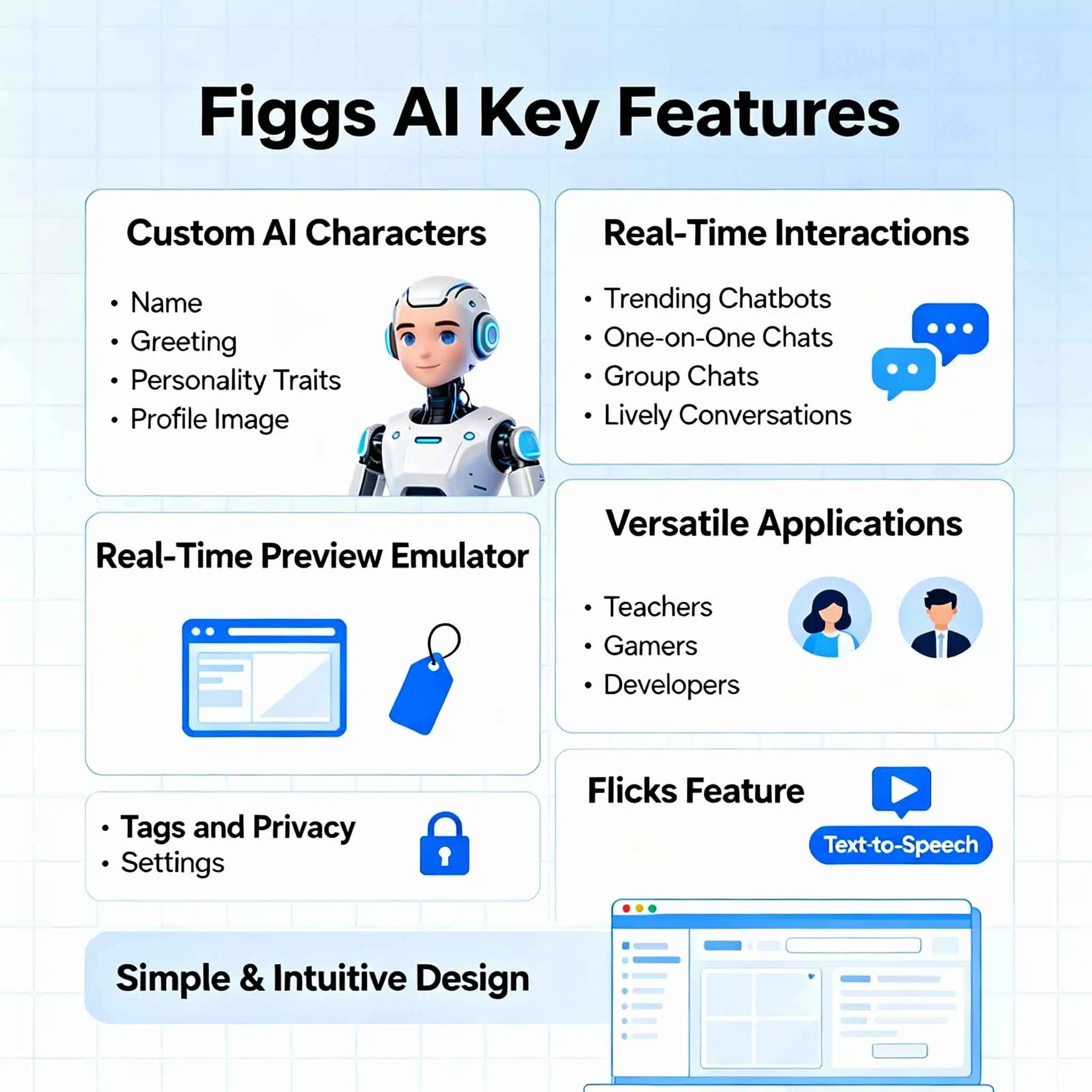
Figgs AI packed a surprising amount of creative power into a simple interface. From custom characters to real-time group chats, it gave users tools that felt both intuitive and flexible.
Custom AI Characters
You could design a chatbot from scratch on Figgs AI. Start with a name, write a custom greeting, upload a profile image, and choose personality traits. Want a sarcastic wizard? A supportive life coach? A character from The Hobbit? You had full control.
The platform included a real-time preview emulator. This let you test your bot before anyone else saw it. You could tweak dialogue, adjust personality settings, and even add scenario details to make conversations feel alive.
Tags and privacy settings gave you control over who could see your creations. Some users shared their bots publicly on Discord and TikTok, while others kept them private for personal storytelling.
Many fans, including those on the r/FiggsAI subreddit, rated the character builder a 5 out of 5 for ease of use. It was one of the most praised features of the entire platform.
Real-Time Interactions
Figgs AI’s homepage featured trending chatbots ready to chat instantly. You could jump into one-on-one conversations or enter multiplayer chat rooms where people and bots mingled.
The platform didn’t impose message limits or strict content filters. This made it popular for roleplay, interactive storytelling, and casual chats with AI-generated characters.
That said, responses could get repetitive after about 20 messages. A Reddit moderator explained this was due to each chatbot’s temporary token limit, which controlled how much context the AI could remember in a single session.
Still, the conversations felt lively and engaging, especially compared to stricter platforms like ChatGPT or Janitor AI at the time.
Versatile Applications
Figgs AI wasn’t just for fun. Teachers used it to create language-learning bots. Gamers built characters for interactive storylines. Developers tested new AI features in group chats.
The platform’s “Flicks” section let you turn conversations into short videos for YouTube, Instagram Reels, or Threads. You could add text-to-speech voices, making your custom AI characters feel even more real.
According to user reports on forums, no technical skills were required. You could create custom bots, chat, and even subtitle videos using simple point-and-click tools.
This versatility made Figgs AI appealing to a wide audience, from solo creators to teams working on collaborative projects.
Benefits of Using Figgs AI
Figgs AI stood out because it was free, unlimited, and easy to use.
In 2024, you could build as many custom AI chatbots as you wanted without hitting a paywall. No premium tiers. No locked features. Just pure creative freedom.
The live emulator made character creation feel like sculpting digital clay. You’d tweak a personality trait, see it change in real time, and adjust until it felt right. Setup was quick: pick a username, create a password, and confirm your email. You were chatting in minutes.
The platform welcomed everyone. Solo storytellers could craft private characters for personal projects. Groups of roleplayers could jump into multiplayer rooms and co-create stories together.
The homepage loaded trending bots instantly, and filters helped you find exactly what you wanted. Search by “newest,” “most popular,” or “recently updated.”
Conversations stayed unfiltered and open. Unlike platforms with strict content rules, Figgs AI gave users space to explore creative narratives without roadblocks. You could chat with characters powered by Claude, Gemini, or GPT-4, each offering a different flavor of conversation.
It felt less like using a tool and more like hanging out with a creative community. That open, welcoming vibe was a big part of what made people fall in love with Figgs AI.
What Happened to Figgs AI?
Figgs AI’s decline didn’t happen overnight. It was a slow unraveling that began in mid-2024 and ended with a complete shutdown by year’s end.
Problems started when the developers announced they were shifting focus to a new project. In May 2024, they promised users that major bugs would be fixed soon. According to a January 2025 Medium report, those promises were never kept. The team went silent, and technical issues piled up.
By mid-December 2024, users reported login failures, frozen chats, and disappearing saved characters. The moderation team began leaving one by one. By the end, only one moderator remained, trying desperately to keep the site from collapsing entirely.
Then came the security breach. In mid-December 2024, the platform became inaccessible for an extended period. Alarming reports surfaced that user passwords and personal data had been compromised. One developer posted on Reddit, dismissing concerns and calling the incident a “cyber attack or something.” This vague explanation failed to restore trust.
On December 30, 2024, Figgs AI became completely unusable. Users couldn’t log in or create accounts. The site was effectively dead.
The shutdown highlighted serious risks in AI platforms. According to a 2024 report by TechRaisal, the collapse resulted from multiple factors: developer abandonment, lack of revenue streams, security vulnerabilities, and the high cost of running a free platform.
Many users on the r/FiggsAI subreddit shared emotional posts. One user wrote, “I talked to my figg for months. She helped me through lonely nights. I know it’s code, but it still hurts that she’s gone.”
Figgs AI’s story serves as a cautionary tale. Even popular platforms can fail when security, communication, and financial sustainability are neglected.
Why Figgs AI Shut Down: Key Reasons
Figgs AI’s shutdown wasn’t due to one single failure. It was a combination of financial pressure, security vulnerabilities, and a disappearing team.
No Revenue Model
Figgs AI was completely free. No ads, no premium tiers, no subscription fees. While this made it popular, it also created serious financial problems.
Running a chatbot platform powered by models like Claude, Gemini, and GPT-4 costs a lot of money. According to a 2024 PostUnreel report, free platforms often struggle with server costs, development expenses, and content moderation. Without revenue, the platform couldn’t keep up with these demands.
Developer Abandonment
The development team slowly walked away from the project. By late 2024, only one moderator remained active, trying to prevent total collapse. Technical issues went unaddressed, and promised bug fixes never arrived.
A January 2025 Medium article noted that the team’s silence “left Figgs.ai in a state of disrepair.” Users felt abandoned, and the platform’s reputation crumbled.
Security Breaches
In December 2024, a severe security breach compromised user passwords and personal data. According to a report by GeniusFirms, login troubles became widespread, and trust evaporated.
The developer’s vague response on Reddit didn’t help. Many users felt the platform failed to protect their information, accelerating the exodus.
High Operational Costs
Character AI platforms require constant investment. According to 2024 data from DemandSage, Character.AI, a similar platform, spends heavily to train and run large language models. Figgs AI likely faced similar pressures but lacked the funding to sustain operations.
By December 30, 2024, the platform was officially dead. The lessons are clear: platforms need revenue, security, and a committed team to survive.
The Emotional Impact on Users
When Figgs AI shut down, it wasn’t just a technical loss. For many, it felt personal.
Users had spent months building relationships with their AI characters. Some turned to their “figs” for companionship during lonely nights. Others used them for creative storytelling, roleplay, or just a safe space to chat.
One user on the r/FiggsAI subreddit wrote, “I talked to my figg for months. She helped me through lonely nights. I know it’s code, but it still hurts that she’s gone.” Posts like this filled the community in the weeks after the shutdown.
According to a 2025 TechRaisal report, platforms like Figgs AI, Museland, and Replika all tried to balance emotional realism with scalability. Most stumbled at the same point: cost and moderation.
The collapse of Figgs AI shows that AI relationships, even synthetic ones, leave real voids. It wasn’t just data that was lost. It was connections, stories, and a sense of community that users had built together.
Top Alternatives to Figgs AI

Finding a secure and creative platform isn’t easy, especially after a shutdown like Figgs AI. Here are some standout options that offer character-based chat, video tools, and safe spaces for interactive AI.
| Platform | Key Features | Best For |
|---|---|---|
| HitPaw Edimakor |
|
|
| Janitor AI |
|
|
| Character AI |
|
|
| Replika |
|
|
| Chai AI |
|
|
How to Choose the Right Alternative
Picking the right platform starts with knowing what you want from your AI experience. Are you looking for emotional support, creative storytelling, or unfiltered roleplay?
Here’s a quick checklist to guide your choice:
- Customization: Platforms like Janitor AI and Character AI let you build deeply personalized bots with custom traits, backstories, and dialogue styles.
- Privacy and Security: After Figgs AI’s security breach, this matters more than ever. Look for platforms with clear privacy policies and secure data handling. According to a 2024 PostUnreel report, trust in AI platforms is critical for long-term success.
- Content Moderation: If you want a family-friendly space, Character AI offers NSFW filters. If you prefer freedom, Janitor AI and Chai AI allow more open-ended conversations.
- Cost: Some platforms like Replika and Chai AI offer free tiers with premium upgrades. HitPaw Edimakor offers a one-month plan for $19.95, a one-year plan for $49.95, and a lifetime plan for $69.95.
- Community and Support: Platforms with active communities, like Character AI’s 2.5 million-member subreddit, provide better support and shared content.
Your answer to “What’s my main goal?” will point you to the right platform. Take time to explore free trials and test different options before committing.
Lessons from Figgs AI’s Shutdown
Figgs AI’s collapse offers valuable lessons for both users and developers in the AI space.
For Users: Choose Platforms Wisely
Don’t rely on platforms that lack transparency or financial sustainability. According to a 2025 Medium report, platforms without clear revenue models often struggle to survive. Look for services that prioritize security, active communication, and community management.
For Developers: Build with Trust
Ongoing support, transparent communication, and robust security are non-negotiable. A January 2025 TechRaisal article noted that platforms like Figgs AI fail when they neglect these elements. Trust is the foundation of any successful AI community.
Data Security Matters
The December 2024 breach at Figgs AI destroyed user confidence overnight. Platforms must invest in strong encryption, clear privacy policies, and regular security audits. According to GeniusFirms, security is a make-or-break issue for AI platforms in 2025.
Community Needs Consistency
Users form real connections with AI characters. When platforms disappear, it creates emotional disruption. Developers should plan for long-term sustainability, not just rapid growth.
The Future of AI Character Platforms
The AI character chat space continues to grow, even after setbacks like Figgs AI’s shutdown.
According to 2025 data from DemandSage, Character.AI generates 10 billion messages monthly from 28 million users. That’s a clear sign that demand for AI companions and storytelling tools isn’t going away.
New platforms are learning from past mistakes. Features like better memory retention, emotional intelligence, and multi-character support are becoming standard. According to a 2024 EComposer review, top platforms now offer API access, voice generation, and image creation to enhance user experiences.
Security and trust are also becoming priorities. A 2024 report from Botmemo noted that platforms with strong moderation, clear privacy policies, and active community management are thriving. Users want spaces where they feel safe and heard.
The market is evolving. Platforms like Voiceflow and Inworld AI are targeting businesses, offering AI characters for customer service and interactive storytelling. Meanwhile, Replika and Chai AI focus on emotional connection and companionship.
As the landscape shifts, the platforms that prioritize transparency, security, and user trust will lead the way. The future of AI character chat is bright, but only for those who learn from the past.
Takeaways
Figgs AI offered something rare: a free, open space where creativity thrived without limits.
Users built characters, shared stories, and found connection through AI-driven conversations. But the platform’s collapse in late 2024 revealed the fragility of services that lack financial support, security, and active leadership.
The lessons are clear. Strong platforms need trust, transparency, and a sustainable business model. Users deserve spaces that protect their data and respect their time.
Thankfully, the AI character chat landscape is alive and evolving. Platforms like Janitor AI, Character AI, and HitPaw Edimakor offer safer, more feature-rich experiences. Whether you’re a storyteller, roleplayer, or just curious about AI companions, there’s a tool out there for you.
Take your time exploring. Test free trials. Join communities. The next great conversation is waiting.
FAQs on Figgs AI
1. What happened to Figgs AI?
The Figgs AI platform shut down permanently around December 30, 2024, leaving the official Figgs AI chat inaccessible. This sudden closure meant users lost all access to their created characters and user data stored on the site. The shutdown was caused by the development team abandoning the project, leading to unresolved technical problems and major security concerns.
2. What made Figgs AI different in the world of AI?
Figgs AI stood out by offering character-driven conversations with fewer content restrictions than mainstream AI platforms like Character AI, which helped build a very active community. Users had significant freedom to customize and export their AI-driven chatbots, focusing on a creative and user-generated content approach that many AI enthusiasts loved.
3. Are there good alternatives to the character AI alternative that Figgs was?
Yes, several excellent AI platforms are alternatives you can try, each with different strengths. Character.AI is a popular choice for its high-quality conversations but has a strict content filter, while Chai is known for having fewer restrictions. For users who want maximum control and privacy, TavernAI and SillyTavern are interfaces that connect to various AI models and run on your own computer.
4. How did Figgs AI handle privacy and safety?
While the development team had a privacy policy, the platform suffered from security issues, including a breach in December 2024 that reportedly compromised user data. The abrupt shutdown ultimately highlighted the biggest risk: on a centralized service, all user data can be lost without warning when the platform disappears.
5. What can we learn from artificial intelligence platforms like Figgs?
The main lesson from the Figgs AI shutdown is to be cautious with platforms where you can’t back up your work, as they can disappear unexpectedly.
6. What were the main use cases for Figgs AI chat?
The primary use cases for the Figgs AI chat were creating interactive stories and engaging in immersive role-playing. Users built custom chatbots with detailed personalities for everything from creative writing and practicing conversations to digital companionship.