Introduction
A motor is a device that mechanically transforms electrical energy. There are many different kinds of motors in use today, and they are all essential to modern life. Brushless DC motors (BLDC) stand out due to their great efficiency and outstanding controllability, two reasons why they find widespread use. When compared to other motor types, the BLDC motor is more efficient with electricity.
Motors are Machines that Transmit Power
Engineers may consider the process of energy conversion from electrical signals while constructing electrical equipment to execute mechanical activities. Therefore, devices like actuators and motors are used to translate electrical impulses into mechanical motion.
Brushed DC motors are the simplest design. These motors work by circulating current via a set of coils embedded in a permanent magnetic field. With enough current, the coils produce magnetic fields that spin the coil assembly by pushing each coil away from the like pole and pulling it toward the unlike pole of the fixed field. For the coils to keep “chasing” the dissimilar fixed poles, the current must be reversed repeatedly. The current in the coils is reversed by the rotation of a commutator, which makes contact with fixed conductive brushes to supply power. What sets a brushed DC motor apart from others is its commutator and brushes.
Standardized Motor Configurations
To generate rotation, motors use either alternating current (AC) or direct current (DC), and their power sources are also distinct. Following, we shall briefly examine the defining features and typical uses of each classification.
Simple in construction and control, brushed DC motors are commonly used to open and close disc trays. They are commonly used in vehicles to control the position and movement of power side windows. These motors are versatile due to their inexpensive price. However, because of their constant interaction, brushes and commutators wear out fast and need to be replaced and serviced regularly.
The rotation of a stepper motor is pulse-controlled so that with each pulse, the motor completes a discrete rotational increment (or “step”). These motors are common for implementing positioning modifications because to the precision with which the rotation may be regulated by the number of pulses received. For instance, they are frequently utilized for controlling the paper feed in fax machines and printers, as these equipment feed paper in discrete steps that can be easily associated with pulse count. Because the motor’s spin stops promptly when the pulse signal is terminated, pausing may also be readily controlled.
Brushes for DC motors can be found in a variety of voltages and motor configurations, from 12v brushless dc motor to 48v brushless dc motor.
Unlike induction motors, the spinning of synchronous motors is perfectly in time with the frequency of the input current. These motors are typically used to power the microwave oven’s revolving trays, with the help of reduction gears in the motor unit to achieve the necessary high rotational speeds for cooking. As with synchronous motors, induction motors experience a change in rotational speed as a function of frequency. These motors were once commonplace in household appliances like electric fans and washers.
How come BLDC Motors Rotate?
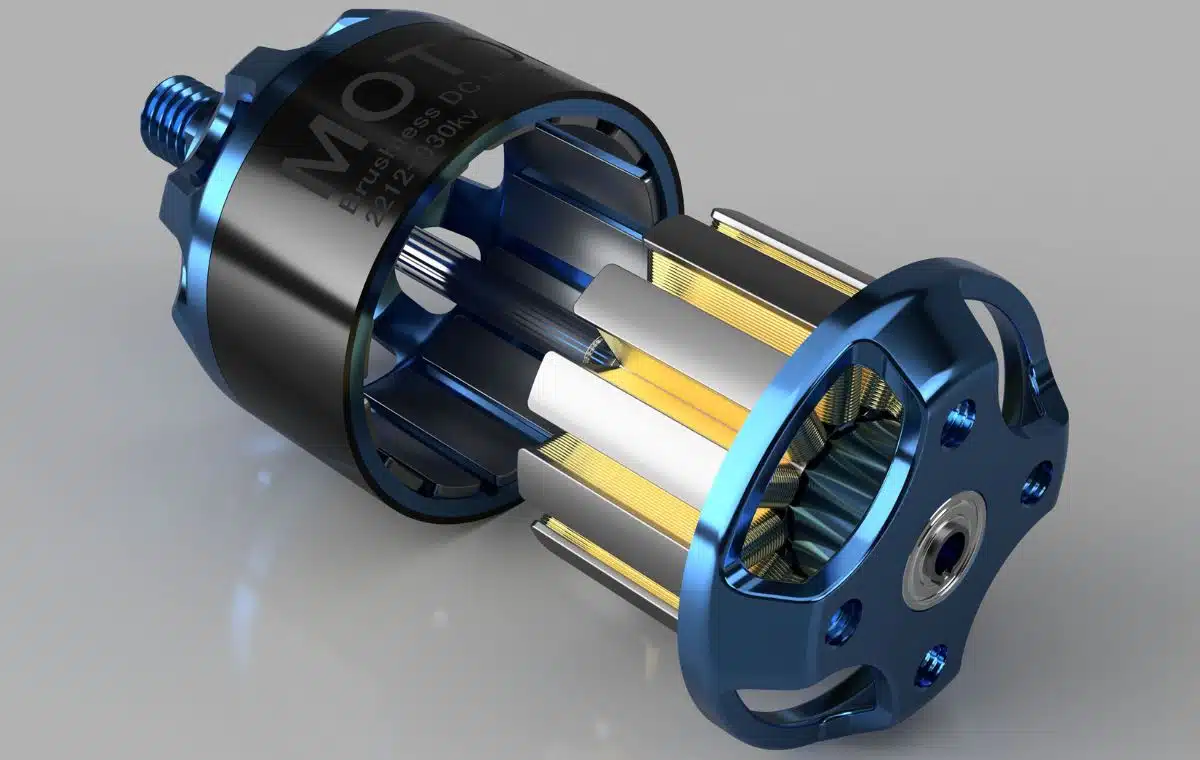
Brushless DC motors, as the name implies, do not make use of brushes. In a brushed motor, the commutator is responsible for directing current from the brushes to the rotor’s coils. So, how does a brushless motor get power to the rotor coils? This is because the coils are not situated on the rotor, rendering the device ineffective. A permanent magnet is used as the rotor, with the stator’s coils remaining stationary. It is unnecessary to employ brushes and a commutator because the coils are immobile. See Figure 3 for clarification.
In a brushed motor, the rotor turns by adjusting the strength of the magnetic field produced by the rotor’s coils, while the magnetic field produced by the stator magnets remains constant. Altering the coils’ input voltage results in a corresponding change in rotational speed. The BLDC motor’s permanent magnet is what really spins, with the help of reversing the magnetic fields produced by the surrounding coils. Changing the strength and orientation of the current flowing through these coils enables one to command the rotation.
BLDC Motors’ Many Pros
Three coils on the stator of a BLDC motor would require six wires (two to each coil). Three of these wires will often be linked internally, while the remaining three will protrude externally from the motor housing (in contrast to the two wires extending from the brushed motor described earlier). However, there is more to wiring a BLDC motor than just joining the positive and negative ends of the power cell, and we will examine the inner workings of these motors in greater depth in the next episode of this series. We wrap up by discussing the benefits offered by BLDC motors.
This type of motor has the benefit of being very efficient because it can be controlled continuously at its maximum rotating force (torque). In contrast, brushed motors’ peak torque occurs at only a few discrete intervals during the revolution. To match the torque output of a brushless motor, a brushed motor would have to employ far more massive magnets. Because of this, even compact BLDC motors are capable of producing significant thrust.
Second, and related to the first, is the fact that it is easy to exert some degree of command over the situation. BLDC motors can be precisely controlled to deliver the torque and rotation speed required by the use of feedback systems. By lowering power consumption and heat output, as well as the need for charging time for battery-powered motors, precise control extends their useful lifespan.
Since there are no brushes in a BLDC motor, they have a long lifespan and generate less electrical noise. Because of the brushes’ and commutator’s constant motion, wear and sparking are inevitable in brushed motors. In particular, electrical noise is caused by the intense sparks that fly whenever the brushes go over the commutator’s gaps. This is why brushless DC motors are widely used in settings where the elimination of electrical noise is a primary concern.
Uses Where BLDC Motors Shine
We observed that BLDC motors have a long service life, high efficiency, and good controllability. If not that, then what are they good for? They are commonly employed in constantly operating devices due to their efficiency and durability. They have been in use for some time in appliances like washers and dryers, air conditioners, and other consumer electronics, and are just now making an appearance in fans, where their great efficiency has led to a large decrease in power usage.
In addition, they are powering vacuum cleaners. As an example of the superior controllability of these motors, consider the scenario where a simple tweak to the control software resulted in a significant increase in rotational speed.
Because of its reliability and longevity, BLDC motors are also used to spin hard disc drives, which helps reduce energy consumption in an area where that’s becoming increasingly crucial.
Intent on Future Widespread Use
In the future, BLDC motors will likely find employment in a greater variety of contexts. Service robots, which are typically smaller than industrial robots and provide services in areas other than production, will likely make extensive use of them. A stepper motor’s ability to be precisely controlled via pulses may lead one to believe that it would be best suited to this task. Force control, however, is best accomplished with BLDC motors. In addition, a stepper motor would need a sizable and steady current to maintain the position of a structure like a robot arm. The only control current needed for a brushless DC motor (BLDC) would be directly proportional to the external force, saving energy. It is possible that BLDC motors will eventually replace traditional brushed dc motors in golf carts and mobility carts. More precise control from BLDC motors, in addition to their already impressive efficiency, can significantly increase the motors’ battery life.
Also, drones benefit greatly from BLDC motors. Since the attitude of a multirotor drone can be adjusted by adjusting the speed at which each rotor spins, these controllers are ideal.
It has been demonstrated in this seminar that BLDC motors excel in efficiency, flexibility, and service life. However, competent and cautious control is required if one is to make the most of these motors. Our next meeting will focus on dissecting the inner workings of these motors.
Many different motor designs are currently in widespread use. The benefits and uses of brushless DC motors are discussed in this session.