Many developers get stuck picking the right tool for web3 development. They must code smart contracts and test them on the ethereum blockchain. They see Hardhat, Truffle, Brownie and more.
It can feel like ordering pizza in the dark. You might end up with tools you do not like. It slows you down.
Solidity runs 90 percent of smart contracts. Hardhat also leads with over half of top DeFi projects. This blog will explain key tools like Truffle, Web3.js and Ethers.js. You will learn which framework fits your needs.
You will build decentralized applications, or dapps, faster and safer. Read on.
Key Takeaways
- Solidity runs 90 percent of smart contracts, and Hardhat powers over half of top DeFi projects with a fast local blockchain, Mocha/Chai tests, VS Code debugging, and weekly plugin updates.
- Truffle Suite bundles Ganache for private chains, Drizzle for front-end UIs, and a built-in console for EVM scripting, and it rolled out major updates in 2022.
- Brownie speeds up Python-based development with Vyper and Solidity support, built-in gas reports, a powerful test suite, and an Ape Works plugin system.
- Ethers.js delivers a lightweight, TypeScript-ready API that cuts download size versus Web3.js, and Web3.js itself connects JavaScript apps to Ethereum, Binance, Matic, and AVAX via HTTP, IPC, or WebSocket.
- OpenZeppelin offers audited ERC20/ERC721 contracts, Chainlink supplies oracle price feeds and randomness, The Graph indexes data with GraphQL, and IPFS ensures decentralized file storage.
How does Hardhat simplify Ethereum development and testing?
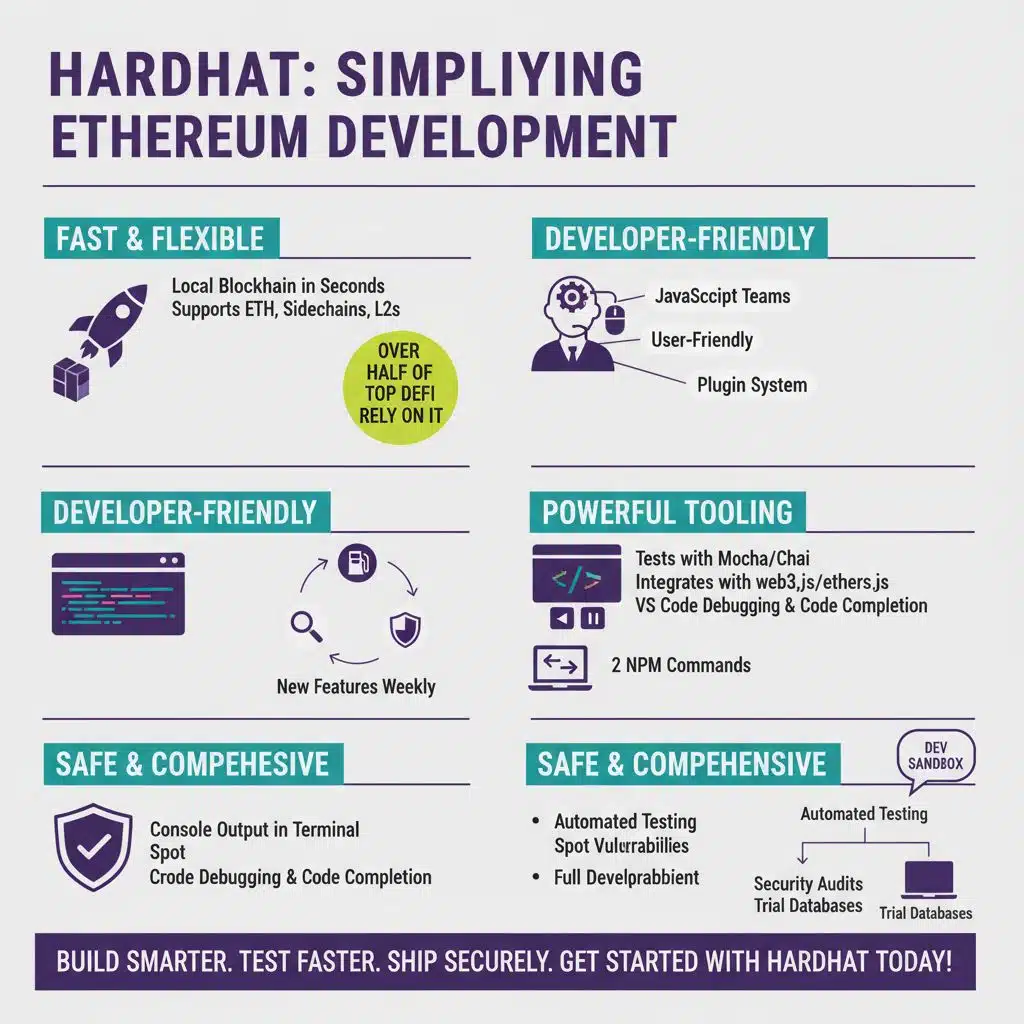
Hardhat runs a fast local blockchain, letting you deploy smart contracts in seconds. It supports Ethereum, sidechain network, layer two solution and scaling network. Over half of top DeFi protocols rely on it.
JavaScript teams find it user-friendly. A plugin system lets you add debugging tools, gas optimization modules or fuzz testing in minutes. An active community rolls out new features every week.
You can craft tests with Mocha and Chai, and integrate with web3.js or ethers.js in a flash.
Installation takes two npm commands. It links with VS Code for step-through debugging, smart contract monitoring and code completion. Developers build dapps, trading bots and NFT marketplaces with the same ease.
The Hardhat Network logs console output right in your terminal, helping you spot vulnerabilities before you push to mainnets. You get a full development environment, so you can run automated testing, security audits and trial databases, all on your laptop.
Some teams say it feels like a dev sandbox that runs an actual blockchain network.
What features does Truffle offer for blockchain development?
The Truffle Suite offers a JavaScript library that handles smart contracts from compile to deployment. It adds native support for Mocha and Chai so developers can write tests that run on a local chain.
A built-in console gives direct access to the ethereum virtual machine and helps with scripting. It logs gas usage for each contract call and offers network tools that switch from a test network to Binance Smart Chain or mainnet.
Ganache provides a private blockchain interface that shows every transaction and account state. That UI works like a debugger for your decentralized applications. Drizzle acts as a front-end tool so you can connect your web application to smart contract methods.
The Truffle team released major updates in 2022 and grew a large developer community. Competitors include Hardhat and Embark yet many still pick Truffle for end-to-end web3 development.
Why choose Brownie for Python-based smart contract development?
Brownie speeds up web3 development. Major DeFi services like automated market makers, lending platforms, and yield aggregators rely on this toolkit. Support for Solidity and Viper helps devs write versatile smart contracts.
Python fans skip JavaScript traps and work in one language. EVM-compatible chains welcome its simple interface.
A powerful testing suite finds bugs before launch. Gas reports deliver clear metrics after each run. JavaScript-based frameworks stay on the sidelines. Ape Works acts as a plugin kit and expands Brownie.
Python developers grab new tools without extra setup.
What makes Foundry a high-performance tool for EVM chains?
Foundry uses a rust programming language core and runs swiftly on EVM chains. Developers tap Ethereum and similar chains with minimal lag. Teams note quicker compile actions and tight gas optimization for smart contracts.
This modern alternative to DappTools delivers a fresh take on web3 development tools.
Built-in fuzzing and debugging tools catch errors before deployment. Command-line utilities let pros craft tests, scripts, and smart contract monitoring tasks. Early adopters praised its stable launch for heavy-duty projects.
Developers link diverse networks with smooth cross-chain communication.
What is Embark’s role in building decentralized applications?
Developers pick Embark as a JavaScript framework that rivals Truffle or Hardhat. It helps users create, test, and deploy smart contracts in one place. This tool links on-chain code to front-end scripts with ease, so you spend less time on glue logic.
Embark offers automated workflows that push your app onto Ethereum or Binance Smart Chain, boosting gas optimization. Engineers can integrate smart contract management tools like web3.js or Ethers.js for smooth upgrades.
A built-in network manager lets you switch and test across blockchain networks without sweat.
Teams love its complete dapp support, from prototype to live code. The framework adds debug features that work alongside Remix IDE or the Truffle Suite. Network management stands out when you juggle private key handling or switch testnets, so you avoid single points of failure.
A live reload feature watches your user interfaces and data persistence layers, and it updates pages in seconds. You can tap IPFS for decentralized storage or The Graph for blockchain data indexing in minutes.
Beginners and experts find that Embark feels like a Swiss army knife for web3 development.
How does Scaffold-ETH enable rapid Ethereum prototyping?
Scaffold-ETH speeds up web3 development for dapps. Austin Griffith made a template that packs boilerplate code for smart contracts and UI. It plugs into React and Next.js and connects via ethers.js and web3.js.
Anyone can spin up a full Ethereum prototype in minutes. It gives a smart contract mold and sample scripts. The open source project has an active community that shares tips and updates daily.
Teams join hackathons and proof of concept events with a ready club of tools. They tweak gas optimization, test block time, and link wallets in real time. They swap code for cross-chain communication trials.
This full stack kit, from contract to UI, saves days of setup. It feels like building with pre-cut parts instead of raw clay.
What command-line tools does DappTools provide for advanced developers?
DappTools uses bash scripts and make files to run commands in your terminal. The dapp build command compiles your Solidity contracts fast. Next, dapp test spins up a local tester and runs every unit test.
You can write scripts for custom workflows in minutes. This setup cuts wasted time.
Hevm, the EVM tester, shows you smart contract code paths and gas use line by line. It acts as a core debugging tool. Seth, the RPC shell, sends transactions to mainnet or local chains.
You glue these tools into GitHub Actions or Jenkins pipelines. Advanced devs love the full command-line control. It fits right into web3 development flows.
How does Web3. js facilitate blockchain interactions in JavaScript?

Code can feel lonely until it talks to a live ledger. Web3.js plugs your JavaScript into that space, acting like a digital bridge. Messages pass over IPC, HTTP, and WebSocket links to network vaults.
The library offers modules for smart contracts, storage spots, and peer to peer messaging. You can load a contract, call a method, and watch events in seconds. This tool handles the Ether chain, Matic chain, Binance chain, and AVAX network.
Front ends can link wallets and send gas optimized transactions fast. Open source fans love it for building decentralized applications and web3 development. Many developers mix it with React, Svelte, or Angular for slick interfaces.
You get live updates, event logs, and cross chain communication without sweat. Code hears new blocks, processes receipts, and flags errors on the fly.
Why is Ethers. js a lightweight alternative for Web3 integration?
Ethers.js packs a light and easy-to-use API. Developers call smart contracts, send transactions, manage wallet connections with concise code. Open source JavaScript library cuts front-end bloat, shrinking download sizes compared to Web3.js.
Support spans Ethereum, Polygon, BSC, Avalanche, boosting cross-chain communication in decentralized applications (dapps). Integration into React and other frameworks feels smooth, thanks to clean TypeScript types and clear function names.
Browser wallets like MetaMask plug into ethers.js without extra layers, giving user authentication in seconds. Gas optimization tools and simple interfaces help teams refine gas costs.
This library avoids heavy runtime chunks, so pages load in milliseconds. Front-end projects on macOS, iOS, cloud services and other ecosystems benefit from fast startup and stable blockchain connectivity.
This web3 infrastructure tool boosts developer speed and trims code weight.
How does OpenZeppelin enhance secure smart contract development?
Developers grab battle-tested code from a library of audited smart contracts. OpenZeppelin offers ready-to-use contracts for ERC20 tokens, non-fungible assets, on-chain organizations, and trading platforms.
Defender service automates smart contract operations, cutting manual workloads. Teams scan code with MythX and Forta to catch bugs early.
Audited packages work across Ethereum, BSC, Polygon, and Avalanche networks. This approach boosts web3 development velocity and cuts security risks. Many top DeFi protocols adopt this library and ship safer decentralized applications.
What does The Graph offer for data indexing and querying?
A protocol called The Graph indexes blockchain data for decentralized applications (dapps). It supports Ethereum, Polygon, BSC, Avalanche, and Arbitrum. Indexing speeds up data retrieval for smart contract events and transactions.
You can query subgraphs with a GraphQL API to fetch NFTs, DeFi stats, and DAO votes. This API cuts out complex RPC calls and speeds up web3 development. The Graph streamlines access to deep on-chain information.
Front ends built with web3.js or ethers.js tap into subgraphs for live data. These queries run in milliseconds, even on busy blockchain networks. Financial dapps display token swaps and liquidity pools without delay.
NFT galleries load art drops instantly using indexed metadata. Many teams pick The Graph over SubQuery for its large ecosystem and uptime. It handles high query volumes across networks, proving its scale.
Startups and institutions use this indexing tool to power dashboards and governance.
How does Moralis provide backend services for Web3 projects?
Moralis speeds Web3 development by rolling out backend services fast. Developers tap APIs for user authentication and real-time data. Support spans Ethereum, Polygon, Solana, Binance Smart Chain, and Avalanche.
The tool delivers node access in seconds. Integration with Web3.js and server-side JavaScript feels like Firebase for blockchain. It cuts down setup time and server chores.
Teams manage smart contracts, user roles, and event hooks from one dashboard. They grab wallet balances, NFT lists, and transaction history with a single call. Smart contract monitoring runs by sending webhooks on chain events.
That slash in development cycles lets you focus on dapps, prototypes, and user interfaces. Moralis keeps backend tasks light, so you can build faster.
What role does Chainlink play in smart contract interoperability?
Chainlink runs a secure oracle network that brings real-world data into smart contracts. Web3 developers use its price feeds and verifiable randomness on Ethereum, Solana, Binance Smart Chain, and other EVM platforms.
Over 50% of top ten DeFi projects tap Chainlink for critical infrastructure. Competing tools like UMA and Band Protocol try similar feats, but most dapps still choose Chainlink.
This network links contracts across chains. It drives off-chain data delivery and automation for cross-chain communication. Many NFT, DeFi, and gaming dapps rely on these decentralized oracles to fetch external APIs and trigger smart contract actions.
Plenty of tutorials and open-source tools help teams integrate Chainlink in minutes.
How does Thirdweb simplify deployment of Web3 applications?
Thirdweb lets devs skip line after line of code. It offers no-code smart contract deployment and crypto collectible creation in minutes. Gasless transactions reduce friction in decentralized apps.
Developers connect to Ethereum, Polygon, Solana, Avalanche and BSC with one click. The process feels as easy as installing a plugin. Its gas optimization and cross-chain communication boost web3 development.
Teams install a user-friendly SDK. They call its methods from web3.js or ethers.js with no sweat. Its APIs handle contract deployment, smart contract monitoring and management without deep technical skills.
Built-in security tools and debugging tools keep apps safe. Rapid prototyping becomes a breeze. Production-level dapps roll out on multiple blockchain networks in hours. Some devs call it the Moralis rival in web development tools.
Why use Ganache as a personal blockchain for testing?
Ganache spins up a local blockchain on your computer. Its desktop tool or CLI unlocks a safe testing lab. The Truffle suite and Drizzle library team up for smooth web3 development.
The dashboard shows every transaction in clear detail. You can rewind, replay, or fast forward blocks in seconds.
Developers test smart contracts for gas optimization and check smart contract security before mainnet. Rapid iteration cuts bugs in dapps and web3 infrastructure projects. Both new coders and seasoned engineers trust this tool for reliable blockchain networks simulation.
Simulating Ether network or Binance Smart Chain saves time and real funds.
What scalable infrastructure solutions does Alchemy provide?
Alchemy offers JSON-RPC endpoints that handle thousands of calls per second, so your dapp feels like a sports car on the highway. These endpoints back leading blockchain networks like Ethereum mainnet, Polygon, Solana, Binance Smart Chain and Arbitrum.
Developers see real-time charts on gas use and transaction times in interactive control panels. They tap this third-party gateway and skip spinning up personal nodes.
The developer relations team answers questions fast, even on weekends. This service fuels multi-chain development and cross-chain communication for smart contracts. It beats Infura, Moralis and QuickNode on speed and uptime.
Your decentralized applications run smoother under heavy load thanks to this robust web3 infrastructure.
How does IPFS support decentralized storage in Web3?
A file on IPFS gets a unique hash. Users fetch data by that hash, not by its location. This avoids single points of failure. Developers plug smart contracts to IPFS for NFT storage, documents, and dapp data.
They cut gas costs, too, by moving large files off Ethereum. Crypto storage token network services boost persistence.
Nodes worldwide keep copies of data to improve redundancy. It thwarts censorship on strict networks. Teams tap a blockchain archiver for permanent snapshots of key files. This web3 infrastructure works across Binance Smart Chain and other blockchains.
Data stays online for NFT marketplaces and DeFi apps, so users grab files fast.
Takeaways
You have met 10 vital Web3 frameworks. They speed up smart contract and dapp work. An Ethereum test runner delivers fast local tests. A Python framework helps Viper and Solidity coding.
JavaScript API plus lightweight SDK link your UI to chains. Security library, oracle network, storage system, and data indexer round out your toolset. Now pick one, build your vision, and make magic happen.
FAQs on Web3 Development Frameworks
1. What are web3 development frameworks?
Web3 development frameworks are toolkits for building decentralized applications. They help you write smart contracts, connect to blockchain networks, and handle blockchain connectivity.
2. Which tools help me write and deploy smart contracts?
Use the Truffle toolkit (truffle suite) or Remix IDE. They offer coding tools, debugging tools, and smart contract monitoring. You can deploy to Ethereum or Binance Smart Chain.
3. How do I talk to Ethereum or other chains in code?
Use web3.js or ethers.js. They let you call RPC methods, manage wallet keys, handle cross chain communication, and even hint at gas optimization.
4. How can I index blockchain data for my dapp?
The Graph is a data indexer that sorts blockchain events into GraphQL, it makes queries fast, it works with smart contract calls and blockchain data indexing.
5. How do I store files in a decentralized way?
Try IPFS, the interplanetary file system. It acts as a decentralized file system for images or NFT marketplaces, it avoids any single point of failure.
6. How can I secure my dapp and contracts?
Use security tools and run audits to boost smart contract security. Keep key management tight, set access control rules, and run smart contract monitoring, it’s like locking your safe before you leave.