In the shifting landscape of UAE real estate, the smartest move for many homeowners today isn’t relocating—it is reimagining what they already own. Villa Renovation in Dubai has become the primary keyword for savvy investors and families looking to maximize their property’s potential.
Whether you own a Spanish-style home in Arabian Ranches or a contemporary townhouse in JVC, updating your space is no longer just about aesthetics; it is about unlocking significant Return on Investment (ROI) and aligning your home with the modern “Quiet Luxury” standard that currently defines the market.
This guide explores the latest trends, costs, and community-specific transformations to help you navigate your renovation journey with confidence.
Key Takeaways
-
Focus Keyword: A “Villa Renovation in Dubai” project is currently the most effective way to upgrade your lifestyle and asset value without the costs of moving.
-
Style: Move towards “Quiet Luxury”—matte finishes, natural stone, and open layouts.
-
Community Specifics: Farmhouse for Ranches; Smart Storage for JVC; Glass & Water for The Palm.
-
Paperwork: Never skip the NOC. The fines for unapproved work can exceed the cost of the renovation itself.
-
Value: Focus your budget on the “Holy Trinity” of renovation ROI: Kitchens, Bathrooms, and Flooring.
The Strategic Shift: Renovation vs. Relocation
Dubai’s real estate narrative has evolved significantly. For years, the spotlight was dominated by shiny off-plan launches and brand-new developments. However, a major shift has occurred as the city’s most established communities—such as The Meadows, Emirates Hills, and Arabian Ranches—begin to mature.
These locations offer established greenery, larger plot sizes, and prime infrastructure that many newer, outer-lying developments simply cannot match. Yet, the villas themselves, often built 15 to 20 years ago, are beginning to show their age visually and functionally.
This disparity has fueled the massive surge in Villa Renovation in Dubai projects. Homeowners and investors have realized that the “bones” of these older properties are often superior to new builds, frequently boasting higher ceilings and more generous floor plans. By choosing to renovate, you are essentially bridging the gap between a prime, established location and modern, turnkey luxury.
The Financial Argument: Creating Equity
From an investment perspective, the math increasingly favors renovation over relocation. Fully upgraded, “turnkey” properties in prime areas currently command a massive premium—often trading at 20% to 30% higher than their standard counterparts.
Smart investors are capitalizing on this by purchasing unrenovated units at lower entry points, injecting capital into a strategic makeover, and instantly “forcing appreciation.” This strategy of equity creation relies on smart budgeting; it requires prioritizing high-impact upgrades—like smart home integration and open-plan layouts—that future buyers are actively searching for.
Customization Over Compromise
Beyond the financials, the drive for renovation is deeply personal. Buying off-plan or ready units often forces you to compromise on the developer’s standard palette. Undertaking a comprehensive renovation allows for bespoke living tailored to your specific needs, whether that is installing a home office with acoustic soundproofing for remote work, creating a dedicated wellness wing with a sauna, or simply ensuring your kitchen layout matches your cooking style.
In a market where buyers are becoming increasingly discerning, a generic finish no longer suffices; a tailored home is the ultimate luxury.
The New Standard: Why Renovate Now?
The Dubai property market has matured. We are seeing a distinct move away from the heavy, ornate gold-and-velvet interiors of the early 2000s toward breathable, biophilic designs. Homeowners are prioritizing functional luxury—spaces that look expensive but feel incredibly livable.
Key Design Shifts
-
Biophilic Design: Integrating nature indoors using large olive trees in atriums, organic curved furniture, and floor-to-ceiling glass to blur the lines between the garden and the living room.
-
Passive Cooling: With rising energy awareness, renovations now heavily feature thermal-break window frames and UV-treated glazing to lower DEWA bills naturally.
-
Smart Automation: It’s no longer just about a smart speaker. We are seeing full KNX or Lutron integrations where blinds, AC, and lighting adjust automatically to the time of day.
Community Makeovers: Tailored Ideas for Top Locations
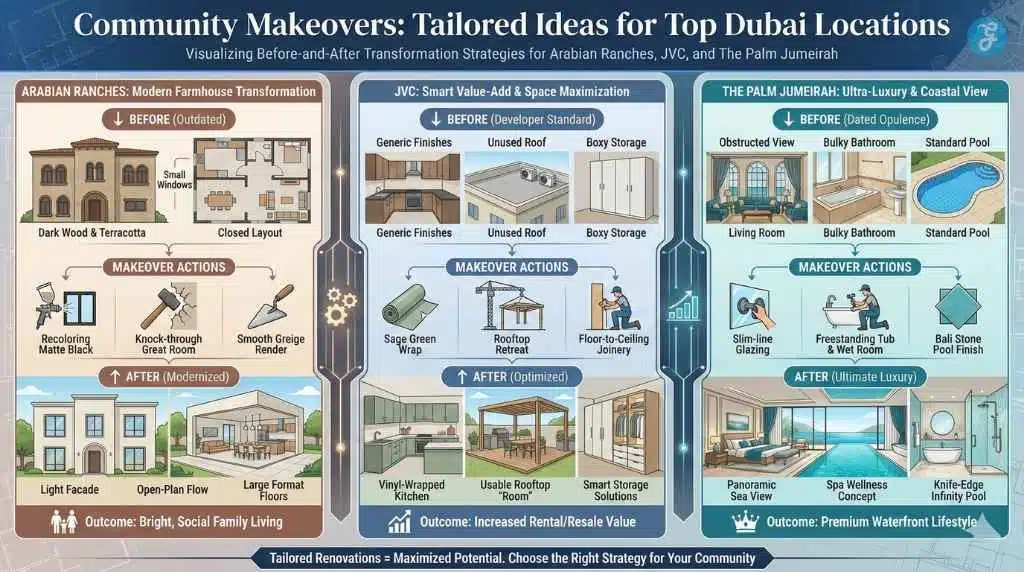
Renovation in Dubai is not “one size fits all.” What adds value in a Palm Jumeirah Signature Villa might be overcapitalization in a JVC townhouse. Here is a breakdown of how to approach the city’s most popular communities.
1. Arabian Ranches: The “Modern Farmhouse” Transformation
The older villas here (Saheel, Savannah, Mirador) are fantastic structurally but often suffer from dark interiors and small, compartmentalized rooms. The current trend is the Modern Farmhouse aesthetic.
-
The Facade: Owners are moving away from the earthy terracotta exterior. The winning formula is smoothing the textured render and painting it a warm Off-White or Greige. Crucially, the dark brown aluminium window frames are being spray-painted Matte Black or Anthracite Grey for a sharp, contemporary contrast.
-
The “Great Room”: A major structural change involves knocking through the wall separating the kitchen from the formal dining room. This creates one massive, social family space.
-
Flooring: Rip out the glossy beige square tiles. Replace them with large-format matte porcelain (120x120cm) or wood-effect herringbone tiles to instantly modernize the feel.
2. JVC (Jumeirah Village Circle): Smart Value-Add
In JVC, space is at a premium. The goal is to maximize every square foot and elevate the “developer standard” finishes to something bespoke.
-
Kitchen Wrapping: You don’t always need a full rip-out. High-quality architectural vinyl wrapping in Sage Green or Navy Blue over existing cabinets is a cost-effective trend. Pair this with a new quartz countertop overlay for a brand-new look at 30% of the price.
-
Rooftop Retreats: Many JVC townhouses have unused flat roofs. Installing lightweight aluminum pergolas with outdoor BBQ stations effectively adds an entire extra “room” to the property, massively boosting rental appeal.
-
Custom Joinery: Combat boxy layouts with floor-to-ceiling built-in wardrobes that use fluted paneling. This adds texture and sound-dampening while hiding clutter.
3. The Palm Jumeirah: Ultra-Luxury & Views
For Garden Homes and Signature Villas, the renovation focus is almost entirely on the water connection.
-
Slim-Line Glazing: The standard sliding doors are being replaced with “invisible frame” systems (like Cortizo or Schuco). These floor-to-ceiling glass walls disappear into pockets, merging the indoor lounge with the beach.
-
Spa Bathrooms: Bathrooms are being expanded into “Wet Rooms.” Think freestanding stone bathtubs, rainfall sky-showers, and “book-matched” marble slabs on the walls.
-
Infinity Pools: The old kidney-shaped blue-tiled pools are out. The upgrade is a knife-edge infinity pool finished with Green Sukabumi stone. This Balinese stone turns the water a deep turquoise, matching the sea much better than artificial blue tiles.
Future-Proofing: Smart Tech & Sustainable Luxury
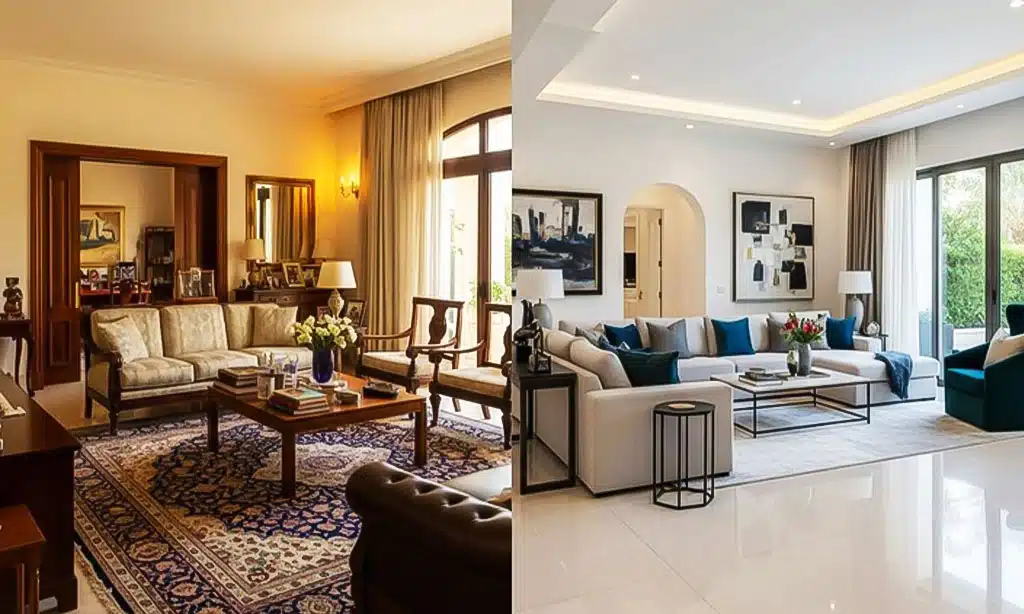
A truly modern renovation in Dubai goes beyond aesthetics; it upgrades the property’s “brain” and “lungs.” In 2025, buyers are actively asking for sustainable features that lower DEWA bills and smart systems that offer genuine convenience.
The “Invisible” Eco-Upgrades
-
Thermal Breaks & E-Coating: When replacing windows, standard double glazing isn’t enough. We are seeing a surge in thermally broken aluminium frames combined with Low-E (low emissivity) glass. This technology reflects Dubai’s harsh UV radiation while keeping cool air trapped inside, potentially lowering cooling loads by 30%.
-
Greywater Recycling: For villas with large gardens (especially in Arabian Ranches and The Villa), installing a simple greywater system to recycle shower and sink water for irrigation is becoming a key selling point.
-
Xeriscaping (Drought-Tolerant Landscaping): The days of water-guzzling English grass lawns are fading. The trend is Xeriscaping—using native plants like Ghaf trees, Bougainvillea, and Pennisetum grasses that thrive in the desert heat with minimal water, paired with composite decking or travertine pavers.
Connected Living 2.0
Home automation has graduated from “gadgets” to “infrastructure.
-
The “Matter” Standard: Ensure your smart home integrator uses devices compatible with Matter. This is the new universal language of smart homes, ensuring your Google, Apple, and Amazon devices all talk to each other seamlessly without expensive proprietary bridges.
-
Smart AC Management: Installing smart thermostats (like Nest or Ecobee) is standard, but the pro move is adding Occupancy Sensors. These shut off ACs in empty guest rooms automatically, preventing the dreaded “AED 4,000 summer bill shock.”
The Economics: Costs vs. ROI
Understanding the financial breakdown is critical. Below is a guide to estimated costs and the potential return you can expect.
| Renovation Tier | Estimated Cost (AED) | Scope of Work | Expected ROI |
| Cosmetic Refresh | 150,000 – 300,000 | Vinyl wrapping, painting, new lighting, bathroom overlay. | High (Quick rental boost) |
| Mid-Range | 400,000 – 750,000 | New flooring, full kitchen replacement, 1-2 wall knock-throughs. | Moderate to High (Resale value) |
| Luxury Overhaul | 800,000 – 2,500,000+ | Structural extensions, slim-line glazing, smart home systems, and landscaping. | Medium (Lifestyle & Premium Resale) |
Pro Tip: Kitchens and bathrooms offer the highest ROI, often recovering 75-80% of their cost upon resale. Conversely, over-customized features like home cinemas or distinctively colored mosaic tiles can sometimes limit your buyer pool.
You cannot simply start swinging a sledgehammer. Dubai has strict regulations to ensure structural safety.
The Authority Matrix
-
Dubai Municipality (DM): Generally covers freehold areas like Arabian Ranches, Dubai Hills, and JVC.
-
Trakhees: The regulatory arm for ports and customs zones, specifically governing Palm Jumeirah and Jumeirah Islands.
-
DDA (Dubai Development Authority): typically for free zones.
The Permit Checklist
-
NOC (No Objection Certificate): Before going to the government, you need approval from the master developer (e.g., Emaar, Nakheel, or Damac). They will check that your design fits the community guidelines.
-
Structural Engineer Report: If you are removing a wall, a licensed engineer must calculate the load and propose beam reinforcements.
-
Contractor Approval: Ensure your contractor is licensed for the specific type of work. A decor license cannot approve structural changes.
5 Common Renovation Mistakes to Avoid in Dubai
Renovating in the UAE comes with unique challenges driven by the climate and specific regulations. Avoiding these common errors can save you tens of thousands of Dirhams.
1. Ignoring the “AC Load” Calculation
The Mistake: Knocking down walls to create an open-plan layout without upgrading the AC unit. The Reality: A single AC unit designed for a closed living room cannot cool a massive open-plan “Great Room” + Kitchen. The Fix: Always have an HVAC engineer recalculate the “cooling load” (BTUs) before you start. You may need to upgrade your ducted split unit or add a “linear slot diffuser” to ensure even cooling.
2. Choosing “European” Wood for Exterior Doors
The Mistake: Installing solid oak or pine front doors imported from Europe. The Reality: The extreme humidity shift between Dubai summers and AC-cooled interiors will cause solid wood to warp, crack, and swell within one season. The Fix: Use Accoya wood (treated timber) or high-quality wood-effect aluminium or composite doors. They look identical to timber but are impervious to the UAE sun.
3. Underestimating the “approval Timeline”
The Mistake: Booking contractors to start the day after you sign the design. The Reality: Approvals from developers (like Nakheel or Emaar) can take 5-10 working days, and Dubai Municipality (DM) permits can take another 1-2 weeks, depending on the complexity. The Fix: Build a 4-week buffer into your schedule purely for paperwork before a single hammer is swung.
4. Skimping on Waterproofing in “Wet Rooms”
The Mistake: Using standard grouting in new walk-in showers. The Reality: Buildings in Dubai settle over time. Standard grout cracks easily, leading to silent leaks that destroy ceilings on the floor below. The Fix: Insist on Epoxy Grout and a “tanking system” (a waterproof membrane layer) under the tiles. It costs 20% more but prevents 100% of leaks.
5. The “White Grout” Trap
The Mistake: Using white grout on floor tiles in the main living areas. The Reality: Fine desert dust is ubiquitous in Dubai. White grout will turn a dirty grey within six months, no matter how much you clean. The Fix: Always choose a light grey or beige grout (specifically “Greige”) that camouflages dust. If you must have white, use stain-proof Epoxy grout.
Frequently Asked Questions (FAQ)
1. Do I need a permit for bathroom renovation in Dubai?
If you are just changing tiles and sanitary ware (taps/toilets) in the same location, you generally do not need a Dubai Municipality permit. However, if you are moving plumbing points or demolishing walls to expand the bathroom, a permit is mandatory. Always check with your developer for an NOC regardless of the scope.
2. How long does a full villa renovation take?
A cosmetic refresh (wrapping, painting, flooring overlay) takes 4-6 weeks. A full structural renovation (new layout, new glazing, extensions) typically takes 4-6 months, including the time needed for approvals and material procurement.
3. What is the most expensive part of a villa renovation?
Usually, it is the glazing and joinery. High-quality, slim-profile sliding doors and custom-built kitchens/wardrobes can consume 40-50% of your total budget. However, these are also the elements that add the most “wow factor” and value.
4. Can I add an extra room to my villa?
Yes, extensions are possible but strictly regulated. You must adhere to the plot’s FAR (Floor Area Ratio) and setbacks (distance from the boundary wall). You will need full structural drawings and approvals from both the developer (e.g., Emaar) and the municipality.
5. Is micro-cement good for Dubai villas?
Yes, micro-cement is trending heavily because it creates a seamless, grout-free look that makes rooms feel larger. It is durable and works well with underfloor cooling systems, making it a practical choice for the UAE climate.
The Final Verdict: Investing in Your Lifestyle
Embarking on a Villa Renovation in Dubai is more than a construction project; it is a reinvention of how you live. Whether your goal is to capitalize on the property market’s high premiums for turnkey homes or simply to create a personal sanctuary, the secret lies in balancing modern aesthetics with functional longevity.
A successful makeover isn’t defined just by the visual transformation, but by meticulous planning and respecting the unique UAE climate. By prioritizing quality materials—like thermal glazing and durable joinery—over quick cosmetic fixes, you are doing more than updating a house; you are future-proofing a high-value asset. The construction dust will eventually settle, but the comfort, joy, and equity you create today will serve you for years to come.