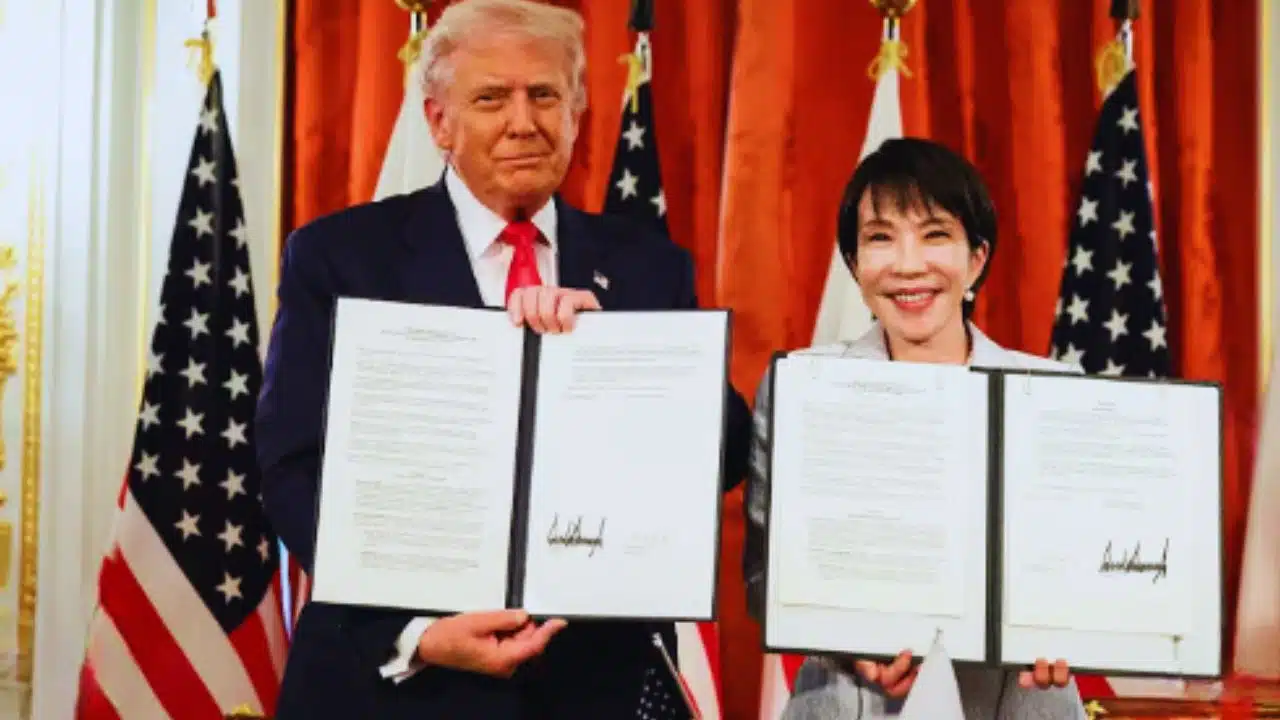
The United States and Japan signed a landmark Memorandum of Cooperation (MOC) on rare earth minerals Monday, a strategic pact aimed squarely at breaking China’s overwhelming dominance of the critical supply chain.
The deal, finalized between U.S. Energy Secretary Jennifer Granholm and Japanese Minister of Economy, Trade and Industry (METI) Ken Saito, was lauded by Japan’s Economic Security Minister Sanae Takaichi on Tuesday as a pillar of a new “golden age” in bilateral ties, signaling a major push by the allies to “de-risk” their economies from geopolitical rivals.
The Rare Earths Agreement
- What Happened: The U.S. Department of Energy (DOE) and Japan’s METI signed a Memorandum of Cooperation (MOC) on Rare Earth Element (REE) supply chains on October 27, 2025.
- The Core Goal: To reduce strategic dependence on China by jointly developing, financing, and securing a “mine-to-magnet” supply chain through allied and domestic sources.
- Why It Matters (Data): China currently controls approximately 70% of global REE mining and a staggering 85-90% of the complex processing stage, giving it a chokehold on materials vital for defense, electric vehicles (EVs), and green technology.
- Key Provisions: The pact focuses on joint R&D, coordinating public/private financing for new mines and processing plants, and establishing high Environmental, Social, and Governance (ESG) standards for a non-Chinese market.
- Official View: Japan’s Economic Security Minister Sanae Takaichi praised the deal, stating the U.S.-Japan relationship is in a “golden age” of economic and national security cooperation.
The ‘Golden Age’ Pact: A New Front in Supply Chain Security
The agreement solidifies a critical objective for both Washington and Tokyo: securing the raw materials that power the 21st-century economy. The phrase “US, Japan sign rare earths deal” marks more than a simple trade understanding; it represents a formal strategic alignment to build a parallel, secure, and stable supply chain for the 17 metallic elements crucial for high-performance magnets.
These magnets are indispensable components in everything from F-35 fighter jets and wind turbines to the motors in nearly every electric vehicle.
The deal was formalized in bilateral meetings held in advance of the upcoming Asia-Pacific Economic Cooperation (APEC) summit. In Tokyo, Minister Takaichi, a prominent figure in Japan’s push for economic sovereignty, did not mince words.
“Speaking to reporters in Tokyo on Tuesday (Oct 28, 2025), Economic Security Minister Sanae Takaichi stated the pact solidifies a ‘golden age’ of bilateral cooperation, crucial for ‘de-risking our economies from over-reliance on specific countries for materials vital to our future.'”
This “over-reliance” is a direct reference to the People’s Republic of China (PRC), which has demonstrated its willingness to use its market dominance as a political weapon. In 2010, China infamously halted REE exports to Japan during a territorial dispute over the Senkaku/Diaoyu islands, sending shockwaves through Japanese industry. That memory is the primary ghost haunting policymakers in Tokyo, and this deal is their most direct attempt to exorcise it.
Data Deep Dive: The Scale of China’s Dominance
To understand the urgency behind the MOC, one must look at the numbers. China’s control over the REE market is not just substantial; it is systemic, covering every stage from mining to the final high-value product.
The Bottleneck: Mining vs Processing
While China’s share of mining has recently decreased from its peak of over 90%, it remains the world’s primary producer.
Global Rare Earth Element (REE) Mine Production — Estimated 2024
| Country / Region | Production (tonnes) | Share of Global Total |
|---|---|---|
| China | 230,000 | ~70% |
| United States | 40,000 | ~12% |
| Australia | 18,000 | ~5% |
| Myanmar | 15,000 | ~4.5% |
| Rest of World | 24,000 | ~8.5% |
| Global Total | 327,000 | 100% |
However, the real strategic chokehold is not in mining; it is in processing.
Extracting REEs from ore is relatively simple. Separating them into high-purity individual elements (like neodymium and dysprosium) is a complex, capital-intensive, and environmentally hazardous process.
- Mid-Stream Processing: China controls an estimated 85-90% of the global capacity for separating REEs into oxides. Western mining companies, including the largest U.S. producer, MP Materials, must still send most of their mined concentrate to China for this vital step.
- Downstream Manufacturing: The control extends to the final, high-value product. China produces over 90% of the world’s high-performance neodymium-iron-boron (NdFeB) permanent magnets, the type most sought after for EV motors and defense applications.
This deal aims to build a non-Chinese supply chain for both processing and magnet manufacturing, a task experts warn is monumental.
Inside the Agreement: What Did Tokyo and Washington Commit To?
While the full text of the MOC has not been released, officials have outlined its three main pillars. This is not about tariffs or quotas, but about building an industry from the ground up.
1. Joint Research & Development
A significant portion of the agreement focuses on technology. The U.S. Department of Energy (DOE), through its national labs like Ames Laboratory, will coordinate with Japan’s National Institute of Advanced Industrial Science and Technology (AIST).
The goals are twofold:
- Find ways to reduce the use of the heaviest, most expensive REEs (like dysprosium and terbium) in magnet production.
- Develop more efficient and environmentally friendly methods for extracting and recycling REEs from existing products (known as “urban mining”).
2. Coordinated Financing and Investment
This is the financial muscle of the deal. Building a new REE processing plant can cost over a billion dollars and take years to permit and construct. Private industry has been hesitant to compete with China’s state-subsidized prices.
The MOC signals that public institutions—like the U.S. International Development Finance Corporation (DFC) and the Japan Organization for Metals and Energy Security (JOGMEC)—will provide loans, grants, and offtake agreements to “de-risk” these massive investments. The targets are projects not just domestically, but in “friend-shoring” locations like Australia, Canada, and potentially Vietnam.
3. Setting ‘Clean’ Standards
This is the deal’s subtle geopolitical move. The U.S. and Japan will collaborate on setting high Environmental, Social, and Governance (ESG) standards for the entire REE supply chain. This is a direct challenge to China, whose REE industry has a long-documented history of severe environmental pollution and poor labor practices.
By creating a “premium” market for REEs certified as “clean” and “secure,” the allies hope to attract ESG-conscious companies (like automakers) and justify the higher cost of non-Chinese production.
Voices: Experts and Industry React
The reaction to the deal has been one of cautious optimism, with experts warning that success is far from guaranteed.
According to analysis from Dr. David S. Cohen at the Brookings Institution, the MOC is a ‘necessary strategic realignment’ but not a ‘silver bullet,'” a recent report states. He notes that ‘building a complete mine-to-magnet supply chain outside of China could take a decade and cost hundreds of billions. The real test will be whether public financing can successfully mobilize the massive private capital required.’
The urgency, however, is palpable within the industry. The 2010 crisis is fresh in the minds of Japanese manufacturers.
The urgency is felt on the factory floor,” an executive at a major Japanese magnet manufacturer in Gunma Prefecture, speaking anonymously to Asahi Shimbun last week, warned. Any supply disruption from China could halt our EV motor production lines within weeks. We are desperate for diversification.”
What to Watch Next: Hurdles and Timelines
This MOC is a starting gun, not a finish line. The key developments to watch over the next 12-24 months are:
- China’s Reaction: Beijing will not ignore this. China has already placed export controls on gallium and germanium and has threatened the same for REE processing technology. Any retaliatory measures could spike mineral prices and test the allies’ resolve.
- First Project Announcements: The market will be looking for the first major joint venture. Will a U.S. miner like MP Materials secure a major financing deal with Japanese partners (like Sumitomo or Mitsubishi) to build a U.S.-based heavy REE separation plant?
- The “Friends” in “Friend-shoring”: How quickly can Australia, Canada, and others ramp up production? Australia’s Lynas Rare Earths is the only significant non-Chinese processor, and its capacity is a fraction of China’s. This deal must incentivize new players to enter the market.
- Political Will: This is a 10-to-15-year strategy. It will require sustained political and financial commitment, even if (or when) REE prices drop, and through changes in political administrations in both Washington and Tokyo.
This agreement is, at its core, a long-term strategic hedge. It’s an admission that the era of purely cost-based, globalized supply chains is over. For the U.S. and Japan, the “golden age” Takaichi speaks of is one forged in shared anxiety over strategic vulnerabilities—and this rare earths pact is their billion-dollar insurance policy.
The Information is Collected from France 24 and BBC.