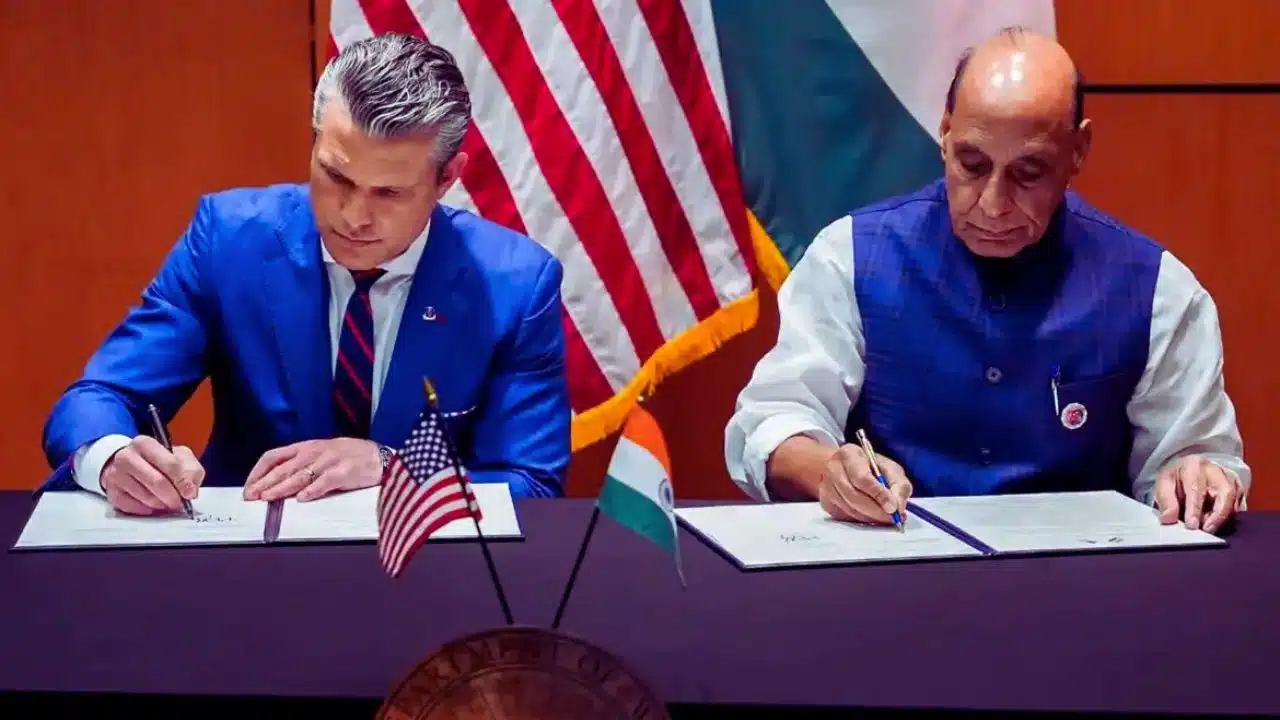
The US India 10-year defence pact was signed in Kuala Lumpur in late October 2025, setting a long-term roadmap to expand operational coordination, information sharing, and defence technology cooperation through the next decade.
A decade-long framework, renewed again
India’s Defence Minister Rajnath Singh and U.S. Defense Secretary Pete Hegseth signed the “Framework for the U.S.-India Major Defense Partnership,” described by both sides as a policy-direction document meant to guide the relationship for the next 10 years.
A U.S. fact sheet describes the Framework as the defining document in the bilateral defence relationship and notes that it is renewed every ten years.
India’s government said the updated framework is intended to usher in a new era in an already strong defence partnership and reflects growing strategic convergence.
What the pact aims to change on the ground
The U.S. fact sheet says the 2025 Framework is guided by the February 13, 2025 joint statement issued after talks between President Donald Trump and Prime Minister Narendra Modi.
That joint statement set a direction to expand defence sales and co-production to strengthen interoperability and industrial cooperation—signaling that future defence ties are expected to go beyond a buyer-seller model.
The U.S. fact sheet also says the 2025 Framework supersedes the 2023 U.S.-India Roadmap for Defense Industrial Cooperation, pointing to a refreshed structure for implementation.
Priorities highlighted publicly
According to the U.S. fact sheet, key priorities under the 2025 Framework include operational coordination, bolstering defence industrial capacity/resilience/innovation through advanced technology cooperation, and defeating terrorism and violent extremism.
India’s government said the agreement supports a shared goal of a free, open, and rules-based Indo-Pacific, framing the defence partnership as part of wider regional stability efforts.
Defence industry: co-production and supply chains
The February 2025 India-U.S. joint statement says the two countries planned to pursue new procurements and co-production arrangements for Javelin anti-tank guided missiles and Stryker infantry combat vehicles in India.
The same joint statement also says India expected completion of procurement for six additional P-8I maritime patrol aircraft, aimed at enhancing maritime surveillance reach in the Indian Ocean Region.
These publicly stated plans align with the Framework’s emphasis on industrial capacity and advanced technology cooperation.
Announced India-U.S. defence tracks (publicly stated)
| Track | What was stated publicly | Where it was stated |
| Co-production (planned) | Pursue new procurements and co-production arrangements for “Javelin” and “Stryker” in India. | India’s Ministry of External Affairs joint statement (Feb 2025). |
| Aircraft procurement (expected) | Expect completion of procurement for six additional P-8I aircraft. | India’s Ministry of External Affairs joint statement (Feb 2025). |
| Policy reset (framework) | The 2025 Framework supersedes the 2023 industrial roadmap and sets a unified policy direction for the next decade. | U.S. fact sheet (media.defense.gov PDF). |
Why the timing matters for both capitals
India’s government described the 10-year framework as a signal of strategic convergence and positioned defence as a major pillar of the bilateral relationship.
The U.S. fact sheet presents the Framework as an instrument to deepen cooperation and strengthen interoperability, linking it to deterrence and conflict prevention.
Taken together with the February 2025 joint statement’s push for co-production and expanded sales, the updated Framework suggests both sides want more predictable defence cooperation that can survive short-term political or market friction.
Bigger context: trade, manufacturing, and capability-building
A policy analysis from ORF America notes estimates that since 2008 India has bought nearly $20 billion worth of American-origin defence equipment, underscoring how large the defence trade channel has become.
On the Indian side, a government release said defence exports reached a record Rs 23,622 crore (about US$ 2.76 billion) in FY 2024–25, highlighting India’s push to expand domestic production and export capacity.
That same release reported the private sector contributed Rs 15,233 crore and defence public sector undertakings contributed Rs 8,389 crore to FY 2024–25 defence exports—figures that help explain why co-production, maintenance, and supply-chain linkages are increasingly central to India’s defence diplomacy.
Key figures often cited in policy discussions
| Indicator | Latest stated figure | Source |
| India defence exports (FY 2024–25) | Rs 23,622 crore (~US$ 2.76 billion). | Government of India press release. |
| Split of India defence exports (FY 2024–25) | Private sector: Rs 15,233 crore; DPSUs: Rs 8,389 crore. | Government of India press release. |
| Estimated U.S.-origin defence buys by India since 2008 | Nearly $20 billion (estimate). | ORF America analysis. |
Final thoughts
Implementation will matter more than announcements: the real test is whether the Framework accelerates joint projects, speeds up approvals, and expands routine operational coordination in measurable ways.
Another key indicator will be whether defence-industrial cooperation becomes more institutionalized through additional procurement or reciprocal market-access arrangements discussed in policy circles.
For readers tracking Indo-Pacific security, the clearest near-term signals will come from follow-on working-level engagements tied to industrial projects and information-sharing mechanisms that the Framework explicitly prioritizes.