Remote work is no longer a pandemic experiment. It has become a stable part of the US labor market.
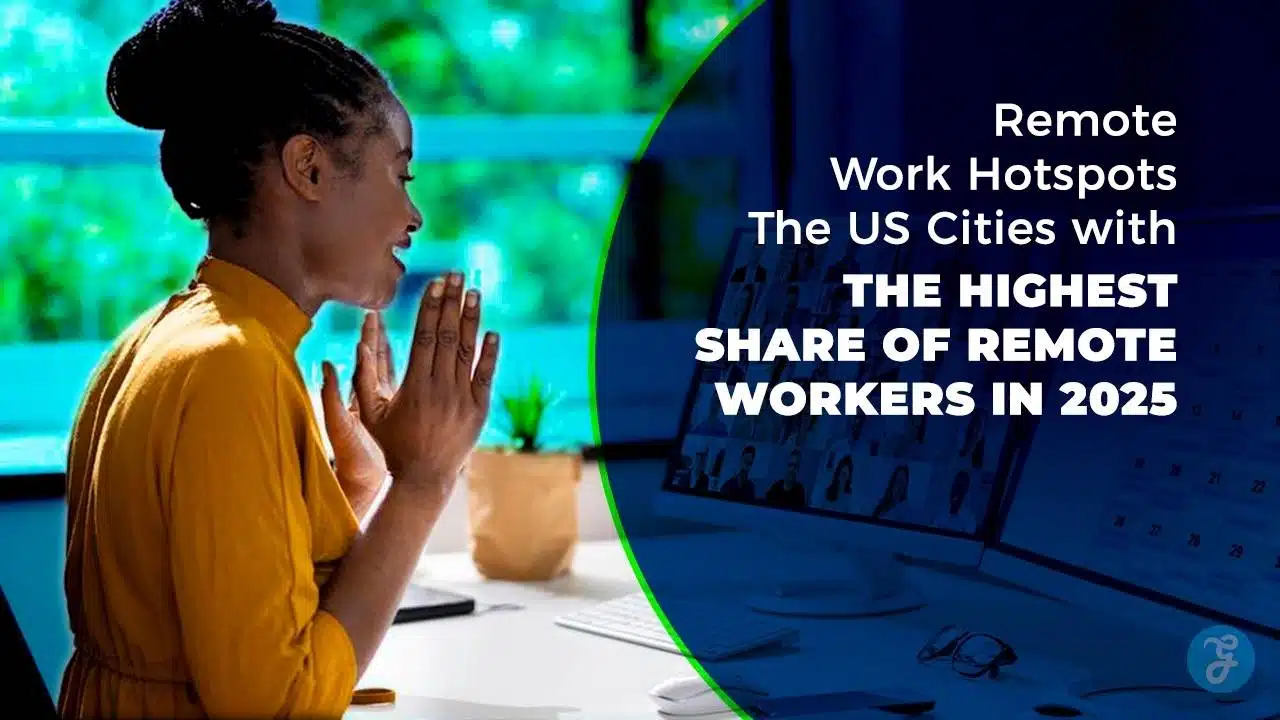
Millions of Americans now work from home full-time or in some hybrid form. Yet this shift is not spread evenly across the country. Some places have embraced remote work so strongly that nearly one in three workers rarely step into a traditional office.
These US cities with the highest share of remote workers are more than just convenient places for laptop workers. They are becoming key remote work hotspots in the US, shaping everything from housing demand and office vacancy to local tax bases and talent flows.
For a global audience, these patterns matter. They reveal where high-value knowledge jobs cluster, how digital infrastructure drives opportunity, and which urban models might influence cities across Europe, Asia-Pacific, and beyond.
To build a clear, data-driven picture, we rely on the latest available figures from large national surveys that track how people usually get to work.

A few key points about the methodology:
- Remote worker definition: In this context, “remote workers” are people who say they usually work from home. That means their primary work location is their home, not just an occasional day away from the office.
- Share of remote workers: The rankings look at the percentage of employed residents in each city who usually work from home. This makes it easy to compare cities of different sizes.
- City, not metro area: The focus here is city-level data, not entire metropolitan regions. Metro areas often include dozens of suburbs and exurbs. City-level figures show where remote work is embedded in daily life.
- Timeframe: The ranking reflects the latest full-year data available, which captures the post-pandemic stabilization of remote and hybrid work patterns. It aligns with 2023 American Community Survey-style work-from-home metrics and 2024 remote work data analysis.
There are limitations. Hybrid workers who split their week between home and an office are not always fully captured. Some corporate return-to-office mandates are still evolving. But the data is strong enough to show which US cities with the most remote workers stand out today.
Nationally, roughly one in seven workers primarily work from home, and around one in four has some remote component. Against that backdrop, the top cities look like clear outliers.
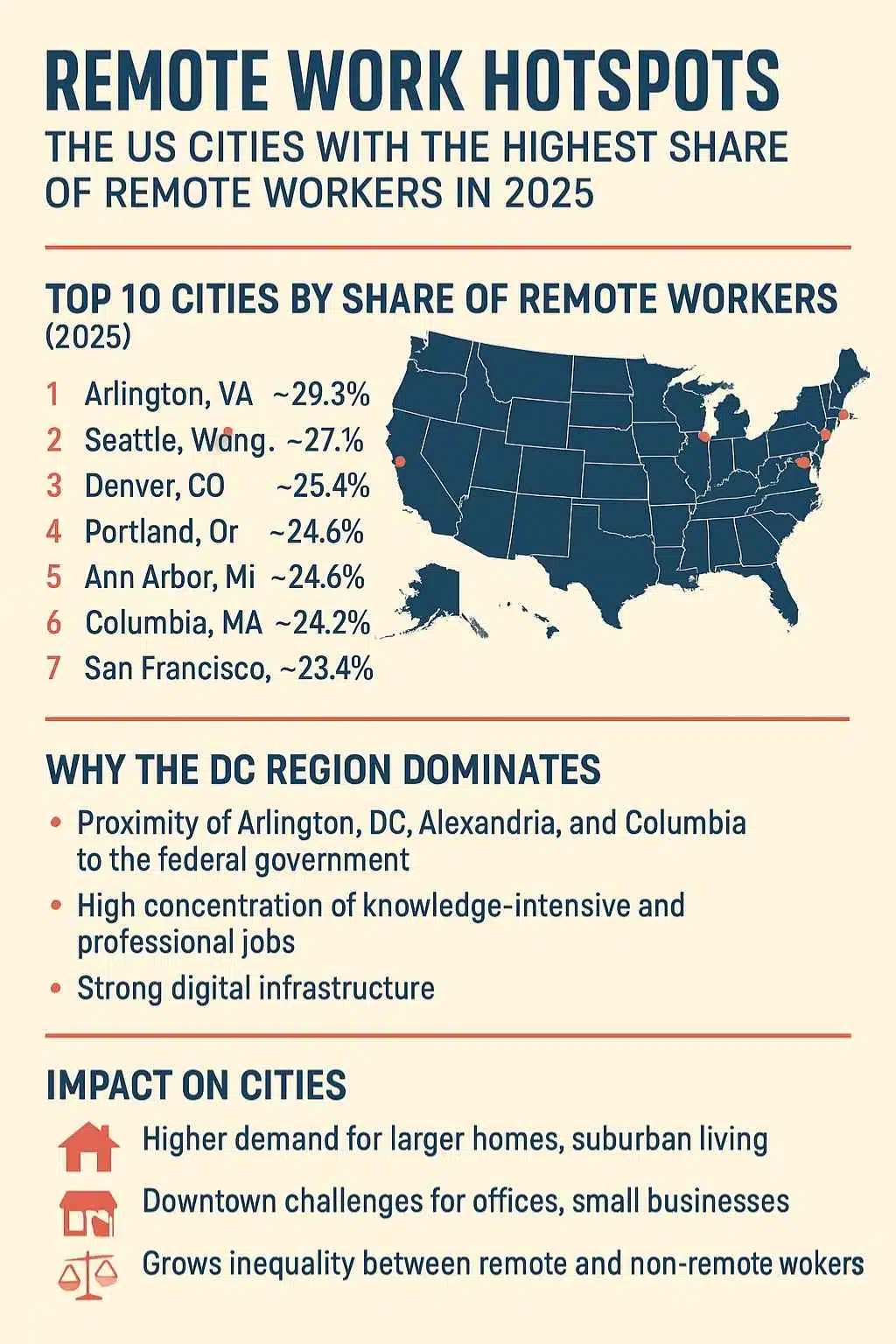
Here is a snapshot of the leading remote work hotspots in the US, ranked by the share of workers who usually work from home.
- Arlington, Virginia – ~29.3% remote
- Seattle, Washington – ~28.6% remote
- Washington, DC – ~27.1% remote
- Denver, Colorado – ~26.2% remote
- Portland, Oregon – ~25.4% remote
- Ann Arbor, Michigan – ~24.6% remote
- Pasadena, California – ~24.6% remote
- Columbia, Maryland – ~24.4% remote
- Alexandria, Virginia – ~24.2% remote
- San Francisco, California – ~23.4% remote
Even within this group, you can see distinct patterns:
- The Washington, DC region dominates the list with Arlington, DC itself, Alexandria, and Columbia.
- Tech and innovation hubs like Seattle, Denver, Portland, and San Francisco rank high thanks to their concentration of digital and professional services jobs.
- Knowledge and university cities such as Ann Arbor and Pasadena show that research and education centres have also become fertile ground for remote work.
Why the Washington, DC Region Dominates Remote Work
The nation’s capital and its surrounding cities form one of the most remote-friendly labour markets in the US. Government, consulting, and high-skill professional services have all leaned into flexible work models.
Arlington, Virginia: America’s Remote Work Capital
Arlington currently sits at the top of the list, with close to three in ten workers usually working from home.
Several factors drive this:
- Proximity to the federal government: Many federal agencies, contractors, and policy organisations adopted telework policies during the pandemic and kept them in place, at least partially.
- High-skill, knowledge-intensive jobs: Arlington has a dense concentration of professional, scientific, and technical services. These roles are naturally compatible with remote work.
- Strong infrastructure and amenities: Reliable broadband, modern apartment stock, and access to transit make remote work practical and attractive.
The result is a city where remote work has become normal, not exceptional. Arlington illustrates how a mix of government, consulting, and tech can combine to create one of the US cities with the highest share of remote workers.
Washington, DC: The Federal Remote Work Lab
Washington, DC itself is not far behind, with more than one in four workers primarily working from home.
DC’s high remote-work share reflects:
- The large federal workforce, where telework rules have been under intense debate, but remain meaningful.
- A deep pool of highly educated professionals in law, policy, research, advocacy, and media.
- A labour market that can function effectively in a hybrid model, with staff only visiting offices for critical meetings and hearings.
At the same time, the shift has raised concerns for downtown shops, restaurants, and transit systems that depended on daily commuters.
Alexandria, Virginia, and Columbia, Maryland: Quiet Remote Strongholds
Alexandria and Columbia sit just outside the core of DC but share its economic base.
Both cities record around 24% of workers primarily working from home. They have become residential hubs for remote-friendly professionals who still want occasional access to offices, campuses, or capital-area institutions.
Their rise shows how smaller, liveable cities within a major metro can turn into remote work sweet spots.
They offer:
- Shorter trips for occasional office visits.
- Family-oriented neighbourhoods and good schools.
- A quieter alternative to high-priced, high-density downtowns.
Together, Arlington, DC, Alexandria, and Columbia form a powerful cluster of remote work hotspots in the US, anchored by government but increasingly diversified.
Tech and Innovation Corridors: Seattle, Denver, Portland, and San Francisco
Beyond the capital region, some of the most remote-heavy cities are classic tech and innovation hubs. These cities already had the digital infrastructure and job mix that made working from home viable long before 2020.
Seattle, Washington: Remote Work Meets Big Tech
Seattle ranks second in the country, with about 28.6% of workers usually working from home.
Why Seattle stands out:
- It is home to major technology companies and a large ecosystem of software, cloud, and gaming firms.
- Many of these employers have adopted hybrid or remote-first models, especially for engineering and knowledge roles.
- The workforce has high digital skills and high average incomes, which support home offices, co-working memberships, and flexible lifestyles.
Seattle shows how US cities with the most remote workers often overlap with long-established technology hubs.
Denver, Colorado: A Mountain Hub for Remote Talent
Denver sits in fourth place, with around 26.2% of workers primarily working from home.
Its strength as a remote work hub comes from a mix of factors:
- A growing tech and startup scene.
- Strong professional services, finance, and telecom sectors.
- A lifestyle appeal built around outdoor recreation and a more relaxed urban experience.
Denver has also attracted remote workers moving from higher-cost cities. For many knowledge workers, it offers a balance of modern infrastructure and access to nature. This makes it a prime example of how remote work trends reshape internal migration within the US.
Portland, Oregon: Creative and Flexible
Portland’s remote-work share is about 25.4%, placing it firmly in the top tier.
The city has long been known for its creative industries, progressive policies, and experimentation around urban living. That culture translates well into flexible work models.
At the same time, Portland faces challenges:
- Downtown storefront vacancies.
- Public debates over safety and public space.
- The need to redefine the role of the city centre when a quarter of its workers rarely commute.
Portland represents a broader question many cities now face: how do you support a high level of work from home while keeping urban cores vibrant?
San Francisco, California: An Iconic Tech City in Transition
San Francisco rounds out the top ten, with around 23.4% of workers usually working from home.
The city was once a symbol of dense, office-centric commuting culture, especially in tech.
Now, it is a global case study in:
- How sustained remote and hybrid work affects office valuations.
- What happens to downtown when foot traffic drops?
- How local governments respond to a smaller daily workforce.
Despite pressure from some employers to bring staff back, San Francisco remains one of the US cities with the highest share of remote workers. The big question is whether this is a permanent shift or a long adjustment phase.
Knowledge and University Hubs: Ann Arbor and Pasadena
Not all remote-work hubs are big tech cities or political capitals. University towns and research centres also feature prominently.
Ann Arbor, Michigan: A University City Goes Remote
Ann Arbor, home to the University of Michigan, has a remote-work share of around 24.6%.
Key drivers include:
- A high concentration of education, research, healthcare, and tech jobs.
- Knowledge workers whose tasks can often be done remotely or in flexible formats.
- A culture that already embraces digital tools and online collaboration.
Ann Arbor illustrates how university cities can become remote work hubs by blending research, innovation, and digital-friendly employment.
Pasadena, California: A High-Skill Suburb Turned Remote Hub
Pasadena, in the Los Angeles region, matches Ann Arbor’s remote share at about 24.6%.

It benefits from:
- Proximity to Los Angeles, with access to media, entertainment, and tech ecosystems.
- It’s own cluster of research institutions, engineering firms, and design studios.
- A smaller-city feel with established neighbourhoods and cultural venues.
Pasadena shows how high-skill suburbs can transform into remote work hotspots when workers no longer need to commute daily into a big city.
The rise of these US cities with the highest share of remote workers has deep consequences for urban planning, real estate, and social equity.
Housing Markets and Cost of Living
Remote workers often seek:
- Larger homes or extra rooms for home offices.
- Neighbourhoods with quiet streets, good schools, and reliable internet.
- Access to parks, cafés, and “third places” where they can occasionally work.
In attractive remote work hubs, this can push up rents and property prices. Long-time residents may find it harder to compete with higher-earning remote professionals arriving from more expensive cities.
As a result:
- Some cities are seeing increased demand in residential areas that used to be considered “commuter suburbs”.
- Debates over zoning reform, density, and housing supply have intensified.
- The balance between liveability and affordability has become a central political issue.
Downtowns, Small Businesses, and Commercial Real Estate
When a large share of workers stay home most days, downtowns feel the impact first.
- Fewer commuters mean less foot traffic for cafés, restaurants, gyms, and retail stores.
- Office towers see higher vacancy rates, especially in older buildings that are harder to adapt for hybrid work.
- Transit systems lose fare revenue, which can threaten service quality.
In response, some cities are exploring:
- Converting underused office space into housing, labs, or educational facilities.
- Encouraging co-working spaces and innovation hubs that provide occasional collaboration zones for remote teams.
- Using events, culture, and tourism to bring people back into central business districts.
Remote work does not necessarily kill downtowns, but it forces them to evolve.
Inequality and Access to Remote Work
Remote work is not available to everyone. It is heavily concentrated in sectors like tech, finance, professional services, education, and research.
Many workers in retail, hospitality, healthcare support, logistics, and manufacturing cannot work from home.
That raises several questions:
- Will remote-eligible workers continue to pull ahead in income, flexibility, and work-life balance?
- How can cities support non-remote workers with better pay, transit, and social protections?
- What role should training and digital skills play in helping more people access remote-friendly jobs?
As remote work trends mature, the gap between those who can work from home and those who cannot may become a major driver of inequality.
What It Means for Workers, Employers, and Policymakers
The US cities with the most remote workers do not only matter for statistics. They shape real decisions for individuals and organisations.
For Remote and Hybrid Workers
If you work remotely, these rankings help you understand:
- Where remote work is normalised and supported.
- Which cities offer strong digital infrastructure and peer networks of other remote professionals?
- Where the cost of living may trade off against flexibility and income.
Practical considerations include:
- Internet quality and reliability.
- Local costs for housing, childcare, healthcare, and transport.
- Time zone alignment with clients or employers.
For global workers collaborating with US teams, these cities often act as key nodes in distributed organisations.
For Employers
Companies designing remote or hybrid models can:
- Use these work-from-home statistics by city to understand where remote talent clusters naturally.
- Consider hub-and-spoke models with small collaboration spaces in high-remote cities instead of large central offices.
- Experiment with benefits such as home-office stipends, co-working access, or travel budgets for periodic team meet-ups.
Employers can also look beyond the obvious hubs. Cities with moderate remote-work shares may offer access to skilled workers with less competition and lower costs.
For City Leaders and Urban Planners
Policymakers face a complex balancing act:
- Support the growing population of remote workers with good broadband, co-working spaces, and safe public areas where people can work.
- Revitalise downtowns by diversifying beyond 9-to-5 office use, adding housing, education, arts, and nightlife.
- Invest in digital inclusion so that remote opportunities do not only go to already-privileged groups.
Cities that treat remote work as a permanent structural shift, rather than a temporary anomaly, are more likely to remain competitive.
Methodology Notes and How Rankings Might Change
Remote work patterns are still evolving. While the current list reflects the latest stable data, several factors could reshape the rankings in the coming years.
- Corporate return-to-office policies: If large employers tighten attendance rules, some cities may see a decline in full-time remote workers, even if hybrid work remains common.
- Housing affordability: If prices rise too quickly in popular remote hubs, some workers may move to smaller cities and towns, distributing remote work more widely.
- Infrastructure and policy choices: Investments in broadband, transit, and mixed-use development can make new locations attractive for remote workers and remote-friendly employers.
New data from future surveys and research will show whether current leaders hold their positions or whether new remote work hotspots in the US emerge.
Bottom Line: Remote Work’s New Map of Urban America
Remote work has redrawn the economic map of the United States. The US cities with the highest share of remote workers—from Arlington and Seattle to Denver, Portland, Ann Arbor, Pasadena, and the DC suburbs—offer an early view of what a digitally anchored urban future might look like.
These cities show that:
- Knowledge-intensive sectors thrive in flexible, remote-friendly environments.
- Housing, downtown business models, and transit systems must adapt quickly.
- Inequality and access to remote-ready jobs are emerging as major policy challenges.
For workers, these remote-work hubs represent opportunity and choice. For employers, they are strategic talent pools. For city leaders, they are both a benchmark and a warning.
As remote and hybrid work matures, the geography of opportunity will keep shifting. But one thing is clear: the US cities with the most remote workers today are already shaping the future of work for the rest of the world.