Have you ever looked at the booming “green jobs” market and wondered exactly where you fit in? It is completely normal to feel a bit unsure about which skills matter most or where to start your training. You might want a career that helps the planet, but the path to getting there can sometimes feel unclear.
Here is the exciting part: you are stepping in at the perfect moment. Demand for green skills has jumped significantly as companies race to meet new energy and climate goals. This guide will walk you through exactly what the green economy is, why it is growing so fast, and the specific courses that can help you land one of these roles.
Grab a coffee and let’s explore the practical steps you can take to join this growing field.
What Is the Green Economy?
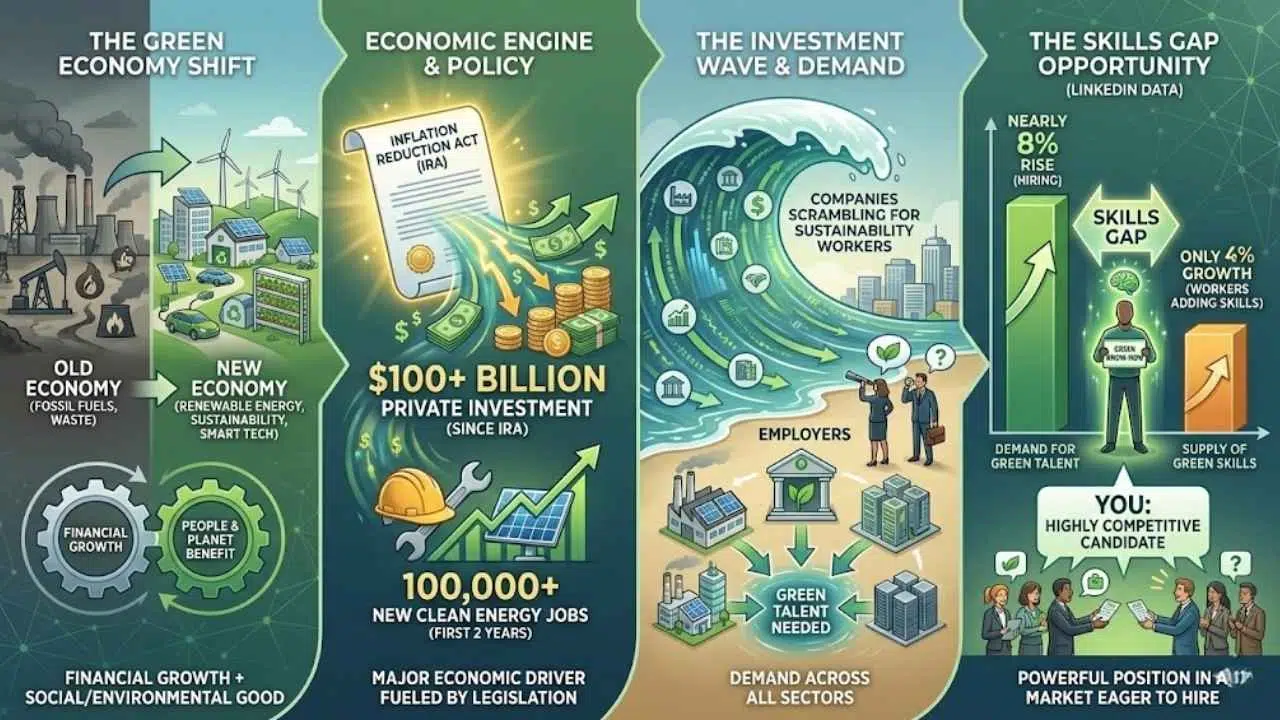
Think of the green economy as a new way of doing business where financial growth helps people and the planet rather than hurting them. It is driven by a massive shift in how we power our homes, build our cities, and manage our resources. Governments and companies are moving away from fossil fuels and toward renewable energy, waste reduction, and smarter technology.
This isn’t just a buzzword; it is a major economic engine fueled by legislation like the Inflation Reduction Act (IRA) in the United States. Since its passage, the IRA has sparked over $100 billion in private investment and created more than 100,000 new clean energy jobs in just its first two years. This wave of investment means that companies in every sector, from manufacturing to finance, are scrambling to find workers who understand sustainability.
The data backs this up. According to LinkedIn’s 2025 Global Green Skills Report, the demand for green talent is outpaced by supply. While green hiring rose by nearly 8%, the number of workers adding these skills to their profiles only grew by about 4%. This gap puts you in a powerful position. If you have the right know-how, you become a highly competitive candidate in a market where employers are eager to hire.
The Importance of Upskilling for the Green Economy
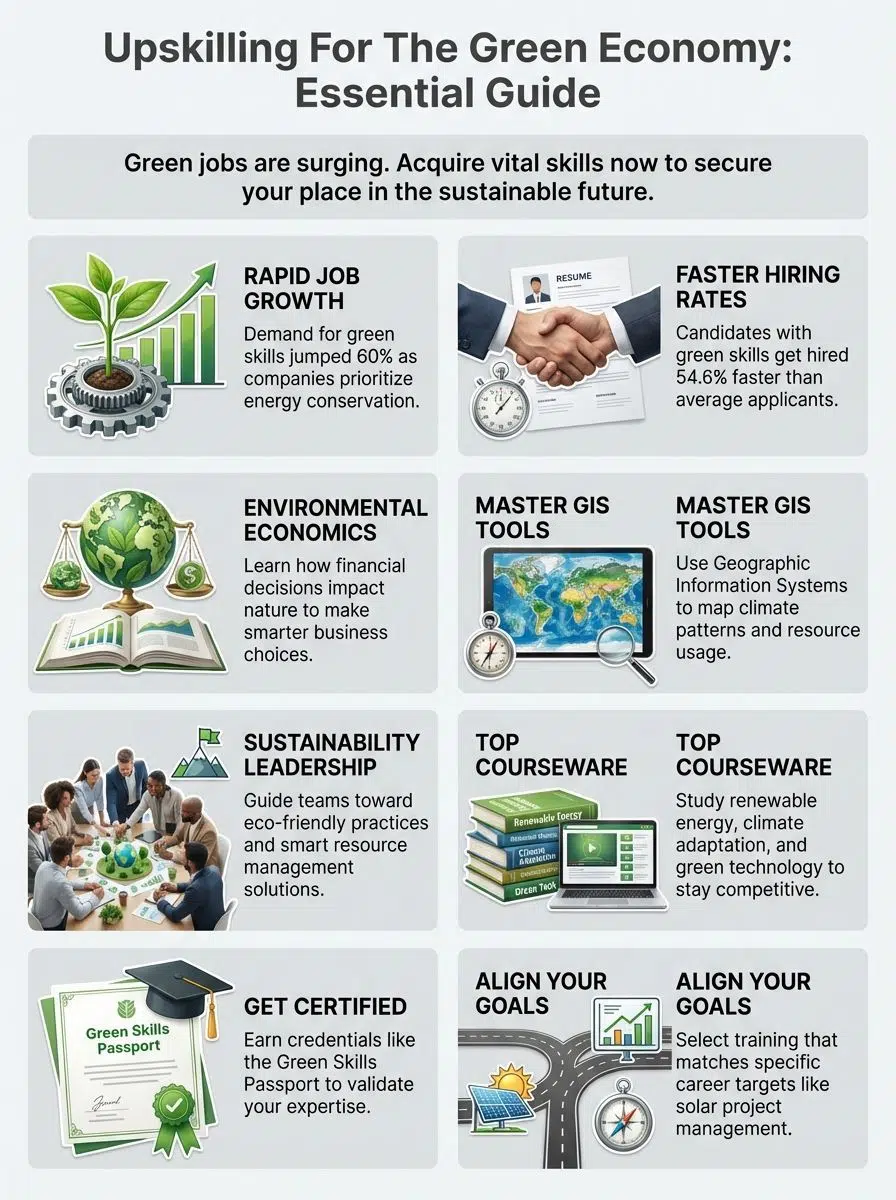
Green jobs are growing faster than the workforce can keep up, which creates a huge opportunity for you. Adding these specific skills to your resume does more than just help the environment; it future-proofs your career.
Addressing Climate Change and Sustainability Challenges
Climate change is reshaping industries in real time. The National Oceanic and Atmospheric Administration (NOAA) reported that the U.S. experienced a record number of billion-dollar weather disasters in recent years. This reality forces companies to rethink their operations to survive and thrive.
Businesses need employees who can help them reduce water waste, cut carbon emissions, and comply with new environmental laws. It is no longer just about “being good”; it is about business continuity. When you learn how to manage these risks, you become an essential asset to any team trying to navigate a changing climate.
Meeting the Demand for Green Jobs
The job market is hungry for qualified professionals. The Bureau of Labor Statistics (BLS) projects that wind turbine service technicians and solar photovoltaic installers will be the two fastest-growing occupations in the entire U.S. economy over the next decade, with growth rates hitting nearly 50%.
But it goes beyond installation roles. Companies need accountants who can track carbon credits, project managers for renewable energy sites, and data analysts who can measure efficiency. Workers with these green skills benefit from a hiring rate that is 54.6% higher than the average workforce. By upskilling now, you place yourself ahead of the curve in a market where two jobs might soon exist for every qualified worker.
Supporting Economic and Environmental Equity
The shift to a green economy also aims to fix long-standing fairness issues. Initiatives like the U.S. government’s Justice40 aim to deliver 40% of the overall benefits of certain federal investments to disadvantaged communities. This focus creates a specific demand for professionals who understand “environmental justice”—the idea that clean air and water should be available to everyone, regardless of zip code.
Training in this area helps ensure that new green technologies benefit all groups equally. Whether you are working in urban planning or public policy, having the skills to build an inclusive economy ensures that no one is left behind as we transition to a cleaner future.
Key Skills for a Green Economy
You need specific, actionable skills to grab these opportunities. Here are the core competencies that employers are actively seeking right now.
Environmental Economics
This skill involves understanding the financial value of natural resources. It moves beyond traditional accounting to include the “hidden” costs of pollution and resource depletion. Professionals in this field often use methods like Cost-Benefit Analysis (CBA) to help companies make smarter investment decisions.
For instance, a business analyst might use CBA to prove that installing solar panels isn’t just an expense, but a long-term savings strategy that protects against rising energy costs. Understanding these financial levers makes you incredibly valuable to executives who need to justify their sustainability budgets.
Sustainability Leadership
Companies need leaders who can turn goals into action. This goes beyond giving speeches; it requires knowing how to report progress using recognized frameworks like the Global Reporting Initiative (GRI) or the Sustainability Accounting Standards Board (SASB) standards. These are the rulebooks that public companies use to show investors they are serious about climate risks.
A sustainability leader might guide a team to reduce the company’s carbon footprint by 20% over five years. They serve as the bridge between technical teams and upper management, ensuring that eco-friendly projects get the resources and executive support they need to succeed.
Geographic Information Systems (GIS)
GIS is a powerful technology used to map and analyze data related to positions on Earth’s surface. In the green economy, professionals use software like Esri’s ArcGIS Pro to identify the best locations for wind farms, track deforestation, or monitor rising sea levels.
This technical skill is in high demand. According to recent salary data from ZipRecruiter and other platforms, the average salary for a GIS Analyst in the U.S. hovers around $75,000, with specialized roles paying even more. If you enjoy working with data and maps, mastering GIS tools is a direct path to a stable, well-paying career in environmental planning.
Environmental Justice
This field focuses on the fair treatment of all people with respect to environmental laws and policies. Professionals here often use tools like the EPA’s EJScreen, a mapping and screening tool that combines environmental and demographic data to highlight vulnerable communities.
An urban planner might use EJScreen to ensure a new industrial facility isn’t placed in a neighborhood that is already overburdened by pollution. As government funding increasingly ties into equity requirements, knowing how to use these tools and apply these principles is becoming a “must-have” skill for grant writers, policy advisors, and community managers.
Courses to Take for Upskilling in the Green Economy
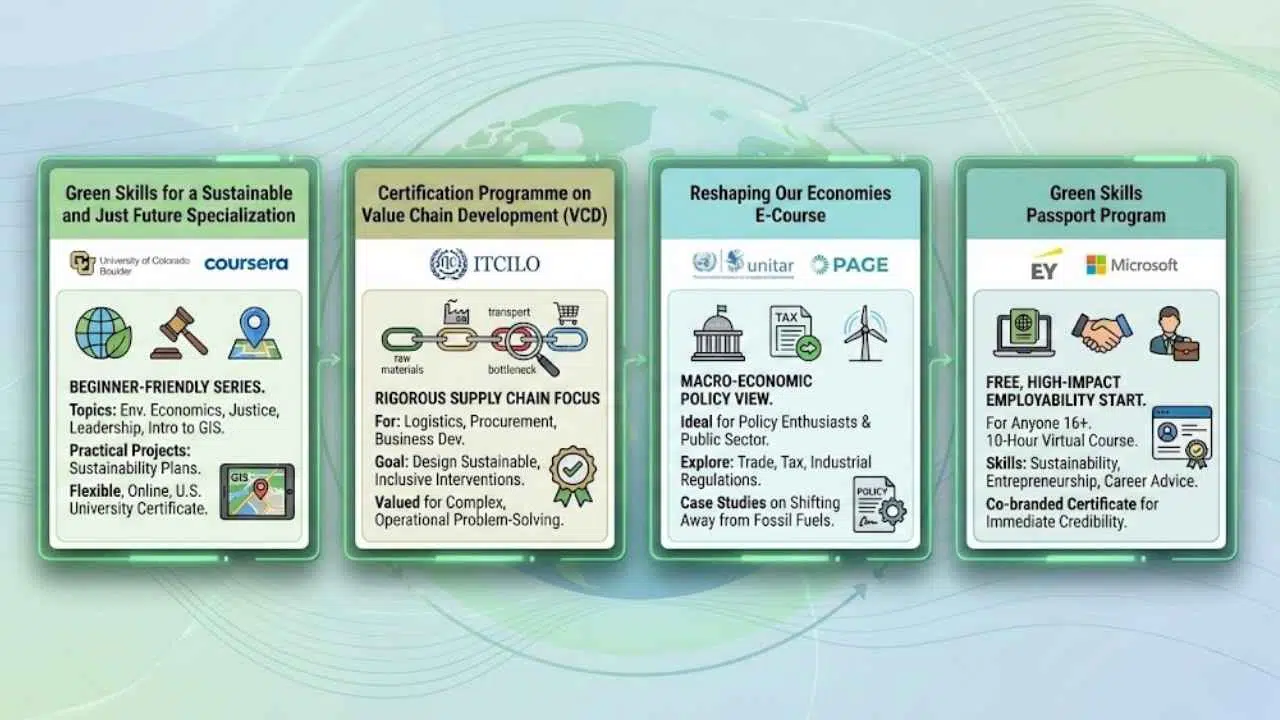
Ready to start learning? Here are four specific programs that offer practical training and recognized credentials.
Green Skills for a Sustainable and Just Future Specialization
Offered by the University of Colorado Boulder on Coursera, this four-course series is perfect for beginners. It covers the essentials of environmental economics, environmental justice, and sustainability leadership. You will also get a hands-on introduction to GIS applications without needing expensive software.
This specialization is designed to give you a holistic view. You won’t just learn the theory; you will work on projects that simulate real-world challenges, like creating a sustainability plan for a business. It is a flexible, online option that allows you to learn at your own pace while earning a certificate from a respected U.S. university.
Certification Programme on Value Chain Development (VCD)
This rigorous program is offered by the International Training Centre of the ILO (ITCILO). It focuses on how to make entire supply chains—from raw material to finished product—more sustainable and inclusive. You will learn to identify “systemic constraints,” which are the hidden bottlenecks that prevent industries from becoming greener.
This certification is ideal if you work in logistics, procurement, or business development. It teaches you how to design interventions that create decent jobs while reducing environmental impact. Employers value this certification because it shows you can solve complex operational problems that span across different companies and borders.
Reshaping Our Economies E-Course
This self-paced course comes from UNITAR (United Nations Institute for Training and Research) and the Partnership for Action on Green Economy (PAGE). It focuses on the big picture: how economic policies like trade, taxation, and industrial regulations can drive a green transition.
It is an excellent choice for policy enthusiasts or public sector workers. You will explore case studies on how different countries are successfully shifting away from fossil fuels. The course provides a strong foundation in “green structural change,” helping you understand the government policies that will shape the business environment for decades to come.
Green Skills Passport Program
The Green Skills Passport is a collaboration between EY (Ernst & Young) and Microsoft. It offers a free, 10-hour virtual course designed to build fundamental sustainability skills for anyone aged 16 and up. The curriculum covers key topics like sustainability, entrepreneurship, and skills for employment.
This program is particularly strong on employability. Upon completion, you earn a certificate co-branded by two global giants, which adds immediate credibility to your LinkedIn profile. It is a fantastic starting point if you want a quick, high-impact overview of the green economy combined with practical career advice.
Tips for Choosing the Right Course
With so many options, it helps to compare them side-by-side to see which one fits your career stage and goals.
| Factor to Consider | Why It Matters | What to Look For |
|---|---|---|
| Career Alignment | Ensures the skills apply to your desired job. | Look for technical skills (like GIS) for analyst roles versus broad frameworks (like GRI) for management. |
| Certification Type | Determines credibility with employers. | University degrees or certificates from recognized bodies like the ILO or Microsoft/EY carry more weight. |
| Time Commitment | Fits your current schedule. | Short courses (10-20 hours) for a quick resume boost vs. multi-month specializations for a deep career pivot. |
| Practical Application | Helps you do the job, not just know the theory. | Check for “capstone projects,” “case studies,” or access to real software tools in the syllabus. |
Align courses with your career goals
Always start with the end in mind. If you want to be a Solar Project Manager, you need technical courses on renewable energy technology and project management. A general course on “sustainability” might be too vague.
On the other hand, if you want to work in Corporate Social Responsibility (CSR), focusing on environmental economics and reporting standards like SASB is crucial. Tailoring your education prevents you from wasting time on skills you won’t use and ensures you are ready for the specific interviews you want to land.
The Role of Organizations in Supporting Upskilling
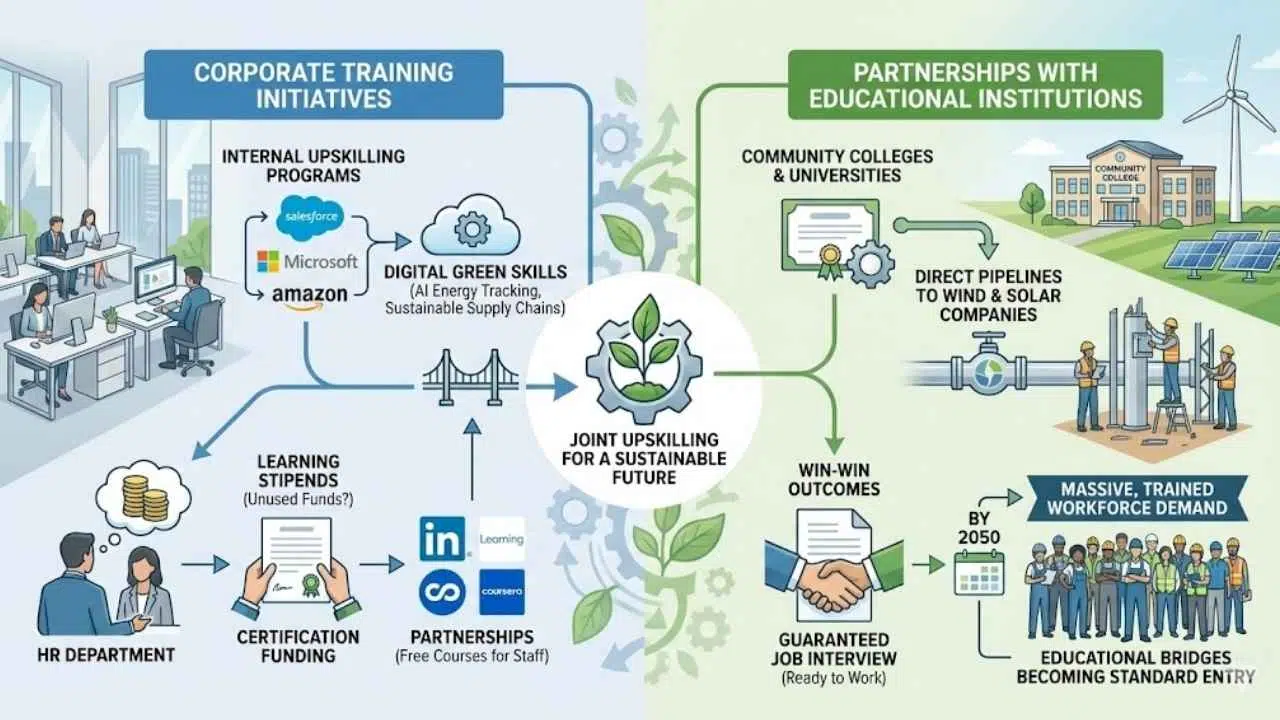
You don’t always have to do this alone. Many forward-thinking organizations are actively paying for their employees to learn these skills because they know it benefits their bottom line.
Corporate Training Initiatives
Major companies like Salesforce, Microsoft, and Amazon have launched extensive internal upskilling programs. They understand that buying talent is expensive, so they prefer to build it from within. These programs often cover digital green skills, such as using AI to track energy efficiency or managing sustainable supply chains.
- Ask your HR department: Many companies have “learning stipends” that go unused. You might be able to get your employer to pay for the University of Colorado specialization or the ILO certification.
- Look for partnerships: innovative firms often partner with platforms like LinkedIn Learning or Coursera to offer these courses for free to their staff.
Partnerships with Educational Institutions
Community colleges and universities are teaming up with local businesses to close the skills gap. For example, many trade schools now have direct pipelines to wind and solar companies, ensuring that the curriculum matches exactly what is happening on the job site.
These partnerships are a win-win. You get training that guarantees a job interview, and companies get workers who are ready to hit the ground running. By 2050, the demand for green jobs will require a massive, trained workforce, so these educational bridges are becoming the standard way to enter the industry.
Final Thoughts
Upskilling for the green economy is one of the smartest moves you can make for your career right now. You have learned about the massive growth in this sector, the specific skills like GIS and environmental economics that pay well, and the courses from providers like CU Boulder and the ILO that can get you there.
The gap between the demand for green skills and the number of people who have them is your opportunity to shine. You don’t need to be a scientist or an engineer to join this movement; you just need to start learning. Pick a course that sparks your interest, update your resume, and take that first step toward a career that supports both your future and the planet.