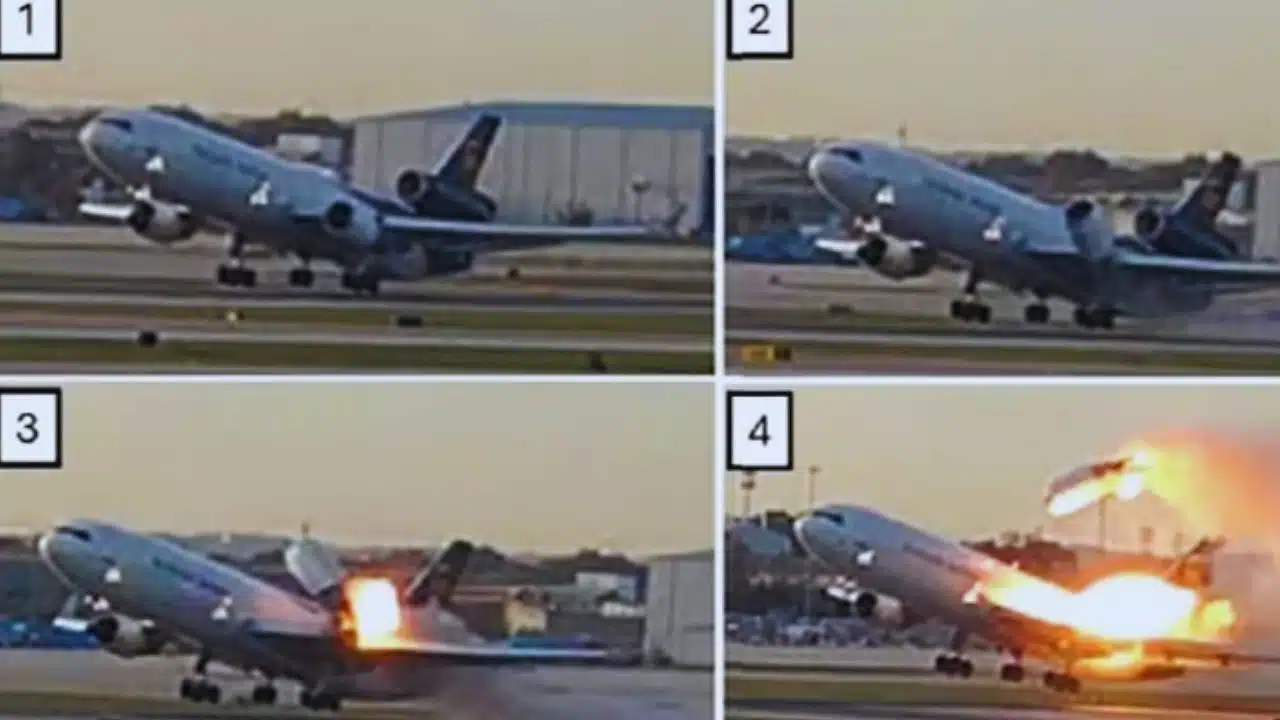
UPS Airlines has grounded its entire fleet of McDonnell Douglas MD-11 cargo aircraft indefinitely after a devastating crash in Louisville, Kentucky, led to a sweeping safety investigation and urgent inspections across the industry. The crash, which occurred on November 4 during a takeoff attempt from Louisville Muhammad Ali International Airport, killed 14 people and injured at least 23 others, marking one of the deadliest aviation accidents involving a cargo carrier in recent years.
The tragic incident began when the aircraft’s left engine detached from the wing seconds after liftoff, causing the jet to lose stability and plunge into a nearby industrial area. The impact triggered a massive explosion and fire, affecting both the UPS crew onboard and people on the ground. Early findings indicate that a structural failure in the engine-to-wing connection—an area subject to high stress—may have played a key role in the separation of the engine. Investigators reported seeing signs of metal fatigue, which can develop slowly over years and remain undetectable without deep structural inspections.
In an internal memo to employees, UPS Airlines President Bill Moore acknowledged the seriousness of the situation, confirming that the company originally expected a multi-week inspection period, but new data from Boeing shows the process will take much longer. The grounding now extends into the peak holiday delivery season, a time when UPS typically operates at its highest capacity. The decision affects all 109 remaining MD-11 aircraft in the UPS fleet, which are, on average, more than 30 years old and represent nearly 10% of its global air operations.
Moore emphasized that meeting federal safety requirements is the company’s top priority and that UPS will not rush the process, even if it means significant operational challenges. He noted that Boeing’s updated technical assessments and the Federal Aviation Administration’s evaluation made it clear that inspections alone would not be enough—many aircraft may require repairs, structural reinforcement, or part replacements before they can return to service. The FAA, which is overseeing the process, must approve all inspection procedures and repair protocols before the aircraft can fly again.
The crash has also prompted other cargo carriers to pause their MD-11 operations. Although FedEx operates a smaller number of these aircraft compared to UPS, the company has similarly grounded its fleet following early investigative findings. The MD-11 model, which has not been manufactured since 2000, is known for its high cargo capacity but also for having a more complex landing and control profile compared to other wide-body aircraft. While major safety upgrades have been implemented over the years, the aging airframes now face renewed scrutiny as aviation authorities push for more rigorous oversight of older cargo jets still in service.
Inspections Expected to Take Months as Boeing and FAA Assess Risks
The extended grounding reflects the increasing severity of the technical challenges uncovered since the crash. According to UPS leadership, Boeing’s engineers have warned that the MD-11 fleet may require “more extensive” inspections than originally anticipated. This includes detailed examinations of engine pylons, wing mounts, load-bearing structures, and adjacent components that endure repeated high-stress cycles during takeoff and landing. Investigators have already identified potential risk areas where long-term wear and microscopic cracking could cause structural weakening.
The MD-11’s design uses a complex three-engine configuration that places significant strain on the wing-mounted pylons. While the aircraft has served reliably for decades, the crash has raised new concerns about whether routine inspection intervals—set decades ago—are adequate for aircraft reaching 30 to 35 years of age. Some safety experts argue that older cargo jets require more frequent and deeper maintenance than passenger aircraft, which tend to retire earlier due to commercial and efficiency demands. Cargo carriers often extend the lifecycle of planes because freight operations do not require the same cabin amenities and fuel-use standards associated with passenger service.
The FAA has instructed Boeing to develop comprehensive inspection and repair procedures before any MD-11 aircraft is allowed to return to service. This process involves reviewing decades of maintenance records, stress-test data, and service bulletins. Boeing engineers are working “diligently,” according to UPS, to deliver guidance that meets regulatory standards. However, because each aircraft has a unique maintenance history and wear pattern, the process is expected to be slow and customized.
Industry analysts warn that the Fleet-wide grounding could last several months, possibly into the new year or beyond. Repair requirements may vary from aircraft to aircraft, and some jets could need extensive structural reinforcement. Aviation experts note that while the MD-11 has been a dependable backbone of the air-cargo industry, its advanced age now presents clear risks, particularly as global trade volumes push aircraft to operate at maximum utilization.
The implications extend far beyond UPS. Many commercial carriers retired their MD-11 passenger fleets years ago, leaving cargo airlines as the final operators of the model. Because production ended more than two decades ago, replacement parts may be limited, and some structural components might need full re-engineering before installation. The logistical challenge of sourcing and producing new parts adds another layer of delay.
The FAA’s ongoing investigation will determine whether new mandatory directives should be issued for the entire industry. These directives could include revised inspection intervals, new structural testing requirements, and potentially even early retirement recommendations for MD-11 aircraft that can no longer meet modern safety thresholds.
UPS Activates Contingency Plans to Protect Peak Season Deliveries
With nearly a tenth of its air fleet grounded indefinitely, UPS is shifting to extensive contingency measures to maintain delivery operations through the peak holiday season. The company has already begun rerouting cargo to other aircraft types, leasing additional air freight capacity where possible, and increasing reliance on its ground network. UPS leaders say customer service will remain uninterrupted, but acknowledge that the situation is dynamic and could strain logistics operations during the busiest shipping period of the year.
UPS is also coordinating closely with international partners and alternative carriers to move time-sensitive cargo. While the company has experience managing seasonal surges, this scenario presents an unprecedented challenge: a long-term grounding of a major fleet segment. The company’s global network usually depends on the high-capacity, long-range capabilities of the MD-11 to move large volumes across continents overnight. Filling that gap requires rebalancing routes and optimizing available aircraft.
The grounding has sparked renewed debate within the aviation community about the future of older cargo fleets. The MD-11, introduced in the early 1990s, was once considered state-of-the-art for long-haul freight operations. But as airlines transition to more fuel-efficient twin-engine wide-body aircraft, such as Boeing 767s and 777s, questions are emerging about whether tri-engine aircraft should continue flying well past three decades of service.
For UPS and FedEx, the outcome of the current investigation could shape long-term fleet planning. If the FAA or Boeing concludes that the structural issues found in the crash are systemic rather than isolated, carriers may need to accelerate their retirement schedules for aging aircraft. That could trigger costly fleet replacements, modifications to international cargo routes, and long-term changes to maintenance strategies.
Despite these challenges, UPS has reiterated that safety is non-negotiable. The company stated that it “will take the time needed to ensure that every aircraft is safe,” even if this means prolonged delays. The FAA also signaled that it will not approve the aircraft for return until all structural concerns are resolved. The coming months will determine not only when the MD-11 fleet returns to service, but also whether the crash leads to fundamental changes in how aging cargo aircraft are maintained, inspected, and certified for flight.