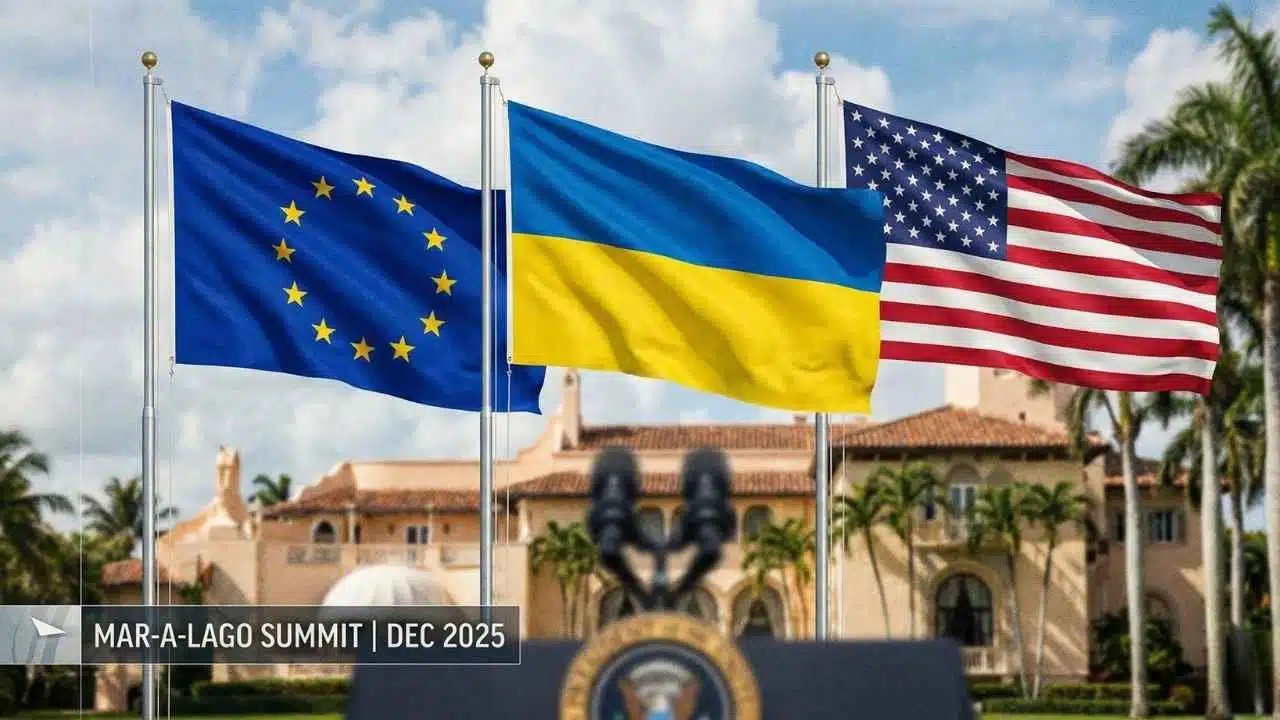
In a decisive display of transatlantic coordination, European Union leadership solidified a unified strategy with Ukrainian President Volodymyr Zelenskyy just hours before his pivotal Mar-a-Lago Summit with U.S. President Donald Trump in Florida. The high-stakes diplomacy has yielded significant results, with reports emerging on Sunday confirming that Ukraine’s Security Guarantees are now “100% agreed,” marking a potential turning point in the roadmap toward peace.
The Pre-Summit Coordination: A Show of European Unity
On December 27, amidst intense speculation regarding the future of U.S. foreign policy, European Commission President Ursula von der Leyen and European Council President Antonio Costa convened an urgent coordination call with President Zelenskyy. The objective was clear: to present a synchronized Western front before Zelenskyy stepped into the negotiation room at Mar-a-Lago.
Strategic Alignment Across the Continent
According to President Costa, the call was not merely a gesture of support but a tactical alignment of negotiation positions. “Together with European leaders, I spoke with President Zelenskyy to coordinate ahead of tomorrow’s meeting with President Trump,” Costa stated on X.
The coordination extended beyond Brussels, involving heads of state from the United Kingdom, Germany, France, Poland, and Finland. This broad coalition ensured that Zelenskyy arrived in Florida backed not just by Kyiv’s resolve, but by the collective economic and political weight of the European continent. The message conveyed was unequivocal: The EU’s support is independent of political shifts across the Atlantic. “In war, in peace, in reconstruction, the EU’s support for Ukraine will not falter,” Costa affirmed.
Defining the 2026 Priorities
Following the coordination, Von der Leyen outlined the European Commission’s aggressive agenda for 2026. She emphasized a three-pillar strategy:
-
Sustained Pressure: Continued and escalating sanctions on the Kremlin.
-
Unwavering Support: Maintaining military and financial aid flows.
-
Integration: Accelerating Ukraine’s accession path to the EU.
Von der Leyen stressed that any peace settlement discussed in Florida must prioritize Ukraine’s sovereignty. “Ironclad security guarantees from day one are paramount,” she noted, rejecting any proposals that might leave Ukraine vulnerable to future aggression in exchange for a temporary ceasefire.
The Financial Shield: Europe’s €90 Billion Commitment
While security guarantees dominated the headlines, the geopolitical leverage for these talks was underpinned by a massive financial agreement finalized by the EU just days prior.
Historic Joint Borrowing Initiative
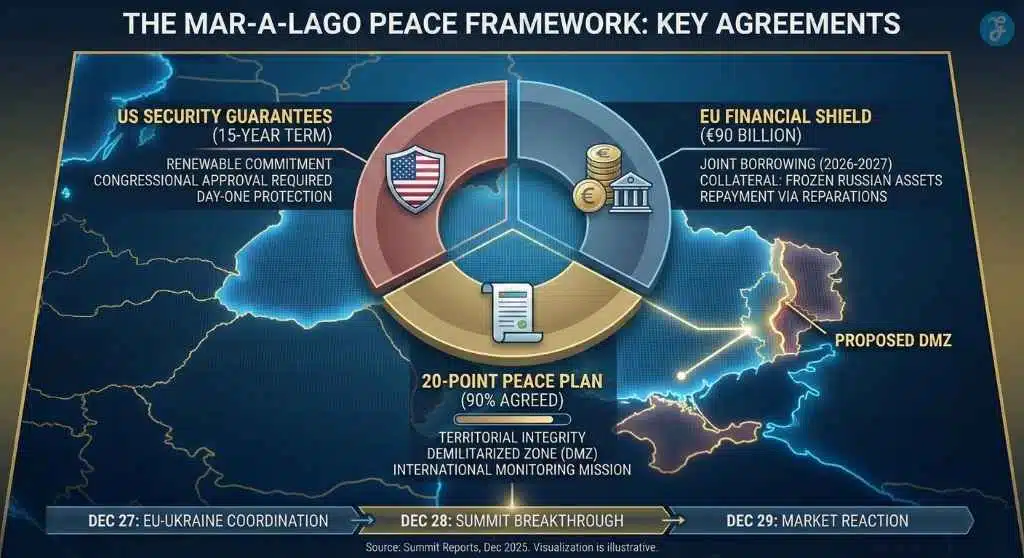
On December 18, the European Union reached a landmark decision to mobilize €90 billion in financing for the 2026–2027 period. This package is structurally significant because it relies on joint borrowing on capital markets, a mechanism that demonstrates the EU’s deep fiscal commitment to Ukraine’s survival.
“We committed, we delivered,” Costa said of the package.
This funding is projected to cover approximately two-thirds of Ukraine’s budgetary needs over the next two years, granting Zelenskyy significant breathing room. It allows Kyiv to negotiate from a position of relative economic stability rather than desperation.
Behind the Scenes: Why the EU Chose “Plan B”
This massive financing package was not the EU’s original plan. Brussels insiders confirm that the “Plan A”, direct seizure of the €210 billion in frozen Russian assets, was shelved due to intense legal pushback from member states like Belgium, where Euroclear is headquartered.
Legal experts warned that direct seizure could destabilize the Euro and invite retaliatory lawsuits. The resulting “Plan B”—borrowing against the EU budget with Russian assets merely as collateral—was the innovative compromise that allowed the EU to bypass veto threats and deliver funds rapidly.
-
Repayment Structure: Ukraine is only required to repay the loan once it receives reparations from Russia.
-
The Collateral Twist: The immobilized Russian sovereign assets sitting in EU jurisdictions will remain frozen and serve as collateral for the borrowing.
Von der Leyen described this structure as a “clear geopolitical message” to Moscow: Europe is prepared to use Russia’s own economic weight to finance the defense of the nation it invaded, without technically breaking international property laws.
The Mar-a-Lago Breakthrough: “100% Agreed”
The summit on December 28 between President Zelenskyy and President Trump appears to have exceeded expectations, producing concrete agreements on the most contentious aspects of the peace process.
Security Guarantees and the Peace Plan
Emerging from the meeting, President Zelenskyy announced that U.S. security guarantees were “100% agreed.” This is a critical development, as Kyiv has long maintained that without binding security assurances, involving both American and European participation, any peace treaty would be fragile.
Furthermore, Zelenskyy revealed that the comprehensive 20-point peace plan is now “90% agreed.” While specific details of the 20 points remain confidential, sources indicate the plan addresses territorial integrity, international monitoring, and long-term defense partnerships.
Inside the Deal: 15-Year Guarantees & A New DMZ
While the headlines celebrate agreement, deep-dive reports have clarified the specific mechanics of the security arrangement. Sources close to the negotiations reveal that the “ironclad” U.S. guarantees are currently set for a renewable 15-year term.
-
Duration Dispute: President Zelenskyy reportedly pushed for a 30-to-50-year commitment to deter long-term Russian revanchism, but the 15-year compromise was accepted with the provision that it can be extended.
-
Congressional Approval: Crucially, Zelenskyy stated these guarantees would likely require approval from the U.S. Congress, institutionalizing support beyond the current administration.
-
The Demilitarized Zone (DMZ): The “90% agreed” peace plan includes a controversial but critical proposal for a Demilitarized Zone along the current contact line in the Donbas. This zone would be patrolled not by NATO troops, but by international monitoring missions, potentially under the aegis of a newly formed “Peace Council” which Trump has proposed seeking to chair.
The Transatlantic Conference Call
In an unprecedented move during the summit, Von der Leyen joined a conference call with Trump and Zelenskyy directly from the Mar-a-Lago meeting room. This trilateral format underscores the inseparable nature of U.S. and EU security interests. Von der Leyen later characterized the progress as “good,” reinforcing the unity of the Western alliance.
The Kremlin’s Shadow & Market Ripples
The geopolitical shockwaves of the Mar-a-Lago summit were felt immediately in Moscow and global financial hubs.
Putin’s Pre-Summit Maneuver
In a strategic maneuver, Russian President Vladimir Putin held a “friendly and businesslike” phone call with Donald Trump just hours before Zelenskyy arrived in Florida. While Kremlin spokesman Dmitry Peskov confirmed that no direct Putin-Zelenskyy talks are currently planned, he signaled that Moscow is “closely monitoring” the 15-year guarantee proposal, warning that the deployment of any NATO-aligned forces remains a red line.
Global Markets React
Financial markets have priced in a higher probability of peace, leading to significant volatility:
-
Oil Plunge: Crude oil prices dropped sharply, with WTI falling nearly 3% to settle around $56 per barrel, as traders anticipate that a ceasefire could flood the market with Russian supply.
-
Safe Havens Slide: Gold and silver prices also retreated, signaling that global risk appetite is returning as the threat of a wider continental war potentially recedes.
Strategic Outlook: The End of the Beginning
The convergence of the Mar-a-Lago summit and the EU’s financial mobilization marks a definitive shift in the conflict’s trajectory: we have moved from the phase of urgent crisis management to the architectural design of post-war Europe.
For three years, the West’s strategy was defined by reactivity. This week, however, demonstrated a proactive alignment of military deterrence and economic lawfare. The “15-year renewable guarantee” is not just a promise to Ukraine; it is a mechanism that binds American security interests to the European continent for a generation, regardless of isolationist currents in Washington. Simultaneously, the EU’s decision to mortgage Russian assets has rewritten the rules of sovereign immunity, creating a financial weapon as potent as any missile system.
Yet, as the delegations leave Florida, the hardest work begins. An agreement “on paper” is vastly different from reality on the ground. The proposed Demilitarized Zone will require enforcement in one of the most heavily mined regions on earth, and the “Peace Council” will face immediate tests from potential spoilers in Moscow. The war is not over, but the endgame has officially begun. The world now watches to see if the unity forged in the ballrooms of Florida can survive the harsh realities of the Donbas winter.