The Union of European Football Associations (UEFA), Europe’s top soccer governing body, is moving closer to an unprecedented vote on whether to suspend Israel from international competitions. According to reports first revealed by the Associated Press (AP), the proposal has gained significant traction within UEFA’s 20-member executive committee, and a majority may support it.
If carried out, the move would prevent both Israel’s national team and its domestic club teams from competing in UEFA competitions, including the prestigious Champions League, Europa League, and European Championship qualifiers. Most notably, it could also impact Israel’s 2026 FIFA World Cup qualifying campaign, since UEFA oversees the European qualification pathway.
This development comes amid rising global criticism of Israel’s ongoing military campaign in Gaza, which began in response to the Hamas-led attack on October 7, 2023. The conflict has drawn accusations of war crimes and even genocide from international bodies, including a recent inquiry by the UN Human Rights Council.
How FIFA Fits Into the Debate
While UEFA has direct control over European club and national competitions, the World Cup is governed by FIFA, the world soccer authority. A UEFA suspension would therefore raise the question of whether FIFA would enforce or override such a decision.
FIFA’s 37-member council, which includes eight UEFA representatives, is scheduled to meet in Zurich next week. The outcome of UEFA’s deliberations could directly influence FIFA’s ruling.
This is politically delicate because FIFA President Gianni Infantino is known for his close ties to former U.S. President Donald Trump, who has openly supported Israel. Infantino has been based recently at FIFA’s satellite office in Trump Tower, New York, coinciding with the UN General Assembly.
The U.S. State Department has already stated it will work to block any attempts to ban Israel’s team from the World Cup. Washington views Israel’s participation in global sports as part of wider diplomatic support for the country, especially with the World Cup set to be jointly hosted by the United States, Canada, and Mexico in 2026.
Comparisons With Russia’s Ban
UEFA’s discussion echoes a major precedent: the suspension of Russia from international football in 2022 after its full-scale invasion of Ukraine. At the time, many UEFA federations refused to play matches against Russian opponents, forcing UEFA and FIFA to act jointly.
In contrast, no European national team or club has yet refused to face Israel. However, several federations, notably Norway and Italy, have expressed unease in recent weeks. Norway’s football federation went a step further, pledging to donate its ticket profits from the October 11 qualifier against Israel in Oslo to humanitarian relief in Gaza, specifically to Doctors Without Borders.
This lack of outright boycotts makes Israel’s case more complicated than Russia’s. Still, the political symbolism and humanitarian outcry are pushing UEFA toward a harsher stance.
Political Pressure Inside and Outside UEFA
The campaign to suspend Israel has been amplified by both government leaders and sports officials.
- Spain’s Prime Minister Pedro Sánchez argued that Israel should face the same treatment as Russia, emphasizing that sports bodies cannot ignore the humanitarian crisis in Gaza.
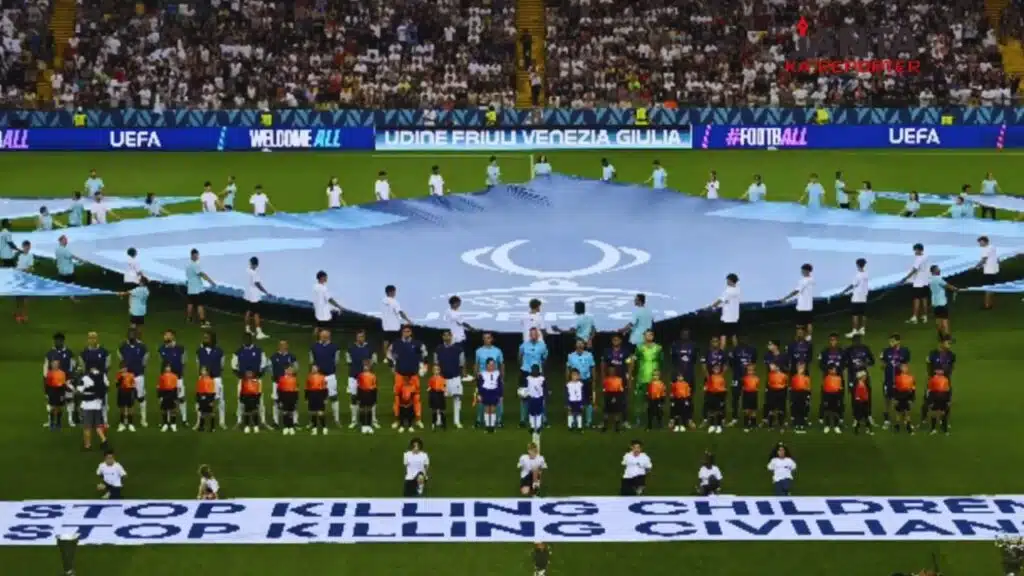
- At the UEFA Super Cup final in Udine, Italy, banners saying “Stop Killing Children” and “Stop Killing Civilians” were placed on the field in front of the teams, signaling UEFA’s growing discomfort.
- At the Champions League final in May, Paris Saint-Germain (PSG) fans unfurled a banner reading “Stop Genocide in Gaza”. Although UEFA rules prohibit political messages, no disciplinary action was taken, raising questions about selective enforcement.
Meanwhile, Qatar’s government, a key U.S. ally and mediator in the Gaza conflict, has been angered by an Israeli airstrike in Doha on September 9, 2025 targeting Hamas leaders. This strained Israel’s ties with Qatar, even as PSG president Nasser Al-Khelaïfi, a Qatari official, sits on UEFA’s executive committee — giving the issue extra diplomatic weight.
Israel’s Strategy to Avoid Suspension
Facing growing pressure, Israel’s leadership is mobilizing to prevent expulsion:
- Miki Zohar, Israel’s Minister of Sports and Culture, confirmed that he, Prime Minister Benjamin Netanyahu, and Moshe Zuares, head of Israel’s football federation, are working “intensively behind the scenes.”
- Their approach focuses on quiet diplomacy, avoiding provocative statements while lobbying UEFA members.
- Israel insists that the sporting arena should not be used as a political battlefield and argues that punishing its athletes for government policy would be unjust.
The IFA also pointed out that UEFA’s next scheduled meeting is in December 2025, casting doubt on whether an emergency vote could realistically happen before then. However, some reports suggest UEFA might call an extraordinary session in early October, just before Israel’s qualifiers against Norway and Italy.
Wider Sporting Context: Not Just Football
The push to exclude Israel from sports extends beyond football. Calls have emerged to bar Israel from other international events, including the Olympics and cultural platforms like the Eurovision Song Contest.
Sports sanctions are often used as a tool of international pressure. Russia’s exclusion from football, athletics, and even the Paralympics after its war in Ukraine showed how powerful such moves can be in isolating a country. For Israel, suspension from UEFA would be a historic setback, undermining decades of integration into European sports since it joined UEFA in 1994.
Humanitarian Dimension Driving the Push
The debate is not purely about politics or football. It is directly linked to the humanitarian toll in Gaza, where thousands of civilians — including many children — have been killed since October 2023.
International NGOs, rights groups, and UN officials have consistently argued that sports federations cannot remain neutral when faced with mass civilian suffering. By excluding Israel, UEFA and FIFA would be sending a symbolic message of accountability, similar to how apartheid South Africa was banned from international sport until the 1990s.
What Happens Next?
- UEFA’s executive committee could call an emergency meeting in early October to vote on the issue.
- If passed, Israel would be barred from all UEFA competitions, including World Cup qualifiers.
- FIFA’s council would then need to decide whether to uphold or challenge UEFA’s decision.
- The United States and allies are expected to push back hard, potentially creating a split within world football governance.
- If suspension happens, Israel may appeal to the Court of Arbitration for Sport (CAS) in Lausanne, Switzerland, which has the authority to overturn or uphold such decisions.
A Decision With Global Repercussions
The looming UEFA vote is about much more than football. It reflects how sports bodies are being drawn into geopolitical conflicts.
If Israel is suspended, it would mark the most significant expulsion from European football since Russia in 2022. Such a move would reshape Israel’s sporting identity, deepen its international isolation, and test whether global football can remain politically neutral in times of war.
At the same time, it could set a precedent for how sports institutions deal with conflicts and humanitarian crises — whether they continue to act as politically detached arenas or become arenas of accountability in the eyes of the world.
The Information is Collected from Fox News and ESPN.