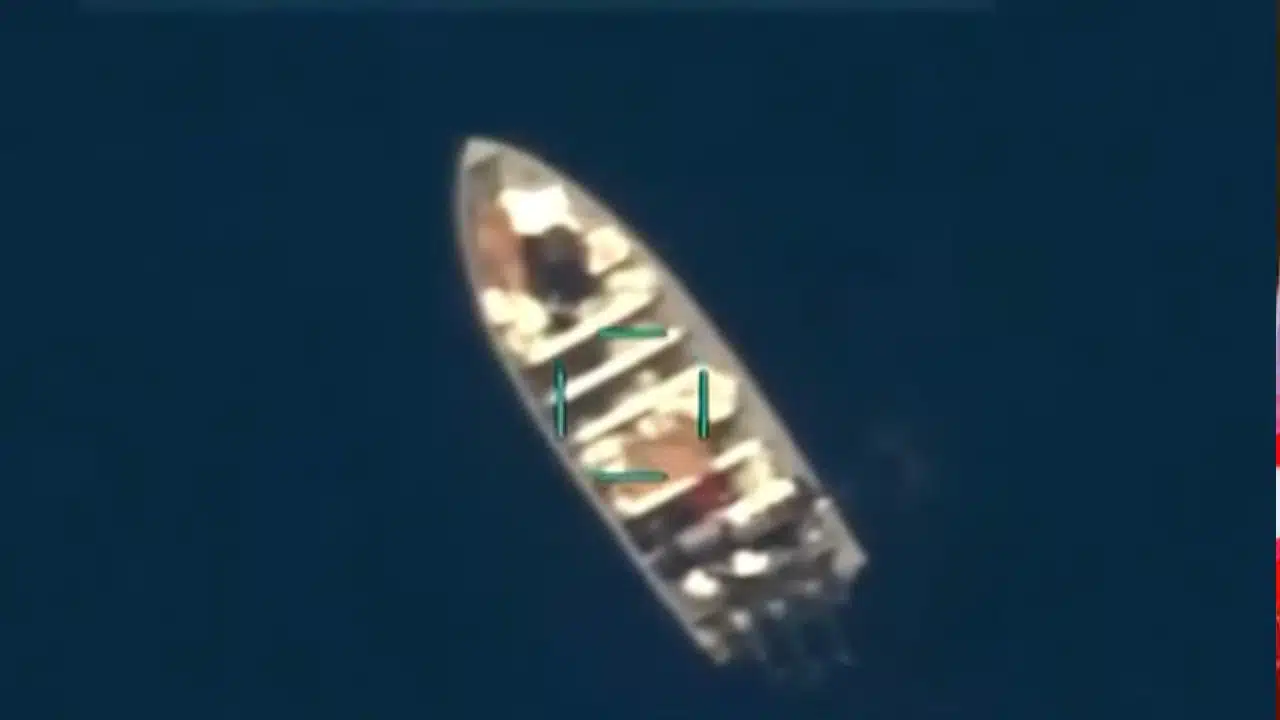
The United States military, acting on the orders of President Donald Trump, conducted a “lethal kinetic strike” on an alleged drug-trafficking vessel in the Caribbean on Saturday, killing all three people aboard, Defense Secretary Pete Hegseth announced.
The operation is the latest in an escalating and highly controversial campaign that the administration terms an “armed conflict” with drug cartels. The keyword event, U.S. military strikes alleged drug boat in the Caribbean killing 3, Hegseth says, marks a continuation of a policy that has now claimed at least 64 lives and drawn formal condemnation from United Nations human rights officials and senior Democrats in Congress.
- The Strike: A U.S. military strike on Saturday, Nov. 1, 2025, in international waters in the Caribbean, destroyed a vessel and killed 3 alleged “narco-terrorists.
- The Campaign: This is at least the 15th such strike since the campaign began in early September 2025, with operations in both the Caribbean and Eastern Pacific.
- Total Fatalities: The total death toll from this campaign has now reached at least 64 individuals, according to a tally of official announcements.
- Official Justification: Sec. Hegseth stated the vessel was operated by a Designated Terrorist Organization (DTO) and compared the cartels to Al-Qaeda, vowing to “hunt them and kill them.
- Legal Challenge: On Friday, Oct. 31, 2025, senior Senate Democrats sent a letter to the administration demanding the legal opinions justifying the strikes, citing “contradictory information.
- International Condemnation: The UN High Commissioner for Human Rights on Friday labeled the strikes “unacceptable” and called for a halt to the “extrajudicial killing.
‘We Will Treat Them EXACTLY How We Treated Al-Qaeda’
In a series of posts on the social media platform X on Saturday, Defense Secretary Pete Hegseth confirmed the operation.
Today, at the direction of President Trump, the Department of War carried out a lethal kinetic strike on another narco-trafficking vessel operated by a Designated Terrorist Organization (DTO) in the Caribbean,” Hegseth wrote.
Hegseth stated that intelligence “confirmed” the vessel was involved in smuggling, though no specific evidence was provided.
“This vessel—like EVERY OTHER—was known by our intelligence to be involved in illicit narcotics smuggling, was transiting along a known narco-trafficking route, and carrying narcotics,” he continued. “Three male narco-terrorists were aboard… All three terrorists were killed.”
The Defense Secretary cast the strike as part of a declared war, directly comparing the cartels to the terrorist group responsible for the September 11, 2001, attacks.
“These narco-terrorists are bringing drugs to our shores to poison Americans at home—and they will not succeed,” Hegseth stated. “The Department will treat them EXACTLY how we treated Al-Qaeda. We will continue to track them, map them, hunt them, and kill them.”
A Pattern of Lethal Force
The strike on Saturday is not an isolated incident but the continuation of a new U.S. policy that began in early September 2025. This strategy has replaced traditional maritime law enforcement—which typically involves interdiction, boarding, and seizure by the U.S. Coast Guard—with lethal military force as a first resort.
The Trump administration has justified the attacks by asserting it is in an “armed conflict” with the cartels, which it has designated as Foreign Terrorist Organizations (FTOs). This designation, according to administration officials, allows it to use the same legal authority that sanctioned the post-9/11 war on terrorism.
Congress and UN Raise Alarm Over ‘Extrajudicial Killings’
This novel legal rationale is facing intense scrutiny. On Friday, October 31, 2025, a group of senior Senate Democrats, including Minority Leader Chuck Schumer and Senate Armed Services Committee members Jack Reed and Mark Warner, sent a formal letter to Secretary Hegseth, Secretary of State Marco Rubio, and Director of National Intelligence Tulsi Gabbard.
The senators’ letter, reported by source, demands the administration provide “all legal opinions related to these strikes and a list of the groups or other entities the President has deemed targetable.”
The lawmakers wrote that the administration “has selectively shared what has at times been contradictory information” with Congress, fueling concerns about the legality and oversight of the military operations.
This congressional alarm follows a sharp rebuke from the United Nations.On Friday, UN High Commissioner for Human Rights Volker Turk issued a statement decrying the strikes.
The US must halt such attacks and take all measures necessary to prevent the extrajudicial killing of people aboard these boats, whatever the criminal conduct alleged against them,” Turk said, calling the attacks “unacceptable.
Legal experts and human rights organizations have echoed these concerns. The Washington Office on Latin America (WOLA) previously described the shift to lethal force as a “dangerous precedent,” noting that traditional interdiction aims to disable a vessel’s propulsion, “not to destroy the ship while the crew is still on board.
Impact on the Ground
The administration has not publicly released evidence confirming the identities of the 64 people killed, their specific cartel affiliations, or what, if any, narcotics were on the vessels that were destroyed.
This lack of transparency has been criticized by regional leaders in Mexico, Colombia, and Brazil. Venezuelan President Nicolás Maduro, whose country has been cited by the administration as a base for the Tren de Aragua gang (a designated FTO), has accused the U.S. of “inventing a new eternal war.
Furthermore, reporting on previous strikes has raised questions about the U.S. intelligence. After an operation in October, two survivors were “quickly released to the authorities of their home countries — Colombia and Ecuador,” an action The Washington Post noted triggered “suspicion that they were let go to avoid extended legal scrutiny of the U.S.’s actions.”
Families of individuals killed in previous strikes have also contested the U.S. narrative, with relatives of victims from Colombia and Trinidad and Tobago telling reporters their family members were fishermen with no known ties to the drug trade.
The administration shows no signs of altering its strategy, with Secretary Hegseth’s Saturday announcement serving as a defiant punctuation mark against the mounting criticism from Congress and the international community.
The central conflict now revolves around transparency and legality. Observers are watching whether the White House will release the legal opinions justifying the strikes or if Congress will attempt to use its legislative power to halt a military campaign that it has not formally authorized.
With at least 15 strikes in approximately eight weeks, this new “war” in the waters of the Western Hemisphere is escalating, with its true human and diplomatic costs yet to be fully calculated.
The Information is Collected from NBC News and CNN.