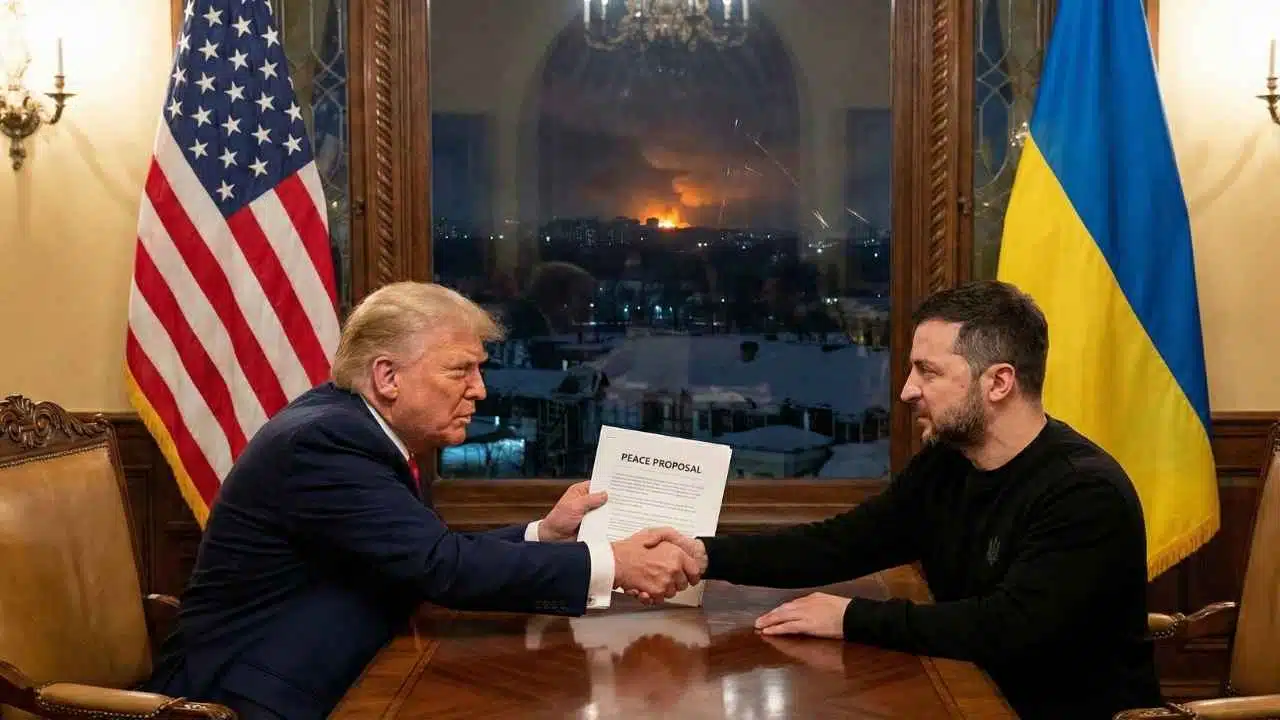
Russia launched one of its most ferocious aerial bombardments of the nearly four-year war this Saturday, December 27, striking Ukraine’s capital with a barrage of over 500 drones and 40 missiles. The assault, which killed at least two people and injured 46, plunged much of Kyiv into darkness and freezing cold just hours before a pivotal summit between President Donald Trump and Ukrainian President Volodymyr Zelensky at Mar-a-Lago.
A Capital Under Siege: The 10-Hour Barrage
The attack commenced in the pre-dawn hours of Saturday, involving a complex mix of weaponry designed to overwhelm air defenses. According to Ukrainian officials, the arsenal included 519 Shahed-type drones, alongside Kinzhal hypersonic missiles, Iskander ballistic missiles, and Kalibr cruise missiles.
-
Casualties: A 71-year-old man was killed in the Dniprovskyi district, and another fatality was later confirmed. Among the 46 injured were two children.
-
Infrastructure Collapse: The strikes devastated energy facilities, initially cutting power to over one million households. By Saturday afternoon, 750,000 homes remained without electricity, and a third of the capital lost heating as temperatures hovered near freezing.
-
Destruction: Debris and direct hits sparked fires in high-rise residential buildings across seven districts. Interior Minister Ihor Klymenko noted, “This is the first time that so many drones have hit the city center,” calling it a deliberate attempt to terrorize civilians before diplomatic negotiations.
NATO on Alert: The Polish Response
The intensity of Saturday’s bombardment rippled beyond Ukraine’s borders, triggering immediate alarm in neighboring NATO states. As Russian missiles hammered Kyiv and western Ukraine, Poland scrambled F-16 fighter jets and temporarily closed civilian airports in Lublin and Rzeszów due to the proximity of the strikes to the border. While no airspace violations were reported, the Polish Operational Command stated the move was necessary to ensure the security of allied airspace, underscoring the high risks of a wider escalation if the Florida talks fail.
Battlefield Discrepancies: The Struggle for Leverage
As the skies cleared over Kyiv, a war of narratives erupted over the ground front lines. On Saturday, the Kremlin claimed its forces had captured the strategically vital logistics hub of Myrnohrad in Donetsk and the city of Huliaipole in Zaporizhzhia. President Putin, briefing his General Staff, touted these as proof that Ukraine’s defense is crumbling.
However, Kyiv vehemently denied these claims on Sunday. The Center for Countering Disinformation (CCD) stated that “fighting is ongoing” and that Russian assault groups were failing to entrench themselves. Military analysts suggest Moscow is broadcasting premature victories to pressure Trump and Zelensky into accepting a “status quo” ceasefire that freezes current Russian gains.
High-Stakes Diplomacy at Mar-a-Lago
Despite the carnage at home, President Zelensky traveled to Florida on Sunday, December 28, to meet President Trump. The summit focused on a “20-point peace proposal” that officials claim is “90% ready.”
“We are getting a lot closer, maybe very close,” President Trump told reporters after the meeting, though he cautioned that “thorny issues” remain unresolved.
Inside the 20-Point Proposal: The ’15-Year’ Guarantee
Emerging details from the Mar-a-Lago summit reveal that the peace plan hinges on a new security architecture. Sources close to the talks indicate the U.S. is offering a 15-year bilateral security guarantee to Ukraine.
-
What it means: While stopping short of immediate NATO membership (Article 5), this deal would legally bind the U.S. to provide arms, intelligence, and potentially air support if Russia violates the ceasefire.
-
The Friction Point: Zelensky reportedly pushed for a 50-year commitment to deter future Russian aggression, arguing that 15 years is merely a “pause” for Moscow to rearm.
-
The “Buffer Zone”: The plan also proposes a demilitarized zone (DMZ) along the current contact line, likely monitored by European—not American—peacekeepers, fulfilling Trump’s pledge of “no U.S. boots on the ground.”
International Support & The “Halifax Halt”
Before arriving in Florida, Zelensky made a strategic stop in Halifax, Canada. In a significant move, Canadian Prime Minister Mark Carney announced an additional $2.5 billion CAD in economic assistance, condemning the Kyiv strikes as “barbarism.
This aid package is designed to unlock further financing from the IMF and World Bank, bolstering Ukraine’s economic resilience as it faces a difficult winter. European Commission President Ursula von der Leyen reaffirmed the continent’s stance during a subsequent video call, welcoming “all efforts leading to… a just and lasting peace.”
The Battlefield Reality: Words vs. Actions
While diplomats reviewed peace drafts in Florida, the situation on the ground remains volatile. Russian President Vladimir Putin warned during a visit to a military command post on Saturday that if Ukraine refuses the current peace deal, Russia will achieve all objectives “by military means.
The two main diplomatic sticking points remain control of Ukraine’s mineral-rich Donbas region and the fate of the Russian-occupied Zaporizhzhia nuclear power plant. Moscow continues to demand that Ukraine withdraw from densely populated areas of Donetsk that Russian forces have failed to capture—a condition Kyiv views as capitulation. The timing of the massive drone strike serves as a stark message: Moscow intends to negotiate from a position of overwhelming force.