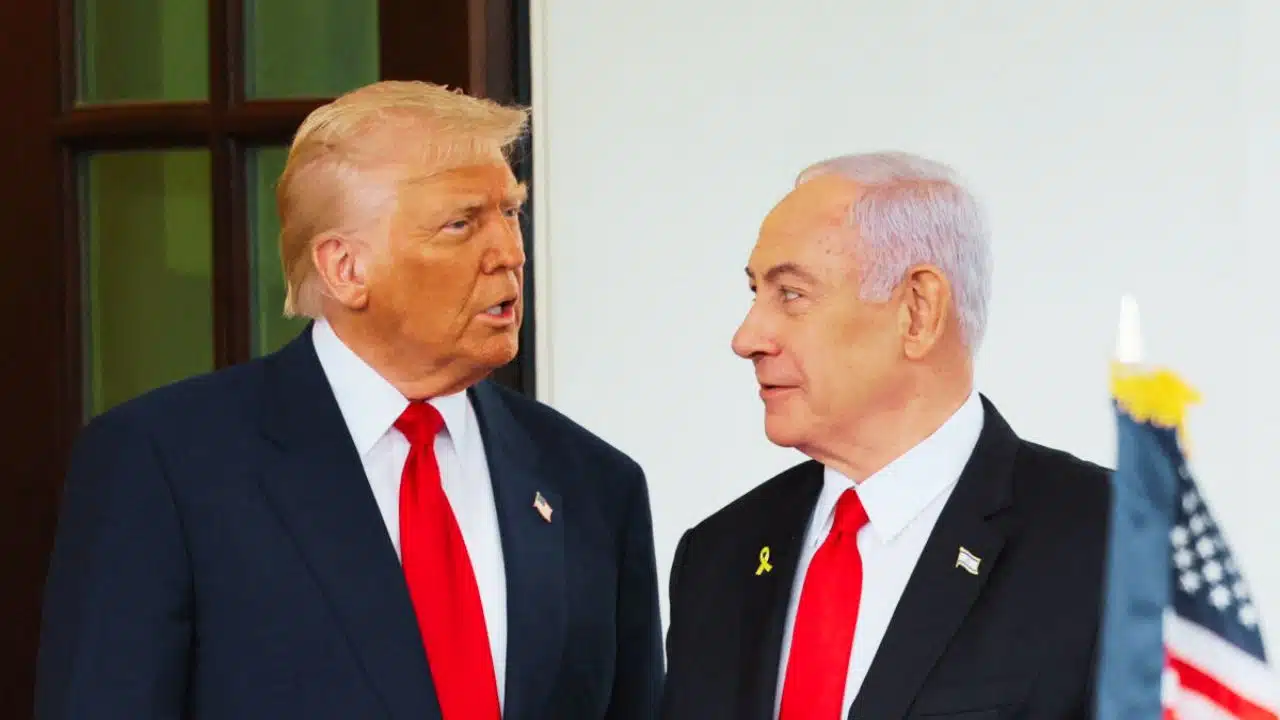
In a stark warning delivered at his Mar-a-Lago estate, President Donald Trump declared the United States would support Israeli military action against Iran if Tehran attempts to rebuild its nuclear weapons capabilities following devastating U.S. airstrikes in June 2025. The statement, made during a December 29 meeting with Israeli Prime Minister Benjamin Netanyahu, signals a hardline approach toward Iran’s nuclear ambitions and raises concerns about potential military escalation in the Middle East.
Trump Issues Stern Warning on Iran’s Nuclear Ambitions
President Trump told reporters on Monday that the United States would “knock the hell” out of Iran if intelligence confirms the nation is attempting to reconstitute its nuclear program or ballistic missile capabilities. “I’ve heard that Iran is attempting to ramp up their efforts again, and if that’s the case, we will have to take action against them,” Trump stated at the press briefing alongside Netanyahu.
When specifically asked whether he would support Israeli strikes against Iran’s missile program and nuclear facilities, Trump responded unequivocally: “If they persist with the missiles, then yes. Regarding nuclear capabilities? Quickly. One will be, absolutely. The other will be addressed immediately”. The president’s comments represent his strongest public commitment yet to backing potential Israeli military operations against Iranian targets.
Trump emphasized that he had received intelligence suggesting Iran was “stockpiling weapons and other materials,” possibly at locations different from the facilities destroyed during Operation Midnight Hammer in June 2025. However, he also expressed hope that military action could be avoided and encouraged Iran to engage in negotiations.
Operation Midnight Hammer: The June 2025 Strikes
The president’s latest warnings come six months after the United States conducted one of its most significant military operations against Iran’s nuclear infrastructure. Operation Midnight Hammer, executed on the night of June 21-22, 2025, targeted three key Iranian nuclear facilities: the Fordow Uranium Enrichment Plant, the Natanz Nuclear Facility, and the Isfahan Nuclear Technology Center.
The operation deployed more than 125 U.S. aircraft, including seven B-2 Spirit stealth bombers carrying fourteen GBU-57A/B Massive Ordnance Penetrator “bunker buster” bombs. A guided missile submarine, believed to be the USS Georgia, fired approximately 30 Tomahawk cruise missiles at the Natanz and Isfahan sites. The strikes lasted nearly 30 minutes and represented the largest B-2 bomber mission since the Afghanistan war began in 2001.
President Trump claimed at the time that the three nuclear sites had been “obliterated,” with Defense Secretary Pete Hegseth stating the U.S. had “devastated the Iranian nuclear programme. However, intelligence reports subsequently revealed that Iran had moved most of its highly enriched uranium from the Fordow facility to undisclosed locations ahead of the attack.
Iran’s Current Nuclear Capabilities and Recent Activities
Despite the extensive damage inflicted during Operation Midnight Hammer, evidence suggests Iran has retained significant nuclear capabilities. According to the International Atomic Energy Agency (IAEA), Iran possessed 441 kilograms of uranium enriched to 60% as of June 13, 2025, just before the strikes began. Intelligence assessments indicate that approximately 408 kilograms of this highly enriched uranium was moved to secret locations, possibly in deeply buried facilities at Isfahan.
A November 2024 U.S. intelligence report stated that Iran has enough fissile material that, if further enriched to 90% weapons-grade level, would be sufficient for “more than a dozen nuclear weapons”. The enrichment process from 60% to 90% would require only a few weeks if Iran has sufficient operational advanced centrifuges.
Recent reports from the Italian foreign policy think tank ISPI suggest that Supreme Leader Ali Khamenei authorized efforts in October 2025 to develop compact nuclear warheads suitable for ballistic missiles. However, intelligence analysts note that progress on warhead miniaturization is expected to be slow, requiring years of testing and specialized technical expertise.
Netanyahu’s Regional Security Concerns
Israeli Prime Minister Netanyahu has pressed successive U.S. administrations for decades to take a harder line against Iran’s nuclear program. During his meeting with Trump, Netanyahu reportedly remained focused on reducing threats from Iran to Israel, a priority he has maintained throughout his nearly 30 years in office.
U.S. and Israeli officials anticipated that Netanyahu would advocate for renewed military actions against Iran during the Mar-a-Lago discussions. CBS News national security contributor Samantha Vinograd noted that “the United States and Israel may have different intelligence assessments of what Iran’s intentions are, what their capabilities are”.
Netanyahu has expressed concerns that despite the recent ceasefires involving Israel with Hamas in Gaza and Hezbollah in Lebanon, these adversaries should not be allowed to rebuild their military strength. The Israeli leader’s cautious approach reflects broader regional security concerns about Iran’s influence through proxy forces across the Middle East.
Regional Tensions and Military Posturing
The threat of renewed military confrontation comes at a particularly tense moment for Middle East stability. Iranian President Masoud Pezeshkian claimed on December 28 that “we are in a full-scale war with the U.S., Israel and Europe; they don’t want our country to remain stable”.
Iran has vowed a “harsh response” to any future attacks on its territory or nuclear facilities. Security analysts note that Iran’s most immediate threat to regional stability may be its massive stockpile of conventional ballistic missiles rather than its potential nuclear weapons program. According to experts, Iran possesses more ballistic missiles than any other nation in the region except Israel, providing significant leverage for wreaking havoc across the Middle East.
Satellite imagery from the Washington-based Institute for Science and International Security indicates that Iran has undertaken minimal cleanup at most damaged nuclear sites following the June strikes. However, Iran has made efforts to access the Isfahan tunnel complex where enriched uranium may be stored, suggesting potential attempts to resume operations.
Key Timeline and Data
| Event | Date | Details |
| Iran’s Enriched Uranium Stockpile | June 13, 2025 | 441 kg of 60% enriched uranium |
| Operation Midnight Hammer | June 21-22, 2025 | U.S. strikes on Fordow, Natanz, and Isfahan |
| Khamenei Authorization (reported) | October 2025 | Approval for compact warhead development |
| Uranium Relocated | Before June 2025 | 408 kg moved to secret locations |
| Trump-Netanyahu Meeting | December 29, 2025 | Warning issued on nuclear rebuilding |
Diplomatic Options and International Response
While Trump has issued stern warnings, he has also indicated a preference for diplomatic solutions. The president encouraged Iran to engage in negotiations, stating “let’s hope it doesn’t come to that” regarding potential military strikes. However, the administration’s approach combines the threat of overwhelming military force with diplomatic outreach, banking on pressure to compel Tehran into nuclear negotiations.
The international community remains divided on how to address Iran’s nuclear ambitions following the collapse of the 2015 Joint Comprehensive Plan of Action (JCPOA), from which Trump withdrew during his first term in 2018. European nations, Russia, and China have maintained different positions on engaging with Iran, complicating efforts to present a unified diplomatic front.
Final Thoughts
Trump’s warning that the United States would back Israeli strikes if Iran rebuilds its nuclear weapons program represents a significant escalation in rhetoric toward Tehran. The statement comes amid ongoing concerns about Iran’s nuclear capabilities despite the devastating June 2025 airstrikes on its enrichment facilities. With intelligence reports suggesting Iran has preserved substantial quantities of highly enriched uranium and may be pursuing compact warhead development, the potential for renewed military conflict remains high. The coming months will test whether Trump’s combination of military threats and diplomatic overtures can prevent further escalation in one of the world’s most volatile regions.