U.S. President Donald Trump has claimed that Hamas is intentionally delaying a ceasefire agreement in Gaza because the group fears what may follow once the remaining Israeli hostages are released. Trump indicated that Hamas suspects that Israel, backed by the United States, may resume aggressive military operations once its primary objective — the return of hostages — is achieved.
This statement from Trump suggests that the ceasefire under discussion may not be part of a broader peace initiative. Instead, it appears to be a tactical pause aimed solely at retrieving hostages, without any guarantees of lasting calm or political resolution. The lack of trust in long-term intentions, particularly from Hamas’s perspective, has reportedly contributed to the breakdown of the ongoing truce negotiations.
U.S. and Israel Shift Focus Away from Long-Term Peace
The Trump administration has shown signs of pulling away from sustained peace efforts. His Middle East envoy, Steve Witkoff, announced that the U.S. was stepping back from its involvement in the ceasefire talks. He accused Hamas of lacking genuine interest in halting the violence and portrayed the group as an obstacle to peace.
Following this announcement, Israeli officials also withdrew their delegation from the negotiations in Qatar, where discussions had been taking place with the support of international mediators, including Qatar and Egypt.
This coordinated withdrawal from both the U.S. and Israeli sides signals a shift away from the possibility of a comprehensive peace deal. The focus now seems limited to achieving short-term objectives, primarily hostage retrieval, without addressing the underlying issues or preventing further escalation.
Hamas Insists on Permanent Ceasefire, Denies Stalling Talks
Hamas, in response, expressed confusion over the U.S. position. The group maintains that it has been sincerely participating in the peace talks and has made significant concessions to promote success. According to Hamas, both Egypt and Qatar — the main mediators — viewed its stance as positive and cooperative.
Hamas’s core demand in the negotiations has been a permanent ceasefire rather than a temporary truce. They argue that a mere 60-day pause, as previously proposed, would do little to change the devastating situation in Gaza unless it leads to a full halt in military operations, unrestricted humanitarian access, and political resolution.
Israel’s Intention to Resume Military Campaign Raises Alarm
Statements from Israeli leadership confirm that any pause in fighting would only be temporary. Prime Minister Benjamin Netanyahu and other top officials have repeatedly emphasized that Israel will continue its campaign in Gaza until Hamas is dismantled. Defense Minister Yoav Gallant has outlined plans for further operations post-hostage release, including actions that may fundamentally change Gaza’s demographics.
One of the more alarming developments comes from Israeli Minister of Defence Israel Katz, who reportedly stated that during any ceasefire period, Israel intends to move hundreds of thousands of Palestinians to an internment area in southern Gaza. This move would allegedly serve as a preparation step for their eventual removal from the territory.
These remarks have intensified fears among human rights organizations, who warn that forced population transfers constitute ethnic cleansing under international law. Such actions, if carried out, would violate the Geneva Conventions and could be classified as crimes against humanity.
Trump’s Past Remarks Spark Accusations of Ethnic Cleansing Support
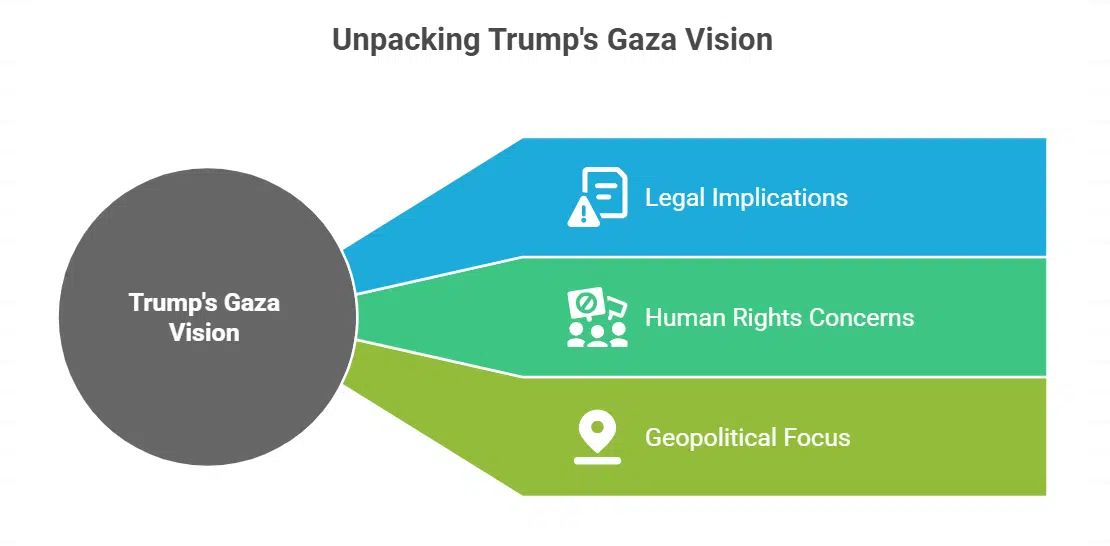
Earlier this year, President Trump made statements supporting the idea of transforming Gaza into a luxury destination for tourism. He spoke of depopulating the territory and redesigning it into a Riviera-style enclave. Legal experts and human rights scholars criticized this vision, warning that any strategy aimed at removing the Palestinian population by force or coercion would meet the legal definition of ethnic cleansing.
Trump’s remarks reinforced existing concerns that both the U.S. and Israeli administrations are more focused on reshaping the geography and demographics of Gaza than on achieving a fair and sustainable resolution to the conflict.
Humanitarian Crisis Deepens as Aid Blockade Continues
The humanitarian situation in Gaza has reached catastrophic levels. With food, fuel, clean water, and medical supplies severely restricted, over two million people are facing desperate conditions. International organizations, including the United Nations and the World Food Programme, have raised alarms that famine is imminent in multiple parts of Gaza, particularly the north.
Israel’s ongoing blockade of aid deliveries is being widely condemned. Aid trucks, humanitarian workers, and even medical teams have struggled to access affected areas. The deliberate obstruction of life-saving assistance, according to legal analysts, could be prosecuted as a war crime under international humanitarian law.
International Leaders Call Out Violations of International Law
World leaders have started speaking out more forcefully against Israel’s handling of the war. Canadian Prime Minister Mark Carney denounced the denial of humanitarian aid to civilians, describing it as a violation of established international laws meant to protect civilians during conflict.
French President Emmanuel Macron has taken a bold step by declaring that France will formally recognize Palestine as a sovereign state at the upcoming United Nations General Assembly session in September 2025. France joins a growing number of countries demanding international recognition of Palestine as part of the two-state solution endorsed by the UN, EU, and Arab League.
Macron’s decision reflects increasing frustration among European nations with the current direction of the conflict and signals a growing international push for accountability and balance.
Trump Dismisses France’s Recognition of Palestine
In sharp contrast to Macron’s stance, President Trump brushed off France’s announcement, claiming it held no real significance. He suggested that such declarations wouldn’t alter the reality on the ground or influence U.S. policy.
Trump’s remarks indicate that the U.S. under his leadership remains firmly aligned with Israeli interests and continues to reject unilateral international recognition of Palestinian statehood without Israel’s agreement.
The Path Ahead: More Violence Likely
Trump concluded his remarks with predictions of further conflict in Gaza. He emphasized that Israel would need to continue military operations to “clean up” the area. This language, combined with statements from Israeli officials, points to a continued strategy of military escalation, rather than de-escalation or diplomacy.
Despite earlier U.S. claims that a ceasefire could lead to “lasting peace,” the facts on the ground suggest otherwise. Both U.S. and Israeli leaders have clearly signaled that any pause in fighting is only a temporary measure. The goal remains the dismantling of Hamas and a restructuring of Gaza that many fear could come at the cost of Palestinian lives and sovereignty.
Human Rights Groups and Legal Experts Raise Red Flags
International human rights organizations, including Amnesty International and Human Rights Watch, are monitoring the situation closely. They warn that actions currently underway — including mass displacement, starvation, and targeting of civilian infrastructure — are in violation of international law and could have long-term implications for global accountability standards.
Legal experts point out that the principle of proportionality, which governs wartime conduct, is being ignored. With tens of thousands of civilians dead, injured, or displaced, and Gaza’s infrastructure almost completely destroyed, pressure is growing on world governments and institutions to step in and enforce international norms.